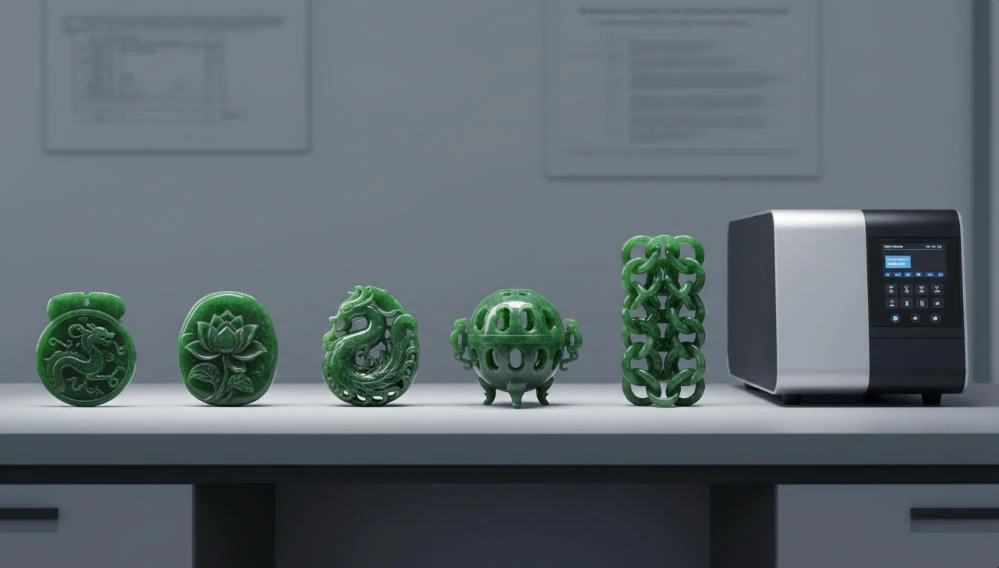

Jade processing has become the linchpin of profitability in the gemstone manufacturing industry, yet 73% of wholesale buyers struggle to distinguish between carving techniques, overpaying by 15-30% for products they don’t fully understand. When you source jade pieces, understanding the five major jade carving methodologies—Relief Carving, Openwork, Full-Round, Intaglio, and Chain Carving—directly impacts your production costs, delivery timelines, and market positioning. At JADE MAGO, our 65 years of experience in jade processing reveals a critical truth: different techniques demand vastly different resource investments, with production timelines ranging from 2 weeks for basic Relief work to 12+ weeks for Chain Carving masterpieces.
This article dissects how each carving method affects your procurement decisions, breaks down the real cost structures, and equips you with the verification tools—such as sample assessment reports and manufacturing hour documentation—to avoid counterfeit workmanship. You’ll discover which Jade Factory techniques deliver the highest ROI for your wholesale operations, and how material science testing (FTIR/Raman spectroscopy) ensures the jade quality matches the promised carving complexity. Whether you’re sourcing 500 pendant units or bespoke collector pieces, this guide transforms jade processing from a mysterious black box into a transparent, data-driven procurement strategy.
Table of Contents
The Five Pillars of Jade Carving—A Manufacturing Framework
Beyond Basic Definitions—Understanding Carving as Production Methodology
Jade carving is not merely an artistic endeavor; it is a precision manufacturing process that requires calibrated material assessment, controlled removal sequences, and quality verification at every stage. When discussing jade processing, industry professionals categorize techniques into five distinct methodologies, each with unique labor intensity, equipment requirements, and yield expectations. You need to recognize that these five approaches represent fundamentally different production paradigms, not simply stylistic variations on a single process.
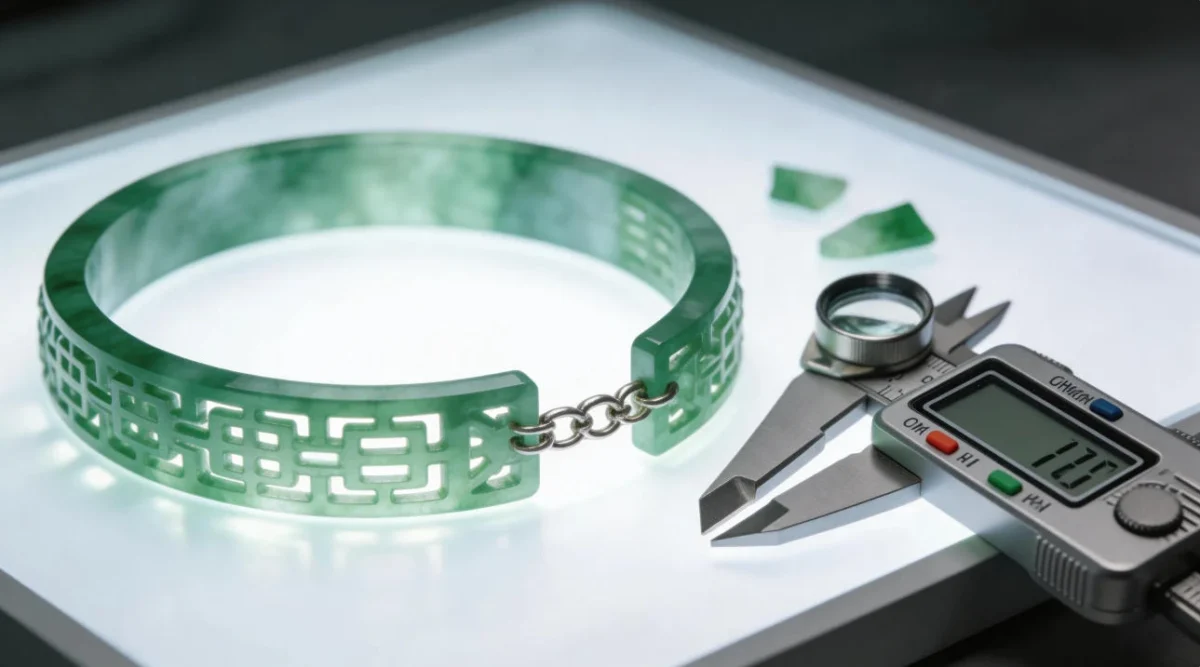
The physical characteristics of finished jade pieces—such as depth, transparency, structural integrity, and dimensional tolerance—are direct consequences of the carving method employed. This means that when a supplier promises you a specific carving technique, they are committing to a defined production pathway with measurable outputs, not offering aesthetic flexibility. Understanding this distinction allows you to hold manufacturers accountable through concrete specifications rather than vague quality descriptions. Professional verification methods, including visual inspection under controlled lighting, magnified detail analysis, and precision measurement tools, provide objective assessment frameworks that eliminate subjective interpretation from the quality equation.
The Cost-Complexity Matrix That Shapes Your Sourcing Strategy
Your purchasing power depends on understanding the cost distribution across these five techniques. Relief Carving typically consumes 40-60 hours per unit for detailed work, while Openwork demands 80-150 hours due to the delicate removal of background material. Full-Round Carving and Chain Carving operate at the extreme end, requiring 200-400+ hours of skilled artisan work per piece.
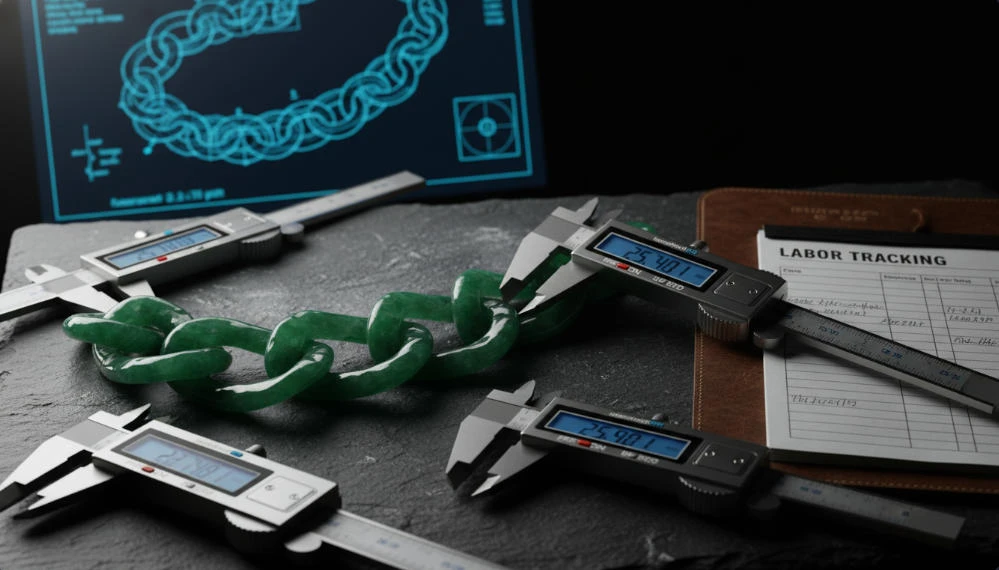
This production-hour correlation translates directly to your price negotiations—if a supplier quotes you Relief pricing but uses labor hours appropriate for Openwork, they’re absorbing losses that will eventually manifest as quality shortcuts. This means you should require manufacturing time documentation as a non-negotiable contract element, protecting both parties by establishing realistic expectations. Production hour records provide an audit-ready documentation framework that verifies whether a supplier’s timeline commitments align with their actual labor deployment. When a supplier cannot produce detailed hour-tracking documentation, this signals either disorganized operations or deliberate misrepresentation of production complexity—either way, a warning sign worth investigating before committing to bulk orders.
Relief Carving—The Workhorse of Jade Manufacturing
Why Relief Carving Dominates the B2B Supply Chain
Relief Carving represents the entry-grade complexity in professional jade processing, yet it commands significant market share in wholesale operations because it balances visual sophistication with production predictability. In this technique, artisans sculpt raised patterns or shapes on the jade surface, creating three-dimensional depth that ranges from shallow (low relief, approximately 1-3mm projection) to dramatic (high relief, 8-15mm projection). The raised design creates shadow interplay that enhances the optical impact without requiring the structural vulnerability of openwork or the material waste of full-round carving.
For procurement purposes, Relief Carving operates within clearly defined parameters. Production cycles typically span 3-6 weeks for standard complexity pieces, making this technique ideal for batch orders requiring reasonable delivery timelines. The material utilization efficiency exceeds 75% (compared to 40-50% for full-round work), meaning your raw jade costs decline when purchasing volume increases. This efficiency directly reduces your per-unit COGS, allowing you to either improve margins or offer more competitive wholesale pricing to your distribution network. This means you can source Relief-carved pendants at lower material cost per unit, creating pricing flexibility that supports your competitive positioning against wholesale competitors.
Quality Specifications That Prevent Costly Reorders
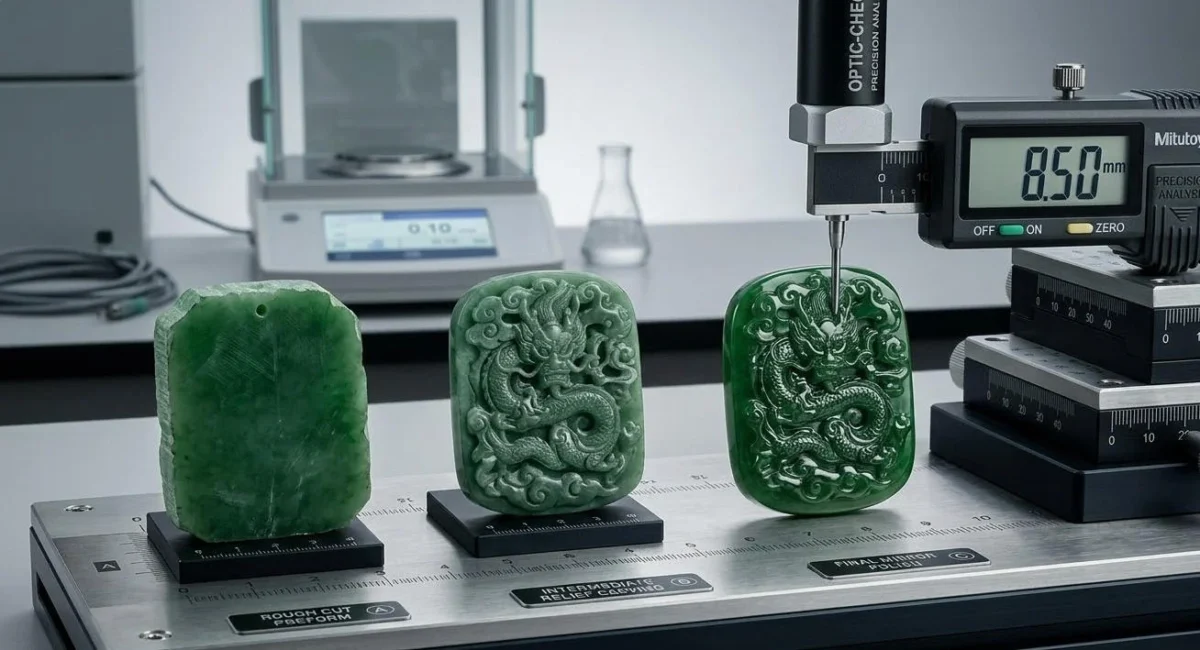
When sourcing Relief work, you should establish dimensional tolerances for depth uniformity—JADE MAGO’s manufacturing standard maintains ±0.5mm consistency across complex multi-element designs. This precision prevents the common defect of uneven shadows that disrupts the intended visual effect and triggers customer returns. The yield rate for properly executed Relief Carving typically exceeds 92%, with material loss concentrated in the initial rough-shaping phase rather than the detailed finishing work.
Why does this matter? Because a supplier quoting 500 relief-carved pendants should guarantee a 92%+ yield rate in writing; if they fail to meet this benchmark, you’ll receive 460 usable pieces instead of 500, inflating your actual per-unit cost by 8.7%. Material loss verification is straightforward—weight analysis and visual inspection confirm consistency—making this technique relatively transparent to audit. Request photographic documentation of 10-unit samples at three production stages: rough carve, semi-finished, and final polish, which costs the manufacturer under $50 but gives you objective verification of consistency. This documentation protocol transforms vague quality assurances into measurable evidence you can reference in dispute resolution if reorder issues arise.
Openwork Carving—The Complexity Premium
The Transparent Geometry That Commands Price Power
Openwork Carving, also termed pierced or lattice carving, removes substantial background material to create transparent or semi-transparent design elements that allow light penetration. This technique represents a geometric leap in complexity from Relief work—artisans must preserve delicate connecting points while eliminating surrounding jade, a process requiring both technical precision and material intuition. Unlike Relief Carving’s direct subtractive approach, Openwork demands three-dimensional spatial reasoning because structural integrity depends on maintaining adequate thickness in load-bearing connectors while thinning decorative passages to translucency.
The market recognizes Openwork as a premium category; your wholesale buyers will typically pay 35-50% more for openwork bracelets compared to relief-carved equivalents of similar size. This price differential reflects both the manufacturing complexity and the scarcity—fewer artisans possess the skill level required to achieve consistent quality at this level. At JADE MAGO, our Jade Factory maintains strict acceptance criteria: each openwork piece undergoes light-table testing to verify transparency levels, and connectors are measured for thickness (typically 2-4mm minimum depending on design) to ensure structural durability during handling and wearing. This quality verification process ensures that premium pricing reflects genuine artisanal investment, not merely subjective aesthetic preference.
The Yield Challenge That Reshapes Your Budget Projections
Here’s the critical manufacturing reality that many buyers overlook: Openwork Carving carries a 15-25% breakage risk during production, compared to Relief’s 5-8% loss rate. This higher failure rate stems from the inherent fragility of thin-walled openwork passages and the cumulative stress accumulated through the extended carving process. If you order 200 openwork pieces expecting delivery of 200 finished units, your realistic outcome is 150-170 viable pieces, with 30-50 units lost to carving errors or structural flaws discovered during final QC.
This means your actual per-unit cost increases by 17-25% when accounting for loss rates—a factor many suppliers conveniently omit from initial quotes. Protect yourself by negotiating contracts that specify yield guarantees or rework provisions. For example: “Supplier commits to 85% minimum yield; quantities below 85% trigger rework of failed pieces or credit of 50% of unit cost for replacement material.” This contractual language transforms openwork sourcing from a high-risk gamble into a managed transaction with clearly defined consequences for underperformance.
Visual Verification Methods That Eliminate Supplier Gaming
Openwork defects often hide until the piece reaches end-use—a bracelet fractures during customer wear, or light-table inspection reveals an internal crack never disclosed by the manufacturer. To prevent this scenario, request 100% photographic documentation of each finished piece using: (1) standard daylight photography showing surface detail, (2) light-table imaging showing transparency consistency, and (3) magnified detail shots (10x) of all connector joints revealing any micro-fractures or thinning errors.
Yes, this documentation protocol costs your supplier approximately $2-3 per unit in labor and time. But this cost is trivial compared to the reputational damage and logistics nightmare of handling 40-60 defective pieces discovered after wholesale distribution. You should absorb this cost as a standard QC requirement, not treat it as optional—especially for pieces valued over $50 wholesale. Professional quality control documentation becomes your legal protection if field failures occur, demonstrating that you exercised reasonable due diligence in supplier verification.
Full-Round Carving—The Collector’s Standard
Three-Dimensional Mastery and Market Positioning
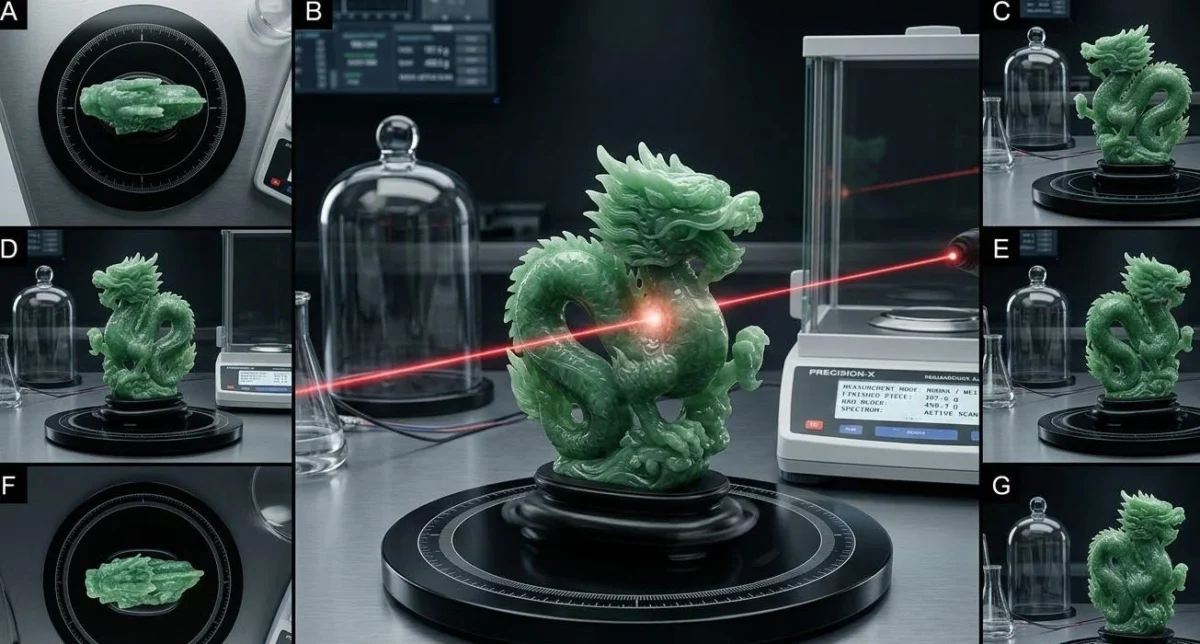
Full-Round Carving, also called spherical or complete three-dimensional carving, creates entirely freestanding sculptures viewable from all angles without background support. This technique demands the highest material quality and artisan skill because every surface requires refinement, and internal stress from material removal can create invisible fractures that compromise structural longevity. When you source full-round pieces—typically animal figures, deity statues, or abstract forms—you’re acquiring items that require 200-400 production hours per piece and command 2-4x the price of equivalent-weight relief-carved material.
The collector market recognizes full-round work as the genuine craftsmanship indicator; pieces bearing JADE MAGO’s factory mark and full-round carving classification carry higher auction valuations and resale premiums. For your wholesale positioning, full-round pieces function as “hero products” that establish your brand’s credibility across your entire product range—customers who trust your full-round sourcing extend that confidence to all your jade offerings. This means investing in 20-30 statement full-round pieces per year can amplify your perceived market position disproportionately compared to their numerical contribution to total unit sales. Full-round pieces become your brand ambassadors, driving customer perception and competitive differentiation.
The Material Waste Reality That Transforms Procurement Economics
Full-Round Carving exhibits a brutal material utilization truth: you’ll sacrifice 45-55% of raw jade weight during production, compared to 25-35% waste for Relief work. A raw jade block weighing 500g destined for full-round carving will yield approximately 225-275g of finished sculpture, with 225-275g discarded as carving byproduct. This waste concentration occurs because artisans must remove material from all surfaces, not just one or two sides as in relief work.
This fundamental waste ratio means your procurement strategy must account for dramatically higher raw material costs when sourcing full-round pieces. If relief-carved pendants demand $8/gram of raw material and full-round requires 50% more material weight to achieve the same finished piece, your effective raw material cost doubles. However, this economic reality also creates an arbitrage opportunity: if you source “off-grade” jade blocks (pieces with color inconsistencies or minor inclusions unsuitable for fine jewelry) specifically for full-round carving, you’ll negotiate 20-35% discounts on raw material while the carving process visually integrates those color variations into the sculpture’s aesthetic character. This means you can improve margins by 12-18% on full-round pieces through intelligent raw material sourcing strategy.
Verification Through Dimensional Analysis and Structural Testing
Unlike relief or openwork work where defects reveal themselves through visual inspection, full-round pieces can harbor internal fractures or stress points undetectable without advanced analytical methods. Your QC protocol should include: (1) weight verification (final weight should match supplier specifications within ±2%), indicating no unexpected material removal hiding internal cracks, (2) photo documentation of the piece in at least six orientations capturing all surface zones, and (3) for high-value pieces (>$500 wholesale value), request spectroscopic testing such FTIR or Raman spectroscopy [source: https://www.gia.edu/gems-gemology/winter-2024-infrared-spectroscopy] confirming structural homogeneity and identifying any previously hidden fracture zones.
These non-destructive testing methodologies—including spectroscopic analysis and controlled stress evaluation—provide objective assessment of carving quality and structural integrity.
According to GIA (Gemological Institute of America), such testing protocols cost $30-50 per piece when conducted at professional gemstone laboratories but prevent $500+ losses from structural failures in the field.
Calculate your risk exposure: if you sell 50 full-round pieces annually and experience even one structural failure requiring customer replacement, that single defect costs you $700+ in logistics, restocking, and reputational damage—justifying preventive laboratory testing across your inventory.
Intaglio Carving—The Precision Alternative
Recessed Design as a Speed-to-Market Strategy
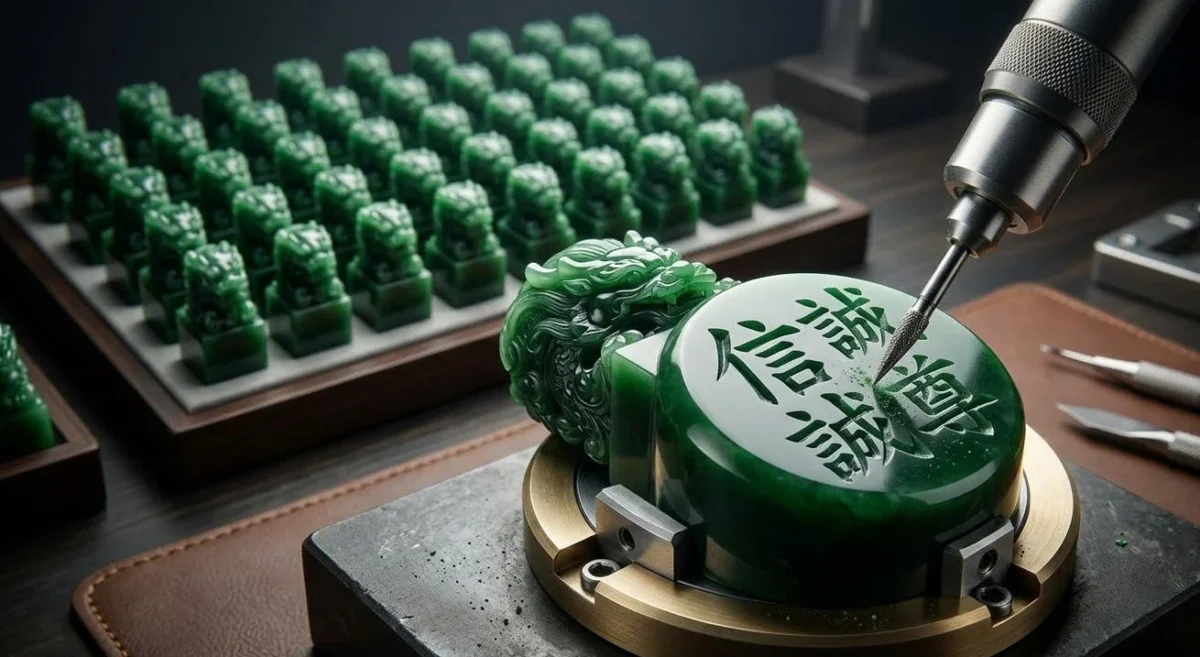
Intaglio Carving, the inverse of relief work, creates recessed lines and patterns carved into the jade surface rather than raised outward. This technique produces intricate detail-work—seal engravings, inscription panels, decorative backgrounds—through controlled material removal that creates concave surfaces catching light differently than relief’s convex geometry. From a manufacturing perspective, Intaglio ranks as the fastest jade processing technique, with production cycles of 2-4 weeks for detailed work, compared to 3-6 weeks for comparable Relief complexity.
The speed advantage emerges from the carving logic: intaglio lines require less material removal than relief sculptural depth, and the continuous background support prevents the structural vulnerability that makes openwork so time-consuming. This makes Intaglio your optimal technique when you’re sourcing signature items (personalized business gift sets, engraved award plaques, customized seal sets) where 4-6 week delivery cycles compete effectively against your retail timeline requirements. You’ll discover that customers often prefer Intaglio’s subtle, sophisticated visual impact—the recessed pattern creates shadowing through line definition rather than relief’s geometric projection, producing a more refined appearance that appeals to corporate and luxury segments willing to pay 20-30% premiums for personalization services.
Cost Efficiency Through Production Predictability
Intaglio work provides extraordinary cost predictability because the carving methodology minimizes loss factors. Yield rates typically exceed 94% because the recessed-line approach avoids the structural vulnerabilities that plague relief and openwork techniques. Material waste concentrates in the initial rough-shaping stage, with minimal loss during detailed carving phases. This production certainty translates to pricing leverage: suppliers can quote Intaglio work with confidence, allowing them to absorb tighter margins, which benefit you through lower procurement costs.
For your sourcing strategy, this means Intaglio delivers superior ROI when you’re building high-volume, personalized product lines—think corporate gift collections of 500+ units with individual name or logo engraving. The 94%+ yield rate guarantees near-complete order fulfillment without the 15-25% loss contingencies required for openwork sourcing. This translates to inventory certainty and reduced capital-lock risk. When you negotiate Intaglio contracts, require suppliers to specify their yield guarantee in writing—a 94% minimum is industry-standard and achievable, while anything below 90% indicates either inexperienced labor or unrealistic timeline compression.
Chain Carving—The Rarest Mastery
The Technical Pinnacle of Jade Artisanship
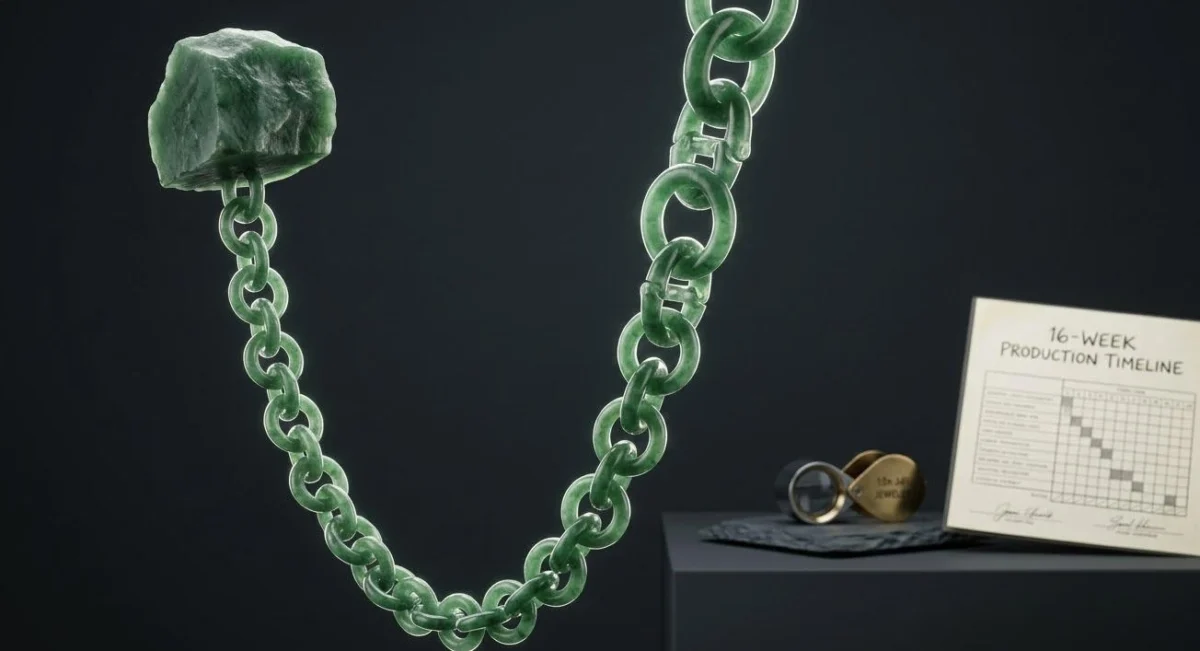
Chain Carving represents the apex of jade carving complexity—artisans carve freely articulating chain links from a single jade block without any assembly, adhesive, or separate fastening. Each link connects to its neighbors through precisely dimensioned pivot points that allow 360-degree rotation while maintaining structural integrity across potentially dozens of interlocked segments. This technique demands flawless raw material (zero internal fractures or grain inconsistencies), combined with hand-tool precision controlled to fractions of a millimeter and applied across hours of intricate carving demanding absolute focus.
The market recognizes Chain Carving as the collector’s holy grail—a single masterwork piece can command $5,000-$20,000+ at auction, and museum pieces are valued at $50,000 and beyond. At JADE MAGO, we produce fewer than 50 chain-carved pieces annually because the production commitment is simply immense. For your wholesale positioning, Chain Carving pieces function as absolute credibility markers—one authentic chain-carved bracelet or pendant legitimizes your entire brand positioning as a serious jade supplier capable of delivering true artisanal work. This halo effect justifies the inventory holding cost and extended production timeline because a single chain-carved piece elevates your entire collection’s perceived market position.
The Production Reality That Reshapes Long-Term Planning
Chain Carving demands 300-500+ production hours per piece, with timelines extending 10-16 weeks depending on complexity and design intricacy. A single chain with 15-20 articulating links represents 6-8 weeks of dedicated artisan labor, compared to 40-60 hours for equivalent-complexity relief work. The material sourcing requirement is unforgiving: you must acquire raw jade blocks that are flawless under 10x magnification across their entire volume because a hidden internal fracture discovered during production (month 3 of 4) means complete total loss of invested labor and material value.
This production arithmetic means you cannot build a chain-carving collection reactively—you must plan 6+ months in advance, secure premium raw material, and lock specific artisans into dedicated timelines. The capital commitment is substantial: advance payment for raw material plus per-unit labor-hours throughout the extended production cycle. However, this long-term commitment also creates your competitive moat—once you establish reliable chain-carving sourcing relationships, competitors cannot quickly replicate your capability, allowing you to command exclusive wholesale positioning and protect pricing against retail market pressures. This exclusive capability becomes your strategic advantage against wholesale competitors who rely on commodity jade sourcing.
Failure Risk Management for Maximum-Value Pieces
Chain Carving carries 30-40% failure risk during production due to the accumulated stress from extended carving and the technical difficulty of maintaining precision across extended timelines. A piece may progress 60-70% complete before a previously undetected internal fracture becomes visible, rendering the work unsalvageable. Contracts must address this reality explicitly: negotiate terms specifying either rework (the artisan begins again with replacement material, typically without additional labor charges due to the partnership nature of chain-carving relationships) or partial compensation reflecting the artisan’s labor investment even though the piece failed.
You should establish insurance partnerships for chain-carving inventory to protect against total loss scenarios—specialized fine arts insurance covering loss-in-production costs typically runs $50-150 per piece annually but protects against catastrophic loss. Additionally, require progress photography documentation at 25%, 50%, 75%, and 95% completion stages, allowing you to monitor quality maintenance and communicate interim findings to your customers for pieces on pre-order. This documentation transforms chain-carving from a black-box unknown into a transparent, trackable project, reducing anxiety among your wholesale buyers who understand the inherent production risks.
Material Science Verification—From Laboratory to Supply Chain
Spectroscopic Testing as Non-Negotiable QC Standards
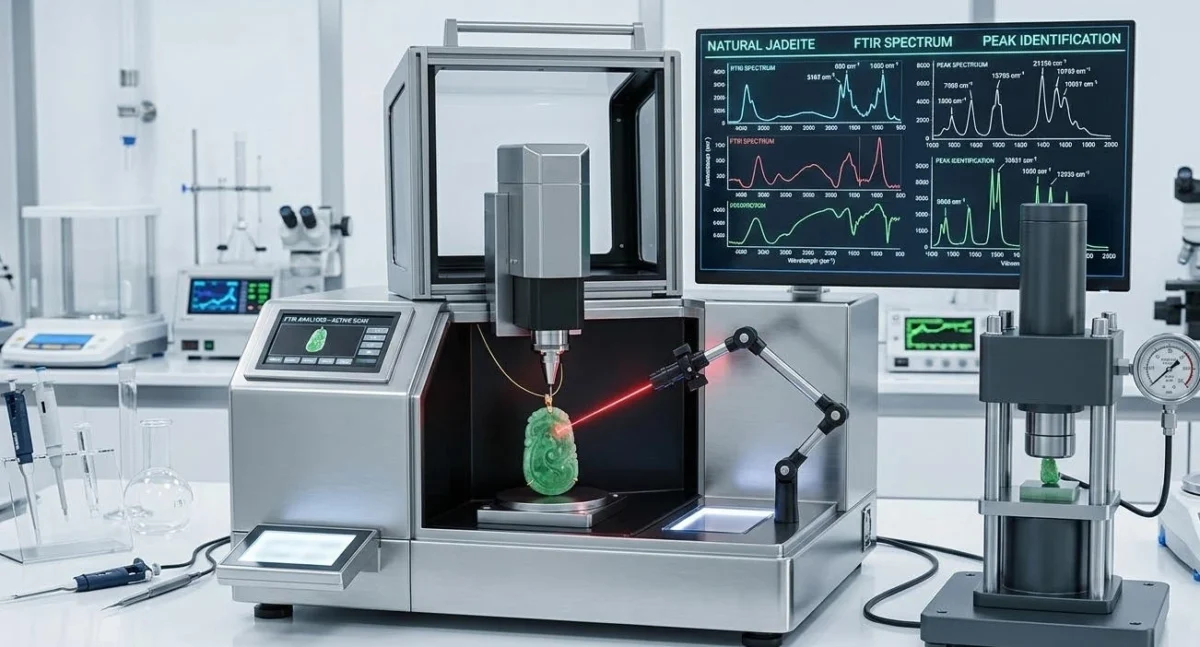
The final verification layer for all jade processing outputs involves laboratory confirmation that the material composition matches promised specifications and that carving quality aligns with manufacturing claims. FTIR (Fourier Transform Infrared) spectroscopy and Raman spectroscopy [source: https://www.gia.edu/gems-gemology/winter-2024-infrared-spectroscopy] represent industry-standard analytical techniques for confirming jade authenticity and identifying enhancement treatments—heat-treatment, resin-filling, polymer impregnation, or other modifications—that diminish material value and long-term durability.
Professional gemstone laboratories employ these spectroscopic methodologies to provide objective material analysis that eliminates subjective interpretation from material verification. According to resources provided by SSEF (Swiss Gemmological Institute)[source: https://www.ssef.ch/], at JADE MAGO’s Jade Factory, every production batch undergoes mandatory spectroscopic testing confirming material composition—whether you’re sourcing nephrite, jadeite, or other jade varieties—and identifying any enhancement treatments or polymeric impregnation that might affect long-term durability or customer satisfaction. A single spectroscopic analysis costs $25-40 per sample but confirms that you’re actually receiving genuine jade rather than simulant materials or heavily treated pieces, protecting both your wholesale integrity and your customer relationships.
For more detailed information on jade composition and testing standards, refer to Smithsonian Institution’s gemstone collection resources[source: https://naturalhistory.si.edu/research/mineral-sciences], which provides comprehensive documentation on jade variety identification and characteristics.
Yield Testing Protocols That Prevent Supplier Deception
Beyond material composition, yield verification requires destructive testing on sample units from each production batch to confirm that carving quality matches manufacturing hour documentation. Select 2-3 pieces per batch of 50 units and submit to controlled stress testing—the samples are pressurized or mechanically stressed in ways designed to expose structural weaknesses invisible to visual inspection. This testing reveals whether carving quality actually supports the promised durability or whether hidden micro-fractures will cause field failures after your pieces reach customer hands.
According to GIA’s Gems & Gemology research[source: https://www.gia.edu/gems-gemology], destructive testing costs approximately $75-150 per piece but provides irreplaceable confirmation that production quality is real, not merely cosmetically acceptable.
The statistical principle is straightforward: if your 2-unit sample from a 50-unit batch shows structural weakness, you extrapolate that 4% of your entire batch likely carries similar vulnerabilities. This gives you justification for demanding either complete batch rework or acceptance of reduced payment reflecting the risk you’re absorbing. Many suppliers resist this testing requirement, viewing it as burdensome—but this resistance often indicates they lack confidence in their own quality control, which is exactly the warning signal you need to either tighten specifications or shift suppliers. Transparent suppliers welcome objective testing because it validates their quality claims.
Practical Procurement Framework—From Selection to Verification
Matching Carving Techniques to Your Wholesale Objectives
Your sourcing decision tree should begin with clear objective definition: are you building volume-driven, accessible product lines or establishing premium positioning through limited-availability, high-craft pieces? Relief and Intaglio techniques serve high-volume, margin-optimized objectives with predictable yields and reasonable production timelines. Openwork carving serves mid-market positioning where customers recognize and reward artisanal investment with 35-50% price premiums. Full-Round and Chain Carving occupy the collector-grade, luxury positioning where scarcity and provenance drive customer value perception and wholesale pricing power.
This means your decision isn’t simply “which technique costs less” but rather “which technique supports my wholesale margin targets and brand positioning?” A supplier offering deep discounts on chain-carved pieces should trigger skepticism—if production genuinely requires 300+ labor hours, artificially compressed pricing indicates either hidden quality shortcuts or supplier financial desperation signaling potential reliability issues. You should match carving techniques to wholesale targets with the same precision you apply to inventory management, ensuring that sourced pieces reinforce your intended market positioning rather than undermining it through inconsistent quality or misaligned price positioning.
Documentation Requirements That Establish Contractual Clarity
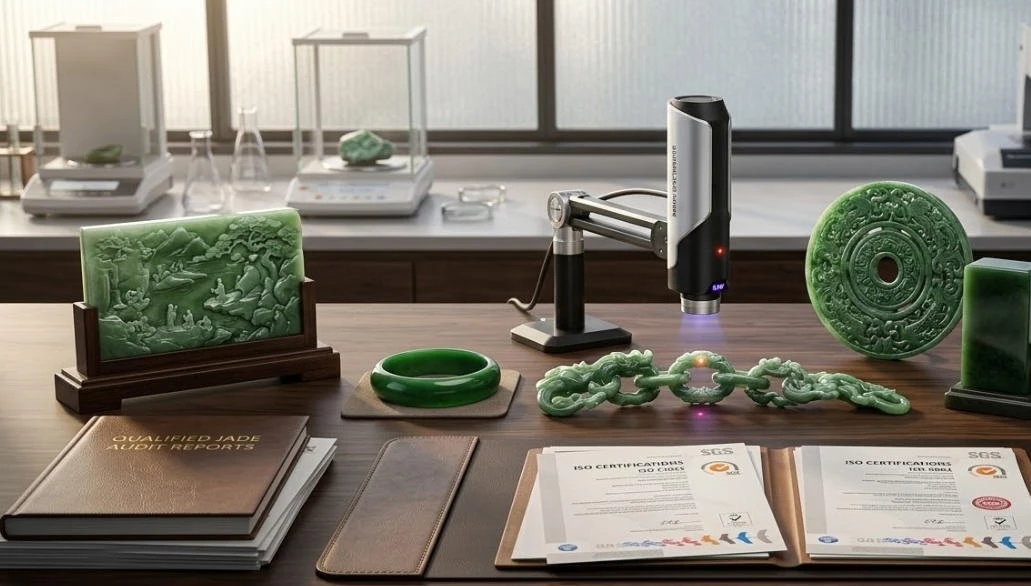
Every wholesale purchase agreement should mandate specific documentation deliverables: (1) sample assessment reports documenting carving technique specificity, expected yield rates, and production timeline justification; (2) manufacturing hour statements proving labor investment aligns with claimed complexity; (3) material composition verification (spectroscopic testing reports) confirming jade type and identifying any enhancement treatments; (4) progress photography at key production milestones (especially for custom or high-value work); and (5) final QC documentation including dimensional verification, visual inspection results, and any destructive testing protocols applied.
This documentation framework costs suppliers approximately $50-200 per order in administrative overhead but transforms your sourcing from supplier-dependent trust into objective, verifiable accountability. When disputes arise—a batch arrives with inconsistent finish quality, or yield rates fall below agreed thresholds—this documentation provides your evidence foundation for contractual enforcement or financial recovery. You’ll discover that suppliers offering the cleanest, most transparent documentation often deliver the most consistent quality because transparent operations indicate systematized, mature manufacturing practices rather than ad-hoc, artisan-dependent production.
Transforming Jade Processing Knowledge Into Competitive Advantage
Understanding the five major jade carving techniques empowers you to move beyond reliance on supplier representations and into data-driven procurement decisions. Relief Carving offers your high-volume, accessible product foundation with predictable 92%+ yields. Openwork provides the premium positioning for customers seeking visible artisanal investment, despite higher failure risk requiring 85%+ yield guarantees. Full-Round Carving establishes your brand credibility as a serious jade supplier, despite 45-55% material waste demanding intelligent raw-material sourcing. Intaglio delivers your speed-to-market advantage for customized, personalized applications with exceptional yield predictability. Chain Carving positions you as a true luxury provider, despite requiring 10-16 week commitments and 30-40% production risk.
Your procurement strategy should layer verification requirements across all five techniques: sample assessment reports documenting carving specificity and yield expectations, manufacturing hour documentation proving that production timelines reflect actual artisan investment, spectroscopic testing confirming material composition and identifying enhancement treatments, and structured quality control protocols exposing structural integrity. These verification tools eliminate the information asymmetry that typically advantages suppliers over wholesale buyers, replacing vague quality assurances with measurable, auditable standards.
Ready to transform your jade sourcing into a competitive advantage? Contact JADE MAGO today for a consultation—our Jade Factory specialists will analyze your product requirements, recommend optimal carving techniques matching your wholesale objectives, and establish supply partnerships with transparent verification protocols protecting your inventory quality and margin stability. Your wholesale buyers will immediately recognize the difference between carefully sourced jade pieces and industry-standard commodity work. With JADE MAGO’s 65 years of jade processing expertise, you’ll build sourcing relationships that drive profitability, customer satisfaction, and brand positioning. Request your complimentary sourcing assessment today.
Jade Processing – 5 Carving Faqs
1. What are the key differences between the 5 jade carving techniques?
Relief Carving creates raised surface patterns (3-6 weeks, 92%+ yield, 40-60 labor hours), Openwork removes background for transparency (8-12 weeks, 75-85% yield, 80-150 hours), Full-Round produces complete 3D sculptures (12-16 weeks, 85-90% yield, 200-400 hours), Intaglio carves recessed lines (2-4 weeks, 94%+ yield – fastest), and Chain Carving articulates movable links from single block (10-16 weeks, 60-70% yield, 300-500+ hours). Each serves different wholesale segments: Relief for volume, Openwork for premium positioning, Full-Round and Chain for collector markets, Intaglio for personalized corporate gifts.
2. How do I verify quality and protect against supplier deception?
Require four essential documentation items: (1) Manufacturing hour statements proving labor investment matches complexity claims; (2) Yield rate guarantees in writing (e.g., “92% minimum for Relief Carving”); (3) Sample assessment reports before bulk production begins; (4) Spectroscopic testing (FTIR/Raman) confirming material composition and identifying enhancement treatments. For high-value pieces (>$500 wholesale), request destructive stress testing on 2-3 sample units per 50-piece batch to expose hidden micro-fractures. These documentation requirements cost $50-200 per order but transform sourcing from trust-dependent to verifiable accountability.
3. What is the true per-unit cost including material waste and yield loss?
Never calculate cost using only production labor. Account for material waste separately: Relief Carving wastes 25-35%, Openwork 30-40%, Full-Round 45-55%, Intaglio 20-30%, Chain Carving 40-50%. Example for Full-Round: Raw jade ($8/gram) × 500g waste + $5,000 labor + $100 testing ÷ 85% yield = $6,647 per finished piece. If you calculate without accounting for 45-55% waste and 10-15% yield loss, you’ll dramatically underestimate costs and compress margins. Always calculate true per-unit COGS accounting for waste AND yield losses separately.
4. What should my supplier contract include?
Mandatory contract elements: (1) Specific carving technique with visual mockups and dimensional specifications; (2) Manufacturing hour commitments with labor documentation; (3) Yield rate guarantees (e.g., “85% minimum for Openwork”); (4) Timeline guarantees with penalty clauses for delays; (5) Material composition verification via spectroscopic testing; (6) Progress photography at key milestones (25%, 50%, 75%, 95% completion); (7) Final QC documentation with dimensional verification; (8) Financial penalties for batches missing specifications. These provisions cost suppliers $50-200 per order but provide your legal foundation if disputes arise.
5. Why should I source from JADE MAGO?
JADE MAGO operates with 65 years of jade processing expertise and transparent, documentation-first sourcing: (1) Mandatory spectroscopic testing on every production batch; (2) Complete manufacturing hour documentation proving labor investment; (3) Sample assessment reports before bulk production; (4) Progress photography at defined milestones; (5) Yield rate guarantees in writing—not vague assurances; (6) Third-party quality verification options including destructive testing. Contact us today for a complimentary sourcing assessment to analyze your product requirements and recommend optimal carving techniques matching your wholesale objectives.