Introduction
The market is currently chasing natural energy and wellness aesthetics, yet many brands have stumbled in this trend—suppliers can’t distinguish between fused crystal and natural crystal, rendering all the marketing work brands put in completely futile. At Jade Mago, we refuse to engage in such shady practices. We firmly reject passing off inferior products as genuine. For a brand to truly command a premium, it must prioritize quality materials and never let “fake crystals” tarnish its reputation. Next, we’ll peel back the layers of “fused crystal’s” disguise, revealing the true nature of “natural crystal,” empowering every quality-driven brand to grasp the benchmark for authenticity.
Table of Contents
Laboratory Crystal Calcination
In industrial workshops, melted crystal is known as crystal lumps or reprocessed crystal. While the technology is impressive, many brands fall into significant pitfalls. The process involves melting quartz powder at 1700°C to remove natural inclusions like gas bubbles, rainbow patterns, phantom bands, and liquid inclusions. Thus, after perfect and uniform chemical refinement, the result is a highly pure, heat-resistant fused crystal.
Fused crystal lacks the unique “double refraction” and complex crystal lattice structure inherent to natural quartz, preventing it from interacting with light energy in measurable, distinctive ways. For brands touting “energy” or “holistic wellness,” using fused crystal is absurd. It’s akin to selling forest recordings while claiming they provide oxygen equivalent to trees. According to Gemological Institute of America (GIA) research, the differences between the two are clearly measurable, yet many suppliers still muddle through with vague claims—after all, muddying the waters is cheaper.
The Quality of Natural Crystals
In contrast, natural crystals are chronicles of Earth’s evolution. Each inclusion narrates a sentence; every fracture tells a chapter. When Jade Mago crafts raw natural quartz, we act not merely as “manufacturers” but as editors. Our artisans must decipher the stone, identifying zones of intense crustal pressure and veins of gentle mineral flow. This is the essence of mineralogical authenticity. It reveals that those “imperfections” are actually fingerprints left by divine creation.
The “brand marketing” you seek lies not in superficial perfection, but in the depth of its origins. The specific gravity and refractive index of natural crystal are qualities that synthetic imitations can only superficially mimic. More importantly, it carries a story. When customers hold a piece from Jade Mago’s workshop, they grasp a treasure buried in the earth for millions of years, unchanged by time. This timelessness is true luxury. If your suppliers cannot articulate this principle, if they cannot explain to your customers “why every parent preparing for their child’s wedding worries about buying a non-natural ring, fearing they might get a B-grade stone,” then they are unworthy of being your partners. They are merely middlemen peddling false transactions.
The “Philosopher’s Stone” of Modern Alchemists
We call the new fusion crystal manufacturers modern alchemists because they treat this craft as a contemporary “Philosopher’s Stone.” They attempt to use this advanced technology to melt mediocre crystals into high-quality natural crystals. Then, under the guise of ‘natural’ and “premium,” they profit. In truth, the melted crystal is better suited for kitchenware. It withstands high temperatures better than natural crystal and distributes heat more evenly. It won’t burn your hands and possesses many advantages gained through human processing. But fabricating the value of high-end natural crystal with lies is wrong.
The Ghost of Melted Stone
Fused crystal haunts the gem trade corridors. To untrained eyes, fused quartz spheres appear flawless—unnaturally so. They lack the “veils” and “internal landscapes” characteristic of natural growth, and this very perfection is their primary flaw. During manufacturing, quartz sand is melted into liquid, completely destroying the crystal lattice structure that gives gemstones their piezoelectric properties. What remains is amorphous glass. This material is like a lobotomy victim, stripped of structural memory in exchange for surface clarity.
When brands unknowingly accept fused crystals from suppliers, they are essentially peddling imitations of natural phenomena.
The “premium” they charge rests on a lie—albeit one born of ignorance rather than malice. From a mineralogical perspective, this difference is as vast as the chasm between a living organism and a plastic model. As noted by the International Gemological Society (IGS), crystal structure determines how a mineral interacts with its environment. The melting process destroys this structure, creating something dead. For brands touting “natural energy,” this represents not merely a procurement error but a metaphysical failure.
How to Easily Screen
Jade Mago’s artisans rely not solely on machines to distinguish authenticity but on “internalized expertise” honed through decades of tactile experience. Natural crystals produce a unique “resistance” on polishing wheels—a characteristic absent in fused glass. Master carvers sense the stone’s tension, discerning its limits of yield and resistance. This dialogue between human and mineral is the guarantee of our products’ authenticity. We don’t merely shape contours; we pay homage to nature’s structure.
In our workshop, each piece undergoes rigorous inspection beyond the visual.
We seek nature’s “fingerprints”—whether ancient water bubbles sealed within cavities or rutile needles that have coexisted with quartz for millions of years. These are the true imprints. If suppliers cannot point out these marks or explain the “growth history” of the material they sell, they are likely hiding behind the anonymity of molten glass. Their indifference to their craft will ultimately cost your brand.
When Silence Becomes the Enemy of Natural Beauty
In social psychology, the **bystander effect** describes a regrettable phenomenon: when many witness wrongdoing, individual responsibility dilutes, leading to inaction.
Regrettably, this effect is quietly eroding the global gemstone supply chain. Amidst the intricate layers of trade, we witness countless “reworked” and ‘melted’ materials flooding the market. Labels are deliberately obscured, terminology layered with euphemisms—behind enchanting names like “sea amethyst” and “cherry quartz” lies a void of truth.
Most choose silence, believing exposing the truth is the regulator’s duty. But at Jade Mago, we know this truth: When everyone chooses silence, this collective unconscious becomes fertile ground for fraud.
Reject Mediocrity: Authenticity Isn’t an Option, It’s a Bottom Line
For many middlemen fixated solely on SKUs and spreadsheets, crystals are merely commodities on an assembly line. They have no connection to the mineral lands, no resonance with the craftsmanship of the polishers, and thus turn a blind eye to the ethical and technical risks of the materials.
This abdication of responsibility has eroded industry integrity. Yet we remain convinced that humanity’s love for natural crystals stems from their unique, energy-infused essence—formed over millions of years. If we tolerate counterfeits flooding the market, we ultimately destroy humanity’s last spiritual connection to nature’s creations.
The Technical Cartography of Gems
Understanding the difference between natural and fused crystals is to grasp the “cartography” of the mineral world. This map, composed of atoms, follows specific repeating geometric structures. Natural quartz belongs to the trigonal crystal system, characterized by the precise arrangement of silicon dioxide molecules (SiO₂). This arrangement is not merely a chemical formula but the physical framework determining a gemstone’s vibrational patterns, thermal conductivity, and light refraction. Fused quartz, though sharing the same chemical formula, lacks this structure. It is an amorphous solid, closer to glass than to gemstone.
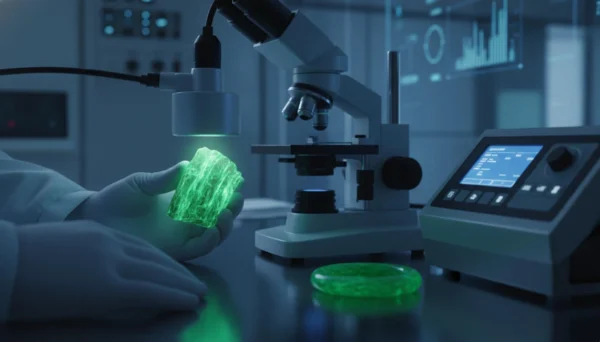
At Jade Mago Laboratories, we treat each batch of rough stones as uncharted terrain. Observing the material’s “optical characteristics” through a polarizing microscope reveals unique interference patterns (“bullseye” or ‘spiral’ patterns) in natural crystals—patterns impossible to replicate in fused material. This is the gemstone’s “soul” revealed under the scientific lens. If your supplier lacks a polariscope or the expertise to use it, they are navigating uncharted waters. They are steering your brand toward perilous territory.
Refractive Index and the Weight of Reality
One of the most objective ways to distinguish truth from illusion is measuring refractive index ($RI$). Natural quartz consistently maintains a refractive index between 1.544 and 1.553. Fused quartz, lacking crystalline structure, typically exhibits a lower and more uniform refractive index. To the untrained eye, these numbers may seem like dry technical data, but to us, they represent the “weight of reality.” They prove the object was forged in Earth’s slow, deliberate furnace, not hastily produced in a factory’s kiln.
Additionally, we examine a material’s “thermal conductivity.” Natural crystal maintains a ‘colder’ feel far longer than fused glass or plastic. This stems from its lattice structure efficiently conducting heat away from the skin. This “cool sensation” is often consumers’ first impression when touching premium jade or crystal pieces, serving as a tactile indicator of authenticity. When suppliers offer fused materials, their products feel “lifeless” in the palm—they heat up too quickly, losing that primal chill connecting to the earth’s depths. According to mineral property research, these physical constants are the only reliable means of verifying authenticity.
The Intangible Premium
Brand premiums are often perceived as “intangible”—halos of prestige, logos, marketing narratives.
At Jade Mago, however, we firmly believe premium value must be rooted in “visible” and “verifiable” substance. The premium is precisely the difference between $1.544 and $1.458. It manifests in the distinction between a tri-lateral lattice and an amorphous chaotic structure, in the gap between artisans who deeply understand jade and mechanical cutters.
When you can precisely articulate to customers the essence of a crystal’s excellence—not merely because it is “better,” but because of its mineralogical authenticity—you build a value proposition impervious to price wars. What you sell is no longer a commodity, but a professionally certified slice of Earth’s history by Jade Mago. In a market increasingly skeptical of “natural” claims, this is the only way to safeguard brand premium. You must show the map, not merely point to the destination.
Technical Report: Precision and Craft Logic in Natural Crystal Processing
In the realm of natural crystal and gemstone processing, the choice of technique directly determines how the material’s physical properties are revealed. Below are the core technical standards Jade Mago adheres to when processing natural crystals and the tangible benefits they deliver to clients.
Physical Progressive Sanding vs. Chemical Polishing
Process Details: Mass production in the industry often relies on strong acid chemical polishing, which rapidly smooths surfaces through chemical etching. We steadfastly employ multi-stage progressive sanding (Progressive Sanding).
- Process: Utilizing abrasive media of varying grit sizes (from coarse sand to ultra-fine powder), we progressively optimize the crystal surface’s flatness layer by layer.
- Benefits Delivered:
- Optical Performance: Preserves the natural crystal’s birefringence, creating layered light refraction instead of the “plastic-like” glare from chemical polishing.
- Tactile Feedback: Hand polishing retains the mineral’s “microtopography,” resulting in a warm, organic feel that aligns with premium brands’ definition of “natural texture.”
Stress Control for Crystal Cleavage
Process Details: The fundamental distinction between natural and fused (synthetic) crystals lies in their internal structure. Fused materials are isotropic (directionless), whereas natural crystals possess cleavage planes and internal tension.
- Technical Challenge: During cutting and polishing, artisans must rely on tactile feedback to gauge the crystal’s “resilience” in real time. Constant pressure (as in fully automated equipment) readily triggers cleavage plane fractures or internal micro-cracks.
- Benefits:
- Structural Stability: Manual force adjustment based on experience minimizes structural damage during processing, ensuring greater durability during shipping and daily use.
- Authenticity Verification: Precisely treated natural surfaces clearly reveal the mineral’s inherent grain growth patterns—the most compelling physical evidence that the product is not melt-pressed.
Ergonomics and Processing Precision
Process Details: The processing environment is not merely an ethical concern but a matter of precision. The significant amount of **silica dust** generated during natural crystal processing, if not strictly controlled, severely impairs artisans’ visual judgment and operational accuracy.
- Facility Standards: We are equipped with high-powered wet dust extraction systems and ergonomically designed professional grinding workbenches, aimed at reducing physical fatigue among artisans.
- Benefits:
- Consistent Yield Rate: A comfortable and safe environment enables artisans to maintain high visual focus for extended periods, ensuring consistent geometric dimensions and polish quality across every SKU in large-volume orders.
- Detailed Execution: Optimal working conditions during intricate carving or irregular-shaped piece processing allow for finer detail refinement, elevating the product’s overall sophistication.
Technical Transparency: Refractive Index & Polarization Testing
Process Details: Prior to delivery, we conduct sampling technical inspections on finished products, including refractive index measurements and polarized light observation.
- Benefits:
- Authenticity Verification: Natural crystal exhibits characteristic interference colors (e.g., bullseye patterns) under polarized light, while fused crystal appears entirely black.
- Brand Endorsement: These technical data serve as direct “quality credentials” for clients to showcase to end consumers, eliminating trust vacuums caused by the “bystander effect.”
When “Hardcore Tech” Meets “Natural Soul”
Many perceive “industrialization” as cold assembly lines that destroy crystal’s spiritual essence. Yet at Jade Mago, advanced manufacturing isn’t about replacing people—it’s about empowering them.
In this era of “melted crystal” proliferation, we refuse to be silent bystanders. We choose to safeguard that weighty, natural authenticity with the most hardcore technology.
Automated Rough Cutting: Handing “Dirty, Hard Work” to Machines
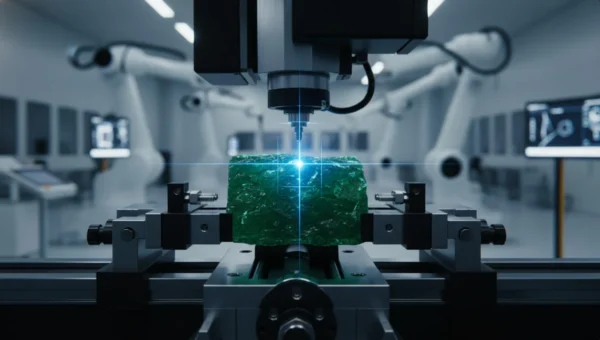
【Technical Explanation】 We introduced high-precision CNC (Computer Numerical Control) machines. During initial processing, machines can achieve tolerances within ±0.05mm based on 3D models.
- In plain terms: Master craftsmen used to spend days grinding away impurities, their hands worn raw. Now machines precisely “lay the foundation,” completing the most tedious, time-consuming basic shaping.
- Your Benefit: This frees master craftsmen from physical labor, allowing them to dedicate 100% of their focus to the final detailed finishing, texture refinement, and soulful expression. Machines create the form; humans breathe the soul.
0.01mm Precision: More Than a Number, It’s the “Feel”
【Technical Depth】 In luxury goods or high-precision components (like smart wearable parts), a 0.01mm deviation can determine whether assembly is possible.
- Technical Details: We utilize custom diamond-coated cutting tools and intelligent sensing systems. Since each natural stone varies in hardness and density, the machine automatically senses resistance during cutting and dynamically adjusts torque to prevent chipping.
- Benefits for You: * Consistency: Order 1,000 units and each will feature highly uniform curves and dimensions—a core credibility factor in B2B delivery.
- * Luxurious Feel: This precision delivers a smoothness impossible for small workshops to achieve through guesswork grinding. The moment you touch it, you know it’s premium quality.
“Living Crystal” vs “Dead Plastic”
【Industry Insight】 Today’s fused crystal (artificially pressed) resembles plastic blocks—uniform to an unsettling degree. Machines can only replicate hollow specifications on its surface.
- Technical Comparison: * Fused Material: Amorphous structure with no internal tension. While fast to process, it lacks the “vitality” of refraction.
- Natural Crystal: Features cleavage planes and natural inclusions. Our equipment adapts to the mineral’s growth patterns—avoiding or accentuating them.
- In plain terms: True craftsmanship is like “X-ray vision,” working with the stone’s inherent character. Honoring ancient nature with cutting-edge algorithms—that’s our definition of “advanced craftsmanship.”
Why choose a supplier with a ‘system’?
In luxury goods, “guessing” is risk.
- Process Assurance: We adhere to ISO industrial standards. From hardness testing upon material intake, through multi-axis CNC machining, to final hand polishing.
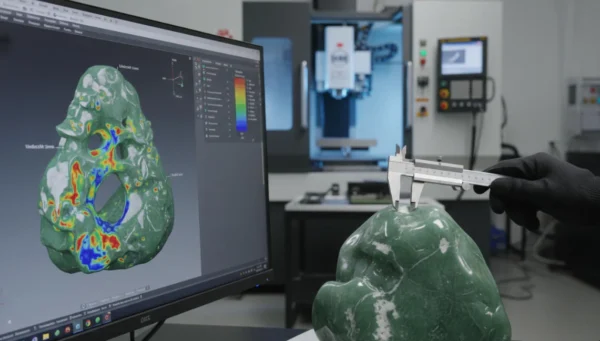
- Your Benefit: You acquire not just a product, but a system of certainty. We don’t rely on luck or chance. Every piece withstands precision caliper measurement and the scrutiny of professional collectors.
Conclusion
Ultimately, we are all witnesses to our own choices. As a brand, you face a decision: either stand idly by as industry values erode, or become a guardian of authenticity. If your supplier cannot or will not distinguish between synthetic and natural gemstones, this reveals the essence of their values—they prioritize their own convenience over your brand’s reputation.
At Jade Mago, we choose the gem itself. We choose the earth’s silence over the furnace’s clamor. We choose mineralogical authenticity—that complex, arduous, yet resplendent truth. We invite you to walk this path with us. Let us create not merely products, but testimonials to truth. For in this world of illusions, truth alone is the eternal luxury.
Frequently Asked Questions
Why should “energy” brands reject fused crystal?
For brands touting “energy” or “wellness,” using fused crystal is absurd—it is akin to selling forest recordings while claiming they provide oxygen.
The melting process destroys the crystal lattice structure that gives gemstones their piezoelectric properties.
Brand premium is rooted in mineralogical authenticity rather than cheap factory processing
How to distinguish authenticity through scientific data?
Natural quartz maintains a refractive index between 1.544 and 1.553, whereas fused quartz typically exhibits a lower, uniform index.
Under a polariscope, natural crystal reveals unique interference patterns (e.g., “bullseye”), while fused crystal appears entirely black.
Natural crystal feels “colder” for longer because its lattice structure efficiently conducts heat away from the skin.
What technical standards does Jade Mago follow for processing?
We use high-precision CNC machines to achieve tolerances within $\pm 0.05mm$ during initial processing.
We reject chemical etching and use multi-stage progressive sanding to preserve the mineral’s microtopography and tactile feel.
Experienced artisans adjust pressure in real-time based on the crystal’s “resilience” to prevent damage to natural cleavage planes.