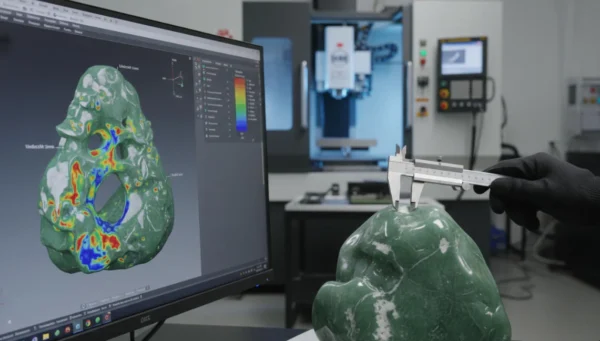
Executive Takeaways for B2B Buyers
If you’re sourcing Jade Processing for a repeatable product line, the real decision is not “machine vs artisan.” The real decision is how you want to allocate risk across cost, tolerance, yield rate, and lead time.
CNC carving is built for dimensional accuracy and repeatability, while hand carving is built for adaptive response to natural variability in stone. Neither process is universally superior, and forcing one method onto the wrong material/design combination is how projects end up with breakage, delays, and supplier disputes.
One more buyer-critical point: even with identical settings and the same CAD file, natural stone results are not guaranteed to be identical. Professional factories manage acceptable ranges, not absolutes, because material variability introduces irreducible randomness.
Table of Contents
Who This Comparison Is For (and Who It’s Not)
This guide is for B2B buyers who must make decisions that survive scale: product managers building SKUs, procurement teams managing supplier performance, and designers balancing aesthetics with manufacturability. If your business depends on reorder stability, you need process logic, measurable specs, and contract-friendly acceptance criteria.
This guide is not for collectors choosing a single artistic piece. When you buy a one-off, “variation” can be the value, and strict repeatability may be irrelevant.

Three common sourcing scenarios
If you’re a brand launching a consistent series, CNC often anchors the geometry while hand finishing controls feel and visual character. If you’re a studio doing small batch drops, hand carving may reduce catastrophic failures on risky rough, but you still need QC gates to keep the batch coherent.
If you’re sourcing gifts or promotional projects at volume, process selection must be made around yield risk, tolerance realism, and what you can accept as “natural variation.” Over-promising “zero variance” is unrealistic in natural stone and becomes a structural trigger for disputes.
What “Jade Processing” Includes End-to-End
In B2B terms, Jade Processing is not just carving. It’s a chain of linked decisions—material selection, design rules, machining strategy, finishing, inspection, and documentation—where each step can either reduce or amplify risk.
A factory that only talks about “craftsmanship” but cannot explain how it controls variance is not ready for commercial-scale supply. Your goal is to source a process system, not just a hand or a machine.
The core workflow (why each step matters)
Material selection is where you decide how much structural uncertainty you can afford. Design translation is where you set thickness, relief depth, and corner radii that determine stress concentration during processing.
Carving and polishing are where hidden problems often surface. A buyer-friendly supplier should be able to tell you where failures happen and which QC checkpoints catch them early, instead of discovering them at final inspection.
Suggested proof assets to insert (for your final page):
- Factory photo: workstation sequence (cutting → carving → polishing → QC)
- Data block: inspection sheet template + reject reason taxonomy
CNC Jade Carving: What It Controls Well (and What It Can’t)
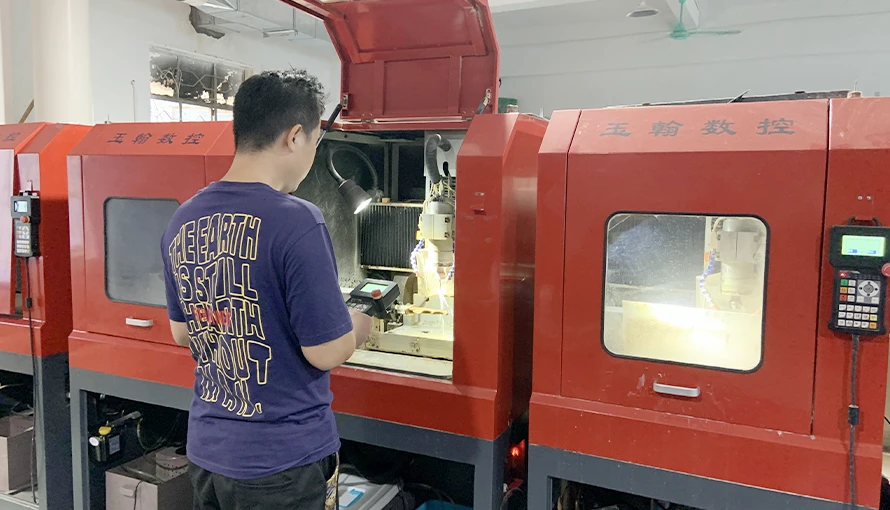
CNC carving prioritizes digital toolpaths, fixed parameters, and repeatability, which is why it excels at standardized designs and scalable production when yield is predictable. When your product needs consistent geometry across batches, CNC is usually the foundation.
But CNC is not magic. CNC assumes the material behaves consistently under the tool, and natural stone violates that assumption because internal cracks, grain orientation, density, and stress distribution vary piece to piece—often invisibly before machining.
Where CNC shines
CNC shines when the design is compatible with the stone’s structural tolerance and your priority is measurable geometry. If your SKU has mating surfaces, inlay requirements, or fit-critical dimensions, CNC helps you define and audit outcomes.
CNC also makes it easier to create consistent “design language” across a product family. That matters for brands because consistency is not only physical; it’s how your catalog looks and feels.
Where CNC is most vulnerable
CNC has limited real-time adaptation to unexpected internal defects. The risk is that defects can be exposed abruptly, and CNC failures are often binary: pass/fail, broken/not broken.
This doesn’t mean CNC is careless. It means CNC should be selected and priced with risk allocation in mind, not marketed as “guaranteed perfect.”
Suggested proof assets to insert:
- Factory photo: CNC machine + fixture setup
- Data block: dimensional report (measurement method + tolerance band)
Handcraft Jade Carving: Where Human Feedback Wins
Hand carving prioritizes continuous feedback and adaptive response. The artisan adjusts depth, pressure, and path based on resistance and texture in real time, which can reduce catastrophic failures on heterogeneous material. In practice, this can mean higher survival rate on risky rough and more graceful recovery when problems appear mid-process.
However, hand carving is inherently skill-dependent. It is slower, harder to scale, and “batch consistency” is limited by human variation unless your supplier has strong training standards and clear QC definitions.
.webp "Jade Processing Explained: CNC Carving vs Handcraft — Cost, Tolerance, Yield Rate, and Scalability 3")
Where handcraft dominates
Handcraft dominates when the stone’s variability is high and the design cannot tolerate brittle failure. It also dominates when the aesthetic goal requires organic transitions, artisan signatures, or subtle shaping that is difficult to express in rigid toolpaths.
The real limitation buyers must plan for
The limitation is not that hand carving is “imprecise.” The limitation is that absolute precision and repeatability are difficult to guarantee across multiple artisans unless the factory runs strict process discipline and acceptance rules.
Suggested proof assets to insert:
- Factory photo: artisan bench close-up (step sequence)
- Data block: labor-hour bands by complexity tier
The Consistency Myth: “Same File, Same Result”
Many buyer disputes begin with a hidden assumption: if the CAD file is the same, the product must be the same. In industrial materials, that assumption is often workable because material properties are standardized; in natural stone, material variability dominates and the process can only manage—not override—that variability.
Professional factories therefore operate with a consistency threshold concept: outcomes fall into acceptable variation, marginal variation, and failure. Optimization shifts probabilities, not certainties.
Why this matters to your contracts
If you write purchase terms that assume zero variance, you’re setting both sides up for conflict. The supplier will either refuse, overprice heavily, or accept and later argue—none of which helps your business.
The more practical approach is to define what “acceptable” means, how it is measured, and what happens when pieces land in the marginal zone.
Cost Model: What You’re Really Paying For
When buyers ask, “Why does CNC cost more here?” or “Why is hand carving expensive?”, the correct answer is rarely “margin.” The correct answer is usually risk allocation and variance management—how much uncertainty the supplier is absorbing for you.
Your goal is to get quotes that separate design engineering cost, production cost, and yield-risk cost. That clarity makes supplier comparison fair and prevents surprises mid-order.
CNC cost drivers (beyond machine time)
CNC cost is driven by CAD/CAM preparation, fixturing, tooling, and inspection requirements. If you demand tight tolerances, you are also demanding tighter inspection discipline, higher rejection rates, and more rework time.
CNC becomes cost-efficient when yield is predictable and the setup is reused across batches. If yield is unpredictable due to rough variability or aggressive thin designs, CNC efficiency can collapse into scrap cost.
Handcraft cost drivers (beyond hours)
Handcraft cost is driven by skilled labor availability, training standards, and the time needed to achieve visual consistency. If you require artisans to match a reference sample closely across a batch, you are paying for selection, correction, and careful finishing, not only carving.
Handcraft can look “slow” on paper but can be economically rational if it reduces catastrophic failures and shortens iteration cycles on risky material.
Tolerance in Jade Processing: Define It Like a Manufacturer
In natural stone, “tolerance” must be defined in layers. Dimensional tolerance matters, but so do visual tolerance and functional tolerance, and they are not always aligned.
Trying to force metal-like tolerances onto stone is a common reason yield rate collapses, timelines slip, and pricing escalates. Narrow tolerance increases rejection risk and cost because you are paying for variance management, not perfection.
Three tolerance categories you should specify
Dimensional tolerance: measurable size, thickness, hole diameter, fit features. This is where CNC is strongest and where you should define measurement tools and methods.
Visual tolerance: acceptable variation in color zoning, inclusions, and translucency. If you don’t define it, your “best sample” becomes a trap because every piece gets judged against a single outlier.
Functional tolerance: what must work in assembly or wear. This is often the most important for B2B products, and it can allow you to relax cosmetic strictness without harming customer satisfaction.
The contract-friendly phrasing that prevents disputes
Avoid absolute language. Define acceptance as a range and describe sampling methods, because professional factories must frame outcomes probabilistically rather than as absolutes.
If commercial stakes are high, align testing and verification to what you need to know, and communicate what was tested and what remains uncertain. Over-testing can backfire if it creates false expectations of certainty beyond the test scope.
Yield Rate and Breakage: The Hidden Budget Line
Yield rate is the most ignored line item in buyer planning, and it becomes the most painful one later. In natural stone manufacturing, internal micro-cracks, orientation differences, and stress distribution change tool–material interaction, and many factors are not observable before machining.
This is why pricing disputes often come from ignoring structural limits. When designs exceed structural tolerance, fissures are exposed, cracks propagate, and yield drops significantly.
Why failures often appear “suddenly”
To buyers, breakage can look like negligence. In reality, certain defects reveal themselves only when stress is introduced during cutting and carving, and outcomes can differ even with the same parameters.
A professional explanation should focus on stress and risk trade-offs, emphasize material uncertainty, and avoid implying incompetence. That tone is not “defensive”; it’s how you keep disputes from escalating while still maintaining accountability.
How to reduce yield risk without killing your design
Most yield improvements come from design rules: minimum thickness, controlled transitions, rounded internal corners, and realistic surface detail depth. The second lever is process strategy: rough-out safely, then finish, rather than cutting aggressively into final geometry.
The third lever is expectation design: define acceptable ranges and a marginal zone handling plan. When you plan the “what if,” you stop treating yield as a moral failure and start treating it as a measurable business variable.
Scalability: When CNC Wins, When Handcraft Still Works
CNC scales via machine time, re-usable setups, and repeatable inspection routines. Handcraft scales via artisan training, process documentation, and QC discipline—harder, but possible if the supplier operates like a system.
The biggest scaling mistake is switching methods purely for speed. If you switch to CNC while your material quality and design rules are not ready, your “faster” plan becomes a scrap factory.
The hybrid approach most commercial buyers end up using
A hybrid process is often the best commercial compromise. CNC establishes stable base geometry and repeatable dimensions, then controlled hand finishing refines edges, surface feel, and visual rhythm.
This approach matches the process selection logic: CNC for tight tolerance and repeatability, hand carving for high defect risk and adaptive response. Suitability depends on design and material, not ideology.
Quality Control Checklist: What to Inspect for Each Method
QC is where suppliers prove they are managing ranges rather than making slogans. It’s also where buyers stop arguing about “quality” and start agreeing on measurable acceptance.
Below is a practical structure you can implement even if you are not a gemologist. You’re not trying to replace lab testing; you’re trying to prevent avoidable arguments and catch production drift early.
CNC-specific QC points
- Datum and fixture stability: if the reference point shifts, the whole batch drifts.
- Depth and symmetry checks on critical features.
- Surface tool-mark limits if your brand expects a specific finish.
Also require a defined measurement method (caliper, gauges, microscope photos) and a sampling plan. Without a measurement method, “tolerance” is only a word.(FTC)
Handcraft-specific QC points
- Motif consistency rules: what must match vs what can vary.
- Edge crispness and shape language consistency.
- Visual harmony criteria: not identical, but coherent.
If your supplier can’t articulate these rules, you’ll end up rejecting for subjective reasons. Subjective rejections are the fastest path to damaged relationships and rising costs.
The 3-zone acceptance model
Define: Must-match zone, Allowed-variation zone, and Natural-character zone. This model aligns to the consistency threshold concept and makes disputes easier to settle because both sides know where strictness is required and where variation is expected.
Decision Matrix: Choose CNC vs Handcraft in 60 Seconds
Use this matrix to decide the default process, then refine with your supplier based on rough selection and risk appetite. It’s not a theory tool; it’s a commercial tool.
Quick scoring rules
Choose CNC when:
- Fit or geometry is critical.
- You need repeatability across batches.
- The design is compatible with structural tolerance and you can accept a realistic yield model.
Choose Handcraft when:
- Material variability is high or defects are likely.
- You need adaptive shaping.
- You accept that absolute precision is limited and consistency is managed through QC rules, not through a file alone.
Choose Hybrid when:
- You need consistent base geometry and a refined “human” finish.
- You want scalable output without paying the full cost of ultra-tight CNC finishing on every surface.
Your RFQ Package: What to Send a Jade Processing Supplier
A high-performing RFQ reduces quote variance and reveals supplier maturity immediately. It also makes it harder for unqualified factories to hide behind vague promises.
Minimum RFQ contents
- Dimensioned drawing (with units and critical dimensions highlighted).
- Tolerance bands (dimensional + visual + functional).
- Finish requirement (polish level, edge feel, surface rules).
- Quantity plan (trial run + target reorder volume).
- Reference photos (good and bad examples), with notes on what matters.
If you only send a photo and “make it like this,” you’re outsourcing decision-making to the factory and then punishing them for your missing specs. That pattern produces unstable supply.
Acceptance, sampling, and dispute-prevention language
Define how inspection will be done (sampling level, measurement tools, and whether photos are part of acceptance). This matches the professional principle that you standardize the process, not the stone, and manage outcomes probabilistically rather than with absolute guarantees.
For testing and certification requests, choose tests based on what you need to know and communicate scope clearly. Avoid absolute language like “guaranteed untreated” because it expands liability beyond what any single test can prove.
FAQ:
Can you guarantee every piece is identical?
A professional supplier will not promise absolutes because process consistency does not equal product consistency in natural stone. Instead, they will propose tolerance bands, acceptance zones, and a sampling plan so you get predictable business outcomes without pretending the stone is standardized.
Why did cracks appear only after carving started?
Because many internal defects are not observable before machining, and stress introduced during processing can expose hidden weakness. This risk exists for both CNC and hand carving, though the failure pattern and recoverability can differ by method.
Is CNC always better for B2B orders?
No. CNC offers higher consistency and dimensional accuracy but has lower tolerance to hidden defects, while hand carving adapts better to variability but limits absolute precision. Suitability depends on your design requirements and material risk profile.