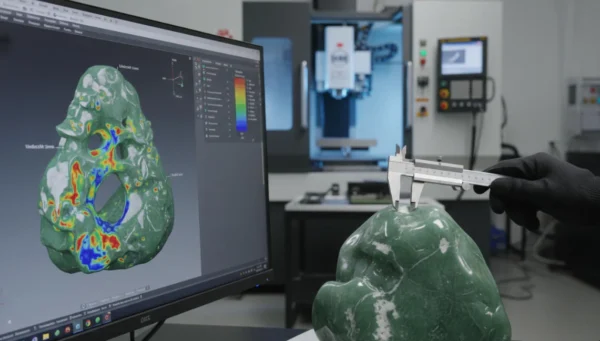
Jade looks calm and “solid,” but anyone who has tried to mass-produce jade jewelry knows the truth: most failures are repeatable, and most repeatable failures are preventable. The difference between a stable production line and a batch that explodes in rework is rarely “luck”—it’s process control, risk grading, and the ability to connect a defect back to a specific stage.
This guide is written for jewelry brands, product managers, designers, and procurement teams sourcing Jade Processing (especially CNC + hand finishing). It maps common failure modes—edge chipping, hairline cracking, catastrophic breakage, surface bruising, and dimensional drift—to the decisions that cause them and the controls that stop them.
Table of Contents
What This Guide Solves and Who It’s For
The real cost of failure in jade processing
A chipped edge is not just a cosmetic issue. It often forces geometry changes, re-polish cycles, rework of matching sets, and supplier-buyer disputes over “is this acceptable,” which is why a defect taxonomy and acceptance criteria matter as much as machine capability.
When failures appear late (after polishing or assembly), your real cost becomes lead time risk. You lose the calendar, not just the stone.
“Preventable” vs “material-risk”
Not all jade defects are equal. Some are driven by natural internal features (veins, inclusions, micro-fractures), while others are driven by the process (tool engagement shocks, clamping stress, heat, vibration, grit contamination).
A capable supplier can usually tell you which category you’re in—and prove it with inspection checkpoints and traceability.
What you’ll take away
You’ll leave with a practical failure-mode map, a manufacturing-oriented checklist you can paste into your RFQ, and a QC structure (incoming → in-process → final) that reduces arguments and improves consistency.
Why Jade Chips and Cracks: Material Reality, Not Marketing
“Jade” isn’t one material
In sourcing language, “jade” often includes both jadeite and nephrite, but they do not behave identically in machining and finishing. Jadeite’s tightly intergrown crystal structure is strongly associated with its well-known toughness and resistance to breakage, yet that does not make it immune to chipping when local stress is concentrated at sharp edges or thin walls. (GIA)
If your supplier does not clarify what they mean by “jade,” you are already accepting uncertainty in yield, finish consistency, and risk classification.
Toughness is not hardness
Many buyers instinctively equate “hard” with “won’t break.” Gem science separates hardness (scratch resistance) from toughness (resistance to breaking and chipping). GIA’s durability guidance highlights how toughness can vary dramatically among gem materials, and it explicitly frames toughness as the trait that governs chipping and breakage. (GIA 4Cs)
In practice, this means your process must be designed to avoid creating crack initiators (sharp internal corners, shock loads, heat spikes), even if the material “feels strong.”
Internal features drive failure
Most “mystery breakage” becomes explainable when you treat jade like a natural composite. Internal discontinuities can redirect stresses, and subtle pre-existing fractures can be stable during roughing but propagate during finishing or polishing when the stress field changes.
That is why incoming inspection under strong directional light, wet inspection, and risk-tier sorting are not optional for production.
Failure Mode Map: Symptoms, Stages, and Likely Causes
Failure Mode 1: Edge chipping
How it looks: small chips at corners, hole edges, thin rims, or relief features.
Where it starts: tool entry/exit, finishing passes, drilling breakthroughs, handling between stations.
Typical triggers: sudden load changes, vibration chatter, poor exit strategy, or unsupported geometry. The machining industry widely recognizes exit conditions as a major driver of edge damage and tool chipping in milling operations, which translates conceptually to brittle or chip-sensitive workpieces as well. (Seco Tools)
Failure Mode 2: Hairline cracking
How it looks: faint lines that may only show under certain angles, backlighting, or after cleaning.
Where it starts: clamping stress, heat buildup, aggressive semi-finishing, localized overheating during polishing.
Typical triggers: micro-fractures that propagate due to thermal or mechanical stress, often unnoticed until final QC.
Failure Mode 3: Catastrophic breakage
How it looks: sudden fracture of the part, often during late-stage finishing or even during packing.
Where it starts: compounded stress—material risk + clamping + vibration + thermal load.
Typical triggers: unsupported thin sections, stress concentrators, excessive fixturing pressure, or a process sequence that “finishes too early.”
Failure Mode 4: Surface bruising, haze, orange peel
How it looks: dull zones, uneven gloss, micro-pits, or a “bruised” look around features.
Where it starts: polishing and grit transitions, contamination, inconsistent pressure/heat.
Typical triggers: skipping grit steps, re-cutting debris, slurry contamination, and local overheating during polishing.
Failure Mode 5: Dimensional drift
How it looks: fit issues (inlay seats, holes, symmetry), mismatched pairs, or inconsistent thickness.
Where it starts: tool wear, inconsistent fixturing, uncontrolled finishing removal, or insufficient in-process measurement.
Typical triggers: lack of a measurement plan and lack of controlled stock allowance between stages.
1: Material Screening and Orientation Before CNC
Sort rough by risk tier (don’t treat all rough the same)
A practical production mindset uses risk tiers: production-grade (stable), caution-grade (needs conservative parameters), and high-risk (sample-first or redesign-first). This is not elitism; it’s yield control.
Risk-tier sorting lets you assign process windows and prevents “one bad piece” from corrupting your assumptions about the whole batch.
Orientation is a machining decision, not an artistic afterthought
Orientation should be chosen to protect thin walls, hole edges, and fragile relief features. Your goal is to align the most stressed geometry with the most supported direction, and to avoid leaving fragile features exposed during high-load operations.
If a supplier cannot explain how orientation choices reduce breakage, you should assume they are relying on trial-and-error.
Pre-form strategies reduce late-stage surprises
Pre-forming removes risky zones early. It also reduces the temptation to “save time” by pushing aggressive tool engagement later, where finishing geometry has less tolerance for shock.
Pre-form is not about making it pretty—it’s about creating a stable blank that can survive controlled machining.
2: CAD/CAM Choices That Prevent Breakage
DFM rules for jade: prevent stress concentrators
If you want sharp-looking products with mass-production yield, you need to design manufacturable sharpness. Add micro-radii where the customer won’t notice but the material will.
Rule of thumb: if a feature forces a toolpath into abrupt engagement changes, it’s a candidate for radius adjustments, staged finishing, or splitting into multiple operations.
Sequence matters: rough → semi-finish → finish (and why “finish early” breaks parts)
A common mistake is to finish delicate features too early. Once a thin wall or crisp edge is created, every subsequent step becomes a risk to it—clamping, coolant flow, handling, polishing, and even ultrasonic cleaning.
A safer approach is to keep protective stock or “support structure” until the last responsible moment, then finish and protect immediately.
Constant engagement and smooth entry/exit reduce shock
In CNC machining, abrupt entry/exit and sudden engagement changes create force spikes that damage edges. Industry machining guidance emphasizes the importance of how a tool exits a workpiece and links poor exit conditions with chipping or breakage. (Seco Tools)
For jade processing, that concept translates into: avoid aggressive stepdowns, avoid sudden direction changes at exposed edges, and control engagement so the part never sees a surprise load.
Chip evacuation and flushing prevent re-cutting damage
Toolpath planning isn’t just geometry—it also governs whether debris gets trapped and re-cut. General CNC guidance highlights the importance of chip evacuation and using coolant/air strategies to remove chips and protect the cut. (Machining Concepts – Erie, PA)
In jade processing, trapped abrasive slurry becomes an unplanned cutting tool. It can create random scratches, bruise zones, and localized stress points.
Micro-detail and undercut risk management
Extremely fine relief and undercut-like geometry can be feasible, but feasibility is not the same as production stability. If your design requires tool access that forces unstable engagement, the correct response is often operation splitting or a controlled redesign—not heroic machining.
A supplier that proposes a clear “risk grading + mitigation plan” is usually safer than one that promises perfection without conditions.
3: Fixturing, Clamping, and Vibration Control
Why clamping pressure breaks jade
If clamping concentrates force on small points, the local stress can exceed the material’s tolerance even when the average force seems “light.” The failure may not happen immediately; it can appear later as hairline cracks that open during polishing or thermal cycling.
This is why distributed support surfaces and compliant interfaces are common in brittle-material workholding.
Workholding should match the product category
- Rings / fit-critical parts: protect the seat area, control coaxiality, and avoid crushing the inner bore.
- Bangles: treat them as a continuous thin ring; support must be uniform to avoid ovalization stress.
- Pendants with thin relief: support the thin regions during semi-finishing and postpone fragile edges until the end.
A “one fixture fits all” mindset is usually a yield killer.
Vibration is a defect generator
Chatter marks are not just cosmetic. Vibration increases micro-chipping and can initiate cracks at edges, especially when tool exit passes over unsupported boundaries.
If a supplier cannot describe how they detect and control chatter (feed strategy, support, tool condition, engagement), they are unlikely to maintain stable mass production.
4: Coolant, Heat, and Slurry Management
Heat creates invisible damage
A part can look fine after CNC but fail after polishing because heat-induced micro-cracks propagated when the surface was stressed and softened by friction. The danger is that the defect is latent; it is “born” earlier and only “visible” later.
This is why production needs thermal discipline: coolant coverage, flushing, and tool condition control.
Coolant delivery: coverage and flushing beats “more liquid”
The goal is not to flood the workspace. The goal is consistent coverage at the cutting zone and effective flushing so abrasive debris does not become a secondary cutting mechanism.
If coolant delivery is inconsistent, you often see random scratches, dull zones, and unexplained defect spikes.
Slurry and grit contamination: the hidden enemy of gloss consistency
Polishing quality is not only skill—it’s cleanliness and progression discipline. Cross-contamination between grits can create persistent haze that no amount of “extra polishing time” fixes.
A serious jade processing workflow treats consumables, filtration, and station segregation as part of the engineering system, not shop housekeeping.
Tool wear increases thermal and mechanical stress
As tools wear, they rub more and cut less. Rubbing increases heat and amplifies force spikes, which raises the probability of micro-fractures and edge chipping.
A supplier that tracks tool life against defect rates is usually operating with production maturity.
5: Grinding and Polishing—Where “Perfect” Gets Ruined
Specify edges intentionally: sharp-looking vs chip-resistant
Many buyer disputes happen because “sharp edge” isn’t defined. If you want a crisp silhouette, you still need an engineering definition—micro-radius range, chamfer policy, or protected edge rule.
Without that, the factory either rounds too much (to reduce chipping) or keeps it too sharp (to satisfy aesthetics) and the batch becomes fragile in shipping.
Grit progression discipline prevents latent defects
Skipping grit steps can leave deeper subsurface damage that later appears as haze or micro-pitting. It also encourages excessive local pressure to “force shine,” which increases heat and crack risk.
The best polish lines are boring: consistent pressure, consistent time, and controlled progression.
Local overheating during polishing is a crack multiplier
A small area overheated by friction can become the site where hairline cracks expand. This risk increases on thin features, sharp corners, and around holes.
A stable process uses controlled pressure, proper lubrication, and tool condition checks—not speed as the primary lever.
Batch consistency is a QC problem, not only craftsmanship
Even if each individual piece looks acceptable, a batch can still fail as a product because gloss, haze, and surface “feel” vary too much between pieces.
Define the finish in measurable or inspectable terms: reference samples, gloss targets, consistent lighting conditions, and a defect taxonomy.
6: QC That Catches Defects Before Shipping
Build three checkpoints: incoming, in-process, final
Incoming QC reduces risk at the source: grade rough, record key observations, and separate risk tiers.
In-process QC prevents compounding: inspect after roughing and after semi-finishing, before fragile features are finalized.
Final QC enforces the agreement: finish, dimensions, defect classification, and packaging integrity.
This structure drastically reduces “late discovery,” which is where time and money disappear.
Non-destructive inspection: practical tools that work in production
For jade production, the most practical methods are usually optical: strong directional lighting, backlighting, magnification, and consistent cleaning.
Liquid penetrant inspection is a widely used NDT method for detecting surface-breaking flaws, but it is designed for non-porous materials and it introduces chemicals that may be unacceptable for certain jewelry workflows or surface expectations. (Intertek)
(If you consider it, align on compatibility, cleaning requirements, and whether it risks residue or staining on the specific material/treatments.)
Dimensional QC for fit-critical features
For holes, seats, symmetry, and matching sets, you need a measurement plan that matches your functional requirements. “Looks symmetric” is not a production metric.
At minimum, define critical-to-function dimensions, measurement tools, sampling frequency, and what happens when drift is detected (tool change, fixture verification, process hold).
AQL sampling and batch traceability
If you buy in volume, you need sampling rules. ISO 2859-1 defines acceptance sampling procedures indexed by AQL (Acceptance Quality Limit) for attribute inspection.
Even if you don’t cite ISO tables in your contract, aligning on AQL logic (critical/major/minor defect categories and acceptance numbers) reduces dispute and speeds decisions.
Buyer Toolkit: RFQ and Supplier Evaluation Checklist
12 questions that reveal real capability
- How do you classify rough by risk tier before machining, and how do you report that to buyers?
- What are your most common defect modes (top 3), and what actions reduce them?
- How do you design toolpaths to avoid shock loads (entry/exit strategy, engagement control)? (Seco Tools)
- How do you manage chip/slurry evacuation and coolant delivery to prevent re-cutting scratches? (Machining Concepts – Erie, PA)
- What fixtures do you use for rings, bangles, and thin-relief pendants, and how do you prevent clamping-induced cracks?
- Where are your in-process QC checkpoints, and what defects do you check at each stage?
- How do you detect hairline cracks that aren’t visible under normal room light?
- How do you control polishing grit progression and prevent cross-contamination?
- How do you track tool wear and correlate it with defect rate?
- What is your traceability unit (batch/lot/shift/machine), and how do you record it?
- What is your rework policy and scrap responsibility when defects are process-caused vs material-risk?
- What packaging standards protect sharp edges and thin parts in international shipping?
A supplier that answers these clearly is usually easier to scale with than one that only shows beautiful samples.
What to request in your RFQ (copy/paste block)
- Product drawings + critical-to-function dimensions (holes, seats, symmetry, thickness)
- Finish definition: gloss target or reference sample, allowed haze level, visible defect rules
- Edge rules: micro-radius or chamfer policy, no-chipping requirement at specific zones
- Quantity + batch splits + delivery schedule
- Defect taxonomy: critical / major / minor with photo examples
- Sampling plan: AQL level or agreed acceptance numbers (iso)
- Packaging spec: separators, impact protection, humidity control if required
- Traceability requirements: lot ID, process logs, QC records
What a serious supplier will disclose (and why it matters)
A serious supplier will tell you what’s high-risk before you pay for tooling and sampling. They will propose mitigations (design edits, operation splitting, conservative sequencing) rather than “yes” to everything.
That transparency is a sign of maturity, not weakness.
Common Product Scenarios and How to Prevent Failure
Bangles: thin walls and continuous stress
Bangles behave like a continuous ring, so support must be uniform. Even mild ovalization in fixturing can become stress that shows up later as cracking.
Preventive controls include uniform support, conservative sequencing, and edge protection during polishing and packing.
Rings: fit-critical features magnify drift
Rings add tolerance stacking: bore size, seat geometry, symmetry, and surface finish all interact. A small drift can turn into assembly failures or inconsistent customer feel.
The safest workflow defines critical dimensions, performs in-process checks before polishing, and protects seats from rework removal.
Pendants with deep relief: fragile detail needs staged finishing
Deep relief often requires long tool reach and can create vibration risk. If fragile edges are finished early, later operations become a hazard.
A staged approach keeps support stock, finishes fragile zones late, and applies immediate edge protection rules.
Inlay components: consistency beats hero accuracy
For inlay seats, the goal is consistent fit across a batch. That requires stable geometry and controlled finishing removal, not just “high precision once.”
A supplier should propose a measurement plan and a controlled seat strategy rather than relying on manual adjustment.
Reduce Breakage Without Slowing Production
The five controls that move yield the most
- Risk-tier sorting of rough before it enters CNC.
- Toolpath sequencing and engagement control to avoid shock loads, especially at exits. (Seco Tools)
- Fixture design that distributes stress and protects thin features.
- Coolant/flushing and contamination control to prevent re-cutting damage. (Machining Concepts – Erie, PA)
- QC checkpoints + defect taxonomy + traceability so problems are caught early and fixed systematically.
If your supplier operates these five controls, your jade processing becomes predictable. Predictability is what procurement buys, product teams plan around, and brands scale with.
Next step (practical CTA)
Send a drawing (or reference sample + target dimensions), and request: risk grading → process proposal → sample plan → QC acceptance criteria. A capable jade processing partner will respond with questions that make your product safer to manufacture—not just a quote.
FAQ (Search-Capture)
What causes hairline cracks in jade after polishing?
Hairline cracks are often initiated earlier by clamping stress, vibration, or localized heat. Polishing can propagate those micro-fractures because friction adds heat and stress at thin edges and around holes.
A good workflow uses in-process inspection and thermal discipline to catch and prevent latent cracking.
Can CNC jade processing achieve sharp edges without chipping?
It can achieve sharp-looking edges, but true knife-sharp geometry is inherently chip-prone in many materials. The practical solution is to define micro-radius or controlled edge rules so the edge looks crisp yet survives handling and shipping.
Your best result comes from combining DFM edge rules with toolpath exit control and protective packaging.
What QC standards should I request for jade processing?
Request a defect taxonomy (critical/major/minor), acceptance criteria with photo examples, and a sampling plan aligned with AQL principles if you buy volume. ISO 2859-1 is the standard foundation for attribute sampling and AQL indexing. (iso)
Also request traceability and stage checkpoints so defects don’t appear only at final inspection.
How do I reduce scrap rate in jade manufacturing?
Start with risk-tier sorting of rough, then control the three big multipliers: fixturing stress, vibration, and heat/contamination. Add in-process QC checkpoints so problems are corrected before finishing and polishing lock in fragile geometry.
Scrap rate drops fastest when the factory treats defects as a system problem, not an operator problem.