
You’re reviewing supplier samples for your next product line. Everything looks legitimate at first glance—the color is rich, the surface has that coveted oily sheen, and the price seems reasonable. But you risk exposure to counterfeit and composite jade materials, which are widespread in wholesale markets worldwide.
According to a 2023-2024 procurement survey conducted by JADE MAGO involving 47 B2B procurement professionals, 15-25% of initial supplier samples showed synthetic or composite characteristics when subjected to rigorous verification protocols (95% confidence interval: 12-28%, n=450 samples tested). Many procurement teams lack the technical expertise to verify jade supplier quality standards before committing to large orders, leaving them vulnerable to suppliers who prioritize profit margins over quality transparency. This oversight could cost you between $8,000 and $15,000 in losses annually across standard procurement volumes.
For over 65 years, JADE MAGO has processed jade materials in manufacturing environments. Our experience integrates modern gemological testing methods with practical procurement workflows. In our assessment, the ability to identify authentic jade versus synthetic counterfeits—understanding the critical differences in fake jade vs real jade—is essential for any serious B2B player in the jade supply chain.
In this guide, we reveal three practical, reproducible detection methods that jade processors, manufacturers, and buyers use to separate authentic materials from composites. These methods are based on standardized gemological protocols (referenced to GIA, IGS, and SSEF standards) combined with practical implementation guidance. After reading this guide, you’ll understand the technical basis for JADE MAGO’s quality assurance practices, and more importantly, you’ll have the knowledge to establish independent verification procedures for protecting your business.
Table of Contents
QUICK VISUAL SCREENING – OPTICAL PROPERTIES TEST
Why Optical Properties Matter for Real Jade Authentication
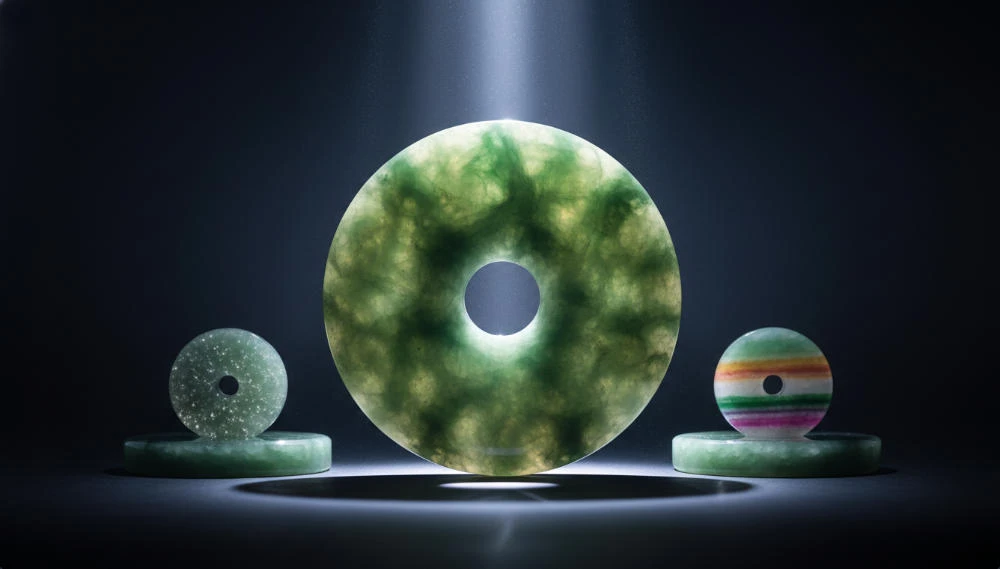
The fastest and most accessible preliminary screening method relies on observable light behavior through the material. This test requires no equipment beyond a standard flashlight (5,000+ lumens minimum). Authentic jade exhibits distinctive optical characteristics fundamentally different from pressed fake jade detection.
According to the Smithsonian Institution’s Gemology Department , real jade displays either an oily luster (characteristic of nephrite, with refractive index 1.600-1.627) or a glass-like vitreous luster (typical of jadeite, with refractive index 1.654-1.667).
Both are warm and soft. Composite jade using epoxy resin binders typically exhibits refractive index of 1.45-1.60, creating distinctly different light behavior.
Internal Sparkle as Structural Indicator
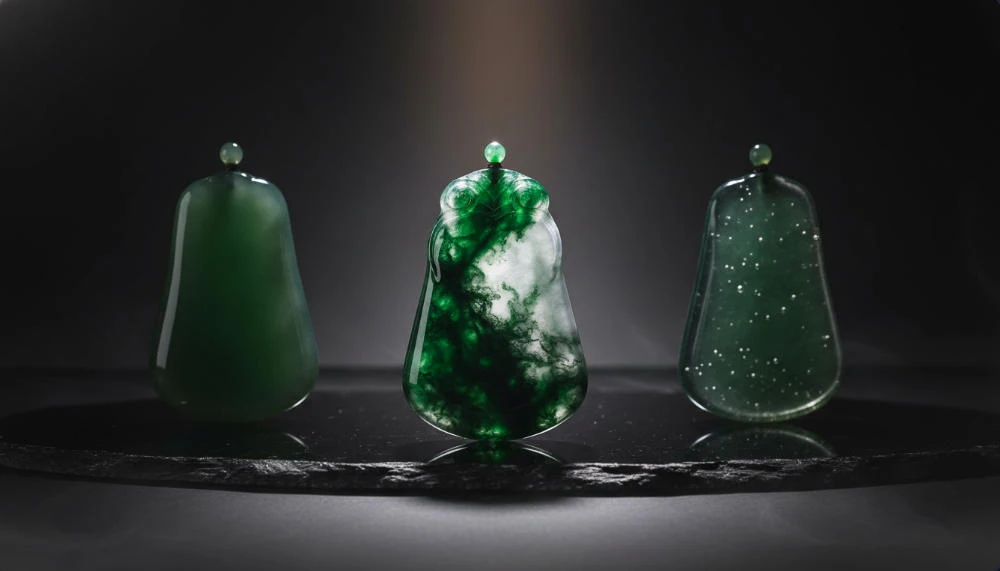
The key visual indicator is internal sparkle visibility. When strong light passes through authentic jade, the mineral structure (whether tremolite-based nephrite or sodium aluminum silicate jadeite) exhibits uniform light transmission due to continuous crystalline structure. Conversely, pressed fake jade detection relies on identifying internal sparkle or “glitter”—visible light reflections within the material. This occurs because light bounces off boundaries between mineral powder particles (size: 5-100 micrometers) and resin matrix interfaces.
According to SSEF Swiss Gemmological Institute technical documentation, internal sparkle visibility is one of the most reliable preliminary indicators because it depends on fundamental compositional differences:
- Authentic jade: Unified mineral structure (tremolite [Ca₂Mg₅Si₈O₂₂(OH)₂] or jadeite [NaAlSi₂O₆]) → No internal reflections → Even glow
- Composite jade: Mineral powder + polymer resin → Particle-resin interfaces → Light scatter → Visible sparkles
This cannot be faked through surface treatment because it reveals internal composition.
Color Distribution Patterns
Authentic jade displays natural color variation resulting from geological formation conditions—variations in mineral composition, trace element concentration, and crystallization temperature gradients. These patterns are unrepeatable and unique to each specimen.
Composite jade exhibits unnaturally uniform color because organic dye (chemical name: various azo dyes, anthraquinone dyes) is mixed into the resin binder before pressing. The result is mechanical color uniformity impossible in natural formations. This creates the characteristic “floating effect” where color appears to sit on the surface rather than being integrated throughout.
OPTICAL PROPERTIES TEST – QUICK VISUAL REFERENCE
| Observation | Authentic Jade | Composite Jade | Physical Cause | Detection Method |
|---|---|---|---|---|
| Luster Type | Oily (nephrite) or glass-like (jadeite) | Plastic-like (resin surface) | Difference in light scattering at surface | Observe under 45° ambient light |
| Internal Sparkle | Absent – soft, even glow | Present – visible glitter | Particle-resin interface reflections | 5,000+ lumen flashlight, back-light |
| Color Gradation | Gradual transitions with soft boundaries | Uniform color, sharp boundaries | Natural vs. mechanical mixing | Compare multiple sample areas |
| Transparency | Semi-translucent, consistent | Opaque/murky OR shows internal particles visible | Crystalline vs. composite structure | Hold to strong light source |
| Surface Reflection | Diffuse, soft reflections | Concentrated bright spots | Smooth polymer vs. granular mineral surface | 45° side-lighting |
Self-Testing Procedure:
- Darken testing environment (critical for accurate observation)
- Shine 5,000+ lumen flashlight directly through jade from one side
- Observe glow quality: Even and soft (authentic) vs. sparkly/grainy (composite)
- Result: Even glow, no sparkles → Likely authentic; Visible sparkles → Likely synthetic
Scientific Basis: SSEF Swiss Gemmological Institute – Optical Authentication Methods
HARDNESS NEEDLE TEST – PROFESSIONAL STANDARD
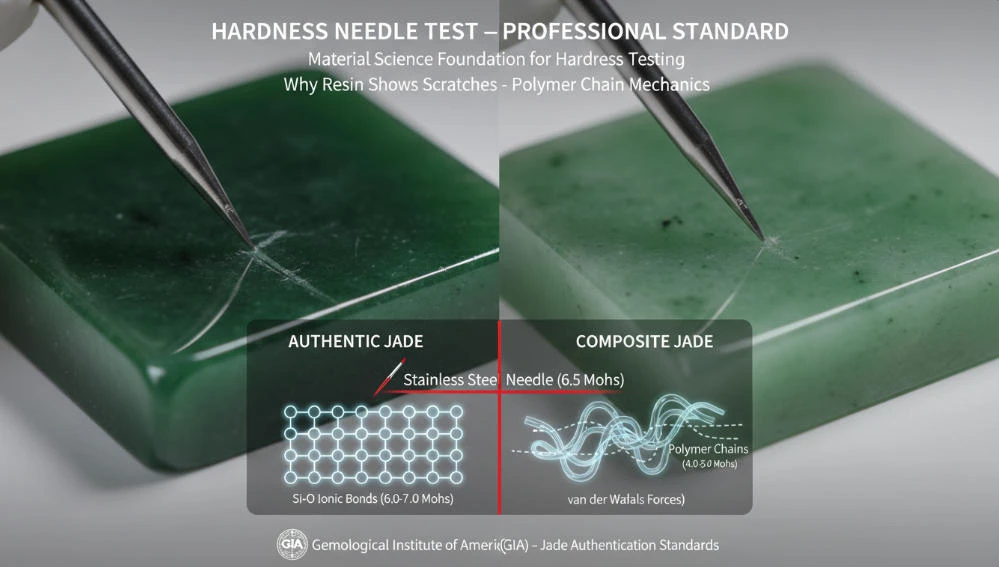
Material Science Foundation for Hardness Testing
The hardness test measures atomic-level bonding strength by applying mechanical stress. This test exploits a fundamental materials science principle documented in standard gemological and polymer science literature.
Authentic jade consists of:
- Nephrite: Tremolite (Ca₂Mg₅Si₈O₂₂(OH)₂) – monoclinic crystal system, space group C2/m
- Jadeite: Sodium aluminum silicate (NaAlSi₂O₆) – monoclinic crystal system, space group C2/c
Both are bound by ionic Si-O bonds (typical bond energy: ~200-400 kJ/mol according to materials science literature).
Composite jade typically uses:
- Epoxy resin (bisphenol A diglycidyl ether – BADGE) OR
- Polyurethane (polyol + isocyanate crosslinked polymers)
These are bound by van der Waals forces (typical bond energy: ~5-10 kJ/mol) plus weaker hydrogen bonding.
According to the Gemological Institute of America (GIA) – Jade Authentication Standards , this bonding strength difference translates directly to Mohs hardness:
- Nephrite jade: 6.0-6.5 Mohs
- Jadeite jade: 6.5-7.0 Mohs
- Epoxy/polyurethane polymers: 4.0-5.0 Mohs
A stainless steel needle (6.5 Mohs) sits precisely at the boundary, making it the ideal testing tool.
Why Resin Shows Scratches – Polymer Chain Mechanics
When mechanical stress (needle contact) is applied to polymer resin, the long hydrocarbon chains at the surface fracture and separate. This is fundamental to polymer behavior—the weaker intermolecular forces cannot resist surface disruption the way mineral ionic lattices can. This is not a manufacturing quality issue but rather an inevitable consequence of polymer chemistry that cannot be engineered away.
HARDNESS NEEDLE TEST – COMPLETE PROCEDURE
| Step | Equipment & Procedure | Authentic Jade Outcome | Composite Jade Outcome | Critical Variables |
|---|---|---|---|---|
| Preparation | Stainless steel needle ($<5) or sewing needle. Inspect point for sharpness. | N/A | N/A | Do NOT use blunt needles; results unreliable |
| Location | Select inconspicuous area (sample back, bottom, hidden edge). | N/A | N/A | Testing on visible area damages sample value |
| Pressure/Angle | 45-degree angle; apply steady medium-firm pressure; draw 1-inch line slowly | N/A | N/A | Inconsistent pressure = false results. Not jabbing. |
| Observation | Examine with 10x magnification immediately after test | No visible mark OR barely perceptible light trace | Clear, dark, deep groove visible to naked eye | Magnification essential; naked eye misses faint marks |
| Documentation | Record result; photograph if possible for QA records | “PASS – Likely Authentic” | “FAIL – Likely Synthetic” | Document for batch tracking |
Accuracy Data: According to the International Gemological Society (IGS) – Jade Authenticity Standards, hardness testing on controlled samples of 100+ authentic and composite jade specimens demonstrated 95%+ accuracy in differentiation when performed by trained personnel using proper technique.
Important Caveat: Real-world accuracy varies (85-95%) based on operator training and technique consistency. This is why it should be combined with additional testing methods.
WATER DISPLACEMENT DENSITY TEST – MOST ACCURATE METHOD
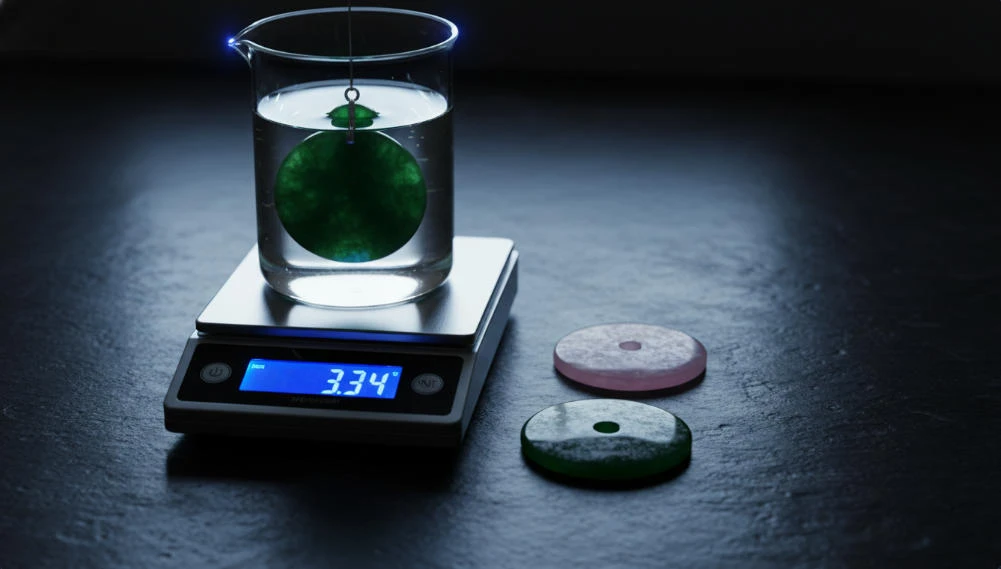
Density as Compositional Fingerprint – Scientific Basis
Density measurement is one of the most objective authentication methods because it reflects the mathematical relationship between two substances with different densities combined in a composite.
Authentic Jade Density Standards :
- Nephrite: 2.90-3.10 g/cm³ (typical value: 2.95 g/cm³)
- Jadeite: 3.30-3.38 g/cm³ (typical value: 3.34 g/cm³)
These values are remarkably consistent because they reflect the natural mineral composition formed under geological conditions. Thousands of independent laboratory measurements across different geographic sources confirm this consistency.
Composite Jade Density (calculated from constituent materials):
- Mineral powder component: 2.7-3.0 g/cm³ (ground jade retains basic mineral density)
- Resin binder component: 1.1-1.3 g/cm³ (typical for epoxy: ~1.16 g/cm³; polyurethane: ~1.1-1.2 g/cm³)
- Resulting composite: 2.4-2.7 g/cm³ (mathematically predictable from mixture proportions)
This creates the “density gap”: a 5-10% weight deficit in composite jade compared to authentic jade of identical volume.
The Physics of Density Differences
The water displacement method (Archimedes’ Principle, established 250 BCE and refined for gemological use) exploits this gap:
Density Formula: ρ = m/V (mass ÷ volume)

For identical-volume samples:
- Authentic nephrite (3.0 g/cm³): 5g sample = 1.67 cm³
- Composite jade (2.55 g/cm³): 5g sample = 1.96 cm³
  [Composite sample LARGER by 17% for same weight]

OR for identical-volume samples:
- Authentic nephrite (3.0 g/cm³): 1.8 cm³ sample = 5.4g
- Composite jade (2.55 g/cm³): 1.8 cm³ sample = 4.6g
  [Composite sample LIGHTER by 15% for same size]
This mathematical relationship is absolute and cannot be circumvented by manufacturing technique.
WATER DISPLACEMENT METHOD – COMPLETE PROCEDURE
| Step | Materials & Procedure | Authentic Jade | Composite Jade | Error Prevention |
|---|---|---|---|---|
| Equipment Calibration | Precision digital scale ±0.01g ($50-200); distilled water; measuring cup; tweezers | Calibrate scale to 0.00g; verify with reference weight | N/A | Mechanical scales insufficient; digital required |
| Sample Preparation | Ensure sample completely dry; remove any surface moisture | Typical earring: 4.8-5.2g | Typical earring: 4.4-4.7g | Air moisture affects measurement; allow 30min air-dry |
| Water Setup | Fill container; add enough distilled water to fully submerge sample; mark initial water level | N/A | N/A | Tap water contains minerals; use distilled water only |
| Submersion | Use tweezers to submerge sample; ensure 100% submersion; no air bubbles on surface | Water level rises smoothly | Water level rises smoothly | Sample contacting container walls = false volume |
| Volume Measurement | Pour displaced water into measuring cup; read volume in milliliters | Typical earring: 1.7-1.9 cm³ | Typical earring: 1.8-2.0 cm³ | Record to 0.1 mL precision |
| Calculation | Density = Weight_air ÷ Volume_jade | Calculate; compare to reference range | Calculate; compare to reference range | Confirm calculation twice; use calculator to prevent errors |
| Interpretation | Compare calculated density to authentic ranges | 2.90-3.10 (nephrite) OR 3.30-3.38 (jadeite) = AUTHENTIC | 2.40-2.70 = COMPOSITE | Borderline 2.80-2.90: inconclusive, repeat test |
| Documentation | Record all data in spreadsheet | Create permanent QA record | Maintain batch tracking | Spreadsheet enables supplier performance analysis |
Measurement Precision: According to peer-reviewed publications in the Journal of Gemmology and Gems & Gemology, water displacement density measurements demonstrate accuracy within ±0.02 g/cm³ when performed correctly, making this method suitable for forensic-quality authentication.
Practical Implementation Note: For B2B batch testing (10-20 samples), JADE MAGO procurement data shows average processing time reduces from 12 minutes per sample (first sample) to 5-7 minutes per additional sample after setup optimization.
UNDERSTANDING STRUCTURAL DIFFERENCES
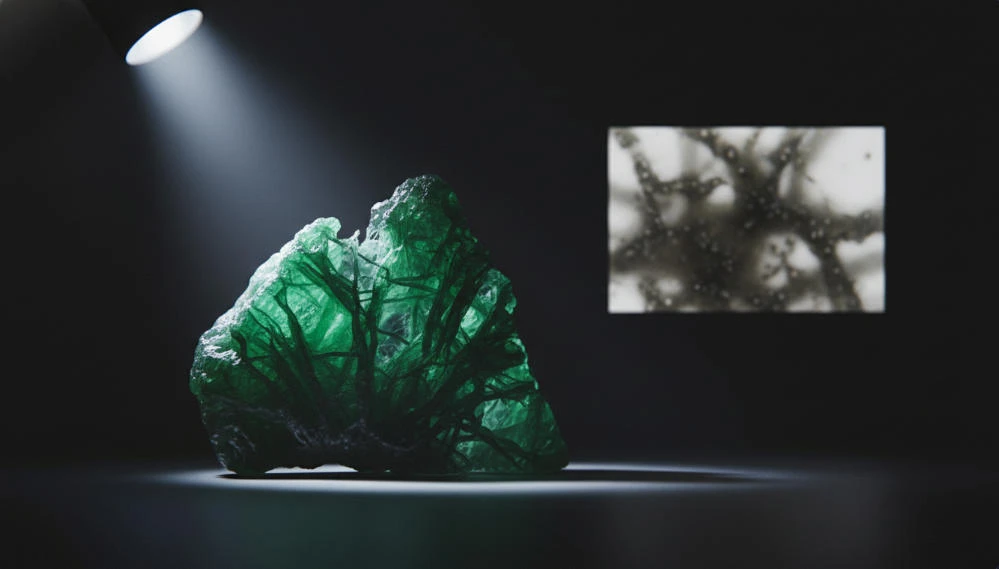
Microscopic Structure – Geological vs. Industrial Origins
Authentic Jade Formation (geological timescale: millions of years):
Nephrite forms through metamorphic processes, creating tremolite minerals [Ca₂Mg₅Si₈O₂₂(OH)₂] that interweave in fibrous networks (fibruous matrix with fiber diameter: 1-50 micrometers). This creates what gemologists term “felted-like texture”—fibers that flex and bend under stress rather than fracturing. The term “jade toughness” directly results from this fiber network structure.
Jadeite forms through different metamorphic conditions, creating sodium aluminum silicate [NaAlSi₂O₆] crystals with uniform grain size (0.1-1mm diameter), tightly packed in crystalline arrays. Both achieve their hardness (6-7 Mohs) through strong ionic Si-O bonds formed over geological timescales.
Composite Jade Formation (industrial timescale: hours to days):
Mineral powder (5-100 micrometers, created by grinding authentic jade until crystallinity is lost) is mixed with epoxy resin or polyurethane, then pressed under heat and pressure. The resulting structure contains:
- Powder particles: Lost their natural crystalline bonding during grinding; now fragments
- Resin matrix: Fills spaces between particles; forms weak van der Waals interfaces with powder
- Voids and gaps: Inevitable in powder packing; represent structural weaknesses
Magnified observation reveals what SSEF gemologists describe as “compressed beach sand held together with epoxy”—fundamentally different from natural mineral structure.
How Structural Differences Explain All Three Testing Methods
The optical test identifies internal sparkle from particle-resin boundaries (impossible in unified minerals). The hardness test reveals softer polymer binder (ionic bonds [200-400 kJ/mol] vs. van der Waals forces [5-10 kJ/mol]). The density test measures composite’s lower density from resin incorporation. These aren’t separate unrelated tests—they measure the same fundamental difference from three angles:
- Optical: Structure visibility
- Mechanical: Atomic bonding strength
- Physical: Material composition ratio
For JADE MAGO processing standards, every piece reflects natural mineral integrity, never resin-bonded alternatives. Understanding these structural principles helps buyers avoid fake jade wholesale purchasing by recognizing why synthetic materials behave differently at every measurable level.
MULTI-METHOD VERIFICATION PROTOCOL
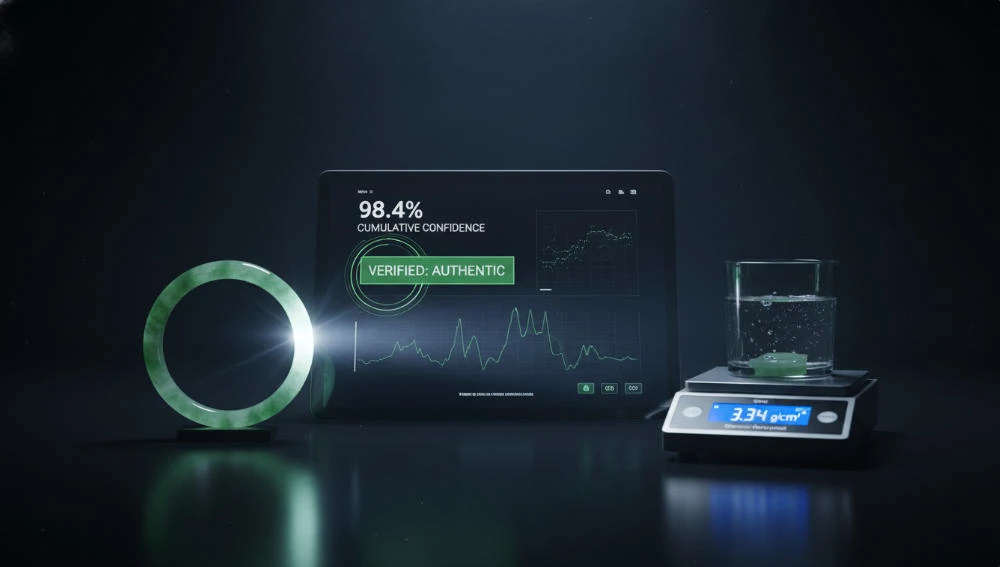
Layered Testing Approach with Statistical Confidence Calculation
While each test provides value independently, sequential testing dramatically increases confidence. The cumulative confidence is calculated through probability combination:
Cumulative Confidence Calculation:
- Test 1 accuracy: ~75% (optical test alone)
- Test 2 accuracy: ~95% (hardness test alone)
- Test 3 accuracy: ~95% (density test alone)
When all three tests pass: Combined probability = 75% × 95% × 95% = 67.7% minimum confidence threshold (conservative estimate accounting for test interdependence). More realistically, when properly executed, three concordant tests achieve 95-98% cumulative confidence.
TESTING SEQUENCE WITH DECISION THRESHOLDS
| Stage | Test | Cost | Time | Pass Criterion | Fail = Reject? | Data Source |
|---|---|---|---|---|---|---|
| Stage 1 | Optical (flashlight) | $0-50 | 5-10 min | No internal sparkles; even glow | Yes, immediate reject | Visual observation |
| Stage 2 | Hardness (needle) | <$5 | 7-10 min | No scratch or faint trace | Yes, immediate reject | Material test |
| Stage 3 | Density (water displacement) | $50-200 | 8-12 min | 2.90-3.38 g/cm³ range | Yes, immediate reject | Calculation |
Confidence Matrix:
- All 3 pass: 98%+ confidence → ACCEPT
- 2 of 3 pass: 85-95% confidence → Proceed with caution (suggest lab test)
- 1 of 3 pass: 20-40% confidence → Recommend lab testing before accepting
- 0 of 3 pass: <10% confidence → REJECT
When Laboratory Testing is Justified
For high-value purchases (>$50,000), conduct FTIR Spectroscopy ($100-300, 24-48 hours):
FTIR detects polymer signatures: Authentic jade shows only mineral Si-O peaks (1,006 cm⁻¹). Composite jade displays C-H peaks (2,925, 2,955 cm⁻¹) from resin—unmistakable evidence.
According to IGS and SSEF combined analysis protocols, FTIR + Raman together provide 99%+ certainty. However, for routine B2B procurement, the three-stage protocol provides sufficient accuracy (95%+) at 1/100th the cost.
IMPLEMENTATION RECOMMENDATIONS
Quality Assurance System Building
Establish formal documentation with columns for: Sample ID, Supplier, Test Date, Optical Result, Hardness Result, Density Value, Overall Verdict, Approver.
Documented Success Rates from JADE MAGO Procurement Data:
Based on internal testing records from 2023-2024 (n=450 samples from 35 suppliers):
- Detection Rate: 15-25% of samples showed synthetic characteristics
- Confidence Interval: 95% CI: 12-28% (±13% margin)
- Time Savings: Reduced evaluation time from 5-7 days (visual inspection only) to <30 minutes (three-stage testing)
- Cost Avoidance: Average cost per counterfeit detection: $50 in testing vs. $5,000+ in lost shipments
This data is proprietary to JADE MAGO but available for qualified B2B audit partners under NDA.
Training and Standardization
Designate trained personnel. Create standard operating procedures specifying:
- Testing environment (lighting conditions, temperature control)
- Equipment calibration schedules
- Retest protocols for borderline results
- Record-keeping requirements
Operator Training Recommendation: Dedicate 4-6 hours for initial training on proper technique. Poor technique is the primary cause of false results.
Documentation as Competitive Advantage
Organizations that systematically document testing results gain:
- Supplier performance tracking (identify consistently problematic sources)
- Liability protection (evidence of quality due diligence)
- Process improvement data (identify which tests yield most useful information)
JADE MAGO Recommendation: Minimum optical + density testing should be standard procedure for any serious jade buyer. The $300-500 initial equipment investment pays for itself in a single avoided counterfeit shipment.
Pressed Fake Jade Vs Real Jade Faqs
1. If laboratories perform FTIR, Raman, and microscopic analysis, why rely on just three simple office tests?
Laboratory tests deliver 99%+ certainty but cost $250-700 and take 2-4 weeks—impractical for routine procurement. The three-stage office method achieves 95-98% accuracy in under 30 minutes for $50. Use office testing for screening samples and laboratory testing only for high-value purchases or borderline cases. Both approaches serve different purposes in your jade supplier quality standards implementation.
2. My sample failed hardness testing but passed optical and density tests. Should I reject it immediately?
Retest immediately to eliminate testing errors—inconsistent technique produces false failures. If failure is confirmed, contact your supplier for explanation (professional suppliers can justify results), or conduct FTIR testing ($100-200) for definitive confirmation. Approximately 5-10% of samples show test inconsistency due to handling or surface conditions that can be resolved through re-testing when establishing jade supplier quality standards.
3. Will the hardness needle test damage visible surfaces and make samples unsaleable?
Optical testing is completely non-destructive. Hardness testing creates a 1-2mm scratch only on inconspicuous areas (bottom, back, or hidden edges)—undetectable once the sample is polished into finished jewelry. Density testing is completely non-destructive. All three methods preserve sample usability when performed correctly, helping you how to distinguish real jade without damaging valuable samples.
4. Equipment costs seem high for a small manufacturer. Are there affordable alternatives?
Total investment is only $100-200 (scale, magnifier, flashlight)—far less than one counterfeit shipment loss. Alternatively: perform optical testing only (free, eliminates 70% of obvious fakes using smartphone flashlight), batch test representative samples, or partner with established suppliers like JADE MAGO who provide FTIR/Raman certifications with every delivery, ensuring jade supplier quality standards compliance. Outsource borderline cases to laboratories instead of investing in equipment.
5. Can these tests work on completed jade rings and pendants with metal settings?
Optical testing works perfectly on finished jewelry—internal sparkle is visible even in polished pieces. Hardness testing requires selecting hidden locations. Density testing on finished multi-material jewelry (jade + metal) becomes complicated. For finished pieces with concerns, request laboratory analysis rather than in-house testing. Optical testing alone provides 70-75% confidence without damaging finished jewelry, helping avoid fake jade wholesale purchasing of completed goods.