
Introduction
Jade sourcing breaks down for one repeatable reason: buyers and suppliers use the same words to mean different things. “Natural,” “Type A,” “untreated,” and even “processed” can describe very different realities, and heat treatment sits right at the center of that confusion. When these terms are not defined and disclosed consistently, disputes feel personal—yet the root cause is usually contractual and informational.
This article draws a clear line between process optimization and artificial color change, explains what laboratories can and cannot confirm, and provides a practical checklist you can apply to RFQs, quotes, and incoming QC. The goal is not to “win” an argument about treatments, but to reduce ambiguity so the supply chain can operate with trust and fewer costly surprises.
Table of Contents
The Controversy in One Sentence: “Optimization” vs. “Artificial Color Change”
Heat is a legitimate industrial tool, and it is also a tool that can be used to change appearance. The controversy exists because some heat-only actions can look like “normal finishing” in one market segment and like “undisclosed enhancement” in another.
For B2B buyers, the risk is rarely philosophical. The risk is practical: brand claims, customer expectations, return rates, and long-term reputation can be damaged if a stone performs differently than promised or if treatments emerge later in resale or certification.
For manufacturers, the risk is also practical. If buyers treat any mention of heat as a red flag, suppliers feel pressure to avoid the topic rather than disclose it properly, and that incentive structure is exactly how trust erodes.
Definitions First: What “Natural Jade” Can Mean in B2B Contracts
Natural origin vs. untreated status
“Natural” can refer to geologic origin (it formed in nature) or to treatment status (no enhancement was applied). Those are not the same claim, and the difference matters because a stone can have natural origin and still be treated.
If your RFQ does not separate these two ideas, you are inviting argument later. A workable contract definition states both: (1) natural origin and (2) disclosed treatment status.
Jadeite vs. nephrite and why the conversation differs
The trade uses “jade” for two different mineral families: jadeite and nephrite. They behave differently in processing, and treatment conversations often get muddled when parties don’t specify which one they mean.
A sourcing spec should always state the material category first. That single line prevents many disputes because lab testing scope, typical treatments, and market language differ by material family.
Why “Type A / B / C” creates confusion
Type labels are widely used in the jadeite market, but they are not always used with consistent rigor across regions and sales channels. In practice, “Type A” is often used as shorthand for “no polymer impregnation and no dye,” while “B” and “C” refer to polymer and dye-related treatments respectively, yet real-world descriptions can drift unless anchored to a recognized disclosure framework. A disclosure-led approach—defining treatment categories and stating what was and was not done—reduces reliance on shorthand that can be misused.
For international trade, disclosure guidance from standards bodies is more reliable than marketing vocabulary. CIBJO provides treatment and disclosure terminology in its Gemstone Blue Book, including heating and other enhancement categories. (CIBJO)
What Heat Treatment Actually Does, and What It Doesn’t
What “heat” can mean in the real world
“Heat treatment” is not one single procedure. It can range from controlled heating intended to influence color or clarity, to heat used as part of a process chain where the main functional goal is stabilization, cleaning, or preparation for finishing.
Standards discussions often treat heating as a recognized treatment category when it is used to alter appearance, and they emphasize disclosure when a stone has been treated. In the CIBJO Gemstone Blue Book, “heating” is described as a category of permanent treatment and it is discussed within disclosure requirements. (CIBJO)
What heat cannot “safely” substitute for
Heat-only processes should not be treated as interchangeable with composite processes that introduce foreign substances. Heating does not turn low-quality material into fine-quality material, and it does not replace the appearance changes created by bleaching plus polymer impregnation or by dyeing.
That distinction matters because buyers often do not object to “optimization” in principle. Buyers object to undisclosed changes that affect value, stability, care requirements, and truthful marketing claims.
The commercial risk of vague heat narratives
In B2B transactions, the issue is not whether heat exists in the world. The issue is whether the supplier can state what was done in a way that is consistent, documentable, and compatible with the buyer’s product positioning.
If heat is used, the safest strategy is to declare it plainly and then clarify whether any additional processes were used. This approach reduces the chance that a buyer later interprets “heat” as a euphemism for more consequential treatments.
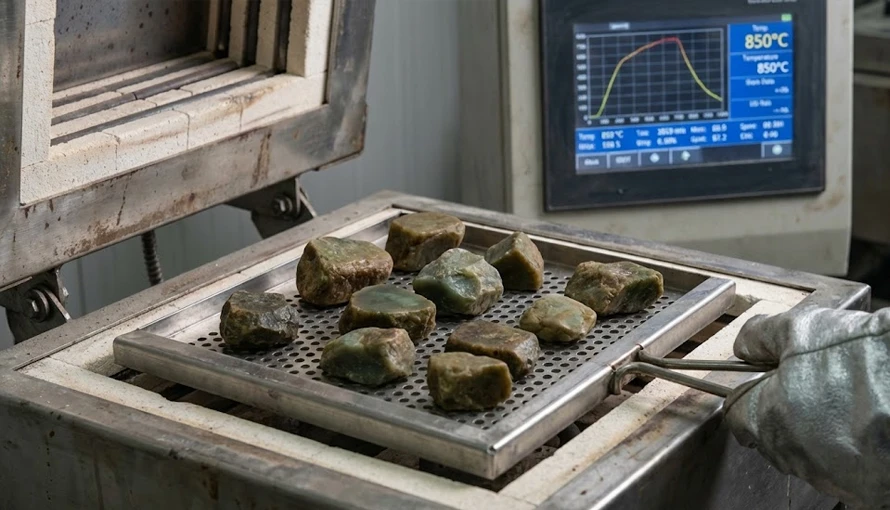
The Real Line in the Sand: Heat Alone vs. Combination Treatments
A useful mental model: “External substance” is the boundary
In practice, the most defensible boundary is whether the process introduces external substances that remain in or on the stone (for example polymers/resins or dyes). Those processes change the material in ways that affect durability, future testing outcomes, and long-term market value.
Combination treatment chains—such as bleaching and polymer impregnation—are widely discussed in gemological literature precisely because they can materially change appearance and the stone’s interaction with testing methods.
Why polymer impregnation is categorically different
Polymer impregnation is not just “more finishing.” It involves introducing organic substances into fractures and pores, often after chemical bleaching, which can alter how the stone behaves, ages, and is identified.
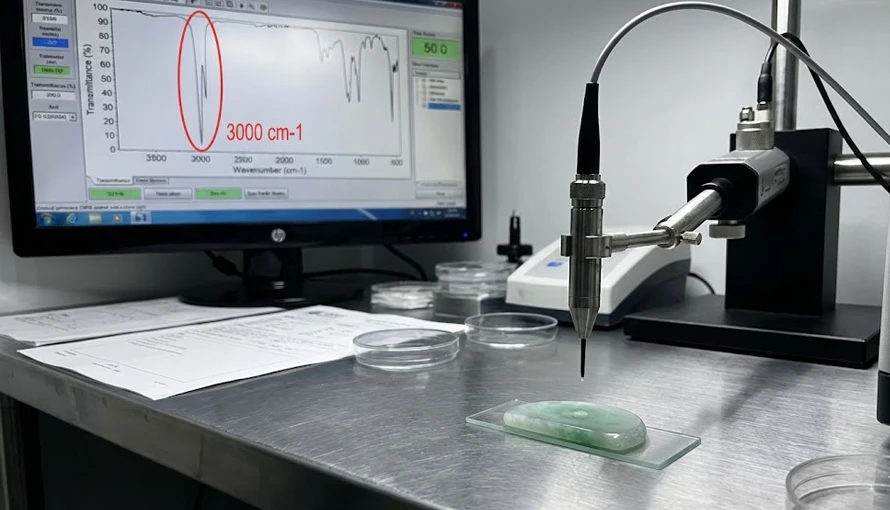
The GIA has published both technical discussion and practical identification guidance on bleached and polymer-impregnated jadeite, including the role of infrared spectroscopy in detecting polymer impregnation.
A note about “undeterminable” treatments and why disclosure matters anyway
Even with advanced testing, some treatments in colored gemstones can be difficult or impossible to determine in certain cases. Industry disclosure guidance often recommends caution in such scenarios, suggesting that when determinability is uncertain, it is prudent to disclose possible treatments rather than imply certainty. (CIBJO)
This is the heart of transparency. A supplier does not need to claim omniscience; a supplier needs to avoid misleading certainty and provide the best available disclosure and evidence.
Detection Reality Check: What Labs Can Confirm, and Where Uncertainty Remains
What labs can often confirm with confidence
For jadeite, polymer impregnation is one of the more practically detectable categories because organic substances have characteristic signatures in infrared methods. GIA’s publications emphasize infrared spectroscopy as providing conclusive evidence for polymer impregnation in cases they studied and reported. (GIA)
That does not mean every screening method is equally reliable. It means buyers can build a rational escalation path: screen routinely, and if risk is high, use the appropriate lab method for that risk.
What may remain ambiguous
Subtle heating, borderline cases, and complex chains can create gray zones, especially if the buyer is trying to infer intent (“Was the goal color change?”) rather than verifying material change. There are also practical limits: labs test the sample they receive, not the entire conceptual process history.
This is why a buyer’s trust strategy should not rely solely on “catching” treatments after the fact. It should rely on demanding clear disclosure and documentation upfront.
Why certification and disclosure are complementary, not interchangeable
A lab report can be a powerful support document, but it is not a substitute for a contract definition of acceptable treatments and required disclosures. In many disputes, the buyer and supplier both have paperwork, but the paperwork does not answer the real question: “What did ‘natural’ mean in this deal?”
The more robust approach is: define terms → disclose treatment status → attach evidence → use labs when risk or value justifies it. SSEF describes its approach to jade certification and the use of methods like FTIR and Raman alongside chemical analysis, reinforcing that multiple methods and disciplined disclosure are central to professional evaluation. (SSEF)
The Boundary Playbook: How to Draw a Clear Line Between Process Optimization and Artificial Color Change
This section replaces vague arguments with a rule set you can enforce in writing. It is designed so procurement teams can apply it consistently across suppliers and product lines, including OEM and custom manufacturing.
The “Intent + Method + Outcome” rule
Intent asks what the process is meant to do in commercial terms. If the goal is explicitly to improve or change perceived color for market value, buyers should treat it as enhancement that must be disclosed clearly.
Method asks whether the process introduces external substances or uses composite chains that go beyond physical shaping and finishing. If a process involves bleaching agents, polymer impregnation, dyes, or coatings, it crosses into “material-altering treatment” territory for most B2B risk frameworks.
Outcome asks what risks or performance changes were introduced. If the result changes stability, care requirements, aging behavior, or downstream test outcomes, it is not “just processing” anymore, and disclosure becomes the minimum standard.
A three-tier classification buyers can enforce
Tier 1 — Standard Processing (non-treatment). This includes cutting, CNC carving, polishing, cleaning, and mechanical finishing steps. It can also include normal surface work that does not introduce foreign substances and does not claim a change in intrinsic color.
Tier 2 — Disclosure-Required Enhancement (heat-only). If heating is used in a way that could be seen as improving appearance, treat it as a disclosure-required enhancement. Even if a market segment considers it “common,” B2B buyers benefit from consistent disclosure because it prevents later disputes and protects brand claims.
Tier 3 — Material-Altering Treatment (composite or substance-based). If bleaching, polymer impregnation, dyeing, coating, or any external-substance pathway is used, require explicit labeling and treat it as incompatible with “untreated” positioning. This is also where lab escalation is most justified, because the commercial stakes and stability concerns are higher. (GIA)
The combination-treatment red-flag map
If any document, conversation, or sample behavior suggests bleaching, impregnation, or dye, buyers should not accept “heat-only” language as sufficient. If heat appears inside a composite chain, it should be disclosed as part of a treatment system, not as a standalone step.
This is not about accusing suppliers. It is about setting a rule that prevents “semantic hiding,” where a major treatment is obscured behind a minor or less controversial word.
Safe vs. unsafe claims in commercial language
A safe claim is one that is definable and auditable. “Natural origin; treatment status fully disclosed” is a claim that can be backed by documents and, when needed, by testing.
An unsafe claim is one that relies on undefined shorthand. “100% natural” or “Type A” without a treatment definition, disclosure statement, and evidence package is not a claim—it is a dispute waiting to happen.
Buyer Checklist: A “Transparency-Complete” RFQ and Purchase Spec
A strong RFQ does not ask, “Is it natural?” A strong RFQ asks the supplier to fill in fields that make “natural” unnecessary as a vague label. Use the checklist below as a required section in every quote and PO.
RFQ minimum fields (what must be stated, not implied)
Material definition and identity. Require the supplier to state whether the jade is jadeite or nephrite and to describe the material basis of the offer. If the supplier uses trade terms, require a one-line definition in the quote.
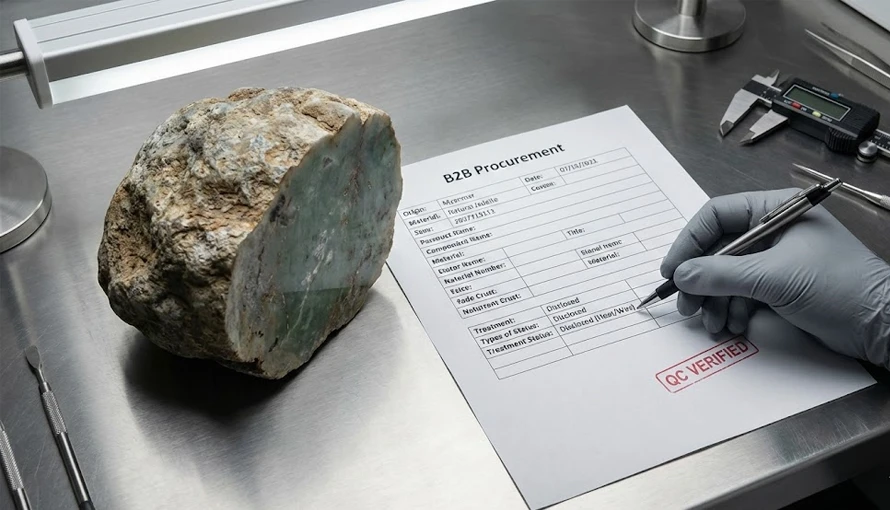
Treatment declaration. Require one explicit statement: “Heat-only used / Heat not used,” and “No polymer impregnation / No dye / No bleaching,” or disclosure of any that were used. This avoids the “half-disclosure” problem where a supplier answers the question they prefer rather than the question you asked.
Batch traceability. Require batch ID, quantities per batch, and a statement that shipments will not be mixed across treatment categories without written approval. This matters because mixed batches can make lab testing and post-sale support almost impossible.
Documentation checklist (evidence that prevents disputes)
Process disclosure sheet. Request a one-page disclosure that lists each major step: cutting, carving, polishing, any heat, and any chemical/substance-based treatments. It does not need to reveal proprietary parameters; it needs to reveal treatment categories.
Photo evidence under controlled lighting. Require pre-polish and post-polish photos under consistent lighting conditions. This reduces the “camera marketing” problem where color differences are created by lighting rather than material.
QC and handling notes. Require any special care instructions if treatments may affect stability, care, or long-term performance. Consumer guidance frameworks emphasize disclosure when treatments are not permanent or require special care, and the same principle protects B2B brands. Federal Trade Commission discusses how treatment disclosure can be necessary depending on permanence and special care requirements. (Federal Trade Commission)
Testing clauses (how to scope lab work without chaos)
If you buy high-value jade or you sell with strong “untreated” positioning, add a simple escalation rule. For example, “If visual screening or documentation raises treatment concerns, buyer may request FTIR-based confirmation for polymer impregnation on a defined sampling basis.”
Also define who pays and what happens if undisclosed treatments are found. Without remedies and cost allocation, testing becomes a negotiation every time, and that negotiation becomes a friction point that discourages transparency.
The Transparency Standard: Documentation That Turns Claims Into Trust
This section describes how Jade Mago positions transparency as a system rather than a slogan. The goal is to make every claim “auditable enough” for a procurement team to defend internally and for a brand to defend externally.
Level 1: Process disclosure you can quote and archive
At minimum, every order should have a written disclosure statement that is stable across emails, quotes, invoices, and packaging documentation. It should clearly answer: heat used or not, and whether any external-substance treatments were used.
This level prevents most misunderstandings because it blocks the “we never said that” pattern. It also forces both parties to define what they mean before production, not after customer complaints.
Level 2: Evidence package that supports the disclosure
A practical evidence bundle includes batch IDs, controlled-light photos, a basic QC checklist, and packaging traceability. It does not require revealing trade secrets; it requires showing that the supplier can control and document what they are selling.
Evidence packages matter because disputes rarely hinge on one message. They hinge on whether the overall transaction record supports the claim the buyer needs to make to their market.
Level 3: Lab pathway for high-value or high-risk claims
When the product positioning is strict and the stakes are high, a lab pathway is rational. It should be used selectively, not indiscriminately, and it should target the risk that matters most (for example polymer impregnation concerns in jadeite).
A good lab pathway is not only about the lab report. It is about aligning the lab scope with your contract language and your disclosure categories so the report answers the right business question.
Common Misunderstandings That Cause Expensive Problems
Misunderstanding 1: “Natural” automatically means “untreated”
This assumption is the #1 driver of disappointment and returns. In reality, “natural origin” and “treatment status” are separable, and your documentation must treat them as separable.
When you force both parties to state treatment status explicitly, you prevent most of the emotional conflict. The deal becomes about agreed categories, not about personal credibility.
Misunderstanding 2: “Heat-only” is always acceptable
Some buyers accept heat-only as long as it is disclosed. Other buyers prohibit it entirely for certain product lines, especially when they sell into “untreated” premium positioning.
The solution is not to argue. The solution is to define in your RFQ which tiers are acceptable for each SKU or collection.
Misunderstanding 3: Lab reports will settle every disagreement
Labs can provide powerful evidence, but they cannot reconstruct every process history. They test what is present and detectable in the submitted material, and some treatment categories across colored stones can be difficult or undeterminable in certain circumstances. (CIBJO)
That is why disclosure discipline is the first line of defense. Labs are the escalation tool, not the foundation.
FAQ
Is heat-treated jade still “natural”?
It can be natural in origin, but “natural” alone is an incomplete claim in B2B trade. The only safe approach is to state “natural origin” and then separately disclose treatment status in plain language.
If your market positioning relies on “untreated,” you should treat heat-only as a disclosure-required enhancement at minimum, and you may choose to prohibit it by SKU. The key is that the rule lives in your spec, not in assumptions.
Can heat treatment be detected reliably?
Detection depends on the type of heating, the material, and what changes were produced. Some categories (like polymer impregnation in jadeite) are far more addressable with methods like infrared spectroscopy than subtle heat-only scenarios. (GIA)
If detection is hard, that increases the importance of upfront disclosure. Your procurement policy should not rely on “gotcha testing” as the only protection.
What should a wholesale buyer demand in writing?
Demand a treatment declaration that clearly states heat used or not and discloses any external-substance processes (bleaching, polymer, dye, coating). Demand batch traceability and an evidence package that supports the claim.
Also demand remedies. A disclosure clause without remedies is an aspiration, not a protection.
What lab methods are relevant for polymer/dye indicators in jadeite?
FTIR is frequently referenced in professional discussions for identifying organic substances associated with polymer impregnation. Professional labs also use multiple methods (including Raman and chemical analysis) as part of a broader approach to identification and treatment disclosure. (SSEF)
-900x375.webp)