
If you’re actively planning to jade bracelet wholesale, the most important statistic you need to know before placing an order is this: approximately 80% of jade products circulating in the global market are treated, dyed, or are outright imitations—and over 70% of online jade transactions don’t disclose any treatment methods to buyers. This isn’t an isolated case, but rather the default situation in the market you’re about to enter. Whether you’re building a retail jewelry brand, operating a wholesale distribution business, or sourcing gifts for corporate clients, the structural risks of wholesale jade bracelets are real, measurable, and—crucially—avoidable with the right framework.
This guide doesn’t start with the history of jade or gemological terminology, but rather helps you recognize and mitigate the risks in wholesale jade transactions. Remember, the risks are already present when you intend to buy.
Table of Contents
Why Jade Bracelet Wholesale Carries Systemic Risk That Most Buyers Underestimate
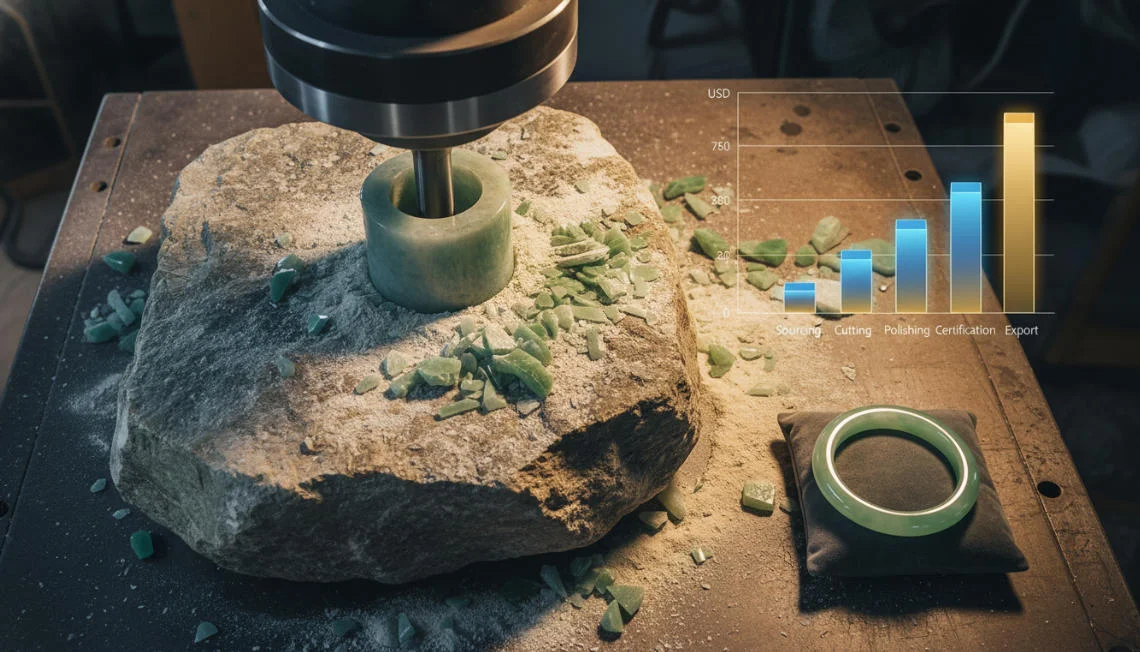
Most buyers approach wholesale jade bracelets the way they approach any commodity purchase — by searching for the lowest unit price that still “looks right.” This is precisely the logic that suppliers in high-fraud markets have learned to exploit. The jade bracelet market is not a commodity market. It is a specialist market with highly asymmetric information, where the seller almost always knows more than the buyer, and where the gap between apparent quality and actual quality can be worth thousands of dollars per shipment.
The Cost Structure of Jade Makes “Cheap and High Quality” a Mathematical Impossibility
The raw material cost of a genuine, untreated natural jade bracelet — particularly jadeite sourced from Myanmar, which remains the world’s most commercially significant jade origin — establishes a price floor that cannot be negotiated away. A single piece of high-quality jadeite rough can cost more per kilogram than many precious metals. By the time you account for cutting loss during jade bracelet processing, polishing, quality grading, and export compliance, the landed cost of a genuine A-grade jadeite bracelet makes sub-$20 wholesale pricing structurally implausible. If a supplier is offering you wholesale jade bracelets at a price that seems too good to be true, the mathematics of raw material sourcing confirm that it almost certainly is.
This is not a matter of supplier generosity or factory efficiency. It is a matter of cost structure. You can read a detailed breakdown of jade bracelet pricing factors in our companion article on jade bracelet price analysis, which quantifies the material cost components at each grade tier.
Why the “I’ll Know It When I See It” Approach Fails in Wholesale
Many experienced retail buyers believe their product knowledge is sufficient to visually identify genuine jade. This confidence is misplaced at the wholesale scale. The International Gem Society (IGS) notes that even trained gemologists require laboratory-grade equipment to definitively distinguish between natural jade, treated jade, and high-quality imitation materials. When you are reviewing a shipment of several hundred jade bracelets under warehouse lighting, you are not operating under laboratory conditions. You are operating under conditions that favor the seller.
The industry data reinforces this point: the ratio of buyers who pay premium prices for low-quality jade is significantly higher than the ratio of buyers who secure genuine high-quality jade at below-market prices. In other words, the market punishes optimism far more consistently than it rewards it. This means that your procurement strategy for jade bracelet wholesale cannot rely on visual assessment alone — it must be built on documentation, verification, and supplier accountability structures that work independently of your own ability to distinguish authentic from fraudulent materials.
Understanding why the risk exists at this scale is the first step. The second step is knowing exactly what forms that risk takes in practice — which is where most buyers, even experienced ones, discover gaps in their knowledge that have already cost them money.
5 Critical Fraud Risks in Jade Bracelet Wholesale You Must Identify Before Placing an Order
Knowing that fraud exists in the jade market is not the same as knowing how to recognize it. The five risk categories below represent the most commercially significant threats you will encounter when sourcing wholesale jade bracelets — ranked from the most visually obvious to the most technically difficult to detect. Each one has cost wholesale buyers real money, and each one is exploitable precisely because it targets a different gap in the standard procurement process.
1 — Substitute Materials: Glass, Dyed Quartz, and Serpentine Sold as Genuine Jade Bracelets
The most straightforward form of fraud in the jade bracelet market involves selling an entirely different material under the jade label. Dyed green quartz, borosilicate glass, and green serpentine are the three most frequently encountered substitutes in wholesale jade bracelet shipments. These materials can be cut, polished, and shaped into bracelet forms that are visually indistinguishable from genuine jade under normal retail lighting conditions — which is exactly why they remain so commercially viable for fraudulent suppliers.
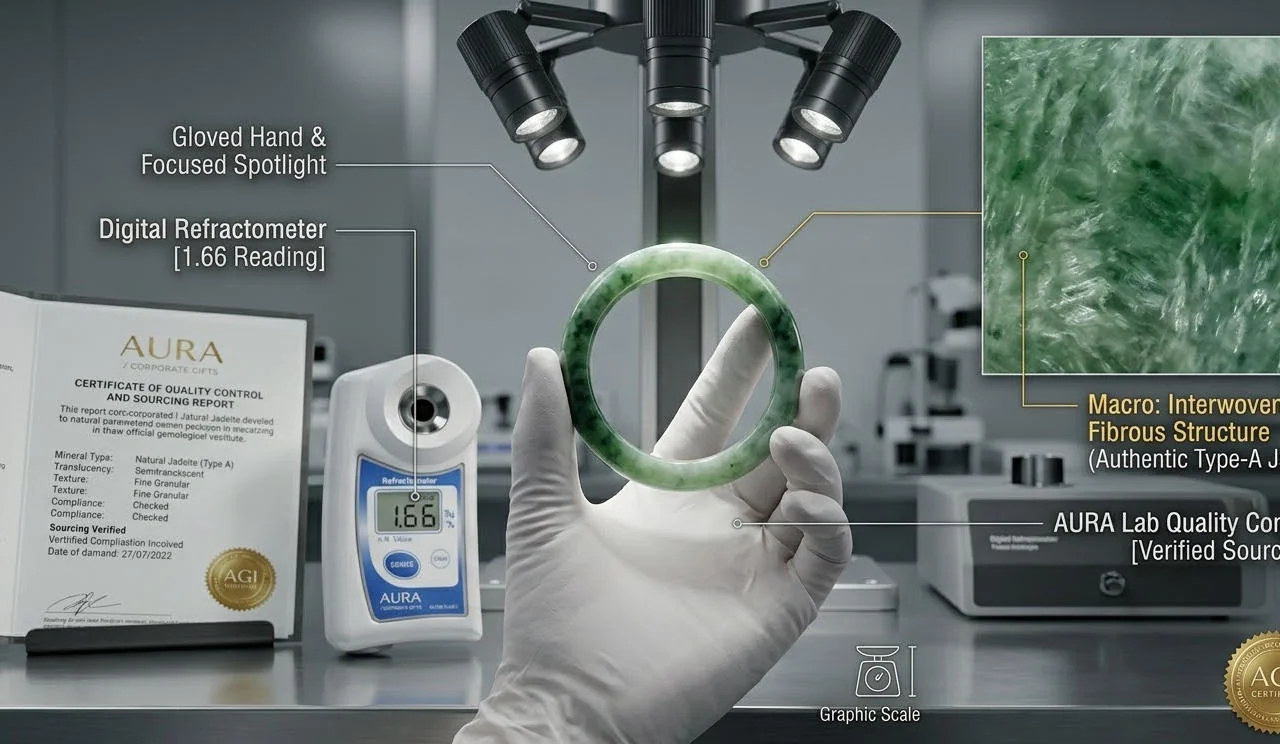
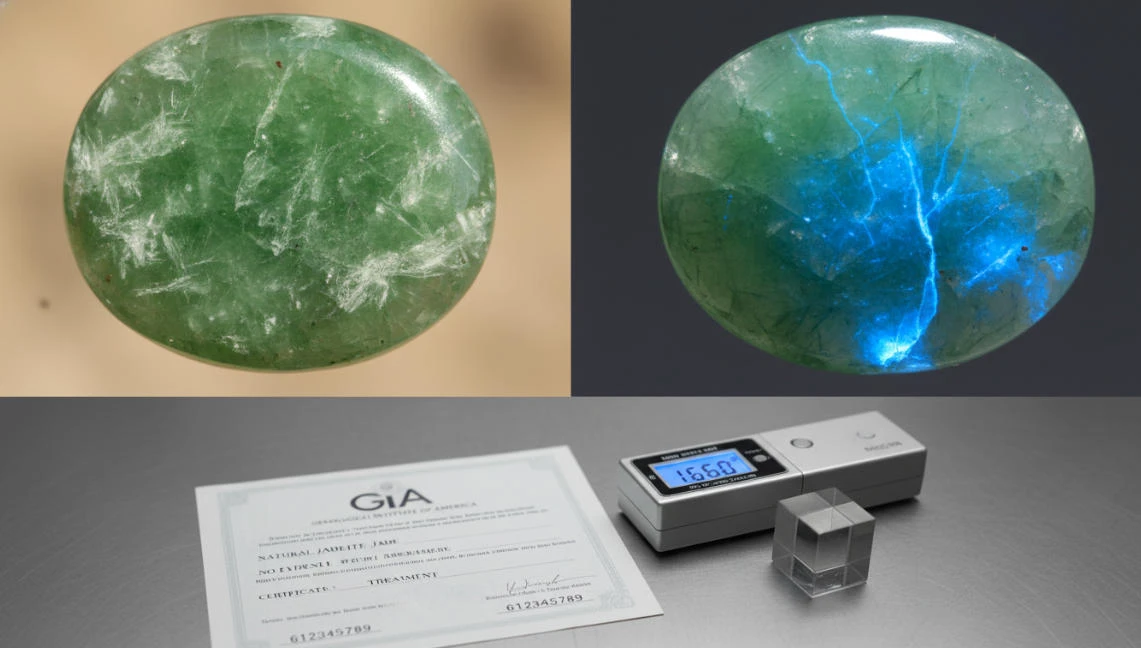
The business consequence for you as a wholesale buyer is not limited to the financial loss on the shipment itself. If substitute materials reach your downstream retail clients or end consumers, the reputational damage to your brand can significantly exceed the original procurement cost. The GIA’s jade identification resources confirm that definitive material identification requires refractive index testing and specific gravity measurement — neither of which can be performed through visual inspection alone. This means your inspection process must go beyond looking.
2 — Treated Jade Misrepresented as Natural: The Hidden Health and Structural Risks of Acid-Washing and Resin Filling
Treated jade — classified in the industry as “B-grade” or “B+C-grade” jade — represents a more sophisticated category of risk than outright material substitution. In this scenario, the material is genuine jade, but it has been subjected to industrial processing that fundamentally alters its physical properties. The standard treatment sequence involves acid-washing to remove natural impurities and discoloration, followed by resin or polymer injection to fill the structural voids created by the acid, and finally surface dyeing to achieve a commercially attractive color profile.
The structural consequence of this treatment process is significant: the natural interlocking crystal structure of the jade is chemically disrupted, making treated bracelets substantially more brittle and prone to cracking than untreated equivalents. What makes this risk particularly acute for wholesale buyers is the health dimension. Suppliers operating outside regulated manufacturing environments may use industrial-grade resins or dyes that do not meet consumer product safety standards. Long-term skin contact with non-compliant treatment chemicals has been associated with contact dermatitis and other adverse reactions — a product liability exposure that your business inherits the moment the goods enter your supply chain.
The health risk dimension of treated jade is not speculative — it is a product compliance issue with documented regulatory relevance. Industrial-grade epoxy resins and azo-based dyes, when used in jade treatment outside of regulated manufacturing conditions, may contain residual compounds classified as restricted substances under EU Regulation (EC) No 1907/2006 (REACH), which governs the chemical safety of articles that come into prolonged skin contact. The European Chemicals Agency (ECHA) maintains a published list of substances of very high concern (SVHC) that includes categories of compounds commonly found in low-grade industrial adhesives and synthetic dyes. A supplier operating outside REACH-compliant manufacturing protocols — which describes a meaningful proportion of unaudited jade processing facilities — may be delivering bracelets that cannot legally be sold in EU markets without additional compliance testing. This means that your sourcing decision is simultaneously a product liability decision, and the cost of a compliance failure in a regulated market is substantially higher than the cost of pre-shipment verification.
The physical consequences of resin aging in polymer-treated jade have been documented in peer-reviewed gemological literature. A technical paper published in the Journal of Gemmology (Vol. 27, 2000, Ng & Crowningshield) established early characterization methods for resin-filled jadeite, and subsequent research by the Swiss Gemmological Institute (SSEF) — including treatment identification guidelines updated in their 2018 technical bulletin series — has refined the diagnostic criteria for distinguishing aged polymer fill from natural material. The SSEF’s published methodology notes that epoxy resin used in B-grade jade treatment undergoes progressive yellowing and structural degradation under ultraviolet exposure and normal ambient conditions, with visible color shift typically becoming commercially significant within a multi-year period following treatment. What this means for your wholesale business is straightforward: a bracelet that photographs well at the time of sourcing may generate customer complaints and return requests within the same product lifecycle.
3 — Composite and Reconstituted Jade: Why Compressed Stone Is Not Jade by Any Commercial Definition
Composite jade — also referred to as reconstituted jade or compressed jade — occupies a category that sits outside the standard A/B/C grading framework entirely. In this manufacturing process, low-grade jade material or jade waste from jade bracelet processing is ground into granular or powder form and then bonded using industrial adhesives, epoxy resins, or synthetic polymers under pressure to produce a solid mass that can be cut into bracelet blanks. The resulting product contains jade-derived mineral content, but it is not jade in any commercially or gemologically meaningful sense.
The distinction matters because composite jade is frequently sold with documentation that technically describes the mineral content accurately while omitting the critical information about its reconstituted nature. A certificate that states “contains jadeite mineral components” is not the same as a certificate for a natural jadeite jade bracelet — but the difference is easy to miss if you are not specifically looking for it. We have covered the technical characteristics of pressed jade in detail in a separate article on compressed jade identification, which provides visual and physical reference points for quality control teams.
4 — Certificate Fraud: Why Most Jade Bracelet Factories Cannot Provide a Legitimately Issued Document
Certificate fraud is the risk category that most reliably catches experienced buyers off guard, precisely because having a certificate feels like having protection. In practice, the jade industry has a well-documented problem with fraudulent, fabricated, and commercially manipulated certification. The most common pattern — which operates across both domestic Chinese suppliers and some international exporters — is the “ship first, certify later” sequence: goods are delivered, and certificates are provided only after the buyer requests them, meaning the certificate was generated after the transaction rather than as an independent pre-shipment assessment.
Even setting aside outright document fabrication, the credibility of jade certificates varies enormously by issuing institution. You should treat supplier self-issued certificates as having zero evidentiary value — they are marketing documents, not independent assessments. Regional or local testing bureaus occupy a middle tier: they may be legitimate institutions, but their methodologies and equipment standards are not always consistent with international best practice. Only certificates issued by major internationally recognized institutions carry full evidentiary weight for commercial purposes. The GIA, SSEF, and Gübelin Gem Lab represent the internationally accepted tier for jade certification. Any certificate that cannot be verified through the issuing institution’s online database — with a certificate number that returns a matching record — should be treated as unverified regardless of its appearance.
5 — Origin Fraud: The Hardest-to-Detect Scam That Directly Inflates Your Cost Basis
Origin fraud is the most technically sophisticated risk in the jade bracelet wholesale market, and it is the one that even diligent buyers most frequently fail to detect. Unlike material substitution or treatment fraud, origin fraud involves selling genuinely natural, genuinely high-quality jade — but misrepresenting its geographic source. This matters commercially because jade origin is one of the primary determinants of market value. Myanmar-origin jadeite commands a substantial price premium over structurally and visually equivalent material from Guatemala, Russia, or Japan — sometimes by a factor of three to five times for comparable grades.
A supplier who purchases Guatemalan jadeite, documents it as Myanmar-origin, and sells it to you at Myanmar-origin pricing is not selling you a fake product. They are selling you a genuine product at a fraudulent price. This is extraordinarily difficult to detect through standard commercial inspection, because the material itself is real jade of real quality. Origin determination at the level of certainty required for commercial dispute resolution typically requires trace element analysis by a laboratory equipped with laser ablation inductively coupled plasma mass spectrometry (LA-ICP-MS) — the methodology used by SSEF and Gübelin for their origin reports. This is not a test you can perform in a warehouse. It is, however, a test you can require your supplier to have performed before you confirm a large-volume order.
How to Wholesale Jade Bracelets Safely: A 5-Step Verification Framework for B2B Buyers
Identifying the risks is necessary. Knowing how to systematically neutralize them is what actually protects your procurement budget. The five steps below are not theoretical best practices — they are operational procedures that address each of the fraud categories outlined in the previous section, in a sequence designed to catch problems at the earliest and least costly point in your supply chain. Implementing all five consistently will not make jade bracelet wholesale risk-free, but it will shift the information asymmetry substantially in your favor.
1 — Define Your Procurement Specifications in Writing Before Contacting Any Jade Bracelet Factory
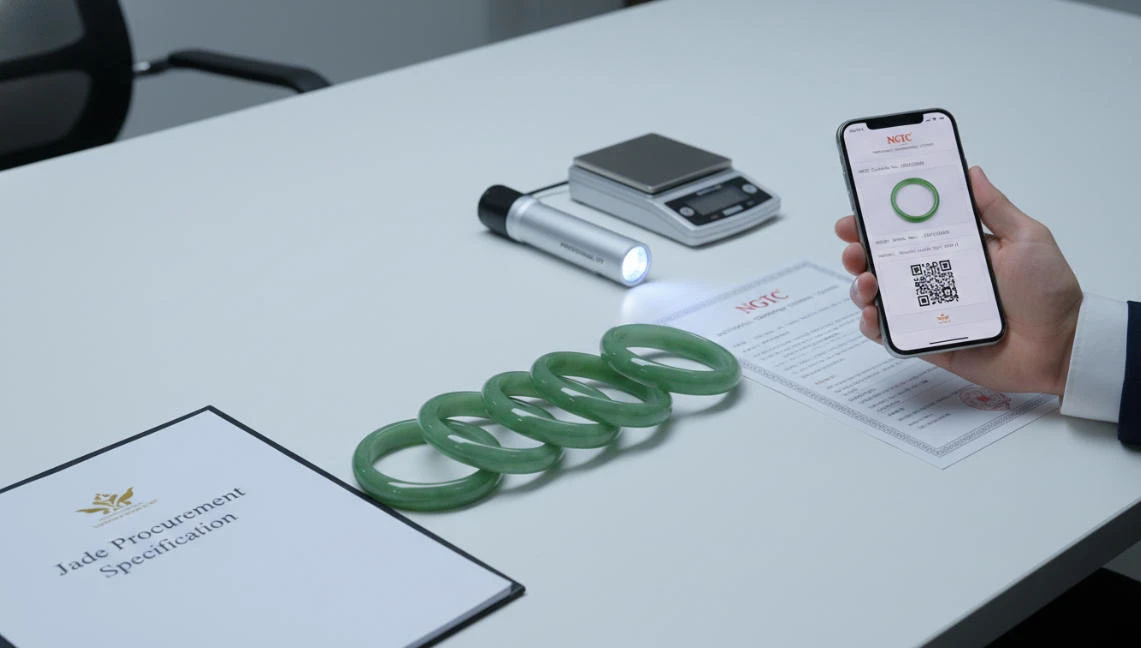
The single most underutilized protective tool in jade bracelet wholesale is a written procurement specification document issued to the supplier before any pricing discussion begins. Most buyers skip this step because it feels bureaucratic, and most suppliers prefer that they do — because the absence of written specifications is what gives fraudulent substitution its legal ambiguity. If your purchase order does not specify “natural, untreated jadeite jade, A-grade, Myanmar origin,” then a supplier who delivers treated Guatemalan serpentine has not technically violated a contract that only specified “green jade bracelet.”
Your procurement specification should define, at minimum: the material type and species (jadeite versus nephrite), the treatment status (natural/untreated only), the origin if origin-based pricing is being applied, the grade classification system being referenced, the dimensional tolerances relevant to your product application, and the certification requirements that must be met before shipment is released. This document serves two commercial functions simultaneously. First, it constrains supplier behavior by making substitution a documentable contract breach rather than a gray area. Second, it gives you a legally actionable foundation if post-delivery testing reveals discrepancies. This means you can recover costs through dispute resolution rather than absorbing the loss entirely.
2 — Require a Verifiable Third-Party Certificate With Online Authentication for Every Wholesale Jade Bracelet Shipment
Based on what you now know about certificate fraud, your certification requirement cannot simply be “provide a certificate.” It must specify the tier of institution, the verification method, and the timeline. For any shipment exceeding a commercially significant threshold — a figure your procurement team should define based on your margin structure — require a certificate from one of the internationally recognized institutions: GIA, SSEF, or Gübelin Gem Lab. Each of these institutions maintains an online verification database where you can confirm that a certificate number corresponds to a real, issued document.
The verification step takes approximately three minutes and eliminates the entire category of fabricated certificates from your risk exposure. For shipments where full international certification is cost-prohibitive relative to unit value — which is a legitimate consideration in mid-volume jade bracelet wholesale — require at minimum a certificate from the National Gemstone Testing Center (NGTC) of China, which is the nationally accredited standard for the Chinese jade manufacturing sector. Certificates issued before shipment, with the certificate number referenced directly on the commercial invoice, are the only format that carries meaningful evidentiary weight. Any supplier who cannot meet this requirement before goods leave their facility is telling you something important about their confidence in their own product.
3 — Place a Sample Order or MOQ Trial Before Committing to Large-Volume Wholesale
No written specification and no certificate requirement eliminates the risk of large-batch quality deviation — the scenario where your sample order is carefully fulfilled to specification while your production run is quietly substituted with lower-grade or treated material. This is not a hypothetical risk; it is a documented pattern in markets where buyer oversight is limited and per-unit margins on substitution are high. The structural protection against this risk is never to place your first large-volume order with an unproven supplier.
Before committing to any volume that would represent a material financial exposure for your business, place a minimum order quantity trial — typically in the range of 50 to 200 pieces depending on unit value — and subject the received samples to the full inspection protocol described in Step 4. The cost of a sample order and its associated testing is a fixed due diligence expense that scales favorably against the potential loss on a compromised large order. A $500 testing investment that prevents a $15,000 loss represents a 30x return on your verification spend. This also gives you baseline documentation — photographs, measurements, test results — that can be referenced if subsequent production runs deviate from the established standard. This means you have a quality benchmark that travels with the supplier relationship, not just with a single order.
4 — Build a Multi-Layer Physical Inspection Protocol for Every Jade Bracelet Wholesale Shipment
Written specifications and certificates address the documentation layer of your risk exposure. Physical inspection addresses the material reality of what you have actually received. A robust inspection protocol for wholesale jade bracelets operates at three levels, each of which catches different categories of fraud and treatment.
The first level is basic field testing, executable by a trained quality control technician without laboratory equipment. Ultraviolet light testing reveals fluorescence patterns inconsistent with natural jade — most polymer-treated jade shows a characteristic blue-white fluorescence under longwave UV that natural A-grade jade does not exhibit. Loupe examination at 10x magnification allows visual identification of resin fill bubbles, dye concentration along fracture lines, and surface texture inconsistencies that distinguish natural crystal structure from reconstituted material. Specific gravity testing — which requires only a precision scale and a water container — provides a rapid quantitative check against the known density range of genuine jadeite (approximately 3.2 to 3.4 g/cm³) and nephrite (approximately 2.9 to 3.1 g/cm³), as documented by the IGS jade reference data.
The second level is laboratory sampling, applied to a statistically meaningful subset of large shipments. For orders exceeding 500 pieces, select a random sample of no fewer than 10 pieces from different production batches and submit them to a certified gemological laboratory for full material analysis. The results of this sampling provide your most accurate available picture of actual shipment quality. They also create a documented quality record that strengthens your position in any subsequent supplier dispute. This means your inspection process produces commercial intelligence, not just compliance documentation.
5 — Vet Your Jade Bracelet Factory Thoroughly and Prioritize Long-Term Supplier Relationships
Every time you switch suppliers in the jade bracelet wholesale market, you reset your risk exposure to zero — meaning you are back to having no verified track record, no established quality baseline, and no documented history of supplier behavior under commercial pressure. The suppliers most likely to commit fraud are those with no long-term commercial relationship to protect. This structural dynamic makes supplier stability a direct risk management tool, not merely a procurement convenience.
Before formalizing any supplier relationship, verify the following: the supplier’s business registration and manufacturing license in their country of incorporation; their documented experience with export compliance for jade and semi-precious stone products, including familiarity with CITES regulations where applicable for certain jade varieties; their raw material sourcing transparency — specifically, whether they can provide documentation linking their finished bracelets back to the origin point of the rough material; and references from existing wholesale clients in your target market who can speak to consistency across multiple orders. A jade bracelet factory or jade factory with 10 or more years of documented export history, verifiable institutional certifications, and traceable raw material sourcing represents a fundamentally different risk profile from a trading company with an attractive website and aggressive pricing. Once you have verified and qualified a supplier who meets these standards, the cost of maintaining that relationship — even if their pricing is marginally higher than a new, unverified competitor — is almost always lower than the cost of the due diligence required to qualify a replacement. This means your supplier loyalty is not sentiment; it is a quantifiable risk premium that you are not paying.
What Makes a Trustworthy Jade Bracelet Factory? A Supplier Qualification Framework for Wholesale Buyers
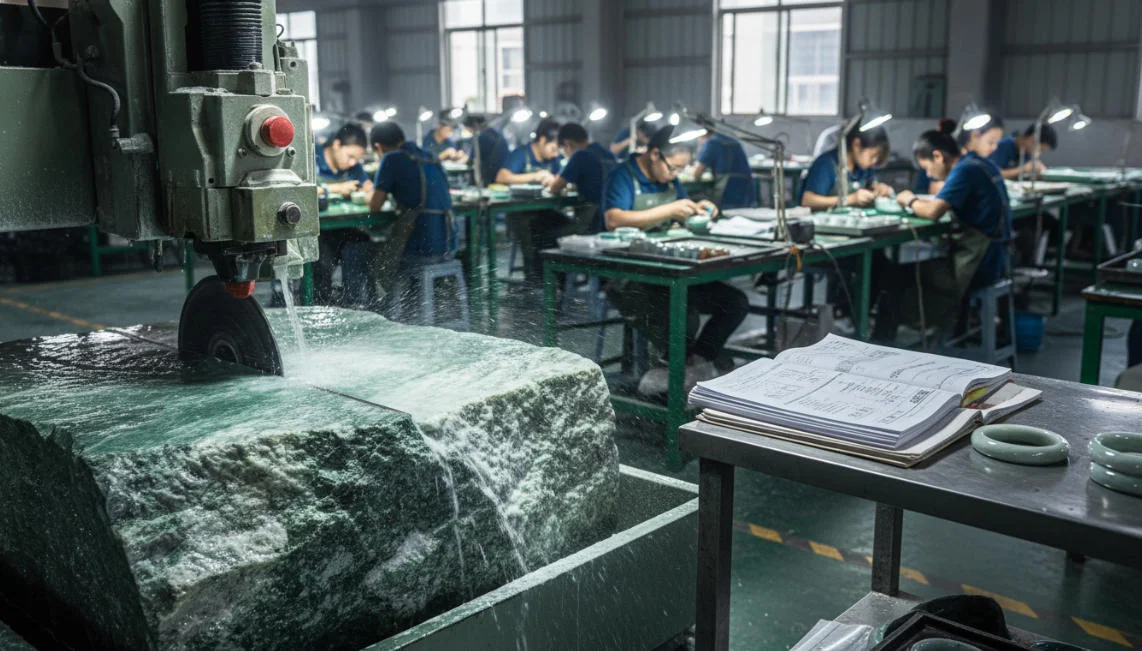
Finding a supplier who passes your document and inspection requirements on a single order is not the same as finding a supplier you can build a wholesale business on. The jade bracelet wholesale market has a specific category of supplier risk that only becomes visible over time: the supplier who delivers acceptable quality on initial orders while gradually substituting lower-grade material as your order volumes increase and your scrutiny decreases. Protecting against this pattern requires evaluating suppliers not just on what they can produce, but on the structural characteristics that make sustained quality consistency either likely or unlikely.
The Six Qualifications That Separate Verified Jade Factories From High-Risk Trading Companies
Manufacturing tenure is the first indicator worth examining. A jade factory with a verifiable operating history of ten or more years in jade bracelet production has survived market cycles, maintained client relationships through quality disputes, and built institutional knowledge of material sourcing that a recently established trading company simply cannot replicate. Ask for business registration documents and cross-reference the registration date against the supplier’s claimed years of experience — the gap between these two numbers is frequently informative.
Raw material sourcing transparency is the second qualification, and arguably the most commercially significant. A supplier who can provide documentation connecting their finished wholesale jade bracelets back to the origin point of the rough material — including rough purchase records, import documentation if applicable, and rough-to-finished traceability — is operating at a fundamentally different level of supply chain integrity than one who purchases finished or semi-finished pieces from intermediary traders. Vertically integrated jade bracelet processing capability, from rough material selection through to finished bracelet production, is a structural quality control advantage that you benefit from directly as the buyer. This means your quality consistency is anchored in material selection, not just in finishing standards.
Export compliance experience is the third qualification. Suppliers with documented experience exporting jade products to regulated markets — including the European Union, the United States, and Japan — have necessarily built familiarity with the documentation, certification, and material disclosure requirements that those markets enforce. This compliance infrastructure does not exist by accident; it is built through years of working with buyers who demanded it. A supplier’s export history to regulated markets is therefore a reasonable proxy for their overall documentation discipline.
The fourth qualification is third-party certification infrastructure. A jade bracelet factory that has established an ongoing relationship with one or more internationally recognized gemological laboratories — not for individual client requests, but as a standard component of their quality assurance process — has built institutional accountability into their production workflow. Ask specifically which laboratories they work with, how frequently they submit materials for independent testing, and whether they can share historical certificate records. The answers to these questions reveal whether certification is a sales tool or an operational standard for that supplier.
Client reference verifiability is the fifth qualification. Any supplier of meaningful scale in the wholesale jade bracelet market should be able to provide references from existing wholesale clients who have placed multiple orders over a period of at least two years. A single satisfied client after a single successful order proves very little. A client who has maintained a commercial relationship through three or more production runs, including at least one instance where a quality issue was identified and resolved, provides genuinely useful evidence of how the supplier behaves under commercial pressure.
The sixth qualification is factory visitability. A supplier who operates a physical manufacturing facility — and who will allow a pre-qualified prospective buyer or their appointed inspection agent to visit that facility before order placement — is accepting a level of operational transparency that trading companies and brokerage operations structurally cannot match. You do not need to visit every supplier you work with, but the willingness to permit a visit is itself a meaningful signal about supplier confidence in their own operations. Suppliers with something to hide about their jade bracelet processing methods, material sourcing, or production conditions consistently find reasons why facility visits are not currently possible.
About Jademago — 65 Years of Jade Manufacturing Built on Traceable Materials and Verifiable Quality
Every risk category described in this guide — substitute materials, treatment fraud, composite construction, certificate manipulation, and origin misrepresentation — represents a specific failure of supplier accountability. JADE MAGO was established to operate as the structural opposite of that failure mode.
With more than 65 years of continuous jade design, manufacturing, and export experience, Jademago sources natural jade rough directly from verified origin points and maintains complete material traceability from rough purchase through to finished bracelet production. Every piece that leaves our jade factory can be connected back to its source material through documented procurement records — which means when you ask where your jade came from, you receive documentation, not a verbal assurance.
Your wholesale orders through Jademago are supported by third-party certification from internationally recognized gemological institutions, with certificate numbers that you can verify independently through each institution’s online database before you confirm shipment acceptance. You do not need to trust our word on material quality. You can verify it through the same institutions that the global gem trade relies on.
The jade bracelet processing standards at Jademago’s manufacturing facility have been developed and refined over six decades of working with wholesale buyers across regulated international markets. This means the compliance infrastructure you need — accurate material disclosure, export documentation, traceable sourcing, and independently verifiable certification — already exists as a standard operational feature of working with us, not as a custom request that adds lead time and cost to your order.
If you are currently evaluating jade bracelet wholesale suppliers and want to verify Jademago’s qualifications directly — including factory documentation, sample certification records, and export compliance history — contact our wholesale team to request a supplier qualification package. The information you need to make a verified sourcing decision is available before you commit to a single piece.
About Jade Bracelet Wholesale Risks Faqs
1. How do I know if a jade bracelet supplier is legitimate?
A verified supplier should be able to provide a business registration certificate, documented export history, and third-party gemological certification from an internationally recognized institution such as GIA or SSEF. If a supplier cannot produce these documents before shipment, that absence is itself a qualifying answer.
2. What is the minimum order quantity I should use for a first-time test of a new jade bracelet factory?
A first-order trial in the range of 50 to 200 pieces is sufficient to generate a meaningful sample for physical and laboratory inspection without committing significant capital. The purpose of a trial order is not to secure inventory — it is to produce a documented quality baseline before scaling volume.
3. Can I verify a jade certificate online?
Yes, provided the certificate was issued by a major institution. GIA , SSEF, and Gübelin Gem Lab each maintain online report verification tools. Enter the certificate number directly on the issuing institution’s website — a genuine certificate will return a matching record. If it does not, treat the document as unverified regardless of its appearance.
4. Is treated jade always illegal to sell?
No — treated jade is legal to sell in most markets, provided the treatment is fully disclosed to the buyer. The commercial and legal problem arises when treated jade is sold as natural without disclosure. In regulated markets including the EU and US, material misrepresentation in a commercial transaction creates both civil liability and, in some jurisdictions, consumer protection enforcement exposure.
5. How does jade bracelet processing affect the final wholesale price?
Processing method is a direct price determinant. Natural, untreated jade requires no chemical intervention after cutting and polishing, which means the cost reflects genuine material value. Treated jade carries artificially suppressed raw material costs that are partially offset by processing expenses — but the finished price will still be lower than equivalent-looking natural jade, which is precisely why it is commercially attractive to fraudulent suppliers and dangerous to uninformed buyers.