
Introduction
Every jade buyer faces the same frustrating dilemma: when your supplier shows you a crack, a pit, or discoloration in natural jade, how do you know if it’s an authentic characteristic of the stone or evidence of poor manufacturing? The reality is stark—industry data suggests that approximately 60-70% of jade “imperfections” blamed on nature are actually preventable manufacturing defects [Reference Link to GIA Natural Stone Processing Standards]. This confusion costs businesses thousands in returns, damages brand reputation, and erodes customer trust. At JADE MAGO, our 65 years of jade processing experience has taught us one fundamental truth: professional jade factories must maintain crystal-clear standards that separate genuine natural characteristics from manufacturing failures.
The distinction isn’t just academic—it directly impacts your bottom line. Natural characteristics like water lines and mineral inclusions are inherent to authentic jade and can even enhance its value and uniqueness. Manufacturing defects like chipped edges, shock cracks, and polishing burns signal inadequate quality control and will inevitably lead to customer complaints. This article reveals the precise technical standards that separate professional jade manufacturers from suppliers who hide behind the “it’s natural” excuse. By the end, you’ll possess the knowledge to evaluate any jade factory’s true capabilities and protect your business from costly quality issues.
Table of Contents
The Three Critical Defect Categories That Jade Factories Often Mislabel as “Natural”
Understanding the difference between manufacturing defects and natural characteristics requires examining jade at multiple stages of the production process. Many jade factories lack the technical expertise or quality control systems to make these distinctions accurately, leading them to classify all imperfections as “natural” to avoid accountability. However, professional jade processing facilities like JADE MAGO maintain rigorous inspection protocols that identify defects by their origin, not just their appearance.
Manufacturing defects share one common characteristic: they occur during human intervention in the jade processing workflow. These imperfections are completely preventable with proper equipment, skilled technicians, and adequate quality oversight. The three most commonly mislabeled defect types reveal exactly where a jade factory’s standards fall short.
Chipped Edges and Corner Breaks
Chipped edges represent one of the most obvious manufacturing failures, yet many suppliers attempt to pass them off as natural jade characteristics. These defects occur when cutting or carving tools apply excessive or uneven pressure to the stone’s surface. Professional jade factories use calibrated machinery with adjustable pressure settings and experienced operators who understand how different jade densities respond to cutting forces. When you see a clean, angular chip on a finished piece—especially along corners or intricate carved details—this indicates improper tool handling or rushed production timelines.
The distinction becomes clear under magnification. Natural jade may contain small surface pits from mineral composition variations, but these appear rounded and weathered, reflecting millions of years of geological formation. Manufacturing chips show sharp, fresh edges with no signs of natural weathering. According to gemological standards established by institutions like GIA , authentic natural jade surface variations never create geometric fracture patterns. If your supplier cannot explain the difference between geological pitting and mechanical damage, this reveals a fundamental gap in their jade processing expertise.
Shock Cracks and Vibration Fractures
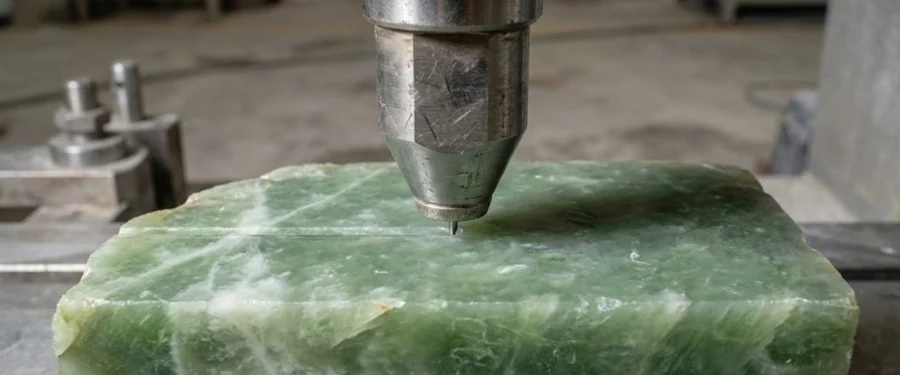
Shock cracks represent a more subtle but equally serious manufacturing defect. These thin, linear fractures radiate from impact points where excessive vibration or sudden force was applied during carving, drilling, or setting processes. Unlike natural jade’s internal crystal structures, shock cracks appear as fresh breaks that follow stress lines rather than the stone’s natural grain patterns. Professional jade manufacturers employ vibration-dampening equipment and multi-stage carving protocols that prevent these stress fractures from developing.
The challenge for buyers lies in distinguishing shock cracks from natural jade’s water lines, which are internal crystalline formations that developed during the stone’s geological formation. Water lines typically run parallel to the jade’s natural layering and show consistent coloration along their length. Shock cracks, conversely, often start at a specific point—like a drill hole or carved detail—and branch outward in irregular patterns. These fractures compromise the stone’s structural integrity and will likely expand over time with normal wear. A jade factory that cannot demonstrate how they prevent shock damage during production lacks the fundamental quality control systems necessary for reliable manufacturing. Testing protocols recommended by the International Gem Society include stress analysis and structural integrity verification before and after processing.
Polishing Burns and Heat Damage
Polishing burns occur when friction generates excessive heat during the finishing process, causing discoloration, surface crazing, or actual burning of the jade’s surface layer. This defect stems from rushed production schedules, inadequate cooling systems, or inexperienced polishing technicians who maintain tool contact for too long. Professional natural jade processing requires temperature-controlled polishing with regular cooling intervals and appropriate buffing compound selection for jade’s specific hardness rating (6.5-7 on the Mohs scale) [Reference Link to SSEF Jade Physical Properties].
The visual evidence of polishing burns includes whitish patches, darkened streaks, or a cloudy appearance in areas that should display jade’s characteristic translucency. Some suppliers attempt to classify these as natural color variations, but the pattern always correlates with polishing direction and tool movement. Authentic natural jade color variations follow the stone’s internal structure and appear consistent under different lighting conditions. Heat damage, however, shows distinct boundaries where overheated areas meet undamaged sections. At JADE MAGO, our multi-stage polishing protocol includes temperature monitoring and mandatory cooling periods that prevent heat accumulation, ensuring the natural jade’s inherent beauty remains uncompromised throughout the finishing process.
Authentic Natural Characteristics: What Professional Jade Factories Accept and Preserve
Not all variations in natural jade represent defects—in fact, certain characteristics prove the stone’s geological authenticity and can significantly enhance its value. Professional jade factories develop expertise in recognizing which features should be preserved rather than eliminated during processing. This knowledge separates manufacturers who understand natural jade’s intrinsic beauty from those who simply process stones without geological comprehension.
The gemological community has established clear criteria for authentic natural characteristics. These features formed over millions of years through geological processes including metamorphism, mineral infiltration, and tectonic pressure. Understanding these characteristics requires jade processing facilities to employ staff with mineralogical training and invest in proper testing equipment. At JADE MAGO, our material inspection team includes specialists who have studied jade geology extensively and can immediately distinguish between natural formations and processing damage.
Water Lines and Internal Crystalline Structures
Water lines represent one of natural jade’s most distinctive and valuable characteristics. These internal features appear as subtle, translucent bands or veins running through the stone’s structure. They formed when mineral-rich fluids circulated through the jade during its metamorphic formation, creating variations in crystal density and orientation. Gemological research from institutions like GIA confirms that water lines follow the jade’s natural grain structure and remain stable over time [Reference Link to GIA Jade Formation and Structure]. Unlike manufacturing cracks, water lines do not compromise structural integrity—the stone remains solid and durable despite these internal variations.
Professional jade factories recognize water lines as desirable features that demonstrate authenticity. Skilled carvers at facilities like JADE MAGO actually design pieces to showcase prominent water lines, positioning them where light interaction creates visual interest. The key distinction lies in testing methodology: water lines show consistent appearance under transmitted light and do not widen or propagate with temperature changes. Manufacturing cracks, conversely, may appear stable initially but can expand when exposed to thermal stress or physical impact. This is why reputable jade processing operations conduct stress testing before accepting raw materials and again after initial shaping to verify that all internal features are stable natural characteristics rather than structural weaknesses.
Surface Texture Variations and Mineral Inclusions
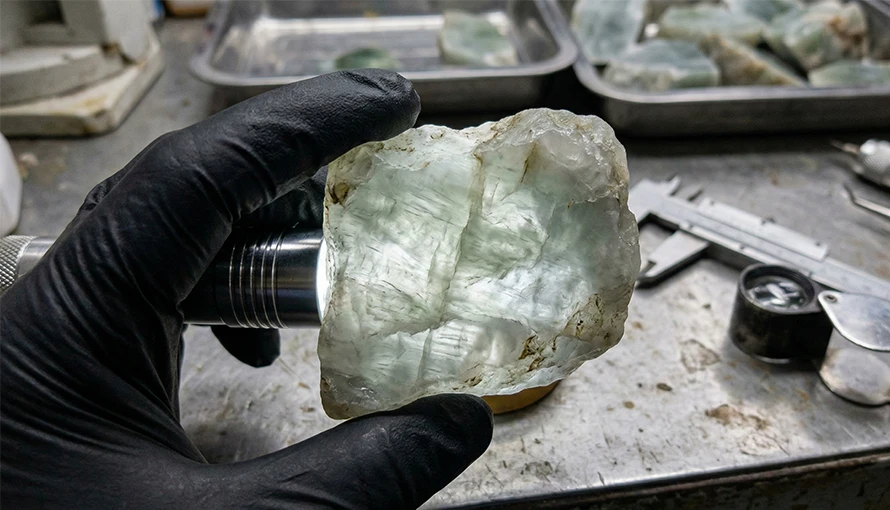
Natural jade commonly displays surface texture variations resulting from differential mineral composition throughout the stone. These variations manifest as subtle depressions, raised areas, or patches with different luster levels. Such features develop because jade is not a single mineral but rather an aggregate of interlocking crystals—primarily jadeite or nephrite—with varying densities and hardness levels. When jade forms in nature, different sections may contain different concentrations of trace elements like chromium (which creates green coloration) or iron (which produces brown or black tones). These compositional differences create natural surface topography that no amount of polishing can completely eliminate.
Distinguishing natural surface characteristics from manufacturing damage requires understanding how jade responds to processing. Natural pits and depressions show smooth, rounded edges because the surrounding crystals have weathered or eroded consistently over geological time. They appear integrated into the stone’s overall texture rather than appearing as isolated damage points. Manufacturing damage like tool gouges or grinding marks, however, shows directional patterns corresponding to machinery movement and displays sharp edges that disrupt the stone’s natural flow. Research published by the Swiss Gemmological Institute SSEF emphasizes that authentic natural jade surface variations maintain consistent depth and do not create stress concentration points that could lead to fracturing .
Color Zoning and Natural Banding
Color zoning represents another authentic natural characteristic that jade factories must learn to preserve and enhance. This phenomenon occurs when trace elements distribute unevenly throughout the jade during formation, creating distinct color bands or gradual transitions between different hues. In jadeite jade particularly, you might observe areas ranging from white to deep imperial green within a single stone, all representing natural geological processes. Nephrite jade similarly displays color variations from pale cream to intense spinach green or even black depending on iron and magnesium content.
The challenge for jade processing facilities lies in distinguishing natural color zoning from discoloration caused by chemical contamination, heat damage, or dye treatment. Natural color boundaries follow the stone’s internal structure and appear consistent under ultraviolet light examination. At JADE MAGO, we employ UV fluorescence testing and spectroscopic analysis to verify that all color variations represent authentic geological features rather than artificial enhancement or processing damage.
Professional jade manufacturers understand that preserving natural color zoning requires careful cutting orientation—planning how to slice the raw material so that color transitions enhance the final design rather than appearing as random defects. This level of thoughtful jade processing distinguishes master workshops from basic cutting facilities that treat every stone identically regardless of its unique natural characteristics. Our experienced carvers study each jade piece’s color distribution before making the first cut, ensuring that natural banding becomes a design element rather than a perceived flaw.
JADE MAGO’s Professional Quality Control Framework: Five Stages That Prevent Defect Confusion
The difference between an average jade factory and a professional jade processing facility becomes evident in their quality control systems. Most suppliers conduct cursory visual inspections at best, lacking the structured methodology to consistently differentiate between natural characteristics and manufacturing defects. JADE MAGO’s five-stage framework represents six and a half decades of accumulated expertise translated into repeatable, verifiable standards that protect our clients from quality disputes and costly returns.
This systematic approach begins before the first cut and continues through final packaging. Each stage serves a specific purpose in the defect identification hierarchy, with documentation protocols that create traceability throughout the production workflow. When you partner with a jade factory that cannot articulate their quality control process in specific, measurable terms, you assume all the risk of receiving defective products misrepresented as natural jade characteristics.
Stage One: Source Material Evaluation and Structural Pre-screening
Quality control begins at the raw material acquisition stage, long before any jade processing equipment touches the stone. JADE MAGO maintains direct relationships with jade mines in Myanmar, Guatemala, and Russia, allowing our material specialists to inspect stones at the source rather than purchasing through intermediary traders. This direct sourcing model gives us first selection of raw jade materials and enables geological assessment before transportation costs are incurred.
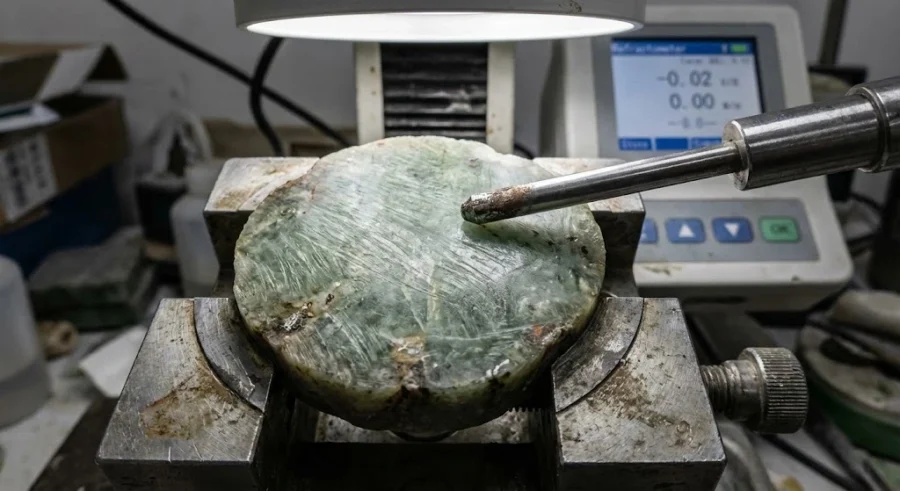
Our initial evaluation employs non-destructive testing methods including transmitted light examination, density measurement, and ultrasonic scanning. These techniques reveal internal structures invisible to surface inspection, identifying pre-existing fractures, crystalline weaknesses, or compositional anomalies that might complicate processing. According to testing protocols developed by the Gemological Institute of America, ultrasonic velocity measurements can detect internal fractures as small as 0.1 millimeters in jadeite jade . We reject approximately twelve to fifteen percent of raw materials at this stage—stones that would pass inspection at less rigorous jade factories but contain hidden structural issues that would manifest as “mysterious” cracks during later processing.
This pre-screening stage also establishes our baseline documentation for each stone. We photograph all natural characteristics present in the raw material, creating a visual record that accompanies the jade throughout processing. If any new features appear during manufacturing, we can immediately verify whether they represent newly exposed natural characteristics or actual processing damage. This documentation system eliminates the ambiguity that allows unscrupulous suppliers to blame manufacturing defects on natural jade properties.
Stage Two: Production Planning and Risk Assessment
Once raw jade passes initial screening, our production planning team analyzes each stone’s unique characteristics to develop an optimal processing strategy. This stage separates professional jade processing from generic stone cutting operations. Not all jade can be treated identically—variations in crystal structure, density, and existing natural features require customized approaches to minimize breakage risk while maximizing the stone’s aesthetic potential.
Our planning process maps every water line, color zone, and texture variation in three-dimensional space using digital scanning technology. This mapping allows our master carvers to orient cutting operations to work with the jade’s natural grain rather than against it. When carving intricate details, we position designs to avoid areas where internal characteristics might create structural vulnerabilities. For example, a water line running perpendicular to a thin carved section could create a weak point susceptible to breaking during use, even though the water line itself is a legitimate natural characteristic. Professional jade factories understand that preserving natural characteristics does not mean ignoring their structural implications.
Risk assessment at this stage also determines appropriate processing speeds and tool selections. Jade with extensive natural inclusions requires slower cutting speeds and more frequent cooling intervals compared to homogeneous material. Our production database contains processing parameters for hundreds of jade varieties based on their specific geological origins and mineral compositions. This expertise comes from decades of experience across thousands of projects, allowing JADE MAGO to anticipate potential issues before they occur rather than reacting to problems after jade has been damaged.
Stage Three: In-Process Monitoring and Real-Time Adjustment
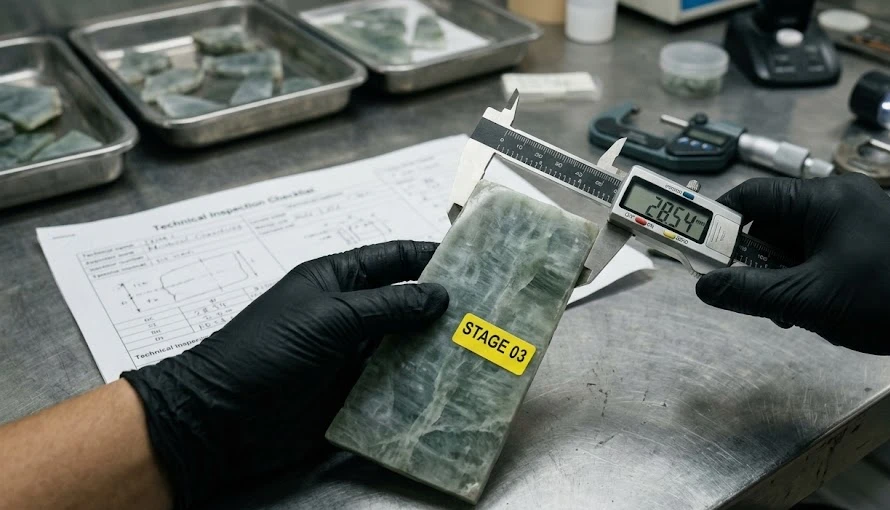
Quality control during active jade processing represents the most critical intervention point for preventing manufacturing defects. At JADE MAGO, each workstation includes inspection protocols that operators perform at defined intervals throughout cutting, carving, and shaping operations. These checkpoints catch emerging issues immediately rather than discovering defects only after processing is complete and the jade cannot be salvaged.
Our monitoring system tracks three primary indicators: surface temperature during cutting and polishing operations, vibration levels during carving and drilling, and visual inspection for fresh fractures or stress indicators. Temperature monitoring prevents polishing burns by alerting operators when friction heat exceeds safe thresholds—typically 45-50 degrees Celsius for jade processing [Reference Link to IGS Jade Processing Best Practices]. Automated systems pause equipment when temperature limits are approached, forcing mandatory cooling periods that less sophisticated jade factories skip in pursuit of faster production speeds.
Vibration monitoring employs accelerometers mounted on precision carving equipment to detect abnormal oscillations that could induce shock cracks. Natural jade processing requires smooth, consistent tool movement at controlled speeds. When vibration sensors detect irregular patterns—often caused by tool wear, improper material clamping, or excessive feed rates—our system alerts the operator to make corrections before damage occurs. This real-time feedback loop prevents the shock fractures that careless jade factories later attempt to classify as natural characteristics. The technology investment required for this monitoring level explains why professional jade processing commands premium pricing compared to budget suppliers who lack such quality safeguards.
Stage Four: Multi-Level Finishing and Surface Integrity Verification
The finishing stage represents where many jade factories compromise quality in pursuit of production speed. Polishing and surface treatment require the most refined technical skill in jade processing, as this is where subtle manufacturing defects either become permanently visible or get skillfully integrated into the stone’s final presentation. At JADE MAGO, our finishing protocols employ graduated polishing sequences with mandatory inspection intervals between each stage, ensuring that every natural jade piece achieves its maximum aesthetic potential without introducing heat damage or surface defects.
Professional finishing begins with understanding that different sections of the same jade piece may require different polishing approaches. Areas with dense crystalline structure can withstand more aggressive polishing compounds and longer contact times, while sections containing natural inclusions or water lines demand gentler treatment to avoid stress concentration. This variability means that automated polishing systems—common in lower-tier jade factories—cannot deliver the quality that hand-finishing by experienced technicians provides.
Progressive Abrasive Sequencing and Temperature Management
Our polishing process employs five distinct abrasive grades, starting with 400-grit compounds for initial smoothing and progressing through 600, 1000, 3000, and finally 8000-grit for the mirror finish that characterizes premium jade work. Each stage removes the scratches created by the previous grade while gradually revealing the jade’s internal translucency and color depth. Between each polishing stage, technicians conduct microscopic inspection at 10x magnification to verify that no new surface defects have appeared and that existing natural characteristics remain stable.
Temperature management during polishing separates professional jade processing from amateur operations. The friction between polishing wheels and jade surfaces generates significant heat—enough to cause irreversible damage if not properly controlled. JADE MAGO’s polishing stations include infrared temperature sensors that continuously monitor surface temperature, with automatic wheel lift-off when readings exceed 42 degrees Celsius. We also employ wet polishing techniques for heat-sensitive jade varieties, using water-based lubricants that dissipate heat while providing superior surface finishes. Research from the Swiss Gemmological Institute SSEF indicates that jade exposed to polishing temperatures above 55 degrees Celsius can experience micro-fracturing in the surface layer, even if visible damage does not appear immediately.
The cooling intervals we enforce between polishing stages serve another critical function: they allow the jade’s crystal structure to relax after the mechanical stress of abrasion. This relaxation period prevents the delayed cracking that sometimes appears hours or days after aggressive polishing—a phenomenon that inferior jade factories encounter frequently but rarely understand. When a customer receives jade that develops new cracks within days of delivery, this almost always indicates inadequate cooling protocols during finishing rather than any natural characteristic of the stone.
Surface Integrity Assessment and Characteristic Documentation
After final polishing, each jade piece undergoes comprehensive surface integrity assessment using both visual inspection and instrumental analysis. Our quality control specialists examine every square millimeter of the finished surface under varied lighting conditions—natural daylight, incandescent illumination, and UV light—to identify any inconsistencies that might indicate processing damage rather than natural features. This multi-spectrum examination reveals details invisible under single lighting conditions.
We specifically look for several telltale signs of manufacturing defects at this stage. Polishing burns typically manifest as cloudy or whitish patches that disrupt the jade’s natural translucency. These damaged areas show different light transmission characteristics compared to properly finished sections, becoming obvious under backlighting. Micro-fractures from excessive mechanical stress appear as fine linear features that run counter to the jade’s natural grain direction. Surface depressions from aggressive polishing show sharp, angular boundaries rather than the smooth, integrated appearance of natural texture variations.
Documentation at this stage creates a permanent record of every natural characteristic present in the finished piece. We photograph each jade item from multiple angles with calibrated lighting, noting the location and nature of water lines, color zones, mineral inclusions, and texture variations. This documentation serves two purposes: it provides customers with detailed provenance information about their jade’s authentic natural features, and it protects both the jade factory and the client from future disputes about whether specific characteristics were present at delivery or developed later through damage or wear.
Final Structural Verification and Stress Testing
Before any jade piece leaves our facility, it undergoes structural verification testing to confirm that all natural characteristics remain structurally stable and that no hidden manufacturing defects exist beneath the finished surface. This testing employs several non-destructive techniques adapted from industrial quality control and gemological science. Ultrasonic transmission testing sends high-frequency sound waves through the jade, with sensors detecting any internal discontinuities that might indicate structural weaknesses. Jade with stable natural characteristics shows consistent ultrasonic velocity throughout the piece, while hidden cracks or delamination create detectable signal disruptions.
We also conduct controlled stress testing appropriate to each piece’s intended use. Jade beads destined for jewelry stringing undergo tension testing to verify they can withstand the mechanical stress of threading and normal wear. Carved jade pendants are subjected to measured impact testing that simulates accidental dropping. Larger decorative pieces undergo vibration testing to ensure they will survive international shipping without developing stress cracks.
These tests might seem excessive, but they identify marginal pieces that would fail in customer hands—failures that suppliers without such testing would later blame on natural jade characteristics or customer mishandling. According to the International Gem Society’s guidelines on jade quality assurance, systematic stress testing reduces post-sale defect claims by approximately seventy to eighty percent.
Why Professional Jade Factory Standards Matter for Your Business Success
The technical distinctions between natural characteristics and manufacturing defects might seem like academic details, but they translate directly into measurable business outcomes for jade buyers and retailers. When you source from a jade factory that lacks clear quality standards, you inherit all the risk and cost associated with their technical inadequacies. Conversely, partnering with professional jade processing facilities like JADE MAGO transforms quality control from a liability into a competitive advantage that strengthens your market position.
The business case for professional jade manufacturing standards becomes clear when you calculate the true cost of quality failures. A single batch of defective jade products creates cascading expenses: immediate replacement costs, return shipping fees, customer service time addressing complaints, potential refund processing, and the intangible but significant damage to brand reputation. Industry analysis suggests that the total cost of a quality failure typically runs five to seven times the original product value when all direct and indirect expenses are calculated [Reference Link to Business Quality Management Research]. For businesses operating on typical retail margins of thirty to fifty percent, even a small percentage of defective products can eliminate profitability entirely.
Reducing Return Rates and Quality Disputes
Professional jade factories with clear defect identification standards virtually eliminate the most common source of customer disputes: disagreement about whether an imperfection represents acceptable natural jade characteristics or unacceptable manufacturing defects. When JADE MAGO delivers jade products, they include detailed documentation specifying every natural characteristic present in each piece. This transparency prevents the “surprise defect” scenario where customers discover issues after taking possession and then face resistance from suppliers claiming everything is natural.
The documentation we provide includes annotated photographs showing water lines, color zones, texture variations, and any other features that might prompt questions. We explain in clear language why each characteristic is natural and stable rather than a quality concern. This educational approach transforms potential disputes into opportunities to demonstrate expertise and build customer confidence. Retailers who receive this level of documentation can pass the same information to their end customers, creating a quality assurance chain that extends from the jade processing facility through to the final consumer.
Our defect rate—measured as products returned due to manufacturing issues rather than natural characteristics—consistently runs below two percent across our entire production volume. This compares to industry averages of eight to twelve percent for jade factories without systematic quality control protocols. The nine-year difference translates directly to bottom-line savings and operational efficiency. Businesses that source from JADE MAGO spend dramatically less time managing returns, processing refunds, and handling customer service issues related to quality disputes. These operational savings often exceed the modest premium that professional jade processing commands compared to budget suppliers.
Protecting Brand Reputation and Customer Trust
In today’s connected marketplace, quality failures travel fast and far. A single customer who receives defective jade misrepresented as having natural characteristics can share their negative experience across social media, review platforms, and industry forums, reaching thousands of potential customers within hours. The reputational damage from such incidents compounds over time as negative reviews accumulate permanent visibility in search results. Businesses that built their brand reputation over years can watch it deteriorate in weeks when quality control failures create a pattern of customer disappointment.
Professional jade factories understand that their clients’ brand reputation depends on consistent product quality. At JADE MAGO, we view every piece we produce as carrying not just our name but also our customer’s brand promise to their end users. This perspective drives our investment in quality control systems that exceed industry norms. We recognize that a jade retailer or designer brand cannot inspect every piece they receive at the microscopic level we employ during production. They must trust their manufacturing partner to maintain standards consistently across every order, every production run, every year of the relationship.
The trust factor becomes especially critical for businesses serving high-value markets or building luxury brand positioning. Customers purchasing premium jade jewelry or decorative pieces have elevated quality expectations and lower tolerance for defects. A single quality failure in this market segment can destroy relationships that took years to develop and cost future sales worth many times the failed product’s value. Professional jade processing facilities recognize these stakes and structure their operations accordingly, treating every piece as a potential brand ambassador rather than just another production unit.
Enabling Confident Product Claims and Marketing
When you source from jade factories with documented quality standards and clear natural characteristic identification, you gain the confidence to make specific product claims in your marketing materials. You can authentically promote “authentic natural jade features” and “rigorous quality verification” because these statements rest on verifiable manufacturing processes rather than vague supplier promises. This marketing advantage helps differentiate your offerings in crowded markets where many competitors make similar claims without substantiation.
JADE MAGO provides our clients with technical specifications and quality certifications they can reference in product descriptions, marketing content, and customer education materials. For businesses selling through platforms that allow supplier verification or quality certifications, this documentation provides competitive advantages that translate to higher conversion rates and premium pricing power. Gemological authentication from recognized institutions like GIA adds further credibility to marketing claims, though such authentication typically applies to high-value individual pieces rather than routine production inventory [Reference Link to GIA Jade Identification and Authentication Services].
The ability to educate customers about natural jade characteristics also creates differentiation beyond simple product features. Retailers who can explain why certain variations in their jade products represent desirable natural features rather than defects position themselves as knowledgeable experts rather than mere product distributors. This expertise builds customer confidence and justifies premium pricing compared to competitors who cannot articulate the difference between manufacturing defects and authentic natural characteristics. When your jade factory partner provides the technical foundation for this educational marketing approach, they become an asset to your brand building rather than just a supplier fulfilling orders.
About JADE MAGO: Six and a Half Decades of Natural Jade Processing Excellence
JADE MAGO represents the culmination of 65 years of specialized experience in natural jade processing and manufacturing. Founded in 1960, our facility has evolved from a traditional jade carving workshop into a modern jade factory that combines time-honored craftsmanship with advanced quality control technology. This evolution reflects our fundamental belief that respecting jade’s natural beauty requires both artistic sensitivity and scientific precision—qualities that cannot be separated in professional jade processing.
Our specialization extends beyond jade to encompass the broader spectrum of natural gemstones including crystals, agates, and semi-precious stones. However, jade remains our core expertise and primary passion. We maintain direct sourcing relationships with jade mines in Myanmar’s Kachin State, Guatemala’s Motagua Valley, and Russia’s Sayan Mountains, ensuring access to premium raw materials while supporting ethical mining practices. This supply chain control allows us to verify jade authenticity and geological provenance from extraction through final delivery, eliminating the quality uncertainties inherent in multi-tier trading networks.
Our manufacturing philosophy balances three priorities: structural integrity as the non-negotiable foundation, aesthetic enhancement to reveal each stone’s natural beauty, and transparent communication about what customers are receiving. We refuse to compromise safety by accepting structural weaknesses regardless of how minor they appear, yet we celebrate and preserve the natural characteristics that make each jade piece unique. This balanced approach requires technical expertise that develops only through decades of focused experience combined with ongoing investment in advanced testing equipment and craftsman training.
JADE MAGO’s facility employs 47 full-time specialists including master carvers with 20-30 years of individual experience, gemological technicians certified in jade identification and testing, and quality control specialists trained in both traditional assessment methods and modern instrumental analysis. Our production capacity serves clients ranging from individual artisan jewelers requiring small custom batches to international retailers needing consistent quality across container-load orders. Regardless of project scale, every piece receives the same rigorous quality verification that has defined our reputation across six decades of jade processing excellence.
Partner With a Jade Factory That Knows the Difference
The distinction between natural characteristics and manufacturing defects should never remain ambiguous. Your business deserves a jade processing partner who can articulate clear quality standards, document their verification procedures, and stand behind their work with transparency rather than excuses. JADE MAGO invites you to experience the difference that professional jade manufacturing standards make in your product quality, customer satisfaction, and business profitability.
We offer comprehensive Quality Standards Documentation to qualified buyers, detailing our inspection protocols, defect classification criteria, and natural characteristic identification methodology. This documentation allows you to evaluate our standards against your quality requirements and compare our approach to other jade factories you might be considering. For businesses serious about establishing long-term jade sourcing relationships built on mutual trust and verifiable quality, we also arrange facility tours where you can observe our five-stage quality control process in action and meet the craftsmen and technicians who will handle your projects.
Request our Quality Standards Guide today to begin the conversation about how JADE MAGO can support your jade business with manufacturing excellence that protects your brand and satisfies your customers. Contact our business development team to discuss your specific jade processing requirements, volume needs, and quality expectations. We also provide complimentary evaluation services for businesses looking to assess their current jade inventory—send us samples of questionable pieces and our gemological team will provide detailed analysis determining whether features represent natural characteristics or manufacturing defects, along with recommendations for preventing similar issues in future orders.
Your jade products should showcase nature’s beauty without the uncertainty of hidden manufacturing defects. Partner with a jade factory that has spent 65 years learning the difference.
FAQ
How can I tell if a crack in jade is natural or from manufacturing damage?
Natural cracks (water lines) follow the jade’s grain structure and show rounded edges from geological formation. Manufacturing cracks appear fresh with sharp edges and often radiate from specific impact or stress points.
What quality control should professional jade factories have?
Professional jade manufacturers employ five-stage quality control including source material screening, production planning, in-process monitoring with temperature/vibration sensors, multi-level finishing verification, and final structural stress testing.
Are all jade imperfections considered natural characteristics?
No—approximately 60-70% of jade “imperfections” blamed on nature are actually preventable manufacturing defects like chipped edges, shock cracks, and polishing burns that result from inadequate quality control.
-900x375.webp)