
Introduction
In the world of gemstone manufacturing, the journey from a raw mineral specimen to a commercially viable product is defined by one critical stage: the finishing process. While the quality of the raw material is undoubtedly the foundation of value, it is the mastery of precision gemstone polishing techniques that ultimately determines the marketability and aesthetic appeal of the final piece. At JADE MAGO, we have spent years refining our approach to surface treatments, understanding that the difference between a mid-tier product and a luxury item often lies in the microscopic details of the polish.
For B2B buyers and industry professionals, understanding the mechanics behind these finishing methods is essential for quality control and sourcing. Polishing is not merely about making an object shiny; it is a rigorous process of surface modification that removes imperfections, enhances light refraction, and seals the porosity of the stone to ensure longevity. Whether we are handling delicate Quartz crystals or tough Nephrite Jade, the objective remains the same: to manipulate light and texture in a way that elevates the natural beauty of the material.
This guide will serve as a technical deep dive into the specific methodologies we employ in the processing of jade and crystal. We will move beyond the basics of tumbling and cutting to explore the specific abrasives, mechanical actions, and chemical interactions required to achieve a “glassy” or “waxy” luster. As we explore these methods, you will gain a clearer perspective on why professional manufacturing standards are non-negotiable for high-end jewelry and decor brands.
Table of Contents
Understanding Material Properties: The Role of Hardness and Structure
Before a single abrasive touches the stone, a master lapidary must first diagnose the physical characteristics of the material. The success of any polishing regimen is entirely dependent on the stone’s position on the Mohs scale of mineral hardness and its specific crystal structure. Attempting to use a standard crystal polishing protocol on a fibrous stone like jade will result in a disastrous finish, often characterized by the “orange peel” effect or undercut grain.
The Structural Integrity of Crystal (Quartz)
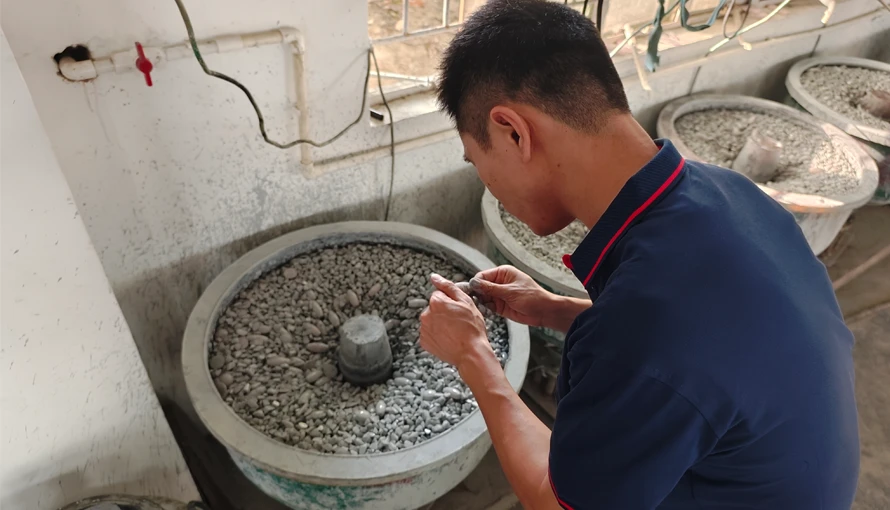
Crystals, particularly those in the Quartz family (including Amethyst, Citrine, and Clear Quartz), possess a macro-crystalline structure with a Mohs hardness of 7. This relatively high hardness combined with a vitreous (glass-like) luster potential makes them somewhat predictable to work with, yet they are unforgiving of thermal shock. When we polish crystal, we are essentially dealing with a brittle material that requires high-speed friction to achieve a gloss. However, because crystal has a distinct cleavage or fracture pattern, excessive heat generated during the polishing phase can cause immediate internal fracturing. Therefore, the finishing of crystal requires a steady, water-cooled environment where the friction is managed carefully to prevent surface crazing.
The Complexity of Nephrite and Jadeite
Conversely, Jade (both Nephrite and Jadeite) presents a completely different challenge due to its crypto-crystalline, fibrous structure. Unlike the single-crystal nature of quartz, jade is an aggregate of interlocking mineral fibers. This structure gives jade its legendary toughness—it is much harder to break than diamond—but it makes polishing exceptionally difficult. If the polishing wheel is too aggressive, it will tear these microscopic fibers rather than smoothing them, leading to a dull, pitted surface.
At JADE MOGO, we treat jade finishing as a process of “burnishing” rather than just abrasion. We must use specific compounds that flow with the grain of the jade fibers. The goal is to create a greasy or waxy luster that feels soft to the touch, which is the hallmark of high-quality jade processing. Understanding this fundamental difference between the brittle nature of crystal and the fibrous nature of jade is the first step in mastering precision gemstone polishing techniques.
The Pre-Polishing Phase: Grinding and Sanding Protocols
The adage in our industry is that “you cannot polish a scratch.” No amount of high-grade diamond paste or cerium oxide can hide a surface that was not properly prepared during the grinding and sanding stages. The polishing stage is transparent; it reveals every mistake made in the steps prior. Therefore, the pre-polishing phase is where the true geometry of the piece is defined and where deep scratches from the cutting saw are systematically removed.
The Progression of Abrasive Grits
The sanding process is a mathematical progression of refinement. We typically begin with coarse silicon carbide or diamond grits, usually starting around 80 or 100 grit, to remove the saw marks and shape the stone. From there, the rule of thumb is to double the grit number at each subsequent step to effectively remove the scratches left by the previous grit. For example, a standard workflow at our factory might proceed from 220 grit to 400, then 600, and finally 1200 grit before the actual polishing begins.factory might proceed from 220 grit to 400, then 600, and finally 1200 grit before the actual polishing begins.
Skipping a step in this progression is a common error in amateur processing, but in a professional B2B manufacturing context, it is unacceptable. If a technician jumps from 220 grit directly to 600 grit, the finer abrasive will bridge over the deep valleys of the 220 scratches. The stone might look smooth when wet, but once it is polished and dry, those underlying deep scratches will reappear as “ghost marks,” ruining the commercial value of the product.
Wet Sanding vs. Dry Sanding
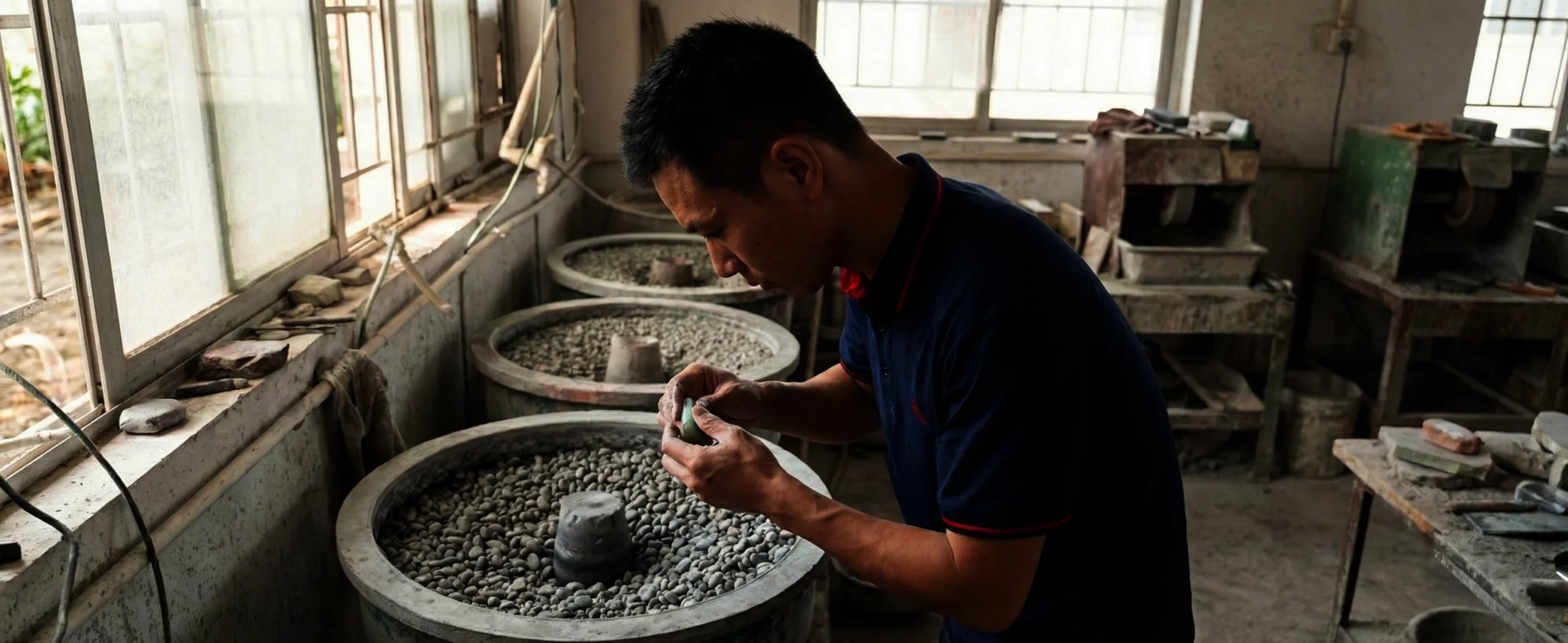
For both crystal and jade, wet sanding is the industry standard, and for good reason. Water serves two critical functions: it acts as a coolant to prevent heat fractures, and it acts as a lubricant to carry away the swarf (stone dust). Dry sanding generates immense heat and poses significant health risks due to silica dust (silicosis). In our facility, we utilize continuous water feed systems on all our lapidary wheels and belt sanders.
Furthermore, the water creates a slurry with the abrasive particles that actually aids in the cutting action. For jade, this slurry helps to keep the fibers hydrated and prevents them from tearing out. We ensure that every sanding station is equipped with proper drainage and filtration systems to recycle water where possible, maintaining an eco-friendly production line while ensuring that the stone remains cool and structurally sound throughout the aggressive sanding phase. For authoritative information on the importance of wet sanding and safety regarding silica dust, you can refer to guidelines from the Occupational Safety and Health Administration (OSHA).
The Chemistry of Shine: Selecting the Right Polishing Agents
Once the grinding and sanding phases have achieved a uniform, scratch-free surface equivalent to a 1200 or 3000 grit finish, the process shifts from abrasion to polishing. This is where precision gemstone polishing techniques rely heavily on chemistry as much as physics. Choosing the correct polishing agent is critical, as different minerals react differently to various compounds. At JADE MAGO, we categorize our polishing agents into two primary families: Diamond Compounds and Oxide Powders.
The Versatility of Diamond Compounds
Diamond is the hardest material known to man, and in the world of lapidary arts, it is the universal problem solver. For our industrial processing, we utilize synthetic diamond pastes that are suspended in an oil-soluble or water-soluble carrier. These pastes are graded by micron size rather than mesh grit, offering a level of precision that standard sandpaper cannot achieve. For instance, we typically transition from a pre-polish stage using 6-micron diamond paste (approx. 3,000 grit) down to a 0.5-micron paste (approx. 50,000 grit) or even finer for ultra-high-end optics and crystal.
The primary advantage of diamond compound is its aggressive cutting speed and its ability to polish mixed-hardness stones without undercutting the softer areas. When we are working with complex carvings or intaglios where preserving sharp details is paramount, diamond on a hard wood lap or a firm felt wheel is the superior choice. It cuts clean and sharp, creating a mirror finish without rounding over the crisp edges of the design, which is a common issue with softer oxide polishes.
Oxide Polishes: Cerium, Tin, and Aluminum
While diamond is powerful, it is often overkill for softer materials or unnecessary for certain types of crystal. This is where metal oxide powders come into play, specifically Cerium Oxide, Tin Oxide, and Aluminum Oxide (often referred to as Linde A). Cerium Oxide is the industry standard for polishing quartz family minerals and glass because it creates a chemical-mechanical reaction with the silica in the stone. The friction generates a localized heat that essentially helps the surface molecules of the quartz to flow and smooth out, resulting in a brilliant, glassy luster that diamond sometimes struggles to replicate on pure quartz.
Aluminum Oxide is our versatile workhorse for general tumbling and cabochon making because it is inexpensive and effective on a wide range of hardnesses. However, for specialized jade work, we often look to Tin Oxide or Chrome Oxide (Green Rouge). These oxides have a unique affinity for the fibrous structure of Nephrite and Jadeite. Although they are messier to work with—Green Rouge will stain everything it touches—they are instrumental in achieving that deep, luscious glow that jade collectors desire. For a deeper understanding of how these oxides function at a microscopic level, the International Gem Society (IGS) offers excellent technical resources on lapidary abrasives.
Mechanical Application Methods: From Wheels to Vibration
The polishing agent is only as good as the tool used to apply it. The carrier—whether it is a spinning wheel, a vibrating tub, or a leather strop—determines how the abrasive interacts with the stone. In a mass-production environment like JADE MAGO, we have to balance the artistry of hand-polishing with the efficiency of machine finishing.
Surface Buffing with Felt, Leather, and Wood
For individual pieces, particularly high-value carvings and jewelry cabs, we utilize rotary buffing stations. The choice of the buffing pad is a critical variable in our precision gemstone polishing techniques. Hard felt wheels are excellent for carrying diamond paste because they are dense enough to press the diamond particles against the stone effectively. However, felt generates significant friction heat. As mentioned earlier, if a crystal gets too hot, it will thermal shock; if jade gets too hot, the surface can “burn” or turn white (whitening).
To mitigate this, specifically for Jadeite and Nephrite, we often employ leather or hard wood pads (such as maple or phenolic resin). Leather has a natural drag that generates the necessary friction to “burnish” the jade without the excessive heat buildup associated with thick felt. The leather allows the technician to work the polish into the pores of the stone, sealing the surface and enhancing the color saturation. Wood laps are used when we need to maintain perfectly flat surfaces, ensuring that the facet junctions remain crisp and do not become rounded or “gummy” looking.
Mass Finishing via Vibratory Tumbling
When processing large orders of beads or smaller tumbled stones, individual hand-polishing is economically unfeasible. In these scenarios, we deploy vibratory tumblers rather than traditional rotary tumblers. Unlike a rotary tumbler that just rolls the stones over each other (which takes weeks), a vibratory tumbler shakes the entire load at high frequency. This action maintains the shape of the pre-forms better than rotary tumbling, which tends to make everything spherical.
In our vibratory systems, we use a carrier media—usually ceramic cylinders or plastic pyramids—mixed with the polishing compounds discussed above. The media acts as millions of tiny hammers and scrubbers, delivering the polish to every nook and cranny of the stone. For crystal beads, we might run a final stage with crushed walnut shell treated with a polishing agent to give a final high-gloss wipe without the risk of chipping the fragile drill holes. This automated process requires strict monitoring of pH levels and slurry viscosity to ensure consistent results batch after batch.
Solving the “Orange Peel” Effect in Jade Processing
One of the most frustrating defects in jade manufacturing is the phenomenon known as “orange peel.” This occurs when the polishing process highlights the difference in hardness between the various mineral components within the jade aggregate. If the polishing wheel is too soft (like a fluffy cotton buff) or the polishing time is too long, the softer minerals between the interlocking fibers wear away faster than the harder fibers. The result is a bumpy, textured surface that resembles the skin of an orange, destroying the smooth tactile experience that is crucial for jade.
The Technique of Hard-Back Polishing
To combat orange peel, the primary rule is to minimize the use of soft buffs. We employ a technique called “hard-back polishing.” By using a harder surface like compressed wood, hard felt, or even a phenolic lap, we force the abrasive to cut across both the soft and hard areas of the stone simultaneously and equally. The lack of “give” in the wheel prevents the abrasive from digging into the softer valleys of the stone’s microstructure.
Additionally, we often reduce the speed of the polishing wheel while increasing the pressure slightly. This control technique allows the polisher to feel the drag of the stone. For Nephrite jade, achieving the perfect “greasy” luster often requires a “dry” polish at the very end of the process. This involves letting the polishing slurry dry out slightly on the wheel, increasing friction for just a few seconds. This risky maneuver requires a master’s touch; hold it too long, and the heat will ruin the stone; time it perfectly, and the jade surface seals into a liquid-like shine that defines premium quality.
Quality Control Protocols: Ensuring Market-Ready Excellence
The polishing process does not end when the wheel stops spinning. In a professional manufacturing environment like JADE MAGO, the true measure of our precision gemstone polishing techniques is validated during the Quality Control (QC) phase. Inspection is a rigorous discipline that requires specific lighting conditions and optical tools to detect imperfections that are invisible to the naked eye but can detract from the stone’s value. A mirror finish must be uniform, free of drag lines, and devoid of any “comet tails”—microscopic trails left by grit contaminants.
The Importance of Lighting and Magnification
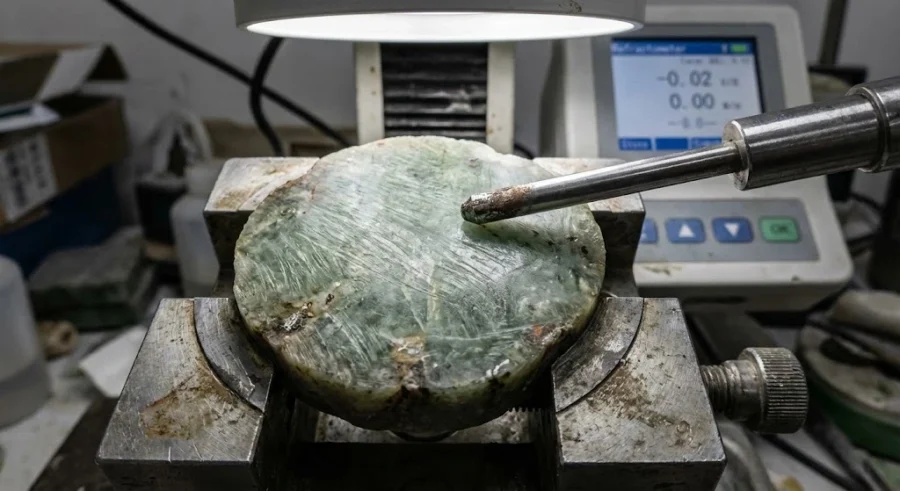
Proper inspection cannot occur under standard warehouse fluorescent lighting, which often flattens the appearance of the stone and hides surface scratches. Our QC technicians utilize a dual-lighting setup consisting of diffused daylight (approximately 5500 Kelvin) to check for color accuracy and intense, directional point-source lighting (often incandescent or high-CRI LED) to examine the surface polish. The directional light hits the polished surface and reflects directly back; any interruption in the light beam, such as a pit, scratch, or haze, becomes immediately apparent as a shadow or a break in the reflection.
We employ standard 10x triplet loupes for detailed inspection of high-value jewelry pieces, ensuring that the polish extends all the way to the girdle of the stone or the setting edge. For larger jade carvings, we inspect for “undercutting,” a defect where the soft areas of the stone have been eroded deeper than the hard areas, creating an uneven wave on the surface. If a piece fails this visual inspection, it is rejected and sent back to the 3000-grit pre-polish stage. We do not attempt to “spot fix” a bad polish, as this usually results in an uneven surface; the entire face must be reworked to maintain geometric integrity.
Post-Polish Cleaning and Ultrasonic Safety
One of the most overlooked aspects of the finishing process is the removal of the polishing compound itself. Diamond paste and oxide slurries are tenacious; they pack into drill holes, engraving lines, and the microscopic pores of the stone. If left to dry, these compounds harden like cement and can permanently stain the stone or create an unsightly residue that customers perceive as a defect. Therefore, immediate cleaning after polishing is mandatory.
While ultrasonic cleaners are the industry standard for removing these residues, they must be used with extreme caution regarding crystal and fractured jade. The high-frequency sound waves that dislodge the dirt can also propagate existing micro-fractures, causing a stone to shatter or split. At JADE MOGO, we utilize variable-frequency ultrasonic units filled with a heated, mild surfactant solution. For sensitive stones like Emerald or heavily included Quartz, we bypass the ultrasonic entirely and opt for high-pressure steam cleaning or gentle scrubbing with soft horsehair brushes. This ensures that the structural integrity of the stone is preserved while achieving a clinically clean surface ready for packaging. For guidelines on gemstone care and the risks of ultrasonic cleaning, the Gemological Institute of America (GIA) provides authoritative protocols that we strictly adhere to.
The Future of Finishing: Automation and Consistency
As the demand for jade and crystal products scales globally, the industry is gradually moving away from purely manual labor toward automated finishing solutions. While the “hand-polished” designation carries a premium prestige for artistic carvings, the consistency required for B2B mass production—such as beads, standard cabochons, and architectural tiles—demands robotic precision. JADE MAGO is at the forefront of adopting these technologies to ensure that our precision gemstone polishing techniques remain scalable without sacrificing quality.
Automated CNC Polishing Systems
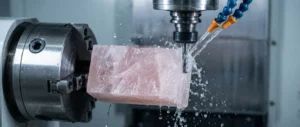
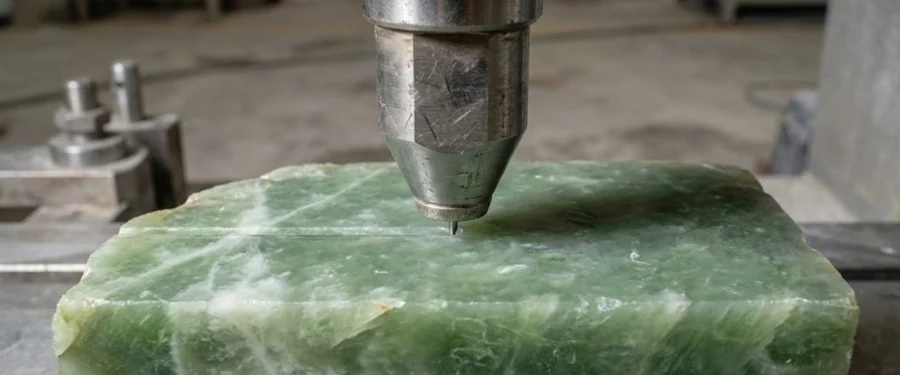
Modern lapidary manufacturing now incorporates 5-axis CNC (Computer Numerical Control) machines capable of grinding and polishing complex curves that were previously only possible by hand. These machines use distinct software algorithms to control the pressure and speed of the polishing head, adjusting in real-time based on the resistance of the material. This eliminates the human variable of fatigue, ensuring that the 1000th piece produced in a shift has the exact same surface finish as the first piece.
Furthermore, automated systems allow for the use of proprietary polishing slurries that are recycled within a closed-loop system. This not only reduces the cost of consumables like diamond powder but also significantly lowers the environmental impact of the manufacturing process. By controlling the particle size distribution in the slurry automatically, we can prevent cross-contamination of grits, which is the leading cause of random scratches in manual polishing environments.
Conclusion: The JADE MAGO Commitment to Surface Perfection
The journey of a gemstone from a rough, opaque mineral to a brilliant, light-reflecting jewel is a testament to the mastery of lapidary science. As we have explored in this guide, achieving a perfect finish is not a singular action but a cumulative result of geology, chemistry, and mechanical engineering. Whether it is understanding the fibrous matrix of Nephrite Jade to prevent orange peel, selecting the precise micron-grade of diamond paste for a Quartz crystal, or employing rigorous quality control under specific lighting, every step matters.
For our B2B partners and wholesale clients, understanding these precision gemstone polishing techniques offers a window into the value we provide. When you source from JADE MAGO, you are not just buying a stone; you are investing in a process that guarantees durability, beauty, and market superiority. A superior polish enhances the perceived value of the final product, allowing retailers to command higher prices and ensuring end-consumer satisfaction.
We invite you to explore our catalog and witness the difference that professional finishing makes. From the deep, waxy luster of our premium jade to the crisp, vitreous brilliance of our crystal components, our commitment to excellence is reflected on the surface of every piece we produce.
-900x375.webp)