
Introduction
Semi-precious stone inlays for smart glasses are becoming a key premium cue in 2026 as wearables shift from “tech” to lifestyle products.Smart glasses and XR headsets are moving from “tech demo” to lifestyle product, and that shift changes how brands think about materials. When a device lives on the face, design language becomes as important as specs, because the product is visible in every conversation, meeting, and photo.
In 2026, semi-precious stones (jade, agate, quartz/crystal families) will show up less as “big jewelry pieces” and more as engineered micro-components: replaceable temple panels, hinge caps, logo medallions, and faceplate accents. The winners won’t be the brands who use the most stone; they’ll be the teams who control risk with the right geometry, build method, and QC logic.
Table of Contents
Executive Summary: What Changes in 2026 and Why It Matters
The headline change is that smart eyewear is being pulled into the fashion and luxury orbit, not just the consumer-electronics orbit. That makes decorative components—especially tactile, cold-to-the-touch materials—commercially relevant again, because they create “recognizable” identity without changing core electronics. (Fashion Business)
At the same time, Android XR and major platform moves are accelerating the number of device makers and form factors entering the market. More device models means more “limited editions,” more accessory ecosystems, and more opportunities for modular decorative parts (especially those that can be produced and swapped without requalifying electronics). (blog.google)
Here’s the practical forecast for semi-precious stones in 2026:
- Adoption grows in small, protected zones (caps, badges, panels) rather than in large exposed slabs.
- Hybrid constructions dominate: stone + metal carrier, stone veneer laminates, and modular “accent kits.”
- Testing and disclosure become procurement requirements, not optional extras, because wearables face sweat, cosmetics, and UV exposure daily (and brands want fewer surprises after launch).\
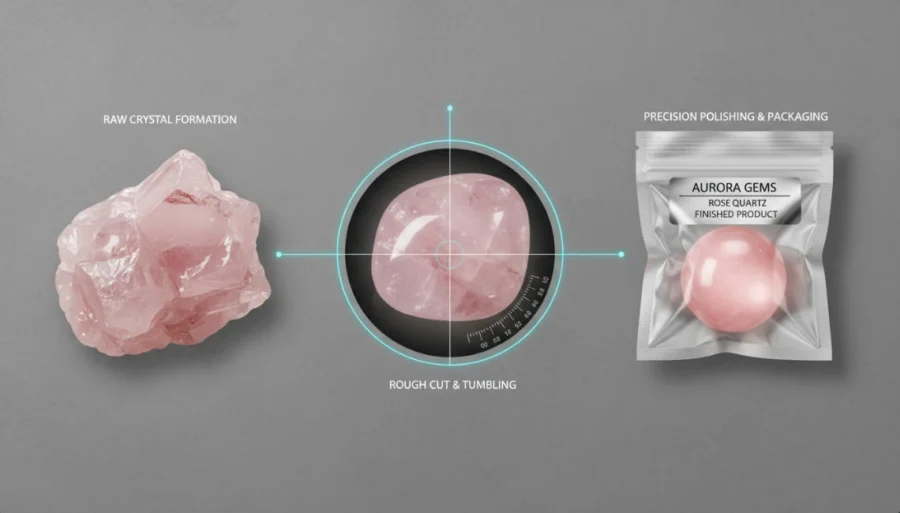
.webp "2026 Forecast: How Semi-Precious Stones Will Be Used in Smart Glasses & VR Decorative Components 1")
Component Map: Where Semi-Precious Stone Inlays for Smart Glasses & VR Devices Excel
Decorative stone is not a single “use case.” It’s a set of component opportunities with very different risk profiles, depending on location, thickness, edge exposure, and assembly shock.
Smart glasses: highest-feasibility component locations
Temple outer panels are the most straightforward place for stone accents because they provide a relatively stable, flat area with design visibility. They also allow the engineering team to build a protective perimeter (metal or polymer frame) that shields stone edges from direct impacts.
Hinge cover caps and logo medallions are also strong candidates. They keep the stone’s footprint small, reduce bending loads, and make it easier to manage scrap and yield during machining.
VR/MR headsets: realistic decorative zones
For headsets, the best targets are faceplate trims, side covers, dial/ring accents, and brand badges. These areas can be designed as modular covers that are mechanically isolated from the structural body, which reduces crack risk during drops and handling.
A common mistake is trying to place stone on zones that flex or act as load paths. If the plastic or metal beneath the stone deforms, the stone behaves like a brittle “glass layer” and fails first, especially at corners and holes.
A Do/Don’t geometry guide for industrial design teams
Do: use generous radii, protect corners, and keep stone edges recessed or framed. The goal is to prevent “first contact” impacts from hitting stone edges directly, because edge chips are what make a premium part look cheap in one day.
Don’t: design sharp corners, unsupported cantilevers, thin ribs, or long narrow strips without mechanical backing. Even if prototypes survive careful handling, assembly-line reality and consumer drops will expose the weakness quickly.
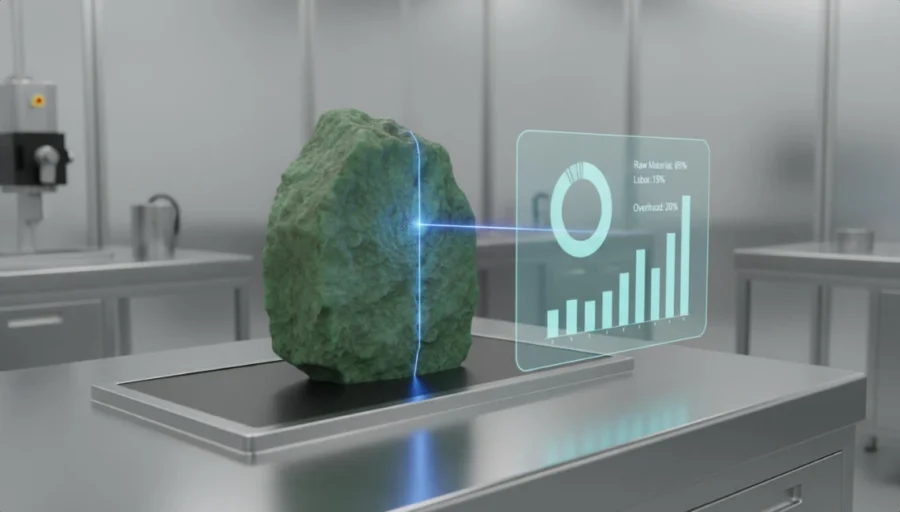
.webp "2026 Forecast: How Semi-Precious Stones Will Be Used in Smart Glasses & VR Decorative Components 2")
Material Selection in 2026: Jade, Agate, Quartz/Crystal and Their Best Use Cases
Natural stones are not like engineered plastics. They are anisotropic, variable, and full of internal stories—veins, inclusions, microcracks—that can be aesthetic features in jewelry but become yield risks in micro-components.
Jade (jadeite/nephrite): where it delivers the best “brand feel”
Jade’s strongest value in wearables is touch perception. It reads “premium” the moment someone touches it, because the surface feels dense and cool compared to coatings or painted plastics.
Jade is most suitable for signature touch points and logo medallions where thickness can be maintained and edges can be protected. For large exposed panels, the risk is that natural variance creates visible differences across batches, which complicates color matching and consistent finishing.
Agate: pattern-rich, scalable for accents if you control orientation
Agate is a powerful design tool because its banding can create a recognizable “series identity.” It also works well as a temple panel, badge, or inlay strip when you control band orientation and keep edge exposure limited.
The supply chain lesson is that agate must be treated like wood grain. If you don’t specify orientation expectations up front, you’ll receive parts that are “technically correct” but visually inconsistent across left/right temples or across production lots.
Quartz/crystal family: modern aesthetics with repeatable finishing
Quartz and crystal-like materials tend to support clean, modern design language and can be finished to high clarity or controlled frosting. That makes them attractive for minimalistic smart glasses and premium headset accents.
The tradeoff is that surface scratches and haze can be more visible on transparent or glossy finishes. In a wearable context, that means your scratch strategy—micro-texture, protective framing, or replaceable modules—matters as much as the material selection.
Natural vs treated vs synthetic: the procurement reality
“Natural” is not a single category. Treatments (heat, resin impregnation, dyeing, coatings) can change performance under UV, heat, and chemical exposure, which is exactly what wearables face daily.
In 2026 programs, expect procurement teams to ask for treatment disclosure, and for QA teams to push for verification protocols when the commercial risk is high. Even a simple internal decision tree—when to accept supplier declaration vs when to send samples for lab confirmation—can prevent brand-level disputes later.
.webp "2026 Forecast: How Semi-Precious Stones Will Be Used in Smart Glasses & VR Decorative Components 3")
Manufacturing Feasibility of Semi-Precious Stone Inlays for Smart Glasses
Most wearable programs fail with stone accents for one of two reasons. Either the design is “jewelry-first” (beautiful but not manufacturable), or the manufacturing approach is “electronics-first” (robust but visually disappointing). The win is in the middle: engineered stone aesthetics with controlled interfaces.
Option A: Full-thickness stone micro-part machining
Full-thickness stone parts are appropriate for small caps, medallions, and protected panels. They are also the easiest to explain in a BOM, because the material is straightforward and the part is a single-piece component.
However, the failure risks are concentrated at thin sections, holes, and sharp transitions. To avoid crack propagation, successful programs enforce minimum thickness rules, edge radii, and conservative hole-to-edge spacing, then validate with real handling and assembly trials—not only CAD checks.
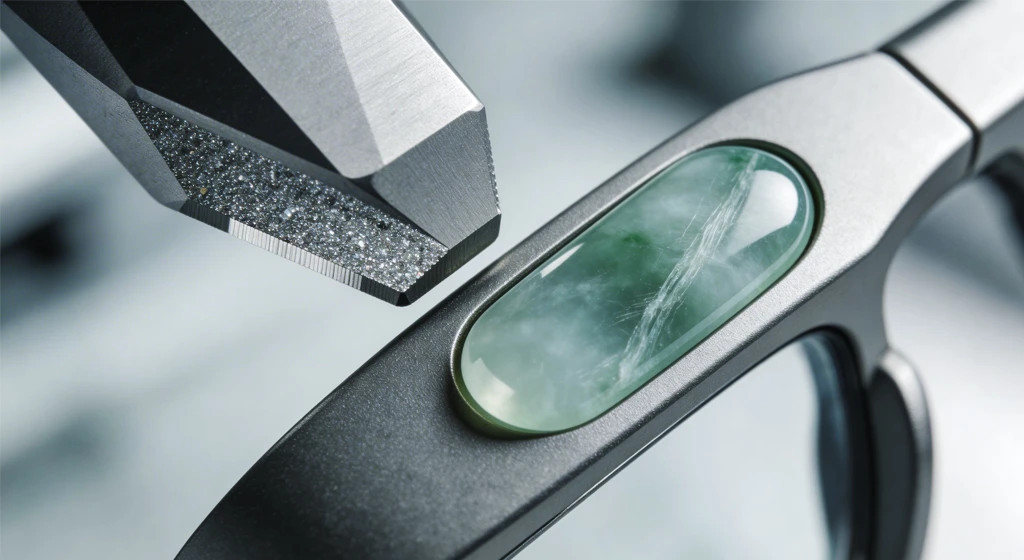
Option B: Integrating Semi-Precious Stone Inlays for Smart Glasses into Metal or Polymer Carriers
Inlay is often the best blend of luxury feel and reliability. The carrier provides structural strength, while the stone provides the surface identity. This approach also improves serviceability: in many designs, the decorative module can be replaced without touching the electronics.
The key engineering decision is whether you rely on adhesive only or combine adhesive with mechanical locking features (undercuts, frames, retention lips). For wearables, mixed retention is usually safer because sweat, UV, and thermal cycling can degrade adhesive performance over time.
Option C: Ultra-thin stone veneer laminates for weight and cost control
Veneer gives you the “real stone” look while controlling weight and reducing raw material cost. It’s also a pragmatic way to create larger decorative surfaces (like VR faceplate trims) without making the part too heavy or too fragile.
The critical constraint is flatness and thermal expansion mismatch between veneer and substrate. If the substrate warps under heat or load, the veneer experiences stress and can crack or delaminate at edges, so substrate selection and surface prep become as important as stone selection.
Option D: Hybrid “stone + metal frame” aesthetic modules
Hybrid modules are the 2026-friendly answer to warranty anxiety. They let the brand ship premium aesthetics while limiting stone exposure to protected zones, and they support accessory ecosystems (seasonal colorways, limited editions, co-branded drops).
If you expect multiple editions, design your decorative component system like a platform. A stable carrier geometry with swappable stone skins lets you reuse qualification work while refreshing the look.
.webp "2026 Forecast: How Semi-Precious Stones Will Be Used in Smart Glasses & VR Decorative Components 4")
Reliability in Wearables: The Tests That Actually Decide Warranty Rate
Wearables don’t fail like desktop devices. They fail slowly from sweat exposure, quickly from edge chips, and unpredictably from consumer behavior. Your testing plan has to mirror that reality.
Mechanical: drops, impacts, and edge chip risk
For stone accents, the most common cosmetic failure is edge chipping, not catastrophic cracking. A part can remain “functional” but look unacceptable after one impact, which becomes a return or a negative review.
Design countermeasures are straightforward: recess stone edges, use protective frames, and avoid sharp corners. Testing countermeasures are equally important: validate with drop and handling simulations appropriate to wearable use, and review failure under magnification to understand whether chips originate from corners, holes, or assembly stress.
Chemical: sweat, cosmetics, sunscreen, and cleaning agents
Smart glasses frames face sweat exposure daily, and eyewear standards explicitly include perspiration resistance testing for frames. ISO 12870 (spectacle frames) includes a resistance to perspiration test method, making it a useful reference point when you’re building a “frame-like” wearable component strategy. (ISO)
In practice, the chemical risk is often at interfaces: adhesive lines, metal-to-stone edges, and coatings. Your most valuable testing isn’t exotic—it’s simply repeating sweat and cosmetic exposure cycles, then checking gloss, discoloration, and delamination around the perimeter.
Environmental: thermal cycling, humidity, UV aging
Environmental stress is where “looks fine in prototypes” becomes “fails after six months.” Thermal cycling expands and contracts mixed-material stacks, and UV can age adhesives and some treatments.
Many electronics programs reference IEC 60068 as a family of environmental test methods (temperature, humidity, shock, vibration). Even when you don’t certify specifically to it, it’s a strong framework for thinking about severity, repeatability, and documentation. (Cybernet Manufacturing)
Surface: scratch and haze expectations
A premium stone surface can still look “worn” if micro-scratches accumulate. That means the product strategy should define what “acceptable wear” looks like and whether the decorative element is expected to be replaceable.
In 2026, replaceability will be an underrated design lever. If the accent can be swapped like a fashion accessory, the brand can treat wear as part of personalization rather than a defect.
.webp "2026 Forecast: How Semi-Precious Stones Will Be Used in Smart Glasses & VR Decorative Components 5")
Quality Control That Works for Natural Materials Without Slowing Launch
QC for natural stone is not “more inspection.” It’s the right inspection logic, so you don’t lose time arguing about subjective aesthetics during a tight launch window.
Grading strategy for mass production: A/B/C bins aligned to product tiers
Instead of fighting variance, use it. Define grading bins that map to SKUs: flagship (tight visual range), standard (moderate range), and limited edition (pattern-forward, wider variance but curated).
This approach prevents two expensive outcomes: throwing away acceptable material, and shipping visually mismatched pairs. Both problems are common when teams treat stone like a uniform plastic.
Dimensional inspection: realistic tolerances for tiny components
Stone micro-parts can hold impressive precision with the right process, but the realistic tolerance depends on geometry type. Flat panels and simple caps are easier to control than thin rings or complex freeform surfaces.
A good practice is to define critical-to-fit dimensions tightly (interfaces, locating features) while leaving cosmetic-only surfaces with reasonable allowances. This keeps assembly stable without overspending on cosmetic perfection that the user may not perceive.
Visual QC: controlling pattern variance with master boards
A master sample board is one of the fastest ways to eliminate interpretation risk. It turns “looks okay” into a documented acceptance range.
For international supply chains (US/EU brands sourcing from Asia), this is also a communication tool. It reduces subjective back-and-forth between design, procurement, and the factory when the schedule is tight.
Packaging and shipping: preventing damage before assembly
Edge chips often happen before the part ever reaches the assembly line. If you don’t control packaging, you can lose yield without realizing it, then blame machining.
The practical fix is to package stone components like optical parts: controlled separation, stable orientation, and minimized vibration during transit. It costs less than rework and protects your schedule.
Cost, MOQ, and Lead Time: What Procurement Needs for 2026 Planning
Stone accents create value, but they also create cost drivers that aren’t obvious in early renders. When procurement is surprised late, programs stall.
The honest cost drivers
Cost is driven by material grade, yield loss, geometry complexity, finishing level, and inspection intensity. The largest hidden variable is yield: if your design forces thin unsupported edges or complex undercuts, scrap increases and cost rises quickly.
Another hidden driver is pairing or matching requirements. If you require left/right temples to match visually, you must plan for sorting and selection time, which procurement should treat as part of the manufacturing process, not an afterthought.
Prototype → pilot → mass production: timeline logic
In wearables, “fast prototyping” is not the same as “fast scaling.” Prototypes can be made from the best material pieces and handled carefully, but pilot builds reveal yield and assembly pain points.
A stable plan is to treat prototyping as a DFM learning loop. The goal is not just to approve appearance; it’s to lock geometry rules, interface strategy, and QC definitions before you ramp.
How to reduce risk and cost without downgrading the look
The best lever is modularity. If the stone accent is a module with a standard carrier, you can change the “skin” without redoing the entire assembly or qualification.
The second lever is surface strategy: a controlled texture or protective framing can preserve premium feel while reducing scratch visibility. That can lower warranty risk without changing the material itself.
2026 Design Playbook: A Supplier-Ready Spec Sheet Template
Most “supplier problems” are actually spec problems. If you want reliable quotes and predictable output, give the factory the minimum viable spec that removes interpretation.
The minimum viable spec for quotation
Provide 3D CAD, 2D critical dimensions, target thickness, edge radius rules, and a clear definition of cosmetic zones. Include real-world use assumptions: sweat exposure, cleaning method, and expected drop/handling level.
If you’re building glasses-like products, referencing a known eyewear testing framework can anchor requirements. ISO 12870 is useful here because it focuses on frame durability and includes perspiration resistance testing. (ISO)
Finish definition: make it measurable
Replace subjective terms like “premium polish” with reference samples, surface gloss targets (if you measure), or process definitions (e.g., polished + chamfered edges + micro-texture zone). When the finish is the brand signature, ambiguity is your biggest enemy.
Assembly interface: adhesive area, mechanical locks, serviceability
Define adhesive footprint and keep-out zones, plus any mechanical retention requirements. If the accent is replaceable, specify how it’s removed and replaced without damaging the underlying frame.
In 2026, serviceability is increasingly a brand feature. It also reduces the fear that “one chip equals one warranty claim.”
Supplier Selection Checklist: How to Vet a Stone Decorative Component Manufacturer
In smart glasses and XR, your stone supplier is not just a “material supplier.” They are part of your reliability system.
Capability proof: what to ask for (and what proof looks like)
Ask for a sample pack that includes multiple geometries: flat panels, small caps, and edge-protected modules. Request documented QC photos and a defect taxonomy, not just “nice samples.”
If your product will face environmental stress, ask how they structure testing severity and traceability. Many teams borrow IEC 60068-style thinking for environmental exposure and mechanical stress, because it forces clarity on conditions and pass criteria. (Cybernet Manufacturing)
Communication and DFM loop: the make-or-break factor
The best factories don’t just say yes. They tell you where the design will crack, where yield will collapse, and how to change geometry to protect appearance.
If a supplier cannot explain risk in plain language, they may not be controlling it. That’s how programs end up in endless sampling loops.
Red flags when sampling and scaling
Red flags include inconsistent finishing across samples, unclear treatment disclosure, weak packaging, and an inability to define acceptance criteria. Another red flag is overpromising tolerances without explaining inspection methods and measurement tools.
A good supplier will be transparent about what’s hard. That transparency is what lets you ship.
Conclusion
In 2026, semi-precious stones will succeed in smart glasses and XR not as “luxury decoration,” but as engineered, modular accent systems built around protective geometry, hybrid constructions, and wearables-grade QC.
If you want stone aesthetics without warranty pain, treat stone like an engineered material system: define where it goes, how it’s protected, how it’s bonded, and how it’s inspected. That’s what turns a beautiful prototype into a scalable product.
FAQ
Why are semi-precious stone inlays for smart glasses considered a premium design cue?
● In 2026, smart glasses are shifting from pure technology to lifestyle products where design language is as critical as hardware specs.
● Semi-precious stone inlays for smart glasses, particularly materials like jade, provide a tactile, “cold-to-the-touch” feel that conveys luxury and recognizable identity without altering core electronics
What is the manufacturing feasibility of using natural jade in wearables?
● The manufacturing feasibility of jade micro-components depends on controlling natural variance and internal inclusions.
● When producing semi-precious stone inlays for smart glasses, using CNC machining with conservative thickness rules and edge radii is essential to avoid crack propagation.
Can CNC machining handle the complex geometries required for smart glasses stone accents?
● Yes, CNC machining is the primary method for creating high-precision semi-precious stone inlays for smart glasses.
● To ensure the best manufacturing feasibility, it is recommended to design stone parts as modular inserts or caps rather than long, unsupported strips that may fail during assembly.