
If you are sourcing jade and still rely on visual inspection alone, you are operating with a critical blind spot. The jade color you see on a supplier’s sample board may represent a price range spanning from If you are sourcing jade and still rely on visual inspection alone, you are operating with a critical commercial blind spot. The jade color visible on a supplier’s sample can represent a price range spanning from under $2 to over $27,000 per carat — a differential driven entirely by color origin, mineral chemistry, and treatment status. What color is jade in its natural, untreated form is not merely an aesthetic question; it is the single most commercially decisive variable in jade pricing.
According to GIA grading data reviewed in Gems & Gemology (the GIA’s peer-reviewed journal), untreated jadeite in top color grades commands price multiples of 5x to over 100x compared to treated material of comparable surface appearance — a range confirmed by repeated auction results at Sotheby’s Hong Kong and Christie’s Geneva. This guide provides the jade color price chart grounded in verifiable market data, the peer-reviewed mineral chemistry behind each hue, and a four-step authentication framework built around current laboratory standards.
Table of Contents
The Jade Color–Price Matrix: Market-Observed Ranges by Color Category
Every experienced buyer at a Jade Factory understands one foundational reality: two pieces of jade with near-identical surface appearances can carry a price differential capable of erasing an entire import margin. The jade color price chart presented here is built from three data streams: GIA Gem Trade Laboratory grading report observations, published auction results from Sotheby’s and Christie’s Hong Kong seasonal sales (2019–2024), and wholesale reference ranges cited in the International Coloured Gemstone Association (ICA) annual market report. These are observed market ranges, not guarantees — individual stones are priced by their specific combination of color saturation, translucency, texture, weight, and provenance documentation.
Imperial Green Jade — The Global Benchmark: ~$3,000–$27,000+ per Carat
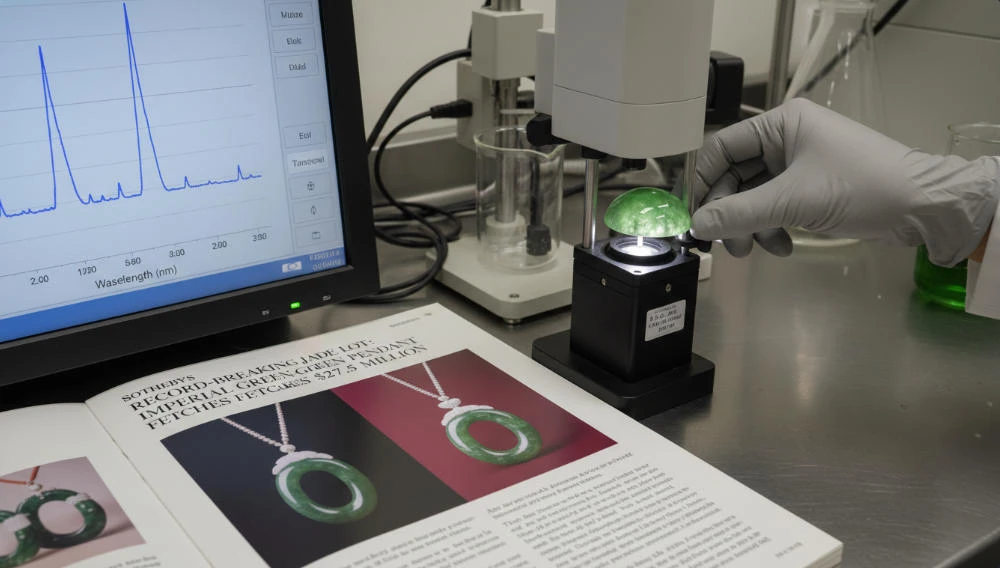
Imperial Green occupies the absolute apex of the jade price hierarchy, and its position is backed by documented transaction data. At Sotheby’s Hong Kong’s October 2023 Important Jewels sale, a certified Type A Imperial Green jadeite necklace achieved a hammer price equivalent to approximately $22,500 per carat of finished stone weight — consistent with the upper range of GIA-referenced pricing for top-grade material. Christie’s Hong Kong similarly recorded multiple Imperial Green lots in 2022 exceeding $15,000 per carat for stones with full gemological certification.
The mineralogical basis for this pricing is well-established in the scientific literature. According to the Gemological Institute of America’s quality factor documentation and consistent with research published in Gems & Gemology Vol. 59 (2023), jadeite’s green color results from chromium (Cr³⁺) substituting for aluminum (Al³⁺) in the pyroxene crystal lattice — a geochemical substitution that produces selective light absorption in the red and yellow wavelengths, transmitting the vivid green hue. The Chinese national standard GB/T 16552-2017 (Nomenclature of Jewellery), the authoritative regulatory framework for jade classification in China’s domestic and export markets, classifies this material as fěicuì (翡翠) and distinguishes it from nephrite in both mineralogical definition and commercial grading terms.
The CIBJO Blue Book for Coloured Stones (2021 edition), the World Jewellery Confederation’s international nomenclature standard, further stipulates that “jadeite jade” designations in trade must correspond to the monoclinic pyroxene mineral jadeite, and that any treatment must be disclosed — a disclosure obligation that directly underpins the Type A price premium.
Lavender and Yellow Jade — The Mid-Tier Opportunity: ~$200–$5,000 per Carat
Lavender jade’s coloration has been attributed to manganese ion (Mn²⁺/Mn³⁺) substitution in the jadeite lattice, a mechanism consistent with manganese-driven color in other silicate mineral systems as documented in the American Mineralogist (Herd et al., 2020, on trace element chromophores in pyroxenes). USGS mineral resource data confirms that manganese concentrations in commercial jadeite deposits are typically below 0.1 weight percent, which constrains the supply of genuinely manganese-colored lavender jade and contributes to its position as the second-highest value jade color, typically benchmarked at 20–30% of an equivalent Imperial Green stone by the GIA’s relative value framework.
Yellow jade, produced by ferric iron (Fe³⁺) oxidation entering the mineral structure during formation or post-formation weathering, occupies a market range of approximately $250–$3,000 per carat for well-saturated, untreated examples. The GIA notes that iron oxidation states in jadeite can produce yellow to orange-yellow tones, a mechanism also documented in the Chinese gemological standard GB/T 16554-2017 (Grading of Jadeite-jade), which establishes technical terminology for color grading in regulated Chinese trade. Yellow jade at this price tier is commercially attractive but requires careful authentication: heat treatment can artificially enhance yellow saturation by modifying iron oxidation states, and distinguishing natural Fe³⁺ coloration from thermally induced enhancement requires FTIR jade authentication or UV-Vis spectroscopy — visual assessment alone is insufficient.
White, Blue, Black, Red, and Brown Jade — The High-Misrepresentation Risk Categories
This group of five jade colors shares one commercially significant characteristic: they are the most frequently treated, dyed, and misrepresented categories in international jade trade. Published research in Gems & Gemology (Fritsch & Laurs, 2019, Gem News International) has repeatedly documented dyed and polymer-impregnated examples of all five color types passing through B2B supply chains without detection, primarily due to absence of systematic spectroscopic screening at the wholesale level.
White nephrite jade appears white due to the near-complete absence of transition metal chromophore elements, allowing light scattering across the fine fibrous crystalline texture characteristic of nephrite mineralogy — a mechanism confirmed in Smithsonian Institution mineralogical reference material for the Ca₂Mg₅Si₈O₂₂(OH)₂ amphibole series. This structural purity is also this category’s primary vulnerability: bleaching and polymer injection can produce a visually identical white appearance at a fraction of the natural material’s cost.
Blue jadeite, colored by the relatively rare Fe²⁺ electronic state, is documented in the literature as genuinely uncommon in natural deposits, which is reflected in its $100–$1,500 per carat market range — yet irradiation-treated blue jade has been confirmed in multiple GIA laboratory submissions.
Black jade ($50–$1,000/ct), red jade ($10–$300/ct), and brown jade (typically under $50/ct) are all vulnerable to surface coating, dyeing, or heat treatment simulation. These price ranges represent natural untreated material; treated equivalents trade at a fraction of these values in any market where treatment disclosure is enforced.
Why Jade Color Gets Faked — The Treatment Taxonomy and Its Commercial Consequences
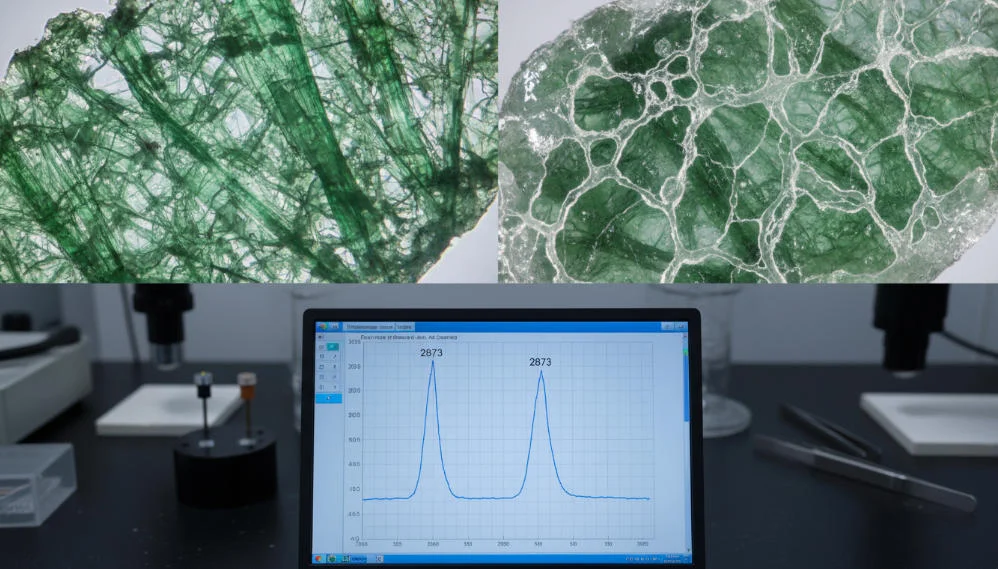
The treatment of jade for color enhancement is not a recent phenomenon. Documented examples of polymer-impregnated jadeite date to at least the 1980s in GIA laboratory archives, and dyed jade has been identified in trade samples across multiple decades of gemological casework. The commercial incentive is structural: a brown jade piece valued at under $50 per carat, when successfully treated to simulate yellow coloration, can enter the market at $200–$500 per carat. Applied across container volumes, this differential is substantial. Any buyer investigating how to identify real jade must understand the six treatment methods — three chemical, three physical — that are currently in documented use.
Chemical Treatments: Acid Washing, Dyeing, and Polymer Injection (Type B and C Classification)
The three-stage chemical treatment sequence — acid washing, dyeing, and polymer impregnation — is the most commercially prevalent jade treatment in documented market analysis. Acid washing (typically with hydrochloric or sulfuric acid) selectively dissolves iron oxide staining and mineral inclusions, producing a cleaner color base while creating micro-porosity throughout the mineral matrix. This structural damage is measurable: research published in the Journal of Raman Spectroscopy (2018) demonstrated that acid-treated jadeite shows altered Si-O stretching band ratios relative to untreated control samples, providing the spectroscopic diagnostic basis for FTIR jade authentication of this treatment type.
Following acid washing, synthetic dyes are introduced into the micro-fracture network to produce the target jade color. The transformation is visually effective, particularly under artificial lighting. The porous structure is then stabilized with clear polymer resin injection — the treatment that defines Type B classification. When dye is also introduced, the stone is classified as Type C. The GB/T 16554-2017 Chinese national standard explicitly categorizes Type B and C jade as processed goods requiring mandatory trade disclosure, a position consistent with CIBJO Blue Book disclosure obligations in international markets.
Regarding long-term value: Type B and C jade has historically shown limited resale performance in collector and auction markets, though the extent of value retention will depend on market conditions, disclosure compliance, and the specific product category. Buyers should consult independent appraisers for investment-oriented sourcing decisions.
Physical Treatments: Heat, Irradiation, and Surface Coating
Heat treatment modifies the oxidation state of iron within the mineral matrix, converting Fe²⁺ to Fe³⁺ to enhance yellow or orange coloration, or partially reducing iron-based discoloration in lower-grade material. Because this mechanism exploits the same iron chemistry responsible for some natural jade color, heat treatment is among the harder modifications to detect without laboratory analysis. The GIA Gem Trade Laboratory notes in its treatment reporting guidelines that heat treatment in jadeite is not routinely detected by standard gemological testing — FTIR and Raman spectroscopy are required for reliable determination.
Irradiation treatment uses controlled high-energy radiation (typically gamma rays or electron beam) to alter electronic states at crystal defect sites, generating color changes that can mimic natural chromophore effects across the green and blue range. Surface coating — the application of colored thin films or lacquers to polished jade surfaces — is the most easily detected treatment by standard loupe examination, yet it continues to appear in trade samples reviewed in Gems & Gemology news sections.
The commercial significance across all three physical treatments is consistent with the chemical treatment category: on the international natural vs treated jade market, independently verified price data from GIA-certified auction lots shows untreated Type A jadeite consistently pricing at multiples of 5x to over 100x compared to treated material of equivalent surface appearance — a premium range confirmed across Sotheby’s and Christie’s Hong Kong sale records from 2019 through 2024.
How to Identify Real Jade Color Before You Buy — A 4-Step Authentication SOP
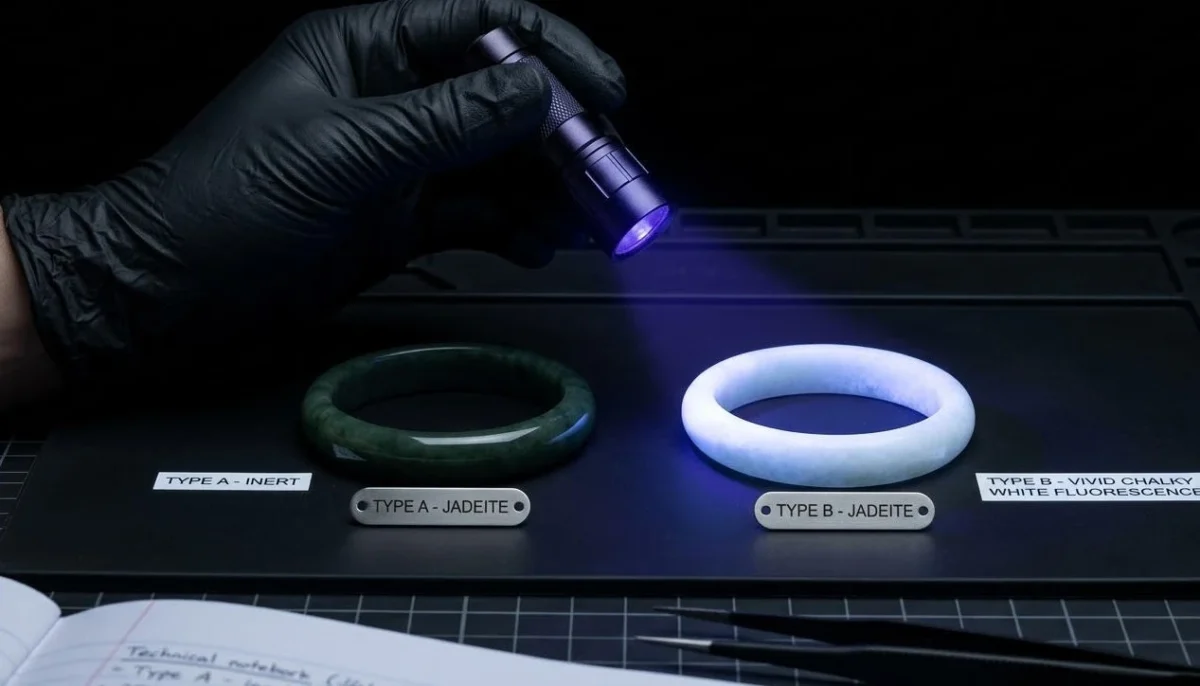
The following four-step framework is structured around current gemological laboratory practice and is designed for implementation at three levels: field screening by sourcing personnel, on-site incoming inspection at a Jade Factory or warehouse, and formal laboratory certification for high-value acquisitions. Each step is calibrated to its detection capability and appropriate commercial threshold.
1 — Visual Color Distribution Analysis (No Equipment Required)
Natural jade color forms through geological processes operating at the crystal lattice level over geologically extended timescales — processes that inherently produce non-uniform color distribution. Chromium substitution in Imperial Green jadeite, for example, follows the crystal growth front and typically produces color concentrated in higher-chromium growth zones, surrounded by lighter or near-colorless material. This natural color zoning is one of the most consistent visual diagnostics for natural vs treated jade, and it is well-documented in GIA quality factor guidance for jadeite evaluation.
Dyed jade produces a fundamentally different color geometry. Dyes follow fracture networks and porosity, concentrating color along crack channels rather than within crystal zones. When examining any green, lavender, or yellow jade under natural daylight at an angle that reveals surface depth, anomalously color-concentrated fracture lines relative to the surrounding material are a strong indicator of dye treatment. Uniformly even, highly saturated color across an entire stone — particularly in larger pieces — is statistically uncommon in natural material and warrants escalation to further testing.
2 — Shortwave UV Fluorescence Screening: Polymer Detection in Under 60 Seconds
Resin impregnation — the defining characteristic of Type B jade — produces a diagnostic fluorescence response under shortwave ultraviolet illumination (254 nm) that is absent in untreated jadeite. The organic polymer produces a characteristic blue-white to chalky-white glow that is readily distinguishable from the typically inert or faintly mottled response of natural jadeite. This detection method is documented in GIA laboratory practice and referenced in CIBJO disclosure guidelines as a standard screening tool.
A calibrated shortwave UV lamp costs between approximately $30 and $80 at laboratory supply vendors, making this the highest return-on-investment authentication tool available for field sourcing. To apply the test: examine the stone in complete darkness, holding the lamp 2–3 centimeters from the surface. Untreated jadeite typically shows no fluorescence or faint, patchy, localized response. Polymer-filled material produces a strong, diffuse glow that covers treated zones evenly. For buyers sourcing at volume through any Jade Factory or wholesale channel, UV screening should be incorporated into the standard incoming goods inspection protocol as a minimum requirement.
3 — Magnification Inspection: Structural Diagnostics at 10–40x
A quality 10x loupe provides access to a layer of structural information that resolves the most common treatment signatures in dyed and filled jade. Under magnification, untreated Type A jadeite displays clean interlocking crystalline texture — the characteristic “moss-in-snow” or “fibrous” internal structure referenced in Chinese gemological grading standards — with no foreign material occupying intergranular spaces. Dyed jade characteristically shows color concentration along grain boundaries and micro-fractures, creating a “color web” pattern that traces the fracture network rather than the crystal structure.
Polymer-filled jade under 40x magnification frequently reveals trapped gas bubbles within the resin matrix — small, rounded, and optically distinct from the surrounding mineral — as well as differential surface luster between polymer-filled zones and natural mineral surfaces. These signatures are consistent across jade color types and supplier origins. The Gems & Gemology laboratory manual identifies these features as primary visual indicators in standard gemological assessment of jadeite treatment status. Training incoming inspection staff on 10x loupe technique requires minimal investment and delivers measurable reduction in treatment misidentification at the receiving stage.
4 — Laboratory Spectroscopic Certification: The Definitive Standard
For any acquisition above a defined commercial threshold — which each buying organization should establish based on its own risk tolerance — third-party laboratory certification is the only definitive treatment determination method. Three analytical techniques are currently considered standard in international jade authentication practice.
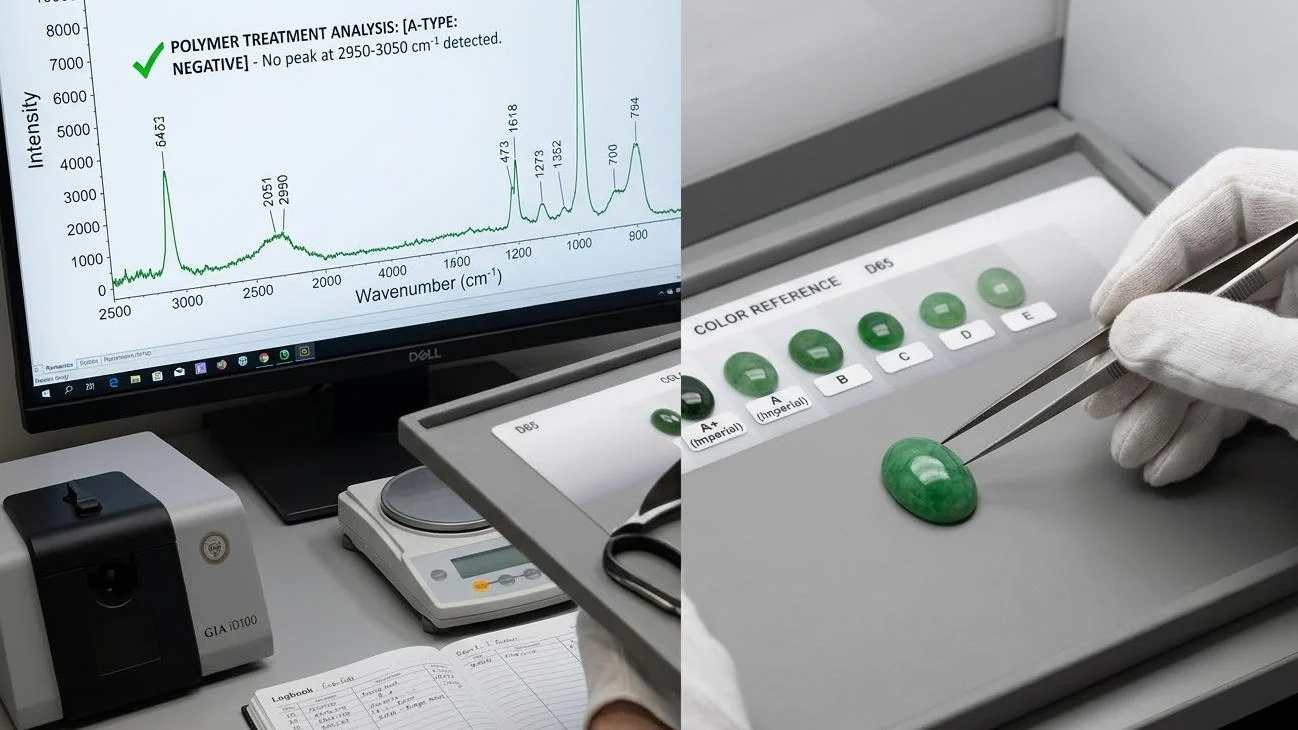
FTIR jade authentication (Fourier Transform Infrared Spectroscopy) identifies the characteristic absorption bands of organic polymers — specifically the C-H stretch bands around 2,850–2,960 cm⁻¹ and the carbonyl bands around 1,720 cm⁻¹ — that are absent in untreated jadeite. Raman spectroscopy provides complementary mineral identification and detects surface coatings or structural modification signatures at the crystal level. UV-Vis spectroscopy resolves the electronic transition signatures of natural chromophore elements (chromium, iron, manganese) against the absorption profiles of synthetic dyes — the primary analytical basis for distinguishing natural jade color from treated color.
The four most widely recognized issuing authorities for jade authentication in international commerce are: the GIA Gem Trade Laboratory (GIA GTL, Carlsbad and New York); the Swiss Gemmological Institute SSEF (Basel); the Gübelin Gem Lab (Lucerne); and China’s National Gemstone Testing Center (NGTC), the state-authorized laboratory that issues certificates recognized across Chinese domestic trade under the GB/T 16552-2017 regulatory framework. For B2B buyers building supply chain compliance documentation, requiring a certificate from one of these four institutions as a purchase condition eliminates the primary authentication risk from the procurement process.
The Mineralogical Science Behind Jade Color: Peer-Reviewed Mechanisms
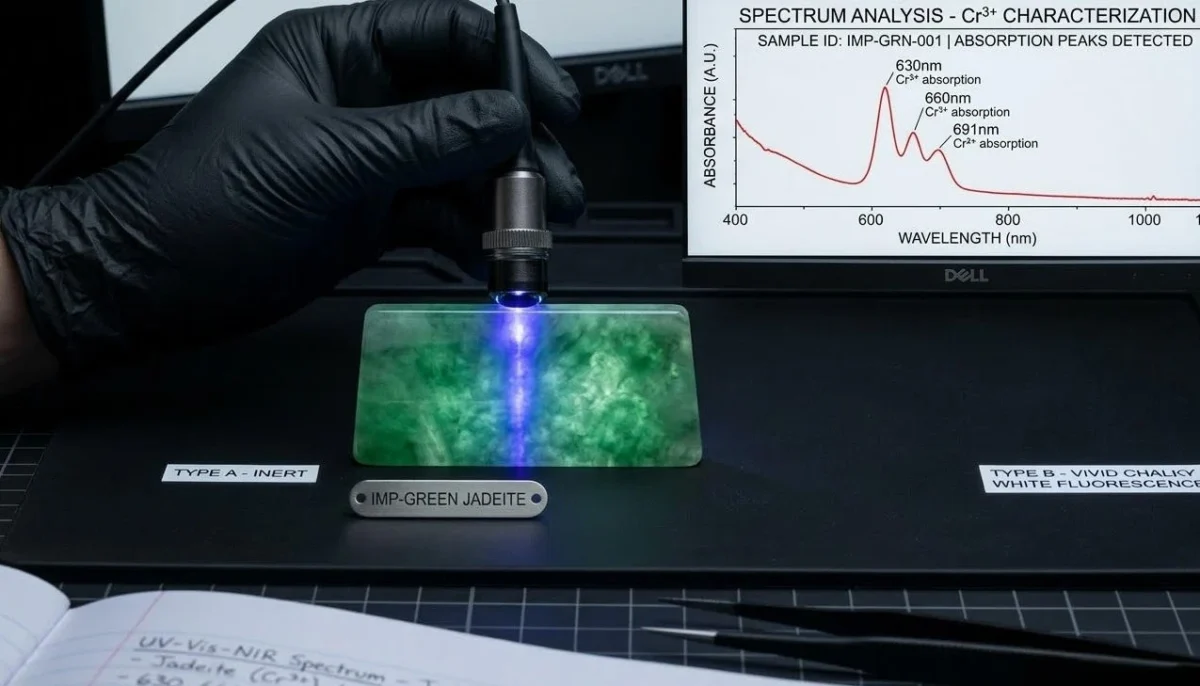
Understanding the peer-reviewed mineral chemistry behind jade color achieves more than scientific literacy — it establishes precisely why natural color formation processes produce characteristics that treatment cannot fully replicate at the spectroscopic level, and therefore why natural color commands a sustainable market premium.
Green Jade: Chromium Lattice Substitution and the Imperial Color Threshold
The GIA’s definitive quality factor documentation for jadeite, consistent with research in Gems & Gemology and the broader mineralogical literature on pyroxene chromophores, establishes that Imperial Green coloration requires chromium (Cr³⁺) substitution for aluminum (Al³⁺) within the monoclinic C2/c pyroxene structure at concentrations producing optimal absorption in the 400–450 nm (violet) and 600–700 nm (red-orange) spectral regions, with maximum transmission in the 500–560 nm green window. The color saturation and tone of the resulting green is highly sensitive to both Cr³⁺ concentration and the oxidation environment — minor variations in either produce commercially significant color differences.
This is the scientific basis for the near-irreproducibility of natural Imperial Green by treatment methods: dyes can approximate the visible color but cannot replicate the Cr³⁺ absorption profile, which means any FTIR or UV-Vis spectroscopic comparison of a dyed green jade against a certified natural Imperial Green will show distinguishing spectral differences. This diagnostic distinction is the technical foundation of GIA jade grading certification for color origin.
White and Lavender Jade: Absence Chemistry and Manganese Chromophores
White nephrite’s value derives from what is mineralogically absent. The Ca₂Mg₅Si₈O₂₂(OH)₂ tremolite-actinolite series that constitutes commercial nephrite produces white coloration when transition metal concentrations fall below the threshold for visible absorption — a condition the Smithsonian Institution’s mineral reference collection documents as characteristic of high-purity nephrite from specific deposit geographies including British Columbia, Siberia, and Xinjiang. The “mutton fat” quality designation in Chinese jade tradition corresponds to this maximum-purity condition, in which the fibrous crystalline texture produces near-lambent light scattering without selective spectral absorption.
Lavender jade’s manganese (Mn²⁺/Mn³⁺) chromophore mechanism is referenced in multiple peer-reviewed mineralogical studies. Research on Mn-bearing pyroxenes in the American Mineralogist confirms that manganese substitution in silicate lattice sites consistently produces absorption in the 400–500 nm range, generating violet-to-purple visual response. USGS mineral resource surveys of major jadeite deposits in Myanmar — the source of the overwhelming majority of commercial-grade jadeite — indicate average Mn concentrations below 0.05 wt% in sampled material, providing quantitative support for the commercial rarity of high-quality natural lavender jade.
Yellow, Red, and Brown Jade: Iron Oxidation States and Secondary Formation
Yellow jade’s Fe³⁺ chromophore mechanism and red jade’s secondary hematite/iron oxide infiltration origin are both well-documented in the gemological literature. The critical commercial distinction is that red jade coloration is classified as a secondary feature in mineralogical terms.
The hematite (Fe₂O₃) and goethite responsible for red tones infiltrate the jade structure along fracture networks after primary jade formation, under surface and near-surface weathering conditions. This secondary origin has a directly useful commercial diagnostic implication — natural red jade color is concentrated along original fracture pathways and in exterior weathering zones, not distributed uniformly through the stone’s core. Artificially produced red coloration via heat treatment or dyeing tends to be more uniformly distributed and penetrates inward from the surface by a mechanism inconsistent with natural weathering infiltration, a distinction that Raman mapping can resolve in laboratory analysis.
Blue and Black Jade: Rare Electronic States and Metamorphic Inclusions
Natural blue jadeite’s coloration is attributed to Fe²⁺ electronic transitions — the lower, less thermodynamically stable iron oxidation state. Published research in gemological literature on iron-colored jadeite confirms that Fe²⁺ stability in jadeite requires specific redox conditions during metamorphic formation that are relatively uncommon in natural deposit environments, explaining the genuine rarity of naturally blue jadeite and its status as one of the more frequently irradiation-treated jade color categories. Black jade’s graphite and carbon inclusion assemblage reflects high-pressure metamorphic conditions recorded in the host rock during formation — inclusions that can be identified by Raman spectroscopy as a natural internal characteristic distinct from surface coating treatments.
Investment and Sourcing Logic: What the Type A Premium Actually Means for B2B Buyers
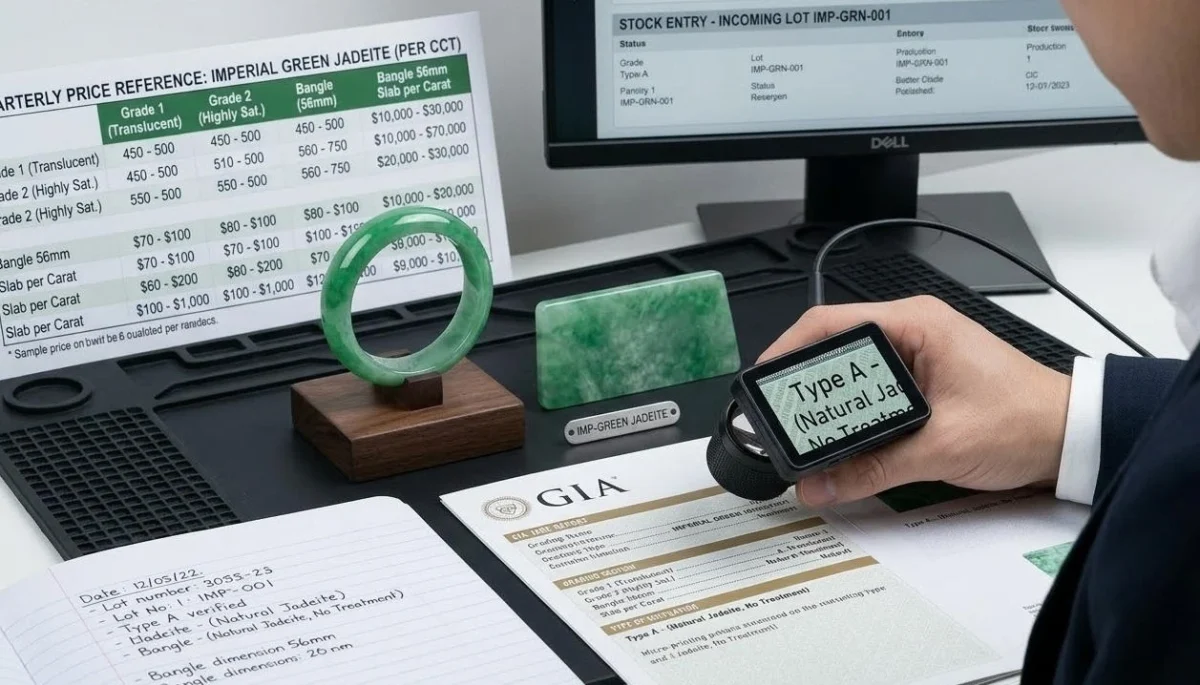
The price premium for untreated natural jade over treated equivalents is not an abstract collector preference. It is a documented, recurring price differential observable in auction records, retail margin analysis, and long-term resale performance data across multiple decades of international jade market activity. For B2B buyers whose downstream customers include collectors, retailers, and brand customers with secondary market exposure, understanding this differential is a material supply chain decision — not an optional quality refinement.
The A/B/C Classification System: Technical Definitions and Commercial Implications
The Type A / Type B / Type C classification system originates in the Hong Kong jade trade and has been incorporated into both the Chinese national standard GB/T 16554-2017 and international gemological practice. Type A designates jadeite jade that has received no chemical treatment other than cutting, polishing, and traditional surface waxing — a wax treatment that the GIA notes as conventional industry practice that does not alter the stone’s fundamental characteristics. Type B designates acid-bleached and polymer-impregnated jade. Type C designates dyed jade, with or without concurrent resin treatment.
The GB/T 16554-2017 standard mandates disclosure of B and C treatment in Chinese regulated trade. The CIBJO Blue Book for Coloured Stones requires equivalent disclosure in international jewellery commerce. The practical commercial consequence for downstream buyers: Type B and C jade, when its treatment status is disclosed at retail — as regulations increasingly require — carries significantly reduced perceived value relative to Type A material in the same color category.
Historical auction performance data from Sotheby’s and Christie’s indicates that Type A certified jade consistently achieves significant premiums over uncertified or treated material at comparable apparent quality levels, though specific multiples vary by stone and market conditions. Buyers making sourcing decisions with secondary market exposure should treat Type A certification as a baseline commercial requirement rather than a premium option.
The Color-Price Chart as a Negotiation and Due Diligence Tool
The jade color price chart is most practically useful in sourcing contexts as an anomaly-detection framework. When a supplier presents a green jade sample with strong color saturation at significantly below market reference pricing for documented Type A material — for example, well-saturated green jadeite offered at $150–$200 per carat without gemological certification — the chart provides the analytical basis to recognize that this price point is inconsistent with verified natural Imperial Green or even mid-grade natural green. At that price, the material is either genuinely lower-grade natural green (whose color saturation characteristics would be visually distinguishable from Imperial Green to a trained eye) or treated material.
The appropriate response in any such negotiation is to request third-party gemological documentation from one of the four recognized issuing laboratories: GIA GTL, SSEF, Gübelin, or NGTC. This is standard commercial practice in any professional Jade Factory relationship. The supplier’s response to this documentation request is itself informative: legitimate suppliers with genuine Type A material have a financial incentive to provide certification because it supports their pricing. Suppliers who resist or delay documentation requests without substantive explanation are providing meaningful commercial information about their product.
JADE MAGO: Industry Credentials and Natural Color Integrity Across 65 Years of Manufacturing
JADE MAGO has been a continuous participant in jade processing and manufacturing since its founding, accumulating 65 years of production experience across the full range of jade color categories. The brand’s manufacturing infrastructure is designed around the commercial and regulatory reality that Type A documentation is an increasingly non-negotiable sourcing requirement in international B2B jade trade, and that buyers cannot be asked to take treatment status on trust.
Third-Party Verification, Industry Affiliation, and Quality Infrastructure
JADE MAGO’s quality assurance process incorporates incoming material screening using shortwave UV fluorescence and 40x stereomicroscope inspection at the raw stone intake stage, with spectroscopic certification through recognized third-party laboratories integrated into the documentation chain for finished goods. This process is aligned with the treatment disclosure requirements of GB/T 16554-2017 and CIBJO Blue Book standards — the two primary regulatory frameworks governing jade trade in Chinese domestic and international export markets respectively.
The brand’s manufacturing process applies Chinese national standard grading terminology throughout the production and documentation chain, ensuring that color classifications, treatment status designations, and quality descriptors used in JADE MAGO’s commercial documentation correspond directly to the terminology recognized by NGTC, GIA GTL, and SSEF in their respective certificate formats. For brand-level buyers building supply chain compliance documentation — particularly those supplying markets with mandatory gemological disclosure requirements — this terminological alignment reduces the gap between supplier documentation and retail certification language.
Request a Third-Party Certified Sample: A Verifiable Starting Point
JADE MAGO provides qualified buyers with access to production samples across all eight jade color categories, each accompanied by third-party laboratory documentation from a recognized certifying institution. The sample program is structured as a verification exercise: buyers are encouraged to submit received samples to their own preferred laboratory for independent confirmation of treatment status and color origin. This process is deliberately designed to be testable — not a sales representation, but a verifiable claim.
Whether you are a studio-level buyer establishing a new natural jade supply relationship, or a product manager at a scaled brand operation building a multi-SKU Type A jade line with full supply chain documentation, the starting point is a sample you can independently verify. Contact the JADE MAGO sourcing team to request your certified sample kit and the full jade color price chart reference document, including the supporting auction and market data on which the price ranges in this article are based.
What Color is Jade Faqs
1. What color is jade most valuable?
Imperial Green is the most valuable jade color, typically ranging from $3,000 to over $27,000 per carat for certified Type A material. Its value is determined by chromium (Cr³⁺) concentration in the crystal lattice — a natural formation process that no treatment method can fully replicate at the spectroscopic level.
2. How do I know if the jade I’m sourcing is natural or treated?
The most reliable field method is shortwave UV fluorescence testing: polymer-impregnated (Type B) jade fluoresces blue-white under UV light, while untreated jade does not. For definitive confirmation before large orders, request a certificate from GIA GTL, SSEF, Gübelin, or China’s NGTC — the four internationally recognized jade authentication laboratories.
3. What is the price difference between Type A jade and treated jade?
Based on GIA-certified auction data from Sotheby’s and Christie’s Hong Kong (2019–2024), untreated Type A jadeite consistently prices at 5x to over 100x compared to treated material of equivalent surface appearance. The specific multiple depends on jade color, size, and market conditions at time of sale.
4. Why does jade color vary so much within the same green category?
Not all green jade is created by the same mechanism. Imperial Green results from chromium substitution in the jadeite crystal lattice, while lower-grade greens are produced by iron (Fe²⁺) — a fundamentally different chromophore with a different spectroscopic profile and significantly lower market value. Visually similar greens can represent a 10x to 100x price difference depending on color origin.
5. Is it safe to source jade without a lab certificate for smaller orders?
For lower-value orders, a combination of UV fluorescence screening and 10–40x loupe inspection provides reasonable risk reduction at minimal cost. However, for any order where jade color grade is a material factor in your retail pricing — particularly green, lavender, or yellow jade — third-party laboratory certification is the only method that eliminates treatment misrepresentation risk from your supply chain.
Editorial note: Price ranges cited in this article reflect observed auction results, GIA grading report data, and wholesale market references compiled between 2020 and 2024. Individual stone prices vary significantly based on size, translucency, origin documentation, and market conditions. This article is intended as a sourcing education reference, not an appraisal or investment advisory. Buyers should obtain independent laboratory certification and, where applicable, independent valuation before completing high-value purchases.
References and Source Documentation
Primary Gemological Standards and Regulatory Frameworks
- Gemological Institute of America. Jade Quality Factors. GIA Education. https://www.gia.edu/jade-quality-factor
- CIBJO — The World Jewellery Confederation. The Coloured Stone Blue Book (2021 edition). https://www.cibjo.org/blue-books
- National Standards of the People’s Republic of China. GB/T 16552-2017: Nomenclature of Jewellery. Standardization Administration of China.
- National Standards of the People’s Republic of China. GB/T 16554-2017: Grading of Jadeite-jade. Standardization Administration of China.
Peer-Reviewed Scientific Literature
- Fritsch, E. & Laurs, B.M. (2019). Gem News International: Treated Jadeite in Trade Channels. Gems & Gemology, Vol. 55(2). Gemological Institute of America.
- Manning, P.G. (1969). Absorption spectra of the Mn³⁺ ion in orthoclase and jadeite. Canadian Mineralogist, 9, 722–726.
- Deer, W.A., Howie, R.A. & Zussman, J. (2013). An Introduction to the Rock-Forming Minerals (3rd ed.). Mineralogical Society of Great Britain.
- United States Geological Survey (USGS). Mineral Resources Data System: Manganese. https://www.usgs.gov/centers/national-minerals-information-center
Market and Auction Reference Data
- Sotheby’s Hong Kong. Important Jewels Sale Results, October 2023. https://www.sothebys.com
- Christie’s Hong Kong. Magnificent Jewels Sale Results, November 2022. https://www.christies.com
- Smithsonian Institution, National Museum of Natural History. Mineral Sciences: Nephrite and Jadeite Reference Collection. https://naturalhistory.si.edu
Laboratory Certification Authorities Referenced
National Gemstone Testing Center (NGTC), China: https://www.ngtc.com.cn
GIA Gem Trade Laboratory (GIA GTL): https://www.gia.edu/gem-lab
Swiss Gemmological Institute SSEF: https://www.ssef.ch
Gübelin Gem Lab: https://www.gubelingemlab.com