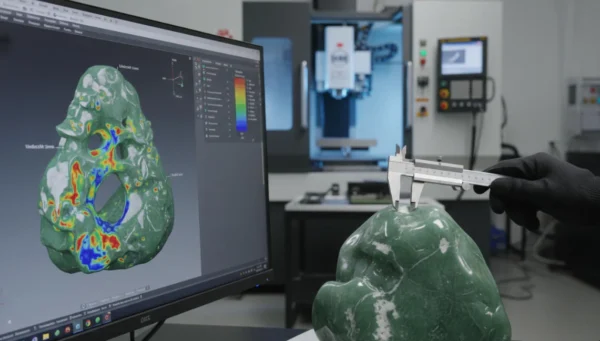
In jade process, a positioning shift of just 1–2mm can turn a premium raw material into scrap. That’s not a warning label — it’s a documented production reality that experienced jade processing manufacturers encounter across both manual and CNC operations. In a single batch run, uncontrolled Positioning Shift has been shown to reduce yield rates by 20–40%, depending on product type and raw material grade. If your operation handles high-value jade — carved figures, qiaose pieces, drilled pendants — the cost of ignoring this issue compounds fast. This article breaks down every major cause of positioning error in jade processing, maps each failure to its real production cost, and gives you the specific prevention protocols that reduce rework and scrap at the process level.
Table of Contents
What Positioning Shift Actually Means in Jade Process — And Why It Hits Harder Here Than Anywhere Else
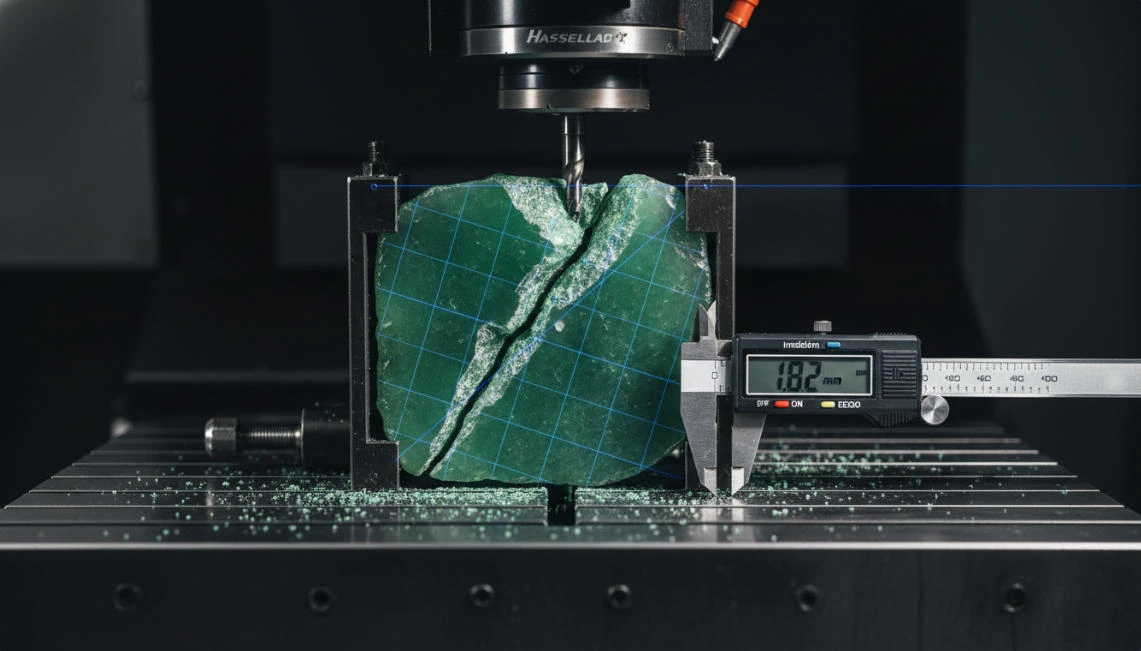
Most machining materials tolerate minor positional deviation without catastrophic consequences. Jade process does not work that way. The combination of jade’s brittleness, its natural color zoning, and the irregular geometry of raw blanks means that positioning errors which would be acceptable in metal fabrication can cause irreversible structural and aesthetic damage in jade. Understanding this distinction is the starting point for any serious jade processing operation.
Defining Positioning Shift in Jade Processing
Positioning Shift refers to the deviation between a workpiece’s intended position during machining and its actual position at the moment of cutting, drilling, or engraving. In jade process, this deviation can occur across multiple axes simultaneously. Linear shift along the X or Y axis typically results in asymmetry and hole displacement. Deviation along the Z axis produces uneven thickness. Rotational offset — often the hardest to detect visually — causes pattern distortion that only becomes obvious after finishing. According to the Gemological Institute of America (GIA), jade’s physical properties vary significantly between nephrite and jadeite, and both types demand tight positional control during processing due to their directional fracture behavior.
Why Jade Is More Vulnerable Than Other Materials
A steel or aluminum workpiece can absorb minor positional error through material ductility. Jade process risks are fundamentally different because jade has virtually no ductility — it is a brittle material that fractures rather than deforms. This means that when a cutting tool contacts jade at a position even slightly outside the designed safe zone, the energy of that contact propagates as a crack rather than being absorbed as deformation. The International Gem Society (IGS) notes that jadeite’s toughness — while high for a gemstone — is still directionally dependent, making tool path accuracy in jade CNC machining directly linked to structural integrity outcomes. For your production operation, this translates to a straightforward principle: the tolerance window in jade is narrower, and the consequences of exceeding it are more final.
The Four Root Causes That Drive Positioning Error
Jade process risks from positioning shift don’t come from a single source. They arise from four overlapping categories: fixturing instability, measurement error, machine-level inaccuracy, and human operational variance. In practice, these causes compound each other — a slightly loose fixture combined with a worn tool and an operator working from visual alignment can produce moderate-to-severe deviation even when each individual factor seems manageable. This compounding behavior is why positioning shift cannot be controlled by addressing only one cause at a time. Your prevention strategy has to be systemic.
The Three-Tier Loss Model — Quantifying What Positioning Shift Costs in Jade Processing
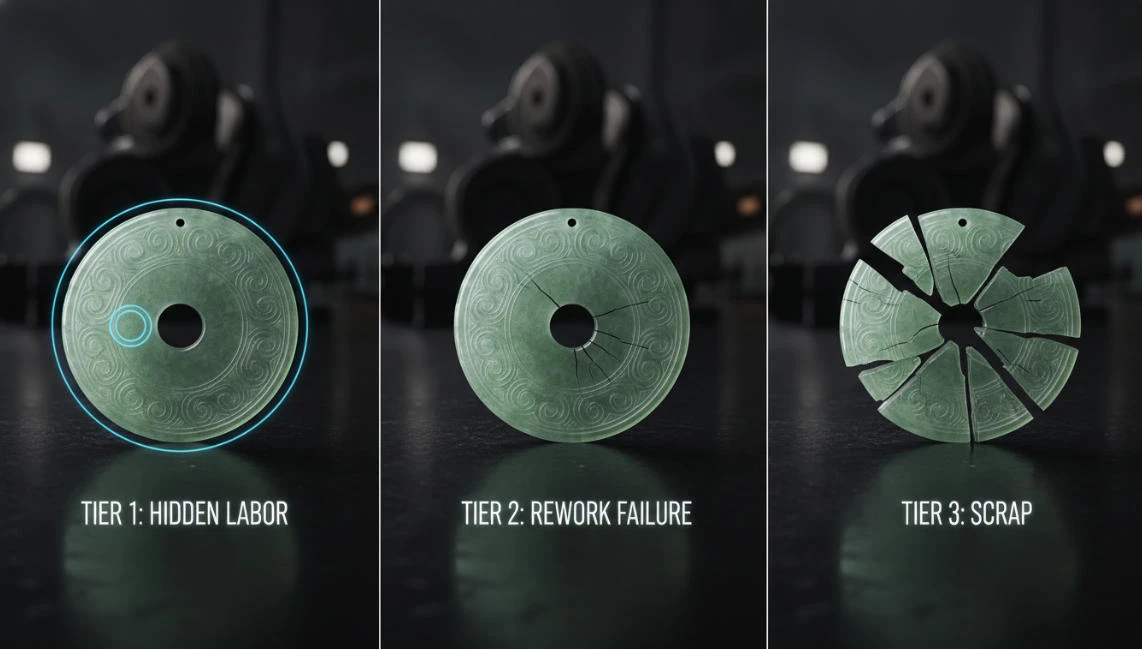
The damage caused by Positioning Shift in jade process is not uniform. It scales with deviation magnitude in a non-linear way, and understanding this scaling is essential for prioritizing where to invest in process control. The three-tier loss model below maps deviation severity to production outcome, giving you a structured framework for cost-impact analysis.
1 — Minor Deviation: The Hidden Labor Drain
Minor positioning deviation — typically under 0.5mm in most jade processing contexts — does not immediately disqualify a product. The dimensions may still fall within tolerance, the structure may be intact, and the product may appear visually acceptable at first glance. However, minor deviation almost always generates a surface consistency problem: uneven depth in engraved lines, slight thickness variation across a flat face, or marginal asymmetry that triggers a corrective grinding cycle. Each corrective cycle adds 15–30 minutes of skilled labor time per piece. Across a production batch of 200 units, that accumulates to 50–100 hours of unplanned labor — cost that never appears in your defect rate but consistently erodes your margin. This means you can be losing money on “acceptable” products without your QC data showing any red flags.
2 — Moderate Deviation: Rework Cycles That Compound Material and Time Cost
Moderate Positioning Shift — roughly 0.5mm to 2mm depending on product geometry — produces failures that QC inspection will catch: asymmetric profile on a gua sha board, hole displacement on a pendant, engraving detail that has shifted visibly off-center. These products cannot ship. They enter a rework cycle, which in jade processing is significantly more expensive than in metal machining because jade’s brittleness restricts what corrective operations are physically possible. In many cases, the rework attempt itself introduces new fracture risk. A 2021 industry cost analysis by the Swiss Gemmological Institute (SSEF) highlighted that rework-to-scrap conversion rates in lapidary operations frequently exceed 30% — meaning that for every three pieces entering rework, one becomes scrap anyway. For your operation, moderate deviation is where the real cost multiplier lives: you pay for raw material, initial machining, and rework, then potentially lose the piece entirely.
3 — Severe Deviation: Direct Scrap and Irreversible Material Loss
Severe Positioning Shift — beyond 2mm or involving rotational offset on complex carved forms — produces outcomes that cannot be recovered: edge fracture, crack propagation through the body of the piece, cutting tool penetration into a structurally fragile zone, or removal of a design feature entirely. In jade CNC machining, severe deviation often results from a combination of factors — a zero-point setting error compounded by tool wear — and the damage typically occurs within the first cutting pass, before any in-process inspection can intervene. The financial damage at this tier includes raw material cost (which for high-grade jadeite can reach thousands of dollars per kilogram), machine time, tooling wear, and the opportunity cost of the production slot. For high-value pieces, a single severe deviation event can generate a loss that exceeds the entire margin of a standard production batch.
Value Destruction Beyond Dimensions — The Jade-Specific Risk That Has No Parallel in Other Materials
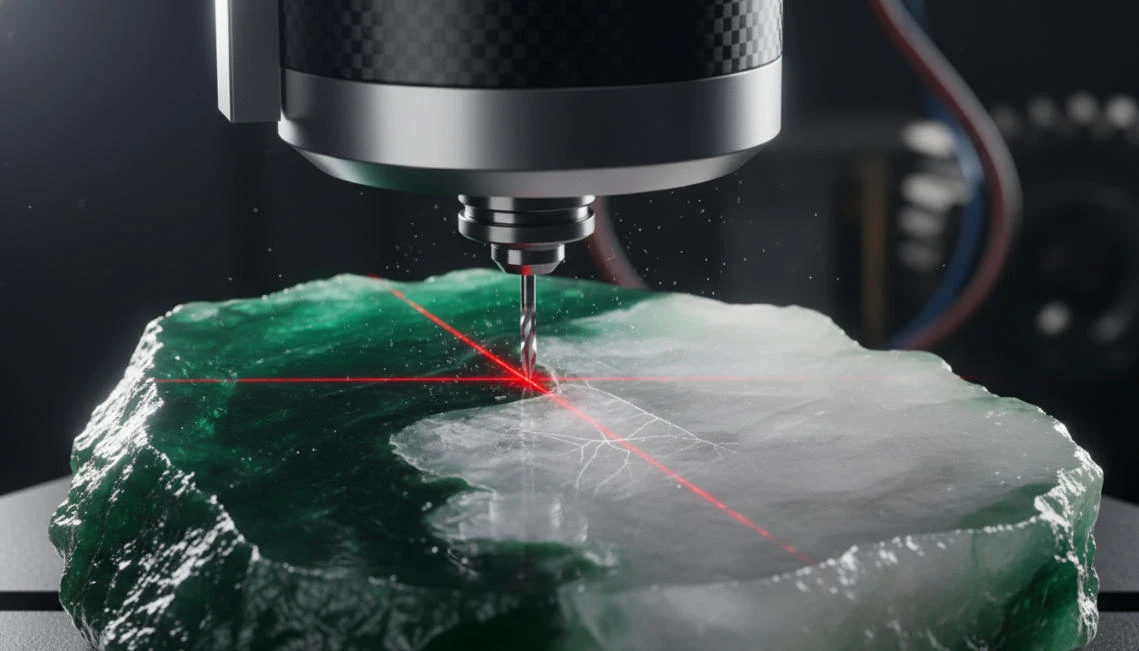
Standard machining risk models focus on dimensional accuracy and yield rate. Jade process risks include a third dimension of value that these models completely miss: the natural aesthetic properties of the raw material itself. This is where jade processing diverges most sharply from any other precision manufacturing context, and where positioning errors carry the highest potential cost per incident.
“Qiaose”: When Positioning Shift Destroys Irreplaceable Natural Color Design
Qiaose (俏色) is a jade carving technique in which the designer deliberately incorporates the raw stone’s natural color transitions into the carved image — using a red inclusion as a flame, a green zone as foliage, a white region as a figure’s face. The result is a piece where the natural geology of the material becomes part of the artistic content. According to the GIA’s jade research documentation, natural color zoning is one of the primary value determinants in high-grade jadeite, and pieces that successfully integrate this zoning into the carved design command significant market premiums.
A Positioning Shift of 2mm in a qiaose piece does not just move a pattern slightly off-center. It moves the cutting path away from the planned color boundary, replacing the intended natural color feature with an undifferentiated zone of the stone. The product is dimensionally complete, structurally sound, and surface-finished — but the qiaose effect is gone. The value difference between a successful qiaose piece and a failed one is not a percentage — it can be a factor of 10 to 100. This means you are not just losing a production unit; you are losing the majority of the potential value embedded in that raw material. In practical terms, a piece of raw jadeite worth $3,000 that was planned as a qiaose carving might yield a finished product worth $30,000 if the positioning holds — or $800 if it doesn’t.
Engraving Distortion: Why Pattern Errors in Jade Carving Cannot Be Fixed After the Fact
Complex engraving — dragon motifs, floral relief, figurative carving — depends on positional accuracy maintained across the entire tool path, not just at the starting point. In jade CNC machining, a coordinate offset introduced at zero-point setting propagates through every subsequent operation, systematically shifting every feature of the carved pattern. In manual jade processing, cumulative hand pressure variation during a long carving session produces a progressive drift that distorts the spatial relationships between design elements. Unlike metal machining, where secondary corrective passes can realign features, jade’s brittleness makes secondary corrective cutting on a partially carved surface extremely high-risk. The fracture initiation points created by the initial engraving make any follow-up tool contact near those areas likely to produce chipping or crack propagation. Once a dragon carving’s positioning is off, it is off permanently. This means your design investment, raw material cost, and machining time are all written off in a single session.
How to Prevent Positioning Shift in Manual Jade Processing
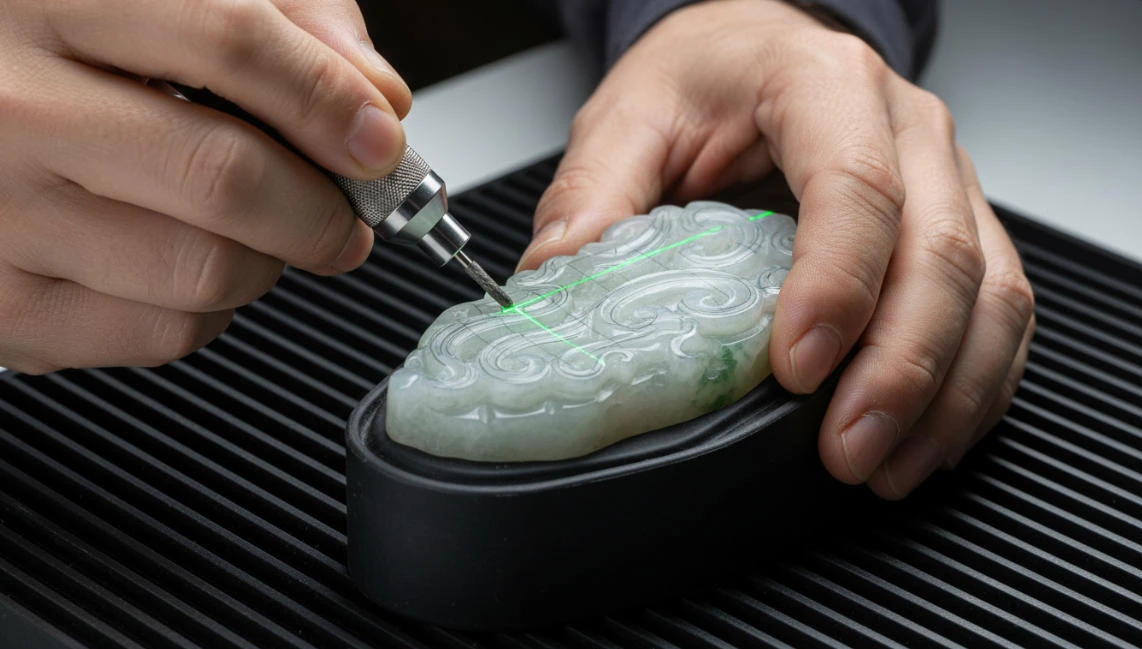
Manual jade process operations face positioning challenges that are fundamentally different from CNC environments. The absence of programmatic control means that each potential error source requires a physical or procedural countermeasure applied by the operator. The following protocols address each root cause directly.
Fixturing: The First Line of Defense Against Positioning Error
The most common source of Positioning Shift in manual jade processing is inadequate workpiece fixturing. Jade blanks are rarely flat or geometrically regular, and standard workshop clamps designed for metal or wood provide uneven contact pressure across irregular jade surfaces. This uneven contact creates micro-movement under tool load — often imperceptible during processing but sufficient to shift the work position by 1–2mm over a processing session. The solution is adaptive fixturing: rubber or silicone jaw inserts that conform to the jade blank’s surface geometry, providing distributed contact pressure rather than point loading. Before each session, verify that the clamping surface is free of dust, grit, and oil — any contamination between the fixture and the jade creates a compliance layer that allows movement under load. This means your fixturing setup should be treated as a precision operation, not a preliminary step.
Visual Reference Systems: Replacing Eye Judgment With Physical Markers
Human visual alignment is accurate to approximately ±0.5mm under good lighting conditions — and significantly worse under workshop lighting, at oblique viewing angles, or after several hours of sustained work. For jade processing operations that require tighter tolerances than this, visual alignment alone is not a viable positioning method. The practical solution is to establish physical reference markers before any cutting begins: pencil lines for coarse positioning, laser dot projection for fine alignment, or physical templates for repeat-production forms. For complex carved motifs, a grid overlay drawn on the jade surface before carving begins provides a continuous spatial reference throughout the process. This means your operators are not making positioning judgments — they are following fixed references, which removes the largest source of human-factor positioning error from the equation.
Two-Stage Processing: Rough Positioning First, Precision Work Second
One of the most effective structural changes you can make to a manual jade process workflow is separating rough positioning operations from precision finishing operations. Rough positioning — establishing the general form, removing excess material, setting the basic geometry — is done first, with wider tolerances and less fixturing sensitivity. Precision finishing — final dimension work, detailed engraving, hole drilling — is done second, after the piece has been re-measured, re-fixtured if necessary, and re-marked. This separation means that any positioning error introduced during rough operations is detected and corrected before precision work begins, rather than being locked in by subsequent cutting. The additional setup time per piece is typically 5–10 minutes; the reduction in precision-stage rework is measurable across batch production.
Environmental Control: Vibration and Temperature as Positioning Variables
Workshop vibration — from adjacent machinery, foot traffic, or HVAC systems — introduces micro-movement in both the workpiece and the operator’s tool hand. Over a processing session measured in hours, this accumulated micro-movement contributes to positional drift that is nearly impossible to attribute to a specific moment of error. Anti-vibration matting under workbenches, combined with physical separation from high-vibration equipment, reduces this input. Temperature variation has a secondary but real effect: jade’s thermal expansion coefficient means that a blank processed at 18°C and measured at 24°C will show dimensional variance in the tenths of millimeters. For high-precision jade processing work, maintaining a stable workshop temperature (±2°C across a session) removes this variable entirely.
How to Prevent Positioning Shift in Jade CNC Machining
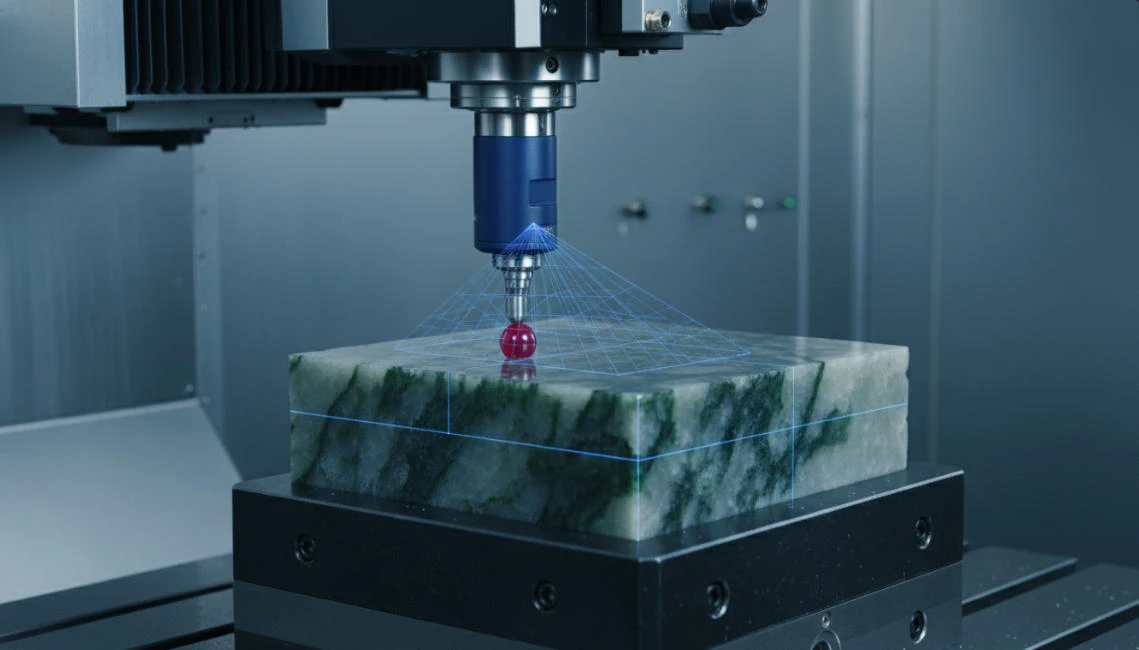
Jade CNC machining introduces a different risk profile from manual operations. Errors in CNC environments tend to be systematic — they repeat across every unit in a production run rather than varying randomly — which means that an undetected CNC positioning error can generate a full batch of defective product before inspection catches it. The prevention protocols below address each CNC-specific failure mode at its source.
Fixture Design for CNC Jade Operations: Resisting Cutting Force Over Time
CNC cutting applies repetitive directional force to the workpiece across hundreds or thousands of tool passes. A fixture that holds a jade blank adequately for the first pass may allow progressive micro-movement as cumulative cutting force acts on the clamping interface. This progressive drift shifts the effective zero point of the workpiece mid-program — without triggering any machine alarm — and produces systematic dimensional error that compounds across the depth of the cut. Vacuum chuck systems provide the most consistent clamping force for flat or near-flat jade blanks, eliminating the mechanical compliance present in jaw-type fixtures. For irregular forms, custom-fit rigid fixtures machined to match the specific blank geometry provide the contact surface area needed to resist CNC cutting forces without point loading.
Zero-Point Accuracy: The Single Most Important Setup Step in Jade CNC Machining
Every error in jade CNC machining traces back to the workpiece coordinate zero point. If the zero is set 1mm off, every feature in the program is 1mm off — perfectly executed by the machine, perfectly wrong in the physical outcome. For regular-geometry jade blanks, precision zero-point setting using a micrometer-equipped touch probe takes approximately 3–5 minutes and eliminates the largest single source of systematic Positioning Shift in CNC operations. For irregular raw blanks — which are common in jade processing because raw jade is rarely a clean geometric form — 3D scanning combined with model-registration software allows the CNC program to be aligned to the actual blank geometry rather than an assumed geometry. This approach adds setup time but removes the assumption error that causes systematic offset on non-uniform material.
Machine Calibration: Managing Cumulative Axis Error in CNC Jade Processing
CNC machine tools accumulate axis positioning error over their operational life through wear in ballscrews, linear guides, and servo systems. In general metal machining, this cumulative error is often negligible relative to the tolerances required. In jade CNC machining, where positioning tolerances for detail carving and hole drilling can be as tight as ±0.1mm, accumulated axis error becomes a significant jade process risk. Regular calibration of the machine’s coordinate system — using a laser interferometer or ballbar measurement — identifies and compensates for this accumulated error before it reaches the threshold where it affects product quality. For high-production jade processing operations, a monthly calibration schedule provides adequate protection; for lower-volume, high-value work, calibration before each significant production run is the appropriate protocol.
Tool Wear Management: When Your Cutter Changes the Answer
A worn cutting tool in jade CNC machining does not fail suddenly — it degrades gradually, and as it degrades, the effective cutting radius changes. This means that a tool programmed to cut at a specific position is actually cutting at a position offset by the wear amount — typically 0.05–0.2mm for heavily worn tooling, but sufficient to push a product outside tolerance on precision features. Tool wear inspection at defined cycle intervals — for example, every 50 pieces in a standard production run — combined with tool length re-certification before critical operations prevents this drift from reaching the product. When tool length compensation values in the CNC controller are updated accurately after each re-certification, the machine’s programmed positions remain aligned with the tool’s actual cutting geometry.
Toolpath Strategy for Symmetric Jade Forms
Symmetric jade products — gua sha boards, paired earrings, matched pendant sets — require that positional accuracy be maintained equally across both sides of the symmetry axis. Single-direction or unidirectional toolpaths introduce asymmetric cutting force that causes the fixture to flex slightly toward the cutting direction, creating a systematic offset that affects one side of the piece differently from the other. A symmetric toolpath strategy — where cutting passes alternate direction across the symmetry axis — balances these forces and prevents asymmetric fixture deflection. Combined with a rough-to-finish staged cutting approach (where material removal in the rough stage is large but tolerance-uncritical, and finishing passes are light and precision-controlled), this strategy reduces cumulative positional error on symmetric forms to levels that are consistently within jade processing quality specifications.
A Three-Stage QC Framework for Positioning Shift Control in Jade Process
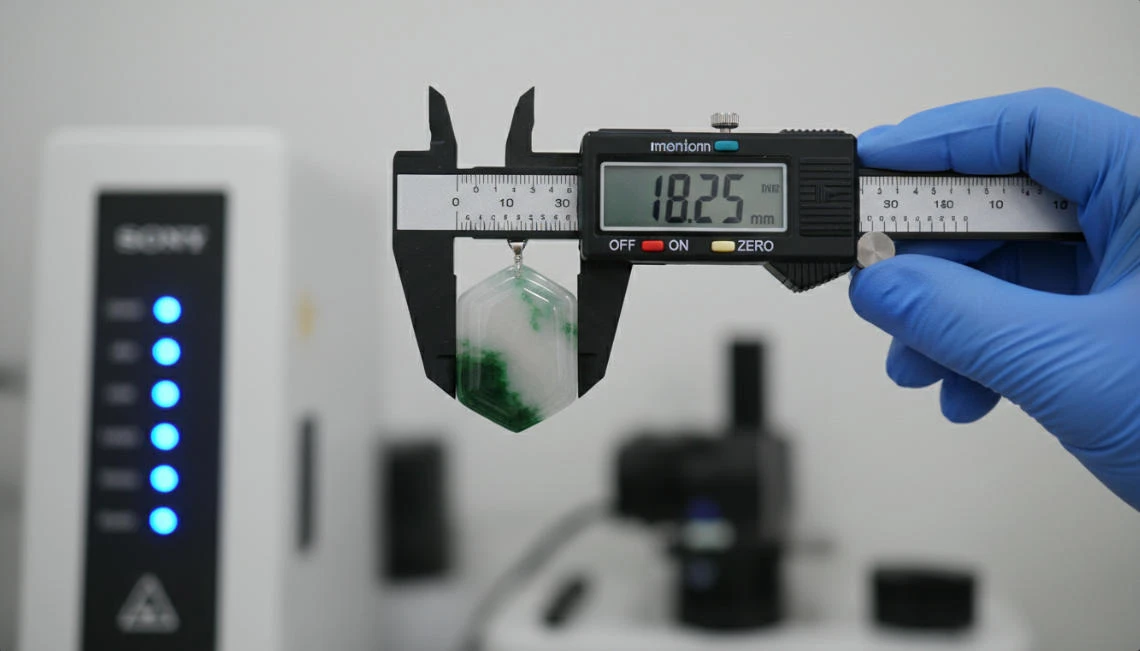
Prevention protocols reduce the probability of Positioning Shift. A structured inspection framework catches the errors that prevention doesn’t eliminate — before they propagate to scrap. The following three-stage framework is applicable to both manual and CNC jade processing operations.
Pre-Processing Verification: Stop the Error Before It Starts
The pre-processing stage is the highest-leverage point in the jade process quality control sequence. Three verification steps, consistently executed, eliminate the majority of positioning errors before any material removal occurs. First, fixture verification: confirm that the workpiece is seated correctly, clamping force is distributed, and the contact surface is clean. Second, zero-point or reference mark verification: confirm that the coordinate zero (CNC) or physical reference marks (manual) correspond to the intended design position on the actual blank. Third, design overlay check: for complex carved pieces, confirm that the design template aligns with the intended raw material features — particularly critical for qiaose work where natural color zone position must match the design layout. This means spending 10–15 minutes at setup can prevent losses that take hours or entire production days to absorb.
In-Process Monitoring: Catching Drift Before It Becomes Damage
In-process dimensional checking at defined intervals is the second layer of positioning control in jade CNC machining and manual jade process alike. For CNC operations, this means stopping the program at defined waypoints — after roughing, before finishing, after hole operations — and measuring the actual workpiece dimensions against the design specification. For manual operations, it means measuring after each major phase of work rather than only at completion. The practical goal is to detect minor or moderate deviation while the piece is still in a recoverable state, rather than discovering severe deviation at final inspection. A piece with 0.8mm of positional drift detected after roughing can often be re-fixtured and corrected before precision work begins; the same drift discovered at final inspection means a completed piece enters the rework or scrap category.
Post-Processing Dimensional Audit: Defining Pass and Fail in Measurable Terms
Final QC inspection for jade process output should operate from defined, measurable acceptance criteria rather than visual judgment alone. Symmetry deviation: typically ±0.3mm for standard production pieces, ±0.1mm for precision or high-value work. Hole position tolerance: ±0.2mm for functional assemblies (bead stringing, pendant hanging hardware). Surface thickness consistency: ±0.2mm across the piece face for flat-form products. These criteria align directly with the three-tier loss model — minor deviation falls within the corrective grinding range, moderate deviation triggers rework assessment, and severe deviation triggers scrap classification. Having explicit numerical criteria means your QC decisions are consistent across operators, shifts, and production runs, and your defect data is structured for trend analysis rather than being a series of individual judgment calls.
Positioning Shift Is Predictable — Which Means It Is Preventable
Jade process risks from Positioning Shift are not random events. They arise from specific, identifiable causes — fixturing inadequacy, measurement error, machine drift, tool wear, operational variance — each of which responds to specific, implementable countermeasures. The three-tier loss model shows that minor deviations create hidden labor cost, moderate deviations generate expensive rework cycles, and severe deviations produce direct scrap and, in high-value jade, potentially catastrophic value destruction. The asymmetry matters: investing in prevention at the process level costs far less than absorbing the output of uncontrolled Positioning Shift in scrap rates, rework labor, and lost material value.
For jade processing manufacturers operating at any scale, the practical starting point is systematic: audit your fixturing setup, define your zero-point verification protocol, establish your in-process inspection intervals, and create explicit numerical QC criteria. These are not advanced process engineering concepts — they are the foundational disciplines that determine whether your jade CNC machining and manual operations produce consistent, predictable output or absorb continuous, avoidable loss. The material is too valuable and the errors too costly to manage any other way.
FAQ: Positioning Shift in Jade Process
1. What is positioning shift in jade processing?
Positioning shift is the deviation between a workpiece’s intended and actual position during machining. Even a 1–2mm offset can cause asymmetry, hole misalignment, or direct scrap in jade process.
2. How does positioning shift affect jade CNC machining output?
In jade CNC machining, a zero-point error repeats across every unit in a batch. One undetected setup mistake can render an entire production run defective before inspection catches it.
3. What are the biggest jade process risks from positioning shift?
The three main jade process risks are dimensional scrap, structural fracture, and qiaose value destruction — where a 2mm error can reduce a high-value carved piece’s worth by up to 100x.
4. How can jade processing manufacturers reduce positioning errors?
Jade processing manufacturers should verify fixture stability, set zero points with precision measurement tools, and run in-process dimensional checks at defined intervals — not only at final inspection.
5. Does positioning shift only affect CNC jade processing?
No. Manual jade processing carries equal risk from unstable fixturing, visual alignment error, and tool pressure variance. Both operations require structured prevention protocols to maintain consistent yield.