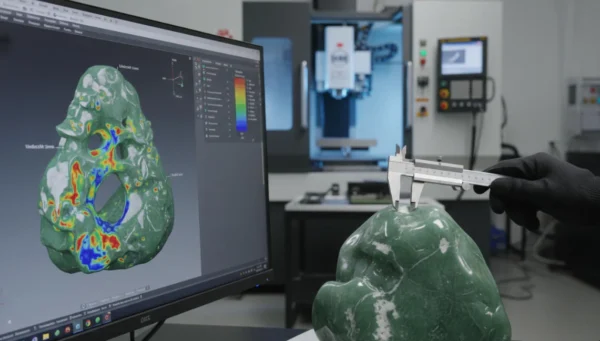
In any jade process involving mechanical grinding or profile shaping, edge chipping is not a random defect — it is a predictable failure with identifiable mechanical origins. Across jade fabrication environments, jade edge chipped defects account for 18% to 35% of total material waste in standard production runs, a figure that climbs sharply when thin-edge geometries, high-speed dry grinding, or worn equipment variables compound simultaneously. The persistence of this failure is rarely due to a lack of production effort. More often, it results from systematic misdiagnosis: most production teams treat chipping as a single-cause issue and apply single-point corrections, when the actual mechanism involves the simultaneous interaction of material brittleness, structural design geometry, and equipment precision. A jade manufacturer operating without a structured framework for distinguishing these three failure pathways cannot reliably control any of them. At Jademago, where jade fabrication operations have generated continuous production data across more than 65 years of manufacturing, this distinction has been foundational to the process quality framework. This analysis traces each failure pathway to its physical root cause, maps it to the specific stage in the jade process where manufacturing intervention is both possible and measurable, and provides stage-specific controls that reduce defect probability without relying on guesswork.
Table of Contents
Why Jade Is Structurally Prone to Edge Chipping — A Material-Level View of Jade Process Risks
Understanding jade process risks at the manufacturing level begins not with tooling or technique, but with the physical properties of the material itself. Jade — whether jadeite or nephrite — exhibits a property paradox that directly drives edge failure: it is hard enough to resist surface abrasion, yet brittle enough to fracture catastrophically under localized impact. According to GIA’s gemological reference documentation on jade, jadeite carries a Mohs hardness of 6.5 to 7.0, placing it in the same hardness band as quartz. What the Mohs scale does not capture is fracture toughness — the material’s resistance to crack propagation under sudden, localized force. GIA characterizes jadeite’s fracture behavior as splintery to granular: a direct consequence of its interlocking crystalline microstructure, which distributes applied stress unevenly across grain boundaries rather than absorbing it uniformly. For anyone evaluating jade process risks from a manufacturing perspective, this is a foundational distinction: the same physical property that makes jade resistant to surface scratching makes it structurally vulnerable to edge fracture under grinding impact.
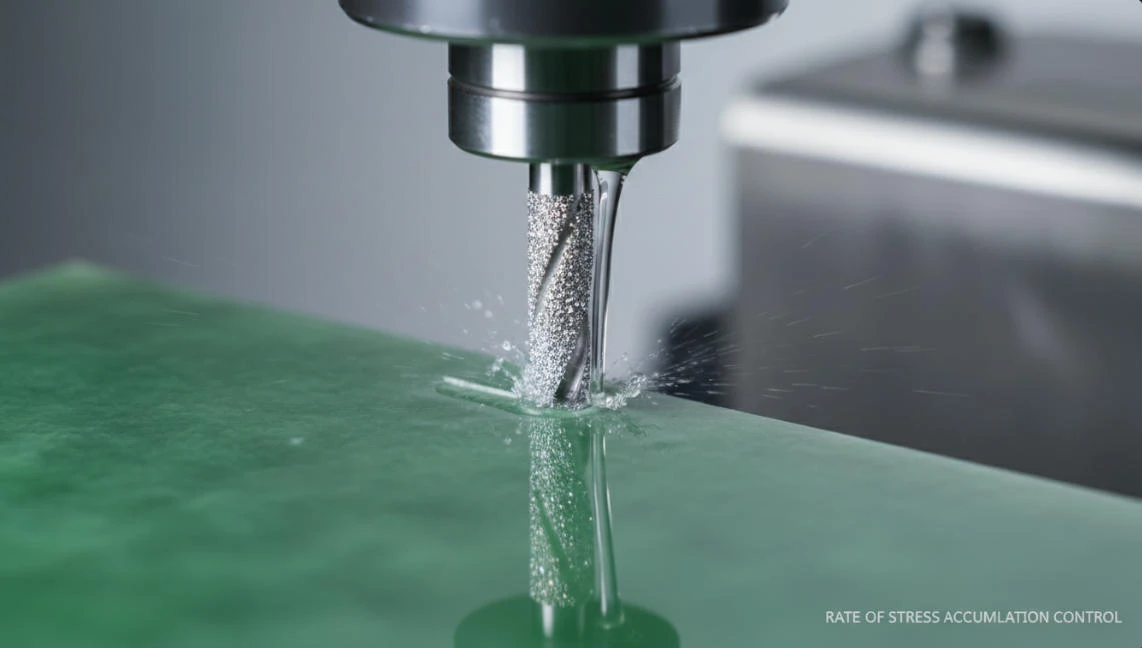
The edge of a jade workpiece is where this material paradox becomes an active production problem. In face-grinding operations, load distributes across a relatively large contact area — the material has width and depth to share the stress. At the edge, the cross-section drops to its minimum, concentrating the same applied force into the smallest available material volume. When a grinding event delivers energy faster than the material can dissipate through the limited edge cross-section, stress exceeds tensile strength at a micro-discontinuity — a grain boundary, a latent micro-fracture, a mineral inclusion layer — and chipping follows. This threshold event is silent until it occurs, which is why it appears to happen suddenly when it does not. This means you gain more quality control by reducing the rate of stress accumulation at the edge than by reacting after chipping has already occurred.
Hardness vs. Impact Resistance — The Core Material Contradiction in Jade CNC Machining
Jade CNC machining operates on the assumption that consistent tool parameters produce consistent outcomes — a reasonable assumption for homogeneous engineering materials, but a problematic one for natural stone. Jade is not structurally uniform within a single block. The same grinding pass that removes material cleanly from the flat face of a jade blank may fracture the edge of that same blank, because the edge presents a different load environment: a smaller cross-section, lower material continuity, and higher stress per unit area under the same applied force. The International Gem Society’s technical reference on jadeite and nephrite notes that jade’s toughness is directionally dependent on crystal orientation — meaning adjacent sections of the same block can respond differently to identical grinding parameters. In jade CNC machining, this variability manifests as batch inconsistency: workpieces cut under identical programmed parameters still exhibit different chipping rates depending on their position within the source block. This means you should treat material-level awareness as a prerequisite for process parameter design, not as a secondary consideration that only becomes relevant when defects appear.
Internal Structural Defects — Micro-Fractures and Grain Boundaries as Latent Failure Zones in the Jade Process
The second material-level factor shaping jade process risks is the presence of internal structural discontinuities invisible to standard incoming visual inspection. Micro-fractures — formed during geological stress events or introduced during mining and transport handling — exist inside raw jade blocks as pre-existing planes of weakness. They do not penetrate the surface; they cannot be detected by the naked eye; but they represent volumes of the workpiece where material continuity is already compromised. When grinding force is applied to an edge adjacent to one of these fractures, the fracture plane becomes the path of least resistance for crack propagation. The resulting chip originates from a subsurface weakness, not from the surface the tool contacted — which is why parameter corrections made after the fact frequently fail to eliminate the defect entirely.
Beyond micro-fractures, mineral inclusion layers and grain boundary geometry create zones of differential hardness within the same blank. The Swiss Gemmological Institute SSEF, which applies polarized light microscopy and laser ablation analysis to jade material characterization, has documented boundary-dependent fracture behavior in both jadeite and nephrite: when the machining direction aligns with a grain boundary plane, crack propagation resistance drops, and the tool’s energy follows the boundary path rather than cutting through intact crystalline material. For the jade process, this means that jade edge chipped failure risk is partially encoded in the raw material before any machining begins. This means you can reduce late-stage unexplained rejects by implementing a pre-processing material screening protocol that removes the most structurally compromised blanks from edge-critical production runs before they reach the grinding stage — converting material-level risk into a manageable, pre-production decision point.
Excessive Grinding Force and Its Direct Impact on the Jade Polishing Process
Of the three primary failure paths producing jade edge chipped defects, excessive grinding force is the most frequently occurring and the most immediately correctable through parameter adjustment alone — without equipment modification or design revision. It is also the most commonly mishandled: operators typically apply a single corrective action when four independent variables are simultaneously driving force over-application. Without a framework for isolating each variable, corrections remain incomplete and chipping continues at a reduced but persistent rate. Understanding how each variable contributes independently — and how they amplify each other in combination — is the precondition for a correction that holds across production runs.
Recognizing Grinding-Force Damage Patterns in the Jade Polishing Process
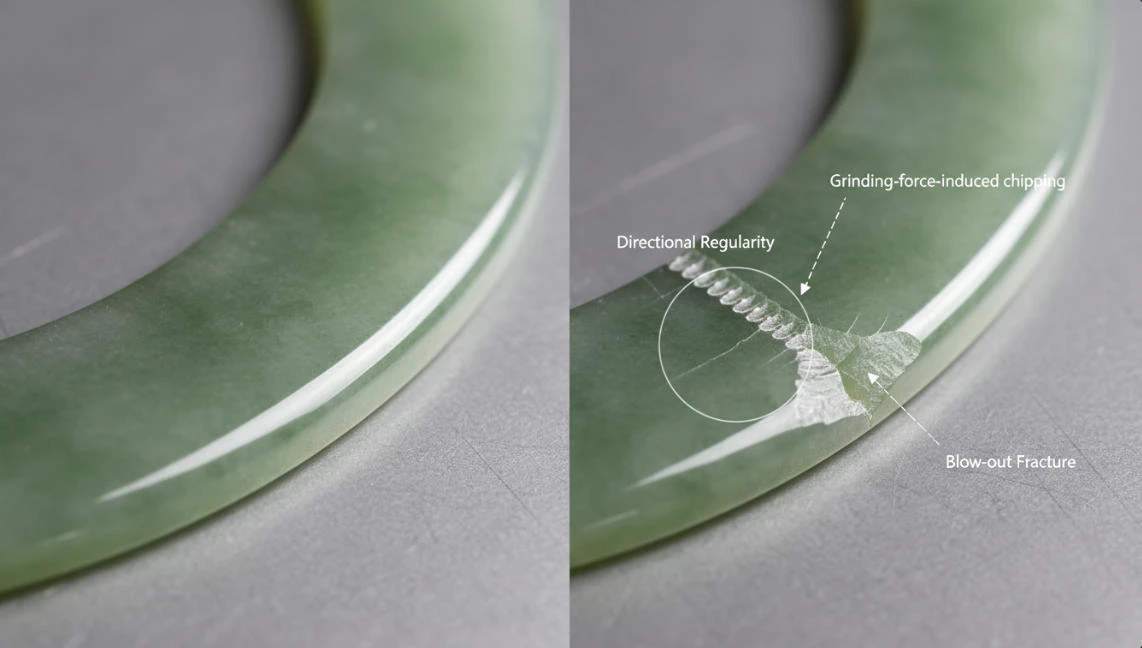
Grinding-force-induced jade edge chipped defects carry a specific visual signature that distinguishes them from other failure modes. Damage presents as consecutive notches running along the edge in a direction consistent with wheel travel — a pattern that reflects repeated impact events at the same relative tool-to-workpiece geometry. Corner regions exhibit disproportionate damage because they present the minimum available cross-section and receive concentrated load at the transition from supported face to unsupported edge point. In severe cases, where abrasive grit is too coarse for the finishing stage of the jade polishing process, single-event blow-out fractures occur — a single large chip replacing a series of small notches, produced when one high-energy abrasive particle penetrates the edge faster than the material can redistribute the impact force.
The directional regularity of this damage pattern is diagnostically significant. If you review a batch of jade edge chipped rejects and the defect locations form a consistent directional pattern along the edge — rather than appearing at random positions with no geometric relationship — the root cause is almost certainly grinding force rather than tool runout or raw material defect. Confirming this pattern before initiating corrective action prevents the common diagnostic error of investigating equipment precision or raw material sourcing when the problem sits entirely within process parameter control.
Contributing Variables — Grit Size, Spindle RPM, Feed Rate, and Dwell Behavior in Jade CNC Machining
Four variables drive force over-application in jade CNC machining, and their effects are multiplicative rather than additive: a marginal excess in any two variables simultaneously produces a disproportionately larger chipping risk than either variable alone. Grit size determines the depth of cut per abrasive contact event — a 60-grit wheel removes approximately four to six times more material per pass than a 240-grit wheel under equivalent pressure, translating directly to four to six times the instantaneous force applied to the edge cross-section. Spindle RPM controls contact frequency: at 8,000 RPM versus 3,000 RPM, the number of abrasive impact events per second more than doubles, compressing the time interval between impacts below the material’s stress-relaxation threshold.
Feed rate determines how quickly the grinding zone advances along the edge profile. At excessive feed rates, the contact zone advances faster than the cooling system can reduce local temperature, creating a thermal gradient that pre-weakens the crystalline structure before the mechanical failure event occurs. Dwell behavior — holding the wheel stationary or near-stationary at a single point — compounds all three effects at a fixed location, producing a localized overload the edge cross-section cannot sustain. Production trial data from Jademago‘s fabrication engineering records indicates that a 30% spindle RPM reduction alone reduces chipping frequency by approximately 22% on edges below 3mm thickness. Combining that reduction with a grit size increase from 80 to 180 grit and eliminating dwell periods reduces jade edge chipped incidence by approximately 58% on the same geometry class. This means you can project the improvement expected from each parameter change before implementing it, rather than applying corrections empirically and measuring results retrospectively.
Corrective Protocol — Sequential Parameter Adjustment in the Jade Polishing Process
Correcting grinding-force-induced chipping in the jade polishing process requires a defined sequence of adjustments rather than simultaneous changes to multiple variables — simultaneous changes make it impossible to attribute improvement to any specific correction. First, verify grit selection for the current production stage: wheels below 100 grit should not contact edges thinner than 4mm under any operational condition. Second, reduce spindle RPM to the minimum level that still produces effective material removal — typically 20% to 30% below the machine’s default jade recommendation. Third, transition to a multi-pass approach: approach target edge dimensions over three to five progressively lighter passes rather than a single pass to final geometry. Fourth, enforce a maximum dwell time of 0.5 seconds at any single contact point along the edge. Fifth, confirm that the water cooling supply is active and correctly directed at the grinding contact zone before beginning any edge work in the jade process.
Each step addresses a specific physical variable in the force over-application mechanism. Is there a case where applying four of five steps is sufficient? No — implementing four while leaving the fifth uncorrected produces partial improvement that is frequently misread as evidence of additional root causes, when the actual situation is an incomplete corrective sequence.
Edge Geometry and the Structural Limits of Thin-Section Design in the Jade Process
When a jade edge chipped defect occurs on a workpiece whose grinding parameters were correctly set and whose equipment was functioning within specification, the failure path almost always traces back to a decision made before any machining began: the edge geometry encoded in the design file. Thin-edge geometries introduce a structural vulnerability that no downstream process correction can fully compensate for. The physics of this failure are straightforward — as edge thickness decreases, the cross-sectional area available to distribute grinding force decreases proportionally, while the stress per unit area increases. At some critical thickness threshold, the material’s tensile strength at the edge boundary is exceeded by routine grinding contact, and jade edge chipped failure becomes statistically inevitable regardless of operator skill or machine precision. In the jade process, this failure path is distinct from grinding-force overload because it cannot be resolved through parameter tuning alone. The intervention must occur earlier, at the design validation stage, before production begins.
What makes this failure path systematically underrecognized is the commercial pressure that typically drives thin-edge design decisions. Thinner edges create visual lightness and apparent refinement in finished jade products — qualities that carry market value. The result is a recurrent conflict in jade manufacturer production environments: design intent optimizes for aesthetic outcome, while manufacturing physics imposes a minimum viable edge thickness below which consistent production becomes untenable. A structured jade process framework resolves this conflict not by prohibiting thin edges, but by defining the conditions under which thin edges can be produced without predictable failure — and distinguishing these from conditions where design modification is the only reliable risk reduction available.
Edge Thickness Thresholds in Jade CNC Machining
Jade CNC machining environments that have tracked chipping rates against edge geometry across multiple material types and equipment configurations consistently produce a recognizable threshold pattern. Edges above 3mm in finished thickness, across standard jade grades and conventional grinding parameters, exhibit jade edge chipped defect rates below 5% under competent process control. As thickness drops below 2mm, defect probability increases non-linearly — empirical production data indicates that edges in the 1.5mm to 2mm range carry chipping rates of 15% to 30% depending on material grade and corner geometry. Below 1.5mm finished thickness, defect rates in standard jade CNC machining environments routinely exceed 40%, and in some material grades approach 60% without specialized process adaptations.
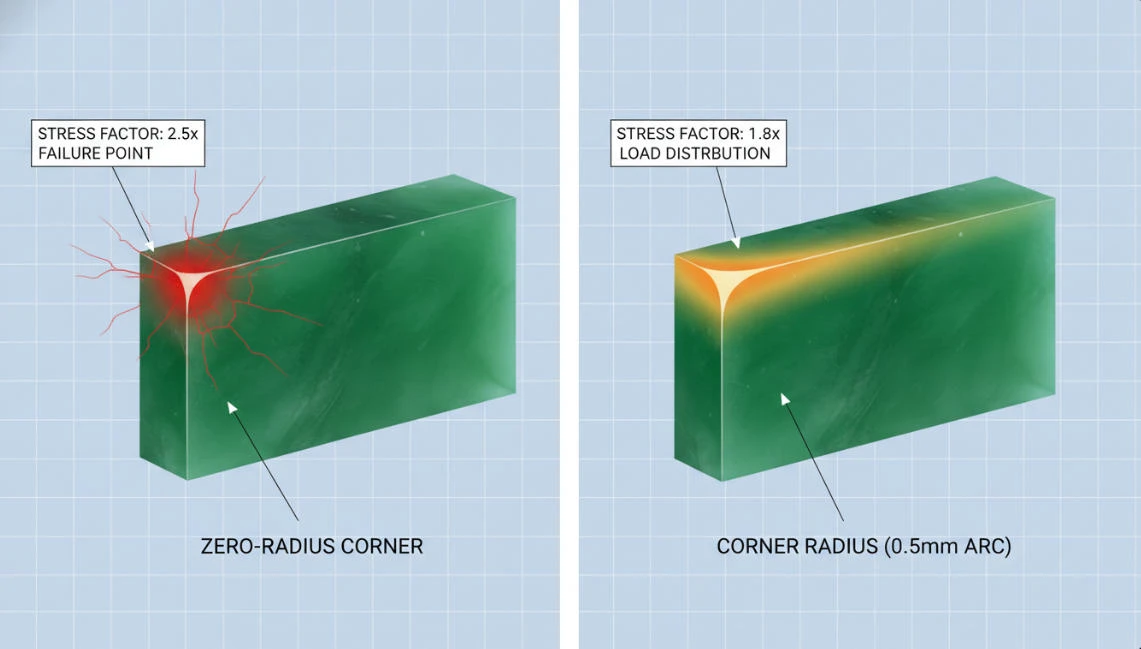
Sharp corner geometry amplifies these figures through a well-documented mechanical effect: stress concentration. At a sharp corner, the absence of radius means that applied force cannot distribute across any curved transition — the full stress load resolves at a geometric point rather than across an arc. According to ASTM International’s material testing standards documentation on brittle fracture mechanics, the stress concentration factor at a zero-radius corner in a brittle material can exceed 2.5 times the nominal stress value, meaning a corner with <1.5mm approach thickness under standard grinding contact effectively experiences mechanical loading equivalent to a 3.75mm section. This means you should evaluate corner geometry as an independent risk variable, not as a secondary concern nested within general edge thickness assessment — a workpiece with adequate face-edge thickness but zero-radius corners still carries a disproportionate jade edge chipped risk at those specific geometries.
How the Jade Process Resolves Thin-Edge Risk Without Sacrificing Geometry
The four structural interventions available at the design stage each address the thin-edge failure mechanism through a different physical principle, and their selection should be matched to the specific geometry creating the risk. Maintaining minimum safe wall thickness — no finished edge below 2mm as a production standard — is the most direct intervention, but it is not always compatible with design intent. When design constraints make sub-2mm edges unavoidable, the remaining three techniques provide viable alternatives, or can be combined to manage risk at geometries that would otherwise be unproducible with acceptable yield.
Corner radius replacement — converting sharp corners to arcs of 0.5mm radius or greater — distributes applied grinding force across the arc length rather than concentrating it at a zero-area point. The stress reduction this provides at a formerly sharp corner is substantial: even a 0.3mm radius reduces the theoretical stress concentration factor from approximately 2.5 to below 1.8 in standard jade grades, a 28% reduction in localized loading from geometry modification alone. Edge chamfering — removing the square edge profile and replacing it with an angled flat — reduces the geometric sharpness of the edge intersection without eliminating the visual line, preserving design intent while increasing the material volume present at the transition zone.
The fourth technique — hidden bevel construction — addresses cases where visual edge refinement is a non-negotiable design requirement. In hidden bevel construction, the visible outer profile appears to taper to a thin or near-sharp edge, while the structural geometry at the actual material boundary maintains a viable minimum thickness through a concealed recessed angle. This means you can achieve the visual outcome of a 0.8mm edge appearance while the actual load-bearing edge cross-section retains 2mm or more of structural material — resolving the conflict between design intent and jade process physics without compromise in either direction. This technique requires precise toolpath programming in jade CNC machining and adds approximately 15% to 20% to per-piece machining time for edge profiles, a cost that is consistently recovered through reduction in finished-piece jade edge chipped reject rates.
Tool Runout and Its Role in Intermittent, Batch-Level Chipping in the Jade Process
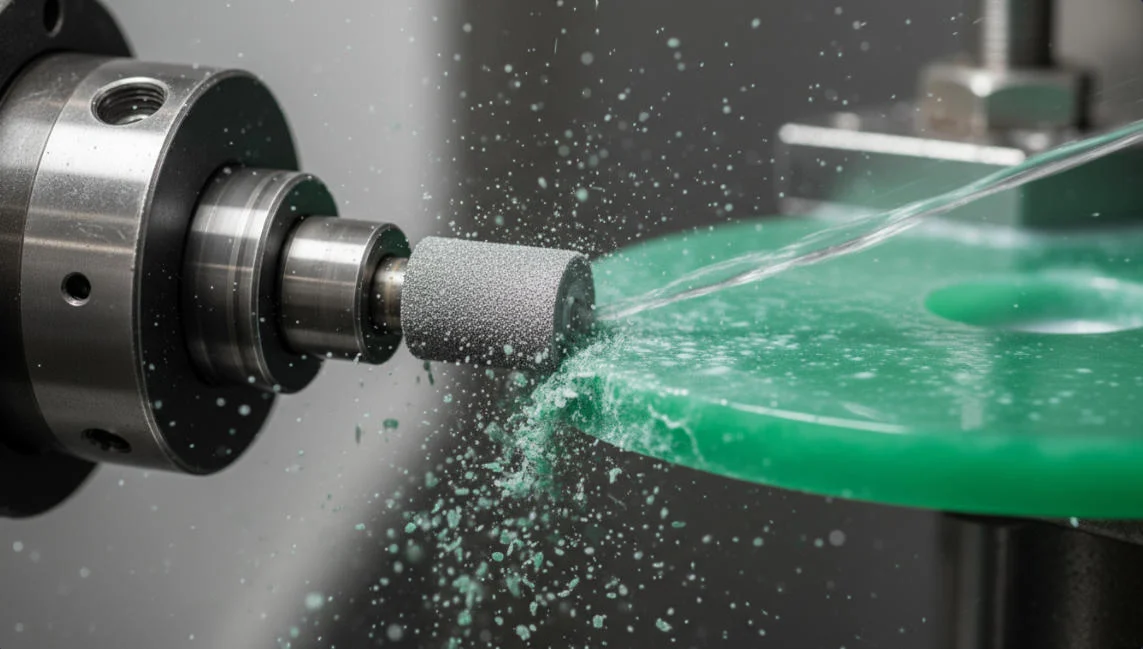
Tool runout is the least visible of the three primary jade process risks and, for that reason, the most frequently misattributed. Where grinding-force failure produces consistent, directionally predictable chipping and thin-edge failure produces geometry-correlated defect rates, tool runout produces something diagnostically distinct: random-position chipping distributed across a batch of otherwise identical workpieces, with no correlation to edge thickness, corner geometry, or tool parameter settings. Five pieces in a production run of twenty exhibit jade edge chipped defects — but not always the same five from one shift to the next, and not always at the same edge location on the affected pieces. This randomness is not evidence of an uncontrollable process — it is a precise diagnostic signature pointing to mechanical precision failure at the spindle or tooling interface level, not at the parameter or design level.
Induced Jade Edge Chipped Defects — Diagnostic Criteria
Three observable characteristics distinguish runout-induced jade edge chipped defects from the other two failure paths, and identifying them correctly is the prerequisite for directing corrective action to the right system. First, defect position is non-correlated with geometry: chipping occurs at edge segments that carry no unusual thickness or corner geometry risk, while adjacent high-risk geometries on the same workpiece may remain intact. Second, batch consistency is absent: the defect rate across a run of nominally identical pieces varies from piece to piece beyond what material variability alone can explain, and the affected pieces do not form a consistent pattern related to their position in the machining sequence. Third, surface texture is irregular even on unchipped areas — the grinding marks visible under magnification show non-uniform spacing or depth, indicating that the tool’s contact geometry is changing within each rotation cycle rather than maintaining consistent engagement.
Together, these three criteria form a runout diagnostic checklist applicable in any jade CNC machining environment without specialized measurement equipment. If all three are present in a jade edge chipped reject analysis, the investigation should proceed directly to equipment inspection rather than process parameter review — parameter changes will produce no measurable improvement if the physical source of chipping is spindle or tooling mechanical variance.
Mechanical Sources of Runout — Spindle Bearing Wear, Chuck Eccentricity, and Resonance in Jade CNC Machining
Tool runout in jade CNC machining originates from five distinct mechanical sources, each of which produces runout through a different mechanism and requires a different corrective action. Spindle bearing wear increases radial clearance over time as the rolling elements and races accumulate surface fatigue — a worn bearing allows the spindle shaft to shift laterally under the varying load of intermittent grinding contact, translating directly into tool-tip displacement from the programmed centerline. According to NSK’s technical documentation on precision spindle bearing degradation, a bearing with 0.01mm of radial wear produces tool-tip runout of approximately 0.02mm to 0.04mm at the cutting edge of a standard-length grinding arbor — a displacement sufficient to generate periodic impact events at the edge of a jade workpiece at rates matching the spindle rotation frequency.
Chuck eccentricity introduces a different runout mechanism: where bearing wear produces displacement that varies with load magnitude, chuck eccentricity produces a fixed-magnitude offset that rotates at spindle frequency regardless of load. A chuck worn or distorted by 0.005mm off-center produces a tool-tip orbit of 0.01mm diameter per rotation — imperceptible in dimensional terms on most materials, but sufficient to produce periodic over-engagement events at a jade edge chipped-vulnerable edge geometry. Wheel imbalance introduces a frequency-dependent force: at specific RPM values, the imbalance force coincides with a structural resonance frequency of the machine frame or workpiece fixture, amplifying vibration amplitude by factors of three to five above the non-resonant baseline. This resonance-coincident amplification is why jade process risks associated with runout are often RPM-dependent: the same spindle on the same workpiece produces acceptable results at 4,000 RPM and unacceptable chipping at 6,000 RPM, because the higher speed crosses a resonance threshold rather than because RPM itself is the root variable.
Equipment Maintenance Protocol for Runout Control in the Jade Process
Addressing tool runout in the jade process requires a structured maintenance schedule rather than reactive replacement — the mechanical degradation processes driving runout develop gradually and can be tracked and intervened before they reach defect-producing thresholds. Spindle concentricity should be verified using a dial test indicator at the tool contact point on a defined cycle — in high-utilization jade CNC machining environments, a monthly verification interval is appropriate, with threshold values set at 0.005mm maximum radial deviation as a production standard. When deviation approaches this threshold, bearing inspection and replacement prevent the non-linear quality degradation that occurs when worn bearings are run past their service limit.
Chuck condition should be assessed using the same measurement protocol: mount a precision ground test bar, rotate the spindle by hand, and observe indicator deviation across a full rotation. Values above 0.003mm indicate chuck wear or contamination requiring cleaning, reconditioning, or replacement. Dynamic wheel balancing should be performed on any new wheel mount and verified after any wheel dressing operation that removes more than 0.5mm of abrasive material — wheel balance degrades non-linearly as diameter decreases, and a wheel balanced at full diameter can become significantly unbalanced at reduced diameter after multiple dressing cycles. Resonance zone mapping — running the spindle through its full RPM range with an accelerometer attached to the machine frame and recording vibration amplitude at each speed increment — allows production engineers to identify and avoid RPM ranges where structural resonance amplifies runout-induced jade edge chipped risk. This means you can configure CNC programs to step over these RPM ranges automatically, eliminating a recurring jade process risk without requiring physical intervention on each production run.
Secondary Risk Factors — Material Screening, Grain Orientation, and Thermal Management in the Jade Polishing Process

Beyond the three primary failure paths, three secondary risk factors contribute to jade edge chipped defect rates in ways that are statistically significant at the production level but are frequently attributed to unexplained process variability rather than correctly identified as independent causal mechanisms. Each of these factors interacts with the primary failure paths: a workpiece carrying latent micro-fractures is more vulnerable to grinding-force-induced chipping; a workpiece machined against grain orientation is more vulnerable to runout-induced defects; a workpiece subject to thermal cracking is more vulnerable to edge failure at thin sections. This means you manage these secondary factors not as separate quality programs, but as multipliers that raise or lower the risk threshold at which primary failure paths become active.
Pre-Processing Material Screening — Detecting Raw Stone Defects Before the Jade Process Begins
Raw stone micro-fractures represent jade process risks that originate before any tooling contacts the material. A blank carrying an internal fracture plane within 2mm of its intended finished edge will, under any competent grinding parameter set, produce a jade edge chipped defect at the point where the fracture intersects the finished geometry — not because the process failed, but because the material was not viable for that geometry before processing began. Transmitted light inspection — holding the blank under a strong directional light source and observing the internal shadow pattern — identifies fracture planes, inclusion bands, and structural discontinuities in translucent jade grades. For opaque material grades where transmitted light is ineffective, surface percussion testing — gently tapping the blank face with a small steel rod and comparing the acoustic response across different zones — identifies internal discontinuities through the dampened resonance they produce. The GIA gemological characterization standard for jade structural evaluation recommends transmitted light examination as standard practice for any jade material assessment preceding dimensional processing. Implementing this as a mandatory pre-processing step rather than an optional quality check converts material-sourced jade process risks from an unpredictable in-production failure into a pre-production screening decision.
Grain Orientation and Directional Cutting in Jade CNC Machining
The crystalline microstructure of jade is directionally organized — grain boundaries do not run uniformly in all directions within a single block, but tend to cluster in orientation bands reflecting the geological conditions under which the material formed. In jade CNC machining, this directional organization means that cutting direction relative to grain orientation affects jade edge chipped risk independently of all parameter settings. Machining in the direction aligned with the dominant grain orientation — “with the grain” — allows the tool to engage material that presents continuous crystal faces to the abrasive contact. Machining against the grain forces the tool to engage at grain boundaries as the primary material removal surface, and grain boundaries in jadeite and nephrite represent the lowest-toughness interfaces within the material’s microstructure. Production data across multiple material grades at Jademago‘s manufacturing facility indicates that reversing cutting direction from against-grain to with-grain orientation reduces jade edge chipped frequency by approximately 18% to 25% on edge profiles parallel to the dominant grain axis, without any parameter change. This means you recover meaningful yield improvement from a fixture and orientation adjustment that adds no cycle time and requires no equipment modification.
Thermal Cracking — Heat Accumulation and Edge Fracture in the Jade Polishing Process
The jade polishing process introduces a thermal risk that operates through a different physical mechanism than mechanical grinding force: localized heat accumulation creates thermal stress gradients within the material, and jade’s low thermal conductivity — approximately 2 to 3 W/m·K for jadeite, significantly lower than engineering ceramics like silicon carbide — prevents rapid redistribution of heat away from the grinding contact zone. When heat accumulates faster than the material conducts it away, a temperature differential develops between the surface layer and subsurface bulk. This differential creates tensile stress at the surface as the hot surface layer tries to expand while the cooler subsurface constrains it. When tensile stress exceeds the material’s fracture toughness at a micro-discontinuity — which, as the SSEF has documented, is frequently located at the grain boundary network in the near-surface zone — a thermal crack nucleates. Subsequent mechanical contact at this thermally pre-damaged edge location converts the micro-crack into a visible jade edge chipped defect.
Dry grinding eliminates the primary mechanism for managing this thermal accumulation, which is why it should not be used at any stage of the jade polishing process involving edge contact on sections below 4mm thickness. Water-based coolant, directed at the grinding contact zone rather than at a point upstream of it, simultaneously limits peak contact temperature, flushes abrasive particles that would otherwise re-engage as secondary cutting points, and reduces the frictional coefficient at the wheel-workpiece interface. High-speed grinding — above 8,000 RPM on edges below 2mm thickness — compresses the time interval between heat generation events below the thermal diffusion time constant of the material, producing cumulative temperature rise across successive passes even with coolant present. Limiting spindle speed to below 6,000 RPM for final-stage edge work in the jade polishing process, combined with active coolant flow and a 3 to 5 second interval between successive edge passes, maintains contact zone temperature below the empirical thermal cracking threshold observed in standard jade grades. This means you prevent an entire category of jade edge chipped defects through two operational parameters — speed and dwell interval — that cost nothing to implement and require no equipment modification.
Integrating Controls Across the Full Jade Process — A Stage-by-Stage Manufacturing Framework
The three primary failure paths analyzed in the preceding sections — grinding force overload, thin-edge structural insufficiency, and tool runout — do not operate in isolation within a production environment. They interact. A workpiece with a 1.8mm finished edge thickness, machined on a spindle carrying 0.008mm of radial runout, using a 100-grit wheel at 7,000 RPM, is simultaneously exposed to all three failure mechanisms at amplified combined risk. Treating each path as a separate corrective action item, addressed in sequence after defects appear, produces marginal and unstable yield improvement. What a functioning jade process quality framework requires instead is a stage-gated approach: specific control objectives assigned to each production stage, implemented before the stage begins rather than after defects from that stage are observed. This structure converts jade process risks from reactive problems into proactive checkpoints, and it is the operational difference between a jade manufacturer that achieves consistent sub-5% jade edge chipped defect rates and one that manages chipping through continuous firefighting.
The framework presented below is organized by production stage rather than by failure path, because that is the sequence in which manufacturing decisions actually occur. Each stage has a defined control objective, a set of specific interventions, and a handoff condition: the quality state the workpiece must be in before it advances to the next stage. This means you can identify exactly which stage produced a given defect by working backward through the handoff conditions — a diagnostic structure that eliminates the ambiguity that makes chipping so difficult to attribute in production environments without systematic stage documentation.
Design Review Stage — Structural Validation Before the Jade Process Begins
The design review stage carries the highest leverage of any stage in the jade process for two reasons: the cost of intervention is lowest here, and the structural decisions made here constrain what is achievable at every downstream stage. A design that encodes 1.2mm sharp-cornered edges into its geometry has already committed the production line to a jade edge chipped defect rate that no parameter optimization in jade CNC machining can reduce to acceptable levels — without design modification, the only available responses are material rejection and rework, both of which consume margin without eliminating the root cause.
Design review for jade process manufacturability should evaluate three criteria before any blank is issued to production. First, edge thickness at all perimeter segments should be mapped against the empirical risk thresholds established in Failure Path #2: segments below 2mm flagged for structural review, segments below 1.5mm requiring either design modification or explicit process adaptation documentation before production release. Second, corner geometry at all intersections should be evaluated for stress concentration risk: zero-radius corners below 3mm section thickness require radius addition or chamfer specification. Third, grain orientation of the assigned blank relative to the edge profiles should be assessed where material characterization data is available, and fixture orientation specified to align machining direction with grain orientation at the highest-risk edge segments. A design review process that consistently applies these three criteria upstream eliminates the largest single category of jade edge chipped defects before a single grinding pass occurs. This means you recover the time invested in pre-production review many times over in reduced rework, material waste, and production interruption downstream.
Rough Grinding Stage — Edge Reserve Management and the Jade Process Risk Buffer
The rough grinding stage of the jade process carries a control objective that is counterintuitive to operators focused on production throughput: the goal is explicitly not to reach final edge dimensions. Rough grinding should remove bulk material efficiently from faces and internal geometries while maintaining a deliberate edge thickness reserve — a minimum of 0.5mm to 0.8mm of additional material beyond the final finished dimension, retained at all edge segments throughout this stage. This reserve serves as a mechanical buffer: the additional material increases the cross-sectional area at the edge, raising the stress threshold above which jade edge chipped failure occurs, and keeping the most structurally vulnerable edge geometry — the final thin section — unexposed to grinding contact until the process stage specifically designed for it.
Grit selection at the rough grinding stage should be limited to 80-grit to 120-grit wheels for bulk removal, with the understanding that these grit ranges are entirely inappropriate for edge contact on sections approaching final dimensions. In jade CNC machining environments where rough and finish grinding are performed on the same machine, toolpath programming should enforce the edge reserve constraint geometrically — the rough grinding program simply does not reach the final edge coordinate, regardless of operator input. Spindle speed during rough grinding can operate at higher RPM ranges appropriate for face removal efficiency, but should be stepped down when the toolpath transitions to any edge-adjacent region, even during the rough stage, to avoid inadvertent contact with the reserved edge zone. Production cycle data from Jademago‘s fabrication engineering records consistently shows that batches with documented rough-stage edge reserve compliance exhibit 34% lower jade edge chipped rates at final inspection than batches where rough grinding approached final edge dimensions — a yield differential that persists across material grades and product geometry types.
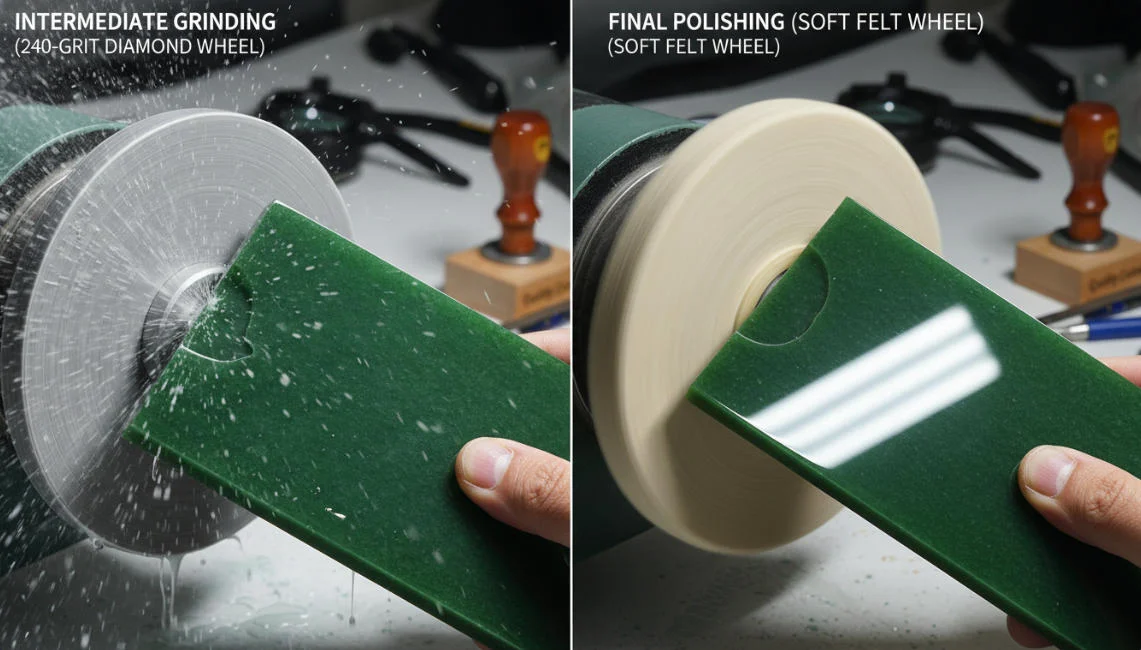
Intermediate Grinding Stage — Progressive Dimensional Approach in the Jade Polishing Process
The intermediate grinding stage bridges the transition from reserved-dimension rough geometry to near-final dimensions, and its control objective is precision of approach rather than speed of material removal. Where the rough stage maintains a deliberate distance from final geometry, the intermediate stage closes that distance — but does so across multiple passes of decreasing depth rather than in a single aggressive pass to dimension. This progressive approach serves a specific mechanical purpose in the jade polishing process: each pass removes a controlled amount of material from the edge cross-section, and the reduced cross-section after each pass has time to be assessed for emerging defects before the next pass reduces it further. A crack nucleated during an intermediate pass is visible as a hairline surface mark under magnification — at this stage, it can be addressed by modifying approach angle or reducing contact pressure before it propagates to a full jade edge chipped defect at the next pass.
Grit transition during the intermediate stage should follow a defined sequence: from rough-stage grit directly to fine grit in a single step introduces too large a surface texture change, and the first fine-grit pass effectively re-cuts the surface left by the coarse grit, generating impact events that the intermediate cross-section may not sustain. A three-step sequence — for example, 120-grit to 180-grit to 240-grit — distributes this transition across three progressive surface refinements, each removing the damage layer from the previous grit before introducing the finer cutting geometry of the next. In the jade process, this grit transition discipline is as important to edge integrity as spindle speed control: skipping grit grades to save cycle time is a documented contributor to intermediate-stage jade edge chipped defects that appear to originate in the finish grinding stage but actually nucleate earlier.
Finish Grinding and Polishing Stage — Controlled Edge Exposure and Surface Refinement in the Jade Polishing Process
The finish grinding stage is the point in the jade process at which the edge cross-section reaches its final, minimum dimension — and therefore the point at which jade edge chipped risk is structurally highest. Every parameter decision at this stage should reflect the reduced mechanical tolerance of the final geometry. Grit selection should be at or above 320-grit for any edge section below 2mm finished thickness; spindle speed should operate at the lower end of the machine’s effective range, typically 2,500 RPM to 4,000 RPM for precision edge work; feed rate should be reduced to the minimum consistent with effective material removal, and dwell periods at any single edge point should not exceed 0.3 seconds. Water coolant must be active and directed precisely at the grinding contact zone — not at the wheel face upstream of contact, but at the point where wheel and workpiece are in actual engagement.
The jade polishing process following finish grinding carries a fundamentally different control objective: surface texture refinement, not dimensional change. This distinction matters operationally because polishing tools — felt wheels, leather laps, rubber-bonded abrasive wheels — are capable of applying lateral force to edge segments if held at incorrect angles or pressed with excessive force. Lateral force on a finished-dimension edge section that has already been reduced to its minimum structural cross-section is precisely the loading condition that produces final-stage jade edge chipped defects — defects that occur after all grinding is complete, that are attributed to polishing error, but that are actually a consequence of the polishing tool being used as a cutting tool rather than a surface-finishing tool. Polishing contact at edge segments should be made with the tool moving parallel to the edge line, never perpendicular to it, and with contact pressure limited to the minimum required to produce surface gloss without edge engagement. This means you prevent the final-stage reject category — the piece that survives grinding intact but chips during polishing — through a single operational discipline that costs nothing beyond consistent application.
Equipment Configuration Standards for Chipping-Sensitive Jade CNC Machining Operations

The process-stage framework described above operates within a defined equipment baseline. When the equipment does not meet this baseline, the stage-level interventions remain valid in principle but become increasingly ineffective in practice — a multi-pass light finish grinding approach still produces jade edge chipped defects if the spindle carrying the finish wheel has 0.015mm of radial runout, because the tool’s actual contact geometry cannot maintain the precision the process design assumes. Equipment configuration for jade process risks management is therefore not a separate quality program from process control — it is the physical infrastructure that makes process control executable.
Precision Spindle and Dynamic Balancing Standards for the Jade Process
Spindle radial runout tolerance for edge-critical jade CNC machining operations should be maintained below 0.005mm at the tool contact point, verified using a precision dial test indicator on a ground reference mandrel. This value is not arbitrary: at 0.005mm runout, the periodic over-engagement of the tool at each rotation produces an incremental force spike of approximately 12% above the nominal contact force on a 3mm edge section — within the material’s tolerance range for standard jade grades. At 0.010mm runout, the same calculation produces a 24% force spike — sufficient to initiate crack nucleation at grain boundaries in mid-grade jadeite under otherwise conservative grinding parameters. NSK’s bearing selection and application engineering guide specifies that angular contact spindle bearings in precision grinding applications should be replaced when measured radial clearance exceeds 0.008mm, a threshold that corresponds to the runout values associated with defect-producing over-engagement in the jade process.
Dynamic wheel balancing should be performed using a two-plane balancing procedure on all grinding wheels above 100mm diameter before first use, and re-verified after any dressing operation removing more than 1mm of wheel diameter. A wheel with residual imbalance of 5 gram-millimeters at 6,000 RPM generates a centrifugal force of approximately 18 Newtons — applied to a machine frame through the spindle bearings as a rotating vector, this force produces frame vibration that couples directly into workpiece edge contact dynamics. FEPA’s grinding wheel specification and balancing standard F10 defines balance grade requirements for precision grinding applications; jade CNC machining edge operations should be specified to balance grade G1.0 or better for wheels used in finish grinding and jade polishing process stages.
Water Cooling System Configuration and Fixture Standards
A water cooling system that is technically present but incorrectly configured provides substantially less thermal protection than its flow rate specification implies. Coolant directed at the wheel face rather than the grinding contact zone loses approximately 60% of its thermal extraction effectiveness through premature evaporation and misdirected flow before it reaches the actual heat generation point. For jade process edge grinding, the coolant nozzle should be positioned to deliver flow directly into the contact zone from the exit side of the wheel rotation — the side where the wheel surface is moving away from the workpiece — at a flow rate sufficient to maintain visible flooding of the contact zone without pressure that displaces the wheel from the workpiece surface. A minimum flow rate of 8 liters per minute is appropriate for edge grinding operations on sections below 3mm thickness; dry contact at any point during an edge grinding pass — even briefly, due to coolant interruption or nozzle misalignment — can generate sufficient thermal stress to nucleate a crack that manifests as jade edge chipped failure in the subsequent pass.
Fixture design for edge-critical work should prioritize two mechanical properties: rigidity at the workpiece contact interface, and minimum transmitted vibration from the machine frame to the workpiece. A workpiece that vibrates relative to its fixture during grinding contact introduces a dynamic component to the edge loading that is entirely separate from spindle runout — the workpiece itself is moving, producing periodic variations in contact depth and force at the edge that mimic runout symptoms but originate at the fixturing interface. Low-runout collets, precision-ground vise jaws with surface hardness above 58 HRC, and vacuum fixtures for flat-backed workpieces all reduce fixture-sourced vibration contribution to jade edge chipped defect rates. This means you address a meaningful category of unexplained batch inconsistency — pieces that chip despite correct parameters and acceptable spindle condition — by investing in fixture precision rather than continuing to investigate process parameters that are not the actual source of variability.
A Structured Approach to Jade Process Risk That Delivers Measurable Yield Outcomes
Edge chipping in the jade process is not an unavoidable characteristic of working with a difficult material — it is a predictable failure distribution shaped by identifiable mechanical variables, each of which responds to specific, implementable controls. The analysis presented across this document establishes three conclusions that should inform how any jade manufacturer or procurement team evaluates production quality in jade fabrication.
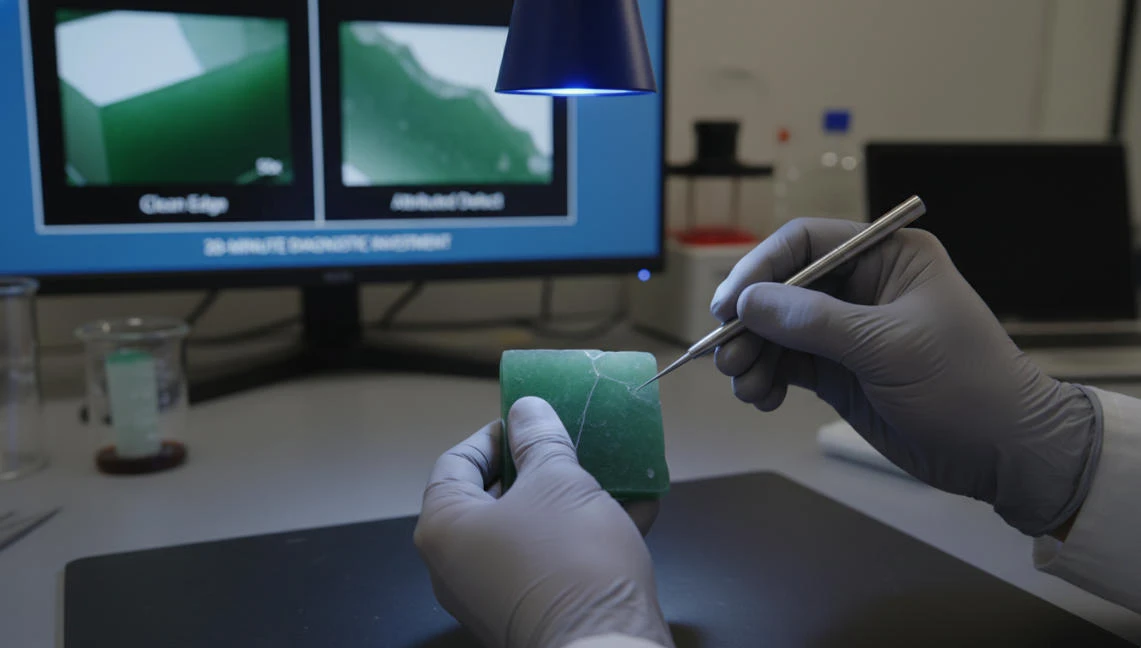
First, chipping source attribution requires stage-specific diagnostic criteria, not general parameter adjustment. Consecutive directional notches indicate grinding force overload and respond to parameter changes. Geometry-correlated defect rates indicate thin-edge structural risk and require design-stage intervention. Random batch-level inconsistency indicates equipment precision degradation and requires mechanical inspection and maintenance. Applying the wrong corrective action to a correctly diagnosed problem wastes production time and produces no yield improvement; applying any corrective action to an incorrectly diagnosed problem compounds the waste. You improve jade process outcomes faster by investing 20 minutes in correct defect attribution than by implementing parameter changes across an entire production run based on incorrect root cause assumptions.
Second, the full-process stage-gate framework — design review, rough grinding with edge reserve, progressive intermediate approach, controlled finish and polishing — produces compounding yield improvement because it addresses all three failure paths simultaneously at their respective highest-leverage intervention points. Jademago‘s fabrication engineering data, accumulated across more than 65 years of continuous jade production, indicates that manufacturing environments implementing all five stage-gate checkpoints achieve jade edge chipped defect rates of 3% to 6% across standard geometry classes — compared to industry survey data suggesting average rates of 18% to 35% in environments without structured stage controls. This means you recover the implementation cost of a structured jade process framework within the first production quarter through direct reduction in material waste, rework labor, and finished-piece rejection.
Third, equipment precision is not separable from process quality in jade CNC machining. The most carefully designed process parameters cannot compensate for spindle runout that exceeds the material’s mechanical tolerance at minimum edge dimensions. Treating equipment maintenance as a production support function rather than a quality function — scheduling bearing inspection and wheel balancing around production convenience rather than around measured precision thresholds — converts a controllable equipment variable into an uncontrolled source of jade process risks that appears in defect data as unexplained process variability. This means you gain more consistent jade polishing process outcomes by establishing precision-threshold-based maintenance intervals than by optimizing grinding parameters on equipment operating outside its functional specification.
For teams evaluating jade fabrication partners, these three principles translate directly into supplier assessment criteria: does the jade manufacturer distinguish between failure path types in its defect reporting, or does it report all chipping as a single defect category? Does it document stage-gate handoff conditions, or does production flow without defined quality checkpoints between stages? Does it maintain equipment calibration records with measured precision values, or does it rely on scheduled replacement intervals without measurement verification? The answers to these questions predict yield consistency more reliably than facility size, equipment brand, or production volume — because they reflect whether the jade process is managed as an engineering system or as an accumulation of individual operator practices. At Jademago, the engineering system framework is the foundation from which every production commitment is made.
FAQs About Jade Edge Chipping in Jade Process
1. What causes jade edge chipping during manufacturing?
Jade edge chipping is usually caused by three main factors: excessive grinding force, overly thin edge designs, or tool runout from worn or imprecise machinery.
2. Can jade edge chipping be prevented?
Yes. Chipping risk can be greatly reduced through proper grinding parameters, maintaining safe edge thickness, using sharp balanced tools, and applying cooling water during machining.
3. Why are thin jade edges more likely to break?
Thin edges have less material to absorb pressure during grinding or polishing, making them much more vulnerable to cracks and chips.
4. Does machine condition affect jade quality?
Absolutely. Spindle wear, wheel imbalance, or tool misalignment can create uneven contact pressure, leading to random chipping and inconsistent product quality.
5. How do professional jade manufacturers reduce defects?
Experienced manufacturers use stage-by-stage quality control, inspect raw materials for internal fractures, optimize machining settings, and regularly maintain equipment for precision results.