

Every jade manufacturer operating at industrial scale encounters a recurring problem: batch output inconsistency that cannot be traced to machine error or operator fault. The root cause is almost always upstream — embedded in the raw stone before it ever reaches the production floor. Frameworks established by the Gemological Institute of America (GIA) confirm that material-level variables are the primary driver of output variation in mineral processing workflows. In practical terms, a jade manufacturer working with unscreened raw stock can expect jade yield rate differences of up to 50% between batches of identical weight and dimension — not because of what happens during machining, but because of what enters the production line without evaluation. Before a single CNC crystal cutting spindle engages, before a single abrasive wheel contacts stone, the quality ceiling and cost floor of every production run have already been determined by the material itself. This article examines, strictly from a manufacturing process perspective, how jade material screening defines the operational parameters of your entire production system — and what the data shows about facilities that skip it.
Table of Contents
How Jade Raw Material Quality Determines Yield Rate Before Processing Begins
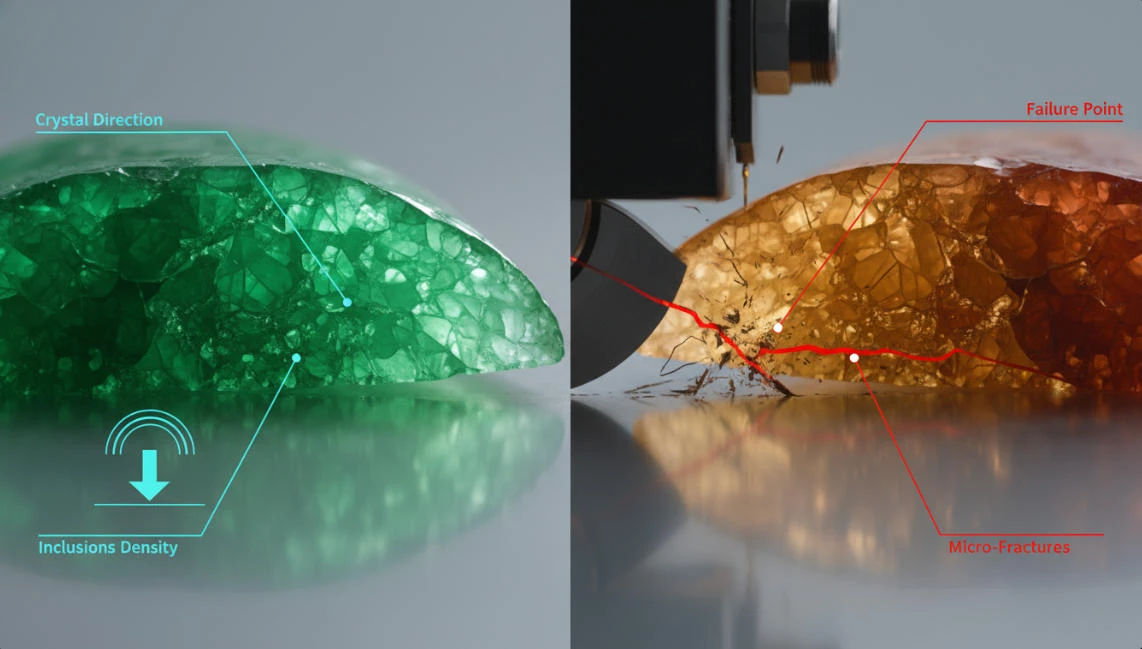
The assumption that jade yield rate is primarily a function of cutting precision or machine calibration is one of the most persistent — and costly — misconceptions in mineral manufacturing. In reality, the yield outcome of any given production run is largely determined the moment raw material enters a facility, or more precisely, the moment it fails to be evaluated before doing so. A jade manufacturer that invests heavily in equipment upgrades while neglecting incoming material assessment is optimizing a secondary variable and ignoring the primary one. The consequence is not merely a missed efficiency gain — it is a structural cost leak embedded into every production cycle, invisible on the machine log but measurable in the final unit economics.
Internal Structure Variations and Their Direct Impact on Usable Output in Jade Manufacturing
No two raw stones are structurally identical, even within a single consignment. Within any batch of jade or crystal rough, internal differences in crystalline grain direction, inclusion density, and natural fracture orientation produce dramatically different usable output from stones of equivalent weight and external profile. The International Gem Society (IGS) documents that jadeite — the primary mineral used in high-grade jade material production — exhibits significant variation in interlocking granular microstructure, a characteristic that directly determines how cleanly the stone can be cut and how much material survives the jade process as a functional finished unit. In controlled production environments, this structural variance produces a measurable output gap that goes far beyond marginal percentage differences.
A well-structured raw stone may yield ten finished units per kilogram of input material, while a structurally compromised stone of identical weight may produce fewer than five units meeting the same dimensional and surface standards. That 100% output differential is a direct manufacturing cost, not an abstraction — and no downstream process refinement can recover material that fractures during cutting or fails surface integrity checks after polishing. This means that when you implement incoming material screening, you are not adding a process step — you are establishing the actual baseline for your cost-per-unit calculation before a single tool engages.
Why Jade Yield Rate Optimization Must Start at the Raw Material Stage, Not the CNC Stage
The operational instinct in most jade processing factories is to pursue yield improvements by refining CNC crystal cutting toolpath parameters, reducing feed rates, or upgrading to finer abrasive specifications. These are legitimate refinements, and in isolation they produce measurable gains — but their effect on yield is bounded by the material they are applied to, and that boundary is set long before the machine cycle begins. If the raw stone carries a subsurface crack running parallel to a planned cut line, no toolpath adjustment prevents the fracture from propagating under mechanical stress. If a batch’s inclusion density exceeds the structural tolerance required by the target product geometry, no spindle speed modification changes that physical reality. The jade process of CNC machining amplifies material properties — it does not override them. A jade manufacturer that understands this relationship will redirect a meaningful portion of its process improvement investment toward the material evaluation stage, where the actual yield ceiling is established.
According to processing efficiency data compiled across mineral manufacturing sectors by the Swiss Gemmological Institute (SSEF), pre-processing material assessment protocols are directly correlated with a reduction in mid-cycle production failure rates of 20 to 35% in hard stone machining environments. You will not find a more cost-effective intervention point in the entire production chain — because this is where the largest single variable is still controllable.
The Direct Relationship Between Jade Material Screening and CNC Crystal Cutting Stability

A CNC crystal cutting system operating at production throughput is not a forgiving environment for compromised material. The mechanical forces involved in high-speed rotary cutting — contact pressures, thermal gradients generated at the tool-stone interface, vibration transmission through the workpiece fixture — create conditions under which pre-existing material weaknesses do not remain stable. They propagate. A subsurface microcrack that poses no visible problem during manual inspection becomes a fracture initiation point the moment it encounters the stress concentration generated by a cutting tool moving at several thousand RPM. The result is not a minor surface defect that can be polished away. It is a catastrophic mid-cycle failure: the workpiece fractures, the fixture may be damaged, the machine cycle must be interrupted, and the material is entirely lost.
This pattern repeats with statistical regularity in any jade processing factory that does not systematically identify and segregate high-risk material before it reaches the production line — and it represents one of the highest unit-cost events in the entire jade process.
How Hidden Cracks and Density Inconsistencies in Jade Material Trigger CNC Processing Failures
The three most common structural failure modes in jade material during CNC crystal cutting operations are subsurface microcracking, localized density discontinuity, and mineral inclusion clusters. Each has a distinct failure mechanism, and each produces a different pattern of production disruption.
Subsurface microcracks — the most dangerous of the three because they are rarely visible under standard inspection lighting — tend to propagate suddenly and completely during the high-stress phases of the cutting cycle, most commonly during initial rough profiling when contact forces are at their maximum. The result is typically a full workpiece fracture with no recoverable material.
Localized density discontinuities create a more gradual failure pattern: the cutting tool encounters alternating zones of differing hardness within a single pass, generating lateral deflection forces that compromise dimensional accuracy across the entire cut geometry. What appears as a “drift” in CNC output tolerances — commonly attributed to machine calibration issues — is frequently a material density problem that no recalibration will resolve.
Mineral inclusion clusters present a third failure type: hard crystalline inclusions embedded in softer matrix material create extreme localized stress concentrations at the inclusion boundary during cutting, producing chipping and edge breakout that ruins surface finish requirements at the final product stage. A GIA technical report on jadeite microstructure notes that inclusion distribution in nephrite and jadeite is highly irregular even within a single stone, making visual surface inspection an insufficient sole screening method for any jade manufacturer running automated production volumes.
Pre-CNC Light Inspection and Slice Testing — Identifying High-Risk Jade Material Before It Reaches the Production Line
The most effective technical interventions for identifying these three failure categories before a stone enters the CNC crystal cutting queue are transmitted light inspection — commonly called lamp inspection or “lam jian” in production floor terminology — and controlled slice testing on suspect material. Lamp inspection uses a high-intensity transmitted light source positioned behind and below the raw stone to render subsurface features visible through light scattering and absorption differential. Microcracks appear as dark linear traces within the illuminated stone volume; inclusion clusters produce irregular dark patches distinguishable from surrounding matrix by boundary sharpness. The light source color temperature matters operationally: a daylight-spectrum source in the 5500–6500K range provides the highest contrast for crack identification, while a warmer source may be preferable for color-related grading in some jade material categories. Inspection angle must be varied systematically — no single viewing angle reveals all subsurface features, and a fixed-position inspection protocol will consistently miss fractures oriented parallel to the line of sight.
Slice testing is reserved for stones that pass lamp inspection but exhibit characteristics — unusual weight distribution, surface texture irregularities, atypical cutting response during test passes — that suggest potential internal anomalies. A controlled cut removing a thin cross-sectional slice from a non-critical position on the stone exposes the internal structure directly, allowing assessment of inclusion density, grain uniformity, and fracture presence across the actual material cross-section that will be engaged during production cutting. Together, lamp inspection and slice testing form the technical core of an effective pre-production screening protocol for any jade processing factory operating CNC crystal cutting lines at scale. You gain, in concrete terms, the ability to route material to appropriate production applications before a single machine hour is spent on a stone that will fail mid-cycle — which means your CNC line runtime is spent producing finished output, not recovering from material-caused interruptions.
Raw Material Screening as the Foundation of Stable Production Capacity Planning in Jade Manufacturing
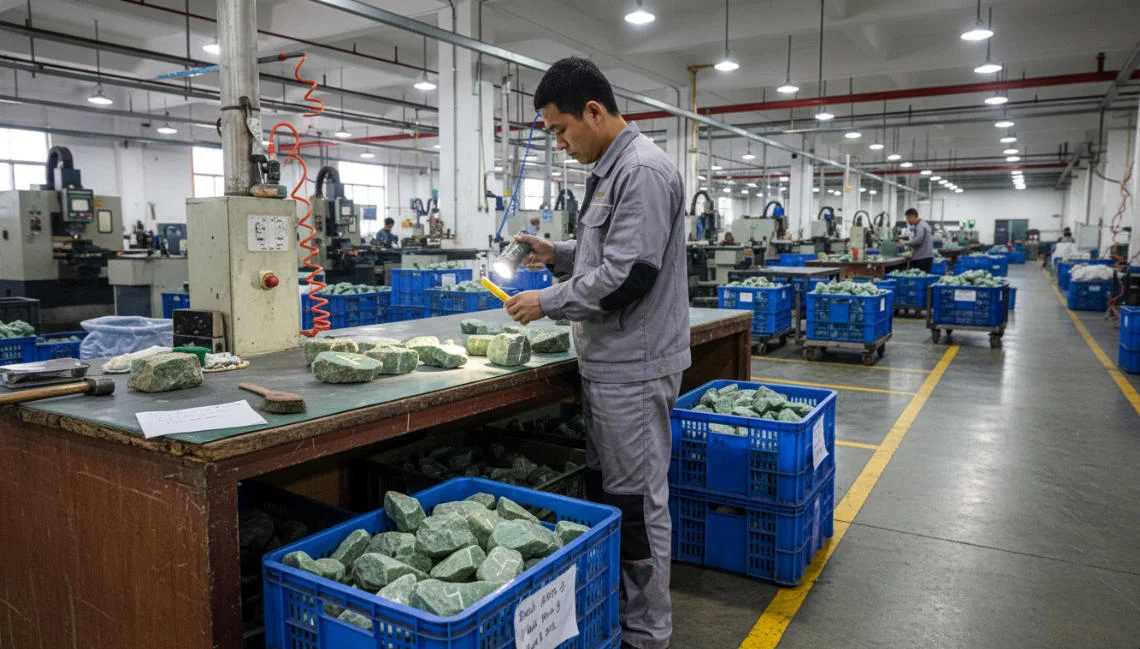
Production planning in a jade processing factory without upstream material data is not planning — it is approximation under uncertainty. When a facility’s scheduling team cannot assign a reliable yield coefficient to incoming raw material, every downstream calculation becomes a range estimate rather than a commitment: estimated daily output becomes a moving target, machine utilization rates cannot be accurately projected, and delivery windows are set based on best-case assumptions that raw material performance frequently invalidates.
The operational consequence is a production environment where actual output consistently diverges from planned output, where schedule adjustments become a routine management task rather than an exception, and where the gap between what was promised and what was delivered accumulates into a systemic reliability problem. A jade manufacturer managing high-volume order fulfillment cannot sustain this operating model across multiple simultaneous production runs without significant downstream consequences — both in internal resource allocation and in external delivery performance. The solution is not more sophisticated scheduling software. It is material data collected before the stone enters the production system, structured in a format that planning functions can actually use.
How Unscreened Jade Raw Material Creates Unpredictable Daily Output in High-Volume Production
The mechanism through which unscreened jade material destabilizes production output is not random — it is systematic and predictable once the underlying variable is identified. When raw stones of varying internal quality are introduced into the same production line without differentiation, the line’s effective throughput fluctuates in direct proportion to the quality distribution of the material it is processing at any given time. On days when higher-quality material dominates the queue, the line runs at or near theoretical throughput capacity: tool engagement is smooth, cycle interruptions are infrequent, and the proportion of finished units meeting dimensional and surface specifications is high. On days when structurally compromised material enters the same line without segregation, the opposite occurs: mid-cycle fractures interrupt machine runs, out-of-tolerance output requires rework or rejection, and the effective unit output per machine hour drops substantially. Across a production week processing mixed unscreened batches, this variance can produce daily output fluctuations of 30 to 50% from the same equipment configuration and operator team — a range wide enough to make any production schedule functionally unreliable.
The IGS resource on gem processing variables notes that material consistency is the single largest controllable factor in stabilizing throughput rates in precision stone cutting operations, a finding that aligns directly with what experienced jade processing factory managers observe on the production floor. You cannot build a reliable delivery commitment on a planning model that lacks the foundational input of material quality data.
Using Material Grade Classification to Build a Reliable Production Output Model for Jade Manufacturers
The transition from approximation-based planning to data-driven production scheduling begins with a structured material grading system applied consistently at the point of incoming material receipt. When each incoming raw stone — or each subdivided lot within a consignment — is assigned a grade classification based on the screening criteria established during lamp inspection, structural assessment, and where applicable slice testing, that classification carries a yield coefficient derived from historical production data for material in that grade category.
A Grade A classification for a given jade material type might carry a historical yield coefficient of 85 to 92%, meaning that for every kilogram of Grade A input material, production planning can project 850 to 920 grams of output in finished units meeting specification. A Grade B classification for the same material type might carry a coefficient of 60 to 72%. A risk-flagged classification might carry a coefficient below 50%, or may be routed entirely outside the standard production line pending secondary evaluation. When these coefficients are applied to the actual volume of graded material in the production queue, scheduling functions can generate a daily and weekly output projection with a defined confidence range — not a single-point estimate subject to constant revision, but a bounded projection that reflects the actual material reality entering the system. This means that when you build delivery commitments using screened and graded material data, those commitments are grounded in the same material parameters that will govern actual production performance — and the gap between projected and actual output narrows from a management problem to a manageable variance.
A jade manufacturer running this model across multiple production lines simultaneously gains the ability to sequence material grades strategically: routing higher-grade material to lines processing orders with tighter tolerances or closer delivery windows, and scheduling lower-grade material for production runs where the output specification allows for broader dimensional acceptance. This is not a theoretical optimization — it is a practical scheduling capability that is simply unavailable to any facility that introduces unscreened material into its production system, because without grade classification data, no basis exists for differentiated routing decisions.
Connecting Material Screening Data to Production Scheduling in Jade Processing Factories
The full operational value of a material screening system is only realized when the data it generates is structured for integration with production scheduling and output tracking functions. A screening record that exists as a handwritten notation on a storage bin label contributes marginally to planning capability. The same data entered into a batch tracking system linked to production scheduling software creates a feedback loop with measurable impact on planning accuracy. Each screened lot receives a batch identifier at the point of grading — a reference number that travels with the material from storage through production, linking the incoming material assessment data to the machine run records and output quality data generated during processing. Over time, this linked dataset builds a material performance history: the actual yield achieved from each grade classification, the frequency and type of mid-cycle failures associated with specific material characteristics, the surface finish outcomes correlated with particular inclusion density ranges in the incoming jade material. This accumulated data progressively refines the yield coefficients used in production planning, improving projection accuracy with each production cycle and giving the jade process management team an increasingly precise instrument for forward scheduling.
According to manufacturing systems research reviewed by the SSEF, facilities implementing traceable material classification systems in hard stone processing report planning accuracy improvements of 25 to 40% within the first two production quarters following implementation — a gain that compounds directly into delivery reliability and internal resource efficiency. The investment required to build this system is front-loaded in process design and data infrastructure; the return distributes across every production run that follows, making it one of the highest-leverage operational improvements available to a scaling jade manufacturing facility.
How Material Screening Controls Product Consistency Across Production Batches in Jade Processing
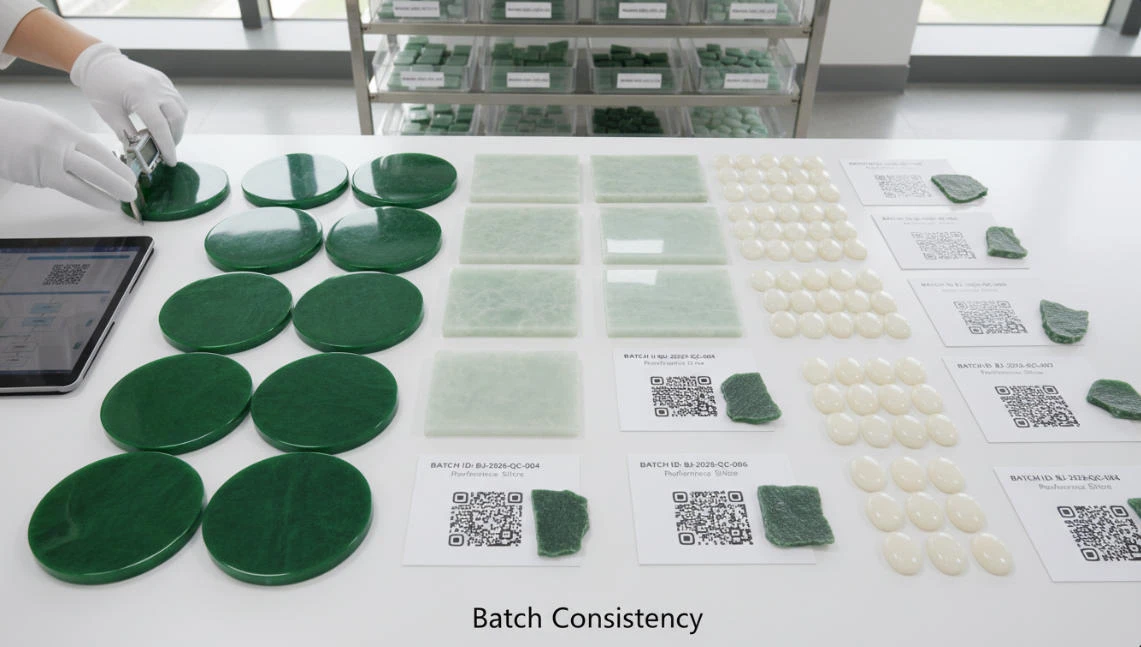
Batch-to-batch product consistency is the metric by which procurement teams evaluate whether a jade manufacturer is operating a controlled production system or an uncontrolled one. A facility that delivers ten consecutive batches of identical specification with consistent dimensional tolerance, surface finish uniformity, and color grade distribution is demonstrating something that equipment lists and factory tour photographs cannot: a production system with genuine process control at the material level. Conversely, a facility whose output shows significant variation between batches — even when individual units within each batch meet stated specifications — is signaling that its production parameters are not stable, that material variables are not being managed, and that the next batch may differ from the current one in ways that cannot be predicted in advance.
For procurement teams managing supply chains where downstream assembly, retail presentation, or product grading depends on consistent input material, this unpredictability is not a minor quality complaint — it is a structural supply chain risk that triggers supplier qualification reviews. The data is unambiguous on this point: according to quality management frameworks applied to mineral processing industries referenced by the GIA’s manufacturing research documentation, material input variability is the primary driver of batch output inconsistency in stone processing operations, accounting for a higher proportion of between-batch variation than equipment calibration drift, operator performance variation, or environmental factors combined. A jade manufacturer that controls its incoming material controls its batch output — and a facility that does not screen incoming material surrenders that control entirely to the geological lottery of whatever raw stock arrives in the next consignment.
The Role of Color Consistency and Texture Uniformity in Jade Material Grading for Batch Production
Among the material characteristics assessed during incoming screening, color distribution uniformity and texture regularity have the most direct and visible impact on finished product consistency within and across production batches. Color in jade material — whether the deep saturated green of high-grade jadeite or the tonal range of nephrite variants — is not uniformly distributed within a single raw stone, and distribution patterns vary significantly between stones even within a single geological source consignment.
A raw stone with a concentrated color zone surrounded by substantially paler matrix material will produce finished units with markedly different color presentation depending on which part of the stone each unit is machined from. When multiple stones with different color distribution profiles are processed together in an ungraded batch, the resulting finished unit population contains a color range that may span multiple commercial grade categories — a Grade A unit and a Grade C unit produced in the same machine run from the same nominal batch. Texture regularity presents an analogous problem. Coarse-grained or mixed-grain texture in jade material produces visible surface patterning after polishing that differs fundamentally from fine-grained material of otherwise similar color characteristics. A batch of finished units combining fine-grain and coarse-grain source material will show surface finish variation that no amount of polishing process standardization can eliminate, because the variation originates in the crystal structure of the material itself, not in the polishing operation.
The IGS documentation on nephrite and jadeite structural characteristics establishes that grain size and interlocking crystal morphology are the primary determinants of surface finish quality in polished jade products — variables that are fixed at the geological formation stage and can only be managed, not modified, during manufacturing. When you implement color and texture grading at the incoming material stage, you gain the ability to batch production runs from material with consistent internal characteristics — which means the finished unit population within each batch shares a common material baseline, and between-batch variation reflects grade tier differences rather than uncontrolled material mixing.
Controlling Within-Batch Variation Through Targeted Material Matching in the Jade Process
Beyond color and texture, the dimensional geometry of raw stones relative to target product specifications creates a third category of batch consistency risk that is addressable at the screening stage and becomes substantially harder to manage once material enters the production queue.
Every product specification in a jade processing factory has an implicit material geometry requirement: the minimum cross-sectional dimension required to yield the target finished unit, the grain orientation most favorable for the planned cutting direction, the maximum acceptable inclusion density for the target surface finish grade. When incoming raw material is screened against these product-specific parameters and allocated to production runs accordingly — rather than introduced into a general material pool where allocation is determined by whatever is at hand — the match between material characteristics and product requirements is established before the jade process begins rather than discovered after it concludes.
This targeted matching approach eliminates the most avoidable source of within-batch variation: units lost or downgraded not because the material was inherently unsuitable, but because it was assigned to a production application whose requirements exceeded what that specific material could reliably deliver. A stone with moderate inclusion density that would perform consistently in a standard commercial grade product run becomes a source of rejects and rework when directed to a production run requiring premium surface finish standards. The same stone, correctly allocated at the screening stage, contributes to a consistent batch output in the application it can actually support. This means your material utilization rate — the proportion of incoming raw material that reaches finished product status in an appropriate grade tier — increases without any change to machining parameters or tooling specifications, purely as a result of better material-to-application matching upstream.
Batch Numbering and Material Traceability Systems for Jade Manufacturing Quality Control
The operational infrastructure that makes material grading data actionable across a production system is the batch numbering and traceability architecture applied from the point of incoming material receipt through to finished product dispatch. Without a structured traceability system, grade classification data generated during screening remains isolated at the storage stage — useful for initial routing decisions but unavailable for correlation with production outcomes, quality inspection results, or customer feedback received after product delivery.
A functional traceability system begins with a unique batch identifier assigned to each screened material lot at the point of grading. This identifier links the material’s screening record — grade classification, lamp inspection findings, slice test results where applicable, dimensional measurements — to the production batch records generated when that material is processed. Machine run parameters, cycle interruption events, mid-cycle failure incidents, and output inspection results are all recorded against the same batch identifier, creating a linked dataset that connects incoming material characteristics to production performance outcomes. When a quality deviation is identified — whether during in-process inspection, final product quality check, or post-delivery customer feedback — the batch identifier provides an immediate pathway to the source material data. Was the deviation consistent across units from a specific raw stone? Does it correlate with a particular screening characteristic that was flagged but accepted at the incoming stage? Does it appear only in units machined from a specific portion of the material lot, suggesting a localized internal defect that passed initial screening? These questions are answerable within hours when traceability infrastructure is in place; they are unanswerable — or answerable only through expensive and time-consuming retrospective investigation — when it is not.
The SSEF’s quality assurance frameworks for gem material processing consistently identify material traceability as a foundational requirement for production quality system certification in the gem and mineral processing sector. Beyond internal quality management, a robust batch traceability system provides a jade manufacturer with a continuously improving performance dataset: each production cycle adds data points that refine the correlation between incoming material characteristics and production outcomes, progressively improving the accuracy of yield projections, the precision of material-to-application matching, and the early detection of raw material supply quality shifts before they propagate into finished product quality problems. This means that the traceability system is not a static record-keeping function — it is an active production intelligence asset that becomes more valuable with each batch processed, compounding its contribution to manufacturing consistency over time.
The 7-Step Jade Material Screening Workflow — A Standardized Process for Industrial
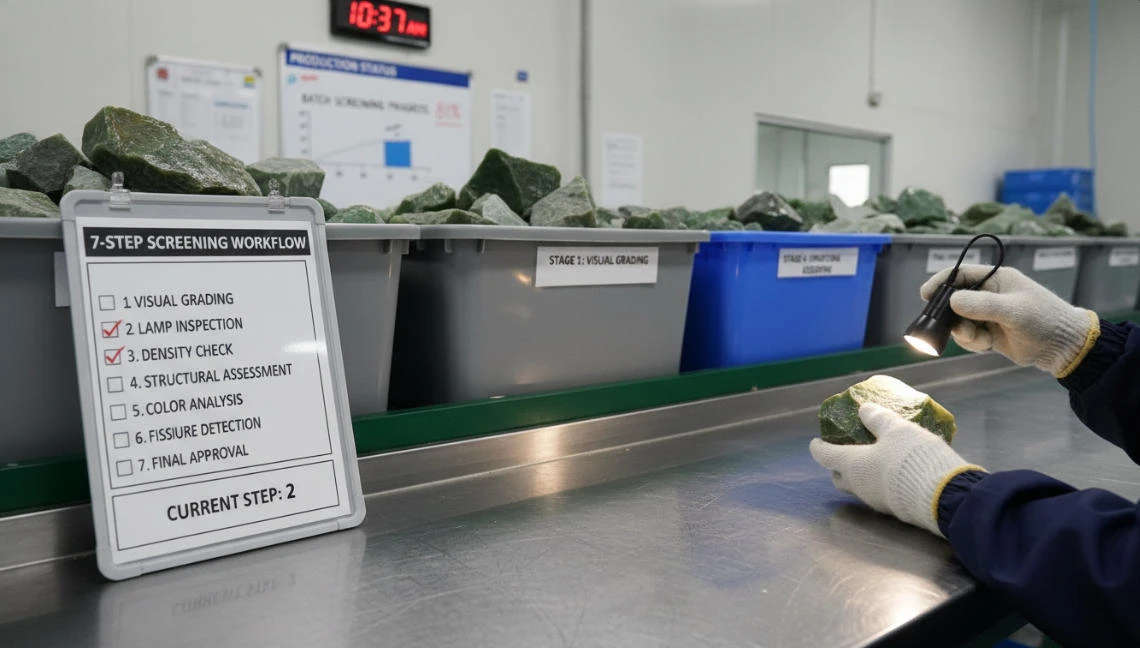
The difference between a jade manufacturer operating a controlled production system and one operating a reactive one is most clearly visible at the incoming material stage. Facilities that rely on informal assessment — a experienced worker’s visual judgment, a quick surface inspection under ambient lighting, a rough weight comparison against known reference stones — are not screening material. They are performing a cursory check that captures only the most obvious surface defects while leaving the structural variables that most directly determine production outcomes entirely unexamined. A standardized screening workflow replaces judgment-dependent approximation with a repeatable, documentable process whose outputs are consistent regardless of which operator performs the assessment, which shift the material arrives on, or how large the incoming consignment volume is.
The seven steps outlined below represent the operational sequence used by professionally managed jade processing factories running CNC crystal cutting lines at production scale — not as a theoretical ideal, but as a practical workflow whose individual steps are sequenced to maximize detection coverage while minimizing the time and material cost of the assessment process itself. Implementing this workflow does not require specialized laboratory equipment beyond what most production facilities already have access to. What it requires is process discipline: the consistent application of defined criteria at each step, applied to every incoming material lot without exception. A jade manufacturer that applies this workflow selectively — screening large orders but not small ones, screening new suppliers but not established ones — captures only a fraction of the risk reduction the system is capable of delivering, because material failures do not discriminate by order size or supplier relationship history.
1–3 — Visual Grading, Lamp Inspection, and Structural Assessment in Jade Raw Material Screening
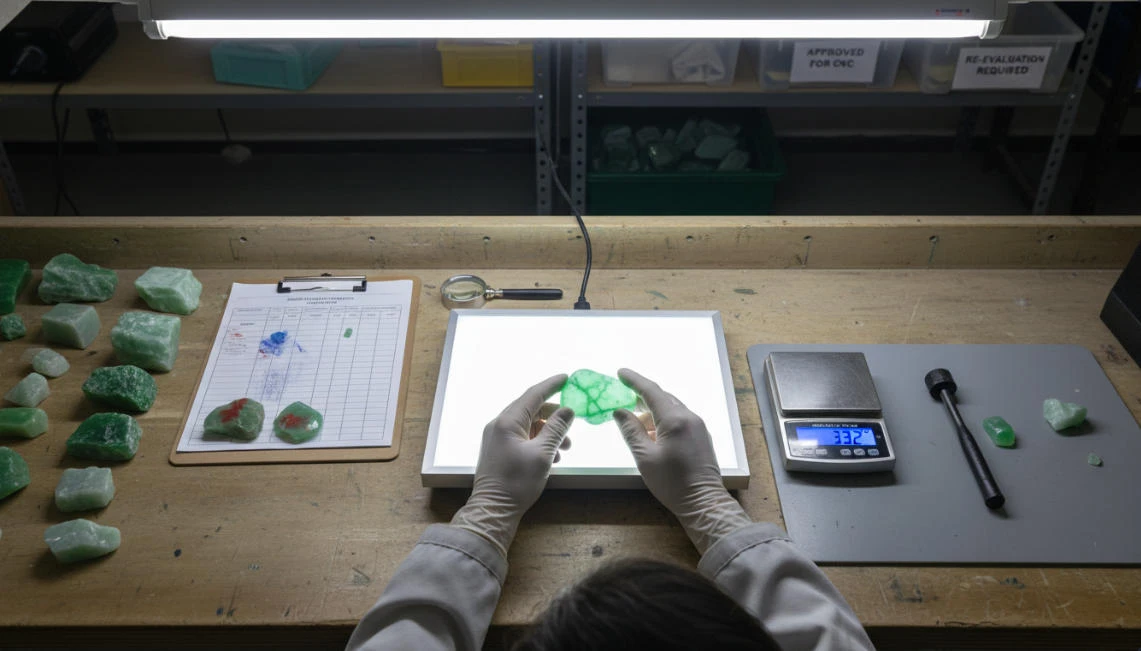
The first three steps of the screening workflow operate as a progressive filtering system, moving from broad visual categorization through surface and near-surface defect detection to internal structural assessment. Each step narrows the material population requiring closer examination at subsequent stages, making the overall workflow efficient even at high incoming material volumes.
1 — Visual Grading is the initial categorization of incoming jade material against defined criteria for color distribution, surface texture class, dimensional geometry, and gross external condition. Color grading at this stage is not a fine gemological assessment — it is a practical classification into working categories that determine which production applications the material is eligible for. A stone with a strongly saturated, uniformly distributed color zone is separated from a stone with patchy color distribution or significant tonal variation across its surface. Texture class — fine-grained, medium-grained, or coarse-grained, assessed by surface appearance under direct light — determines polishing outcome eligibility. Dimensional geometry is assessed against the minimum cross-sectional requirements for target product specifications: material that cannot yield the minimum geometry for any current production order is identified immediately at Step 1 rather than occupying storage and handling resources through the remainder of the screening sequence. Any stone with gross external damage — significant edge fractures, visible through-cracks on external surfaces, severe surface deterioration — is flagged at this stage for direct routing to the risk material handling protocol rather than continuing through standard screening.
Visual grading should produce a preliminary classification record for each stone or sub-lot, establishing the starting parameters that subsequent steps will refine or override.
2 — Lamp Inspection is the most operationally critical step in the screening sequence for CNC crystal cutting risk management, because it is the primary detection method for the subsurface defects that cause the highest-cost production failures. Correct lamp inspection technique requires a transmitted-light source of sufficient intensity to penetrate the full thickness of the stone being examined — for most jade material dimensions used in standard production, a purpose-built gem lamp or high-intensity LED source in the 5500–6500K daylight spectrum range provides adequate penetration while delivering the contrast resolution needed to distinguish microcrack traces from natural color zonation boundaries. The stone is held or positioned above the light source and rotated through multiple orientations, with the inspector systematically varying both the angle of transmitted light and the viewing angle relative to the stone’s major axes. Microcracks appear as dark linear features within the illuminated volume, typically with sharp boundaries and directional orientation following the stone’s natural cleavage or fracture planes. Inclusion clusters appear as irregular dark zones with diffuse boundaries, distinguishable from cracks by their three-dimensional, blob-like appearance rather than planar linearity.
Each lamp inspection finding is recorded against the stone’s screening record with a location reference — which face, which depth zone, which orientation — so that downstream decisions about cutting plan modification or material routing can reference specific defect geometry rather than a general “defects present” notation.
According to technical inspection standards referenced in GIA’s research on jade quality assessment, systematic multi-angle transmitted light inspection detects subsurface fracture features that are invisible under reflected light examination alone in the majority of cases — making lamp inspection a non-substitutable step in any screening protocol intended to manage CNC crystal cutting failure risk.
3 — Density and Structural Assessment addresses the material characteristic that lamp inspection cannot fully capture: localized density variation within the stone volume. In jade material, density discontinuities — zones where mineral composition or crystalline packing density differs from surrounding matrix — create the hardness variation mismatches that generate lateral tool deflection and tolerance drift during CNC crystal cutting operations. Primary assessment at this step uses weight-to-volume ratio comparison against established reference values for the material type: a stone whose measured density falls outside the expected range for its visual classification may contain either high-density inclusion material or low-density voids not visible under lamp inspection.
For nephrite and jadeite, reference density ranges documented by the IGS provide a practical baseline: nephrite typically ranges from 2.90 to 3.02 g/cm³, while jadeite ranges from 3.25 to 3.36 g/cm³. Stones whose measured density falls significantly outside these ranges warrant additional evaluation before production routing. Acoustic assessment — a controlled tap test using a standardized striker against defined contact points on the stone surface — provides a secondary indicator of internal structural integrity: a uniform, clear tonal response suggests consistent internal structure, while a dull, muted, or variable response across different contact points indicates potential internal voids or fracture zones that may not have been fully captured during lamp inspection.
4–7 — Slice Testing, Product Matching, Risk Material Isolation, and Batch Tracking in Jade Processing Factories
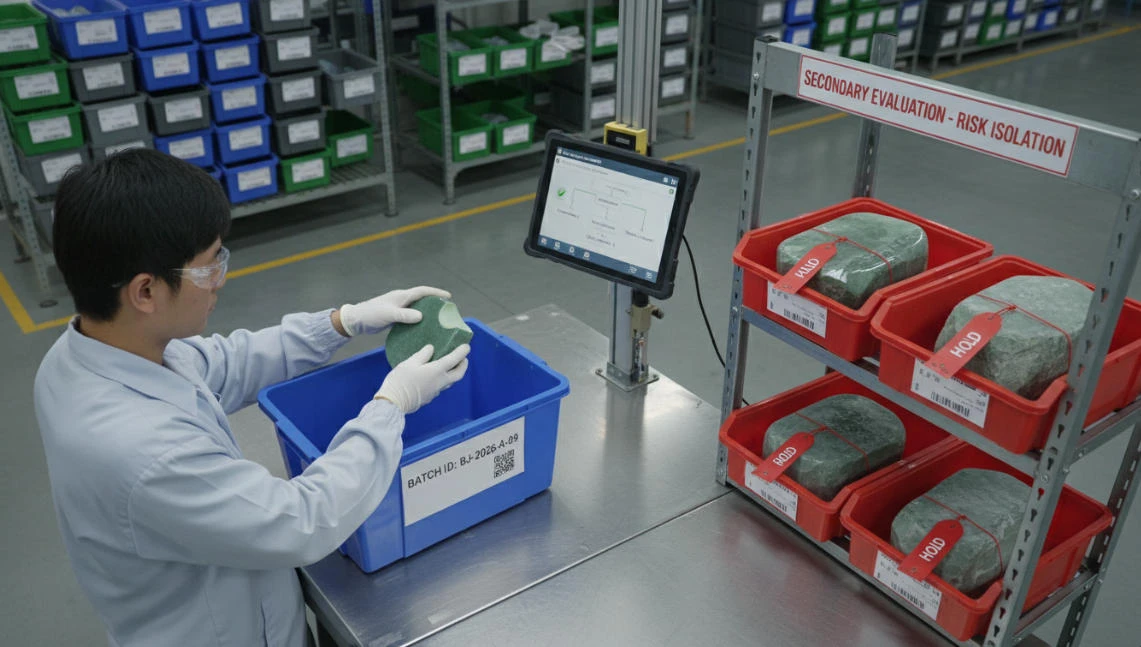
The final four steps of the screening workflow transition from material assessment to material allocation — converting the evaluation data gathered in Steps 1 through 3 into routing decisions that determine how each lot of jade material enters the production system, under what conditions, and with what documentation trail.
4 — Slice Testing is applied selectively to material that has generated ambiguous or borderline results in Steps 2 and 3 — stones that passed lamp inspection without definitive defect identification but showed density anomalies, acoustic irregularities, or surface texture patterns suggesting potential internal issues. A controlled slice test removes a thin cross-sectional sample from a non-critical zone of the stone — typically an end section that falls outside the dimensional envelope required for any planned finished unit — exposing the internal cross-section for direct visual examination. The exposed section reveals inclusion distribution across the actual material cross-section, grain uniformity, the presence of internal fracture planes not detectable from the surface, and color distribution within the stone volume rather than just across its surface.
Slice test results either confirm the stone for standard production routing, reclassify it to a lower grade tier, or flag it for risk material handling based on what the exposed section reveals. The slice taken during testing is retained as a reference sample linked to the stone’s batch record, providing a physical evidence base for routing decisions that can be reviewed if production outcomes from that material lot require retrospective investigation.
5 — Product Matching and Bin Allocation converts accumulated screening data for each material lot into a production routing assignment. Each screened stone or sub-lot is matched against current production order requirements and allocated to the product application and production line best suited to its confirmed grade characteristics. High-grade material — strong color consistency, fine grain, clean lamp inspection, density within optimal range — is allocated to production runs requiring premium surface finish standards or tight color grade consistency. Mid-grade material is routed to standard commercial production lines where specification tolerances accommodate the material’s characteristics without generating reject rates above the facility’s acceptable threshold. Material graded below standard commercial threshold but not flagged as high-risk is allocated to product applications with broader acceptance criteria — larger format pieces where inclusions can be planned around, or lower specification grades where the material’s characteristics are not a production liability.
Bin allocation is recorded in the batch tracking system with the grade classification, routing decision, and the production order references the material is assigned to — creating the linkage between incoming material data and production scheduling that enables the capacity planning functions described in the previous chapter.
6 — Risk Material Isolation and Secondary Evaluation handles the population of material that screening has identified as unsuitable for standard production routing without additional assessment. High-risk material — stones with significant lamp inspection findings, severe density anomalies, or definitive fracture evidence from slice testing — is physically segregated from the standard material storage area and held in a designated risk material zone pending secondary evaluation.
Secondary evaluation may involve more detailed lamp inspection by a senior quality assessor, additional slice testing at multiple positions within the stone, or in cases where the material value justifies it, referral to a third-party assessment service.
The outcome of secondary evaluation produces one of three routing decisions: reclassification and release to an appropriate standard production tier if the secondary assessment determines the initial risk flag was overstated; acceptance for a specifically defined limited application if the material’s usable zones can be isolated and productively utilized; or rejection and return to supplier if the material fails secondary evaluation. All risk material handling decisions are documented in the batch tracking system against the stone’s batch identifier, maintaining a complete decision trail that supports both supplier performance evaluation and internal quality system auditing.
7 — Batch Number Assignment and Production Tracking closes the screening workflow loop by formalizing the documentation linkage that makes screening data operationally useful beyond the initial routing decision. Every screened material lot — whether a single stone, a grouped sub-lot, or a full consignment parcel — receives a unique batch identifier at the completion of screening that travels with the material through every subsequent stage of the jade process: storage location, production line assignment, machine run records, in-process quality inspection results, finished product quality data, and customer order fulfillment records.
This end-to-end identifier creates the traceability chain that transforms individual screening assessments into a cumulative production intelligence database. When a quality deviation surfaces — at any point from in-process inspection through post-delivery customer feedback — the batch identifier provides immediate access to the complete material history for the affected production lot, enabling root cause analysis that distinguishes material-origin deviations from process-execution deviations. Over production cycles, the accumulated batch data builds a performance correlation map: which grade classifications consistently deliver yield rates within projected ranges, which raw material sources produce material whose screening classifications reliably predict production outcomes, and which material characteristics identified during screening most strongly predict mid-cycle failure risk.
This means that your screening workflow improves in precision over time — each batch processed adds a data point that refines the system’s predictive accuracy, and a jade processing factory that has operated this tracking system across two or three years of production has a material performance intelligence asset that a facility without systematic screening cannot replicate regardless of how much it invests in equipment or process refinement.
Building a Material Screening System That Integrates With the Full Jade Manufacturing Workflow
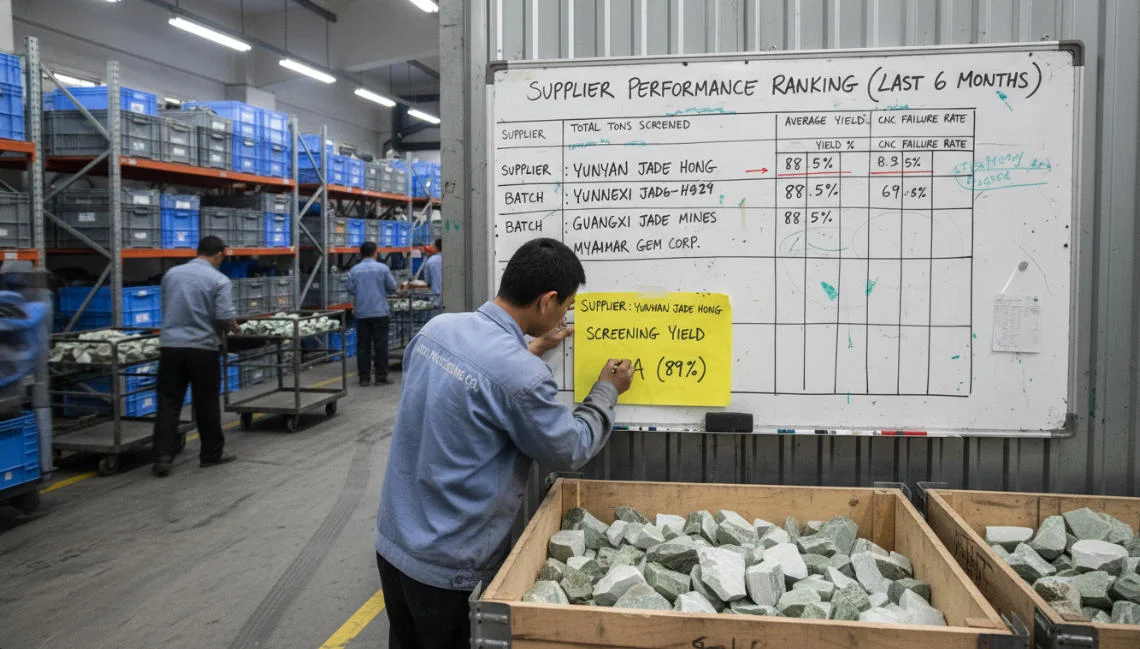
The seven-step screening workflow described in the preceding chapter delivers its full operational value only when it functions as an integrated component of the broader production system — not as a standalone quality gate that material passes through once and then disappears from in terms of documented data flow. A jade manufacturer that screens incoming material, records the results in a format that cannot communicate with production scheduling, and then manages production against a separate planning dataset has built a screening function that reduces material-level surprises on the production floor without generating the planning accuracy improvements that screening data is capable of supporting.
The gap between a screening function that reduces risk and a screening system that improves production performance is a data architecture gap, not a process execution gap. Closing it requires that the outputs of the screening workflow — grade classifications, yield coefficients, defect type records, routing assignments, batch identifiers — be structured from the point of generation in a format that production scheduling, quality management, and supplier evaluation functions can directly consume. This is not a technology investment requirement in the sense of requiring specialized software systems unavailable to mid-scale facilities. It is a process design requirement: defining, before the screening workflow is implemented, exactly what data each screening step will generate, in what format, linked to what reference identifiers, and accessible to which downstream functions.
A jade processing factory that designs its screening data architecture with these downstream consumption requirements as the primary specification will build a system whose value compounds with every production cycle. One that designs its screening records around what is convenient to capture at the inspection station will build a system whose value plateaus at basic risk reduction and never develops into a production intelligence asset.
Connecting Jade Material Screening Data to Production Scheduling and Quality Management Systems
The primary integration point between screening data and production operations is the material-to-order allocation record generated at Step 5 of the screening workflow. When a screened material lot is assigned a grade classification and a production routing decision, that assignment carries an implicit yield projection derived from the historical performance data for material in that grade category. For this projection to be useful to production scheduling, it must be expressed as a quantified parameter — not “good material, should run well” but “Grade A jadeite, 12mm bead specification, historical yield coefficient 87%, projected output 340 units per kilogram input at standard cycle parameters” — and linked to the production order reference it is assigned against.
With this structure, the production scheduling function can aggregate the yield projections across all material lots allocated to a given production order and generate a projected completion timeline with a defined confidence range rather than a single-point estimate. When actual production output is recorded against the same batch identifiers, the variance between projected and actual yield is automatically captured as a data point that refines the yield coefficient for that material grade in future projections. This feedback mechanism is what transforms a static screening classification system into a dynamic production planning tool: the system learns from each production cycle, and its planning accuracy improves progressively without requiring manual recalibration. For quality management integration, the critical linkage is between the defect type records generated during lamp inspection and slice testing, and the in-process quality inspection records generated during CNC crystal cutting operations. When a lamp inspection finding — a subsurface microcrack at a defined location and orientation within a specific stone — is linked by batch identifier to the machine run records for that stone’s processing, the quality management system can correlate specific defect types and locations with specific production failure modes.
Over time, this correlation data answers the question that most jade processing factories currently cannot answer precisely: which incoming material characteristics are actually predictive of production failure, and which are detectable during screening but do not materially affect production outcomes? The answer, built from actual production data rather than theoretical assessment, allows the screening protocol to be progressively refined — investing assessment effort where it generates the greatest production risk reduction, and streamlining assessment at steps where historical data shows limited predictive value for the material types and product specifications the facility actually runs.
According to operational efficiency analysis frameworks reviewed in SSEF’s technical resources for gem processing facilities, facilities that implement data-linked material screening systems report quality escape rate reductions — the proportion of material-origin defects that reach finished product stage without earlier detection — of 30 to 45% within four production quarters of full system implementation. This means that when you build screening data integration with quality management into your system from the outset, you are not just reducing the risk of production failures — you are building a detection and prevention capability that becomes measurably more effective with each production cycle it operates through.
Why Standardized Jade Material Screening Is the Baseline Requirement for Industrial-Grade Jade Process Management
The practical case for systematic jade material screening is ultimately grounded not in quality philosophy but in production economics. A jade manufacturer that screens incoming material operates with a fundamentally different cost structure than one that does not — and the difference is not visible in the line item for screening labor or equipment, which is where most facilities that have resisted implementing structured screening focus their objection.
The difference is visible in the aggregate of cost events that screening prevents: mid-cycle machine run interruptions caused by material fractures, each of which represents lost machine time, potentially damaged tooling, and entirely unrecoverable material cost; rework and rejection costs generated when material-origin defects reach finished product inspection and produce non-conforming output that must be downgraded, reprocessed, or scrapped; planning variance costs accumulated when production schedules built on unvalidated yield assumptions consistently miss their targets, requiring expediting, overtime, or delivery rescheduling to recover; and the supplier relationship costs generated when inconsistent finished product quality is traced back to uncontrolled incoming material variation.
None of these cost categories appears as a discrete line item in most production cost accounting systems, which is precisely why the aggregate cost of not screening is systematically underestimated by facilities evaluating whether to implement structured material assessment. When the full cost of material-origin production failures is captured — machine downtime, material waste, rework labor, quality escape remediation, planning disruption, and delivery reliability impact — the return on investment calculation for a structured screening system is not marginal. It is substantial, and it is front-loaded: the largest cost reductions occur in the first production cycles after implementation, as the most significant material-origin failure modes are identified and prevented before they generate their historical cost impact.
The GIA’s technical research on processing efficiency in mineral manufacturing consistently identifies incoming material assessment as the highest-leverage intervention point for cost reduction in stone processing operations — a finding that reflects the mathematical reality that preventing a production failure costs a fraction of recovering from one. For a jade processing factory operating CNC crystal cutting lines at production scale, the question is not whether structured material screening delivers a positive return — the production economics make this outcome essentially certain for any facility with sufficient volume to generate meaningful material failure frequency. The question is how quickly the system can be implemented and how completely its data outputs can be integrated with production planning and quality management functions, because these two factors determine the timeline over which the return is realized and the ceiling to which it ultimately scales. A jade manufacturer that implements screening as a standalone risk reduction measure captures the first tier of that return. One that builds screening data into an integrated production intelligence system captures the full return — and continues generating compounding improvements in planning accuracy, quality consistency, and supplier management capability for as long as the system operates.
The Long-Term Compounding Value of Systematic Jade Material Screening for Scaling Jade Manufacturers
For a jade processing factory at the growth stage — increasing order volume, adding production lines, expanding the supplier base from which raw material is sourced — the value of a systematic material screening program extends beyond its immediate impact on individual production runs. As production scale increases, the consequences of material-origin production failures scale proportionally: a mid-cycle fracture event that represents a manageable disruption on a two-line facility represents a significant capacity impact on a ten-line facility running concurrent orders with interdependent delivery schedules. The variance in daily output that is a minor planning inconvenience at low volume becomes a serious delivery reliability problem at high volume, because the absolute magnitude of the output gap between projected and actual production grows with the scale of operations even if the percentage variance remains constant.
A screening system implemented at growth stage does not merely address the current volume’s failure risk — it builds the material management infrastructure that prevents the current volume’s failure patterns from scaling into the next volume tier’s operational crises. Equally important for a scaling jade manufacturer is the supplier evaluation capability that accumulated screening data enables. When each incoming consignment from each raw material supplier is screened against consistent criteria and the results are recorded against supplier and source identifiers, the facility builds a comparative performance dataset that allows supplier quality to be evaluated objectively rather than through impression and relationship history. A supplier whose material consistently grades in the upper tiers of the classification system, delivers yield rates at or above the projected coefficient, and generates low lamp inspection defect rates earns a supplier performance profile that justifies preferred sourcing status based on demonstrated production contribution. A supplier whose material consistently underperforms its grade claims, generates above-average lamp inspection defect rates, or produces mid-cycle failure frequencies above the facility’s acceptable threshold generates a documented performance record that supports renegotiation, qualification review, or supplier substitution — based on quantified production impact data rather than subjective quality complaints.
The IGS resource framework for gem material sourcing standards identifies supplier performance data derived from production outcomes as the most actionable basis for raw material sourcing decisions in professional gem processing operations — a standard that systematic jade material screening makes achievable for any facility with the process discipline to implement and maintain consistent incoming assessment protocols. This means that your material screening program is simultaneously a production risk management tool, a planning accuracy improvement mechanism, a quality consistency enabler, and a supplier management instrument — and its contribution to each of these functions increases with the volume of data it accumulates over time. The facility that implements this system earliest in its growth trajectory captures the longest compounding period for that data accumulation, and arrives at each successive scale threshold with a more refined, more accurate, and more valuable material intelligence asset than a competing facility that deferred implementation until the cost of not having it became impossible to ignore.
Material Screening as the Operational Foundation of Controlled Jade Manufacturing
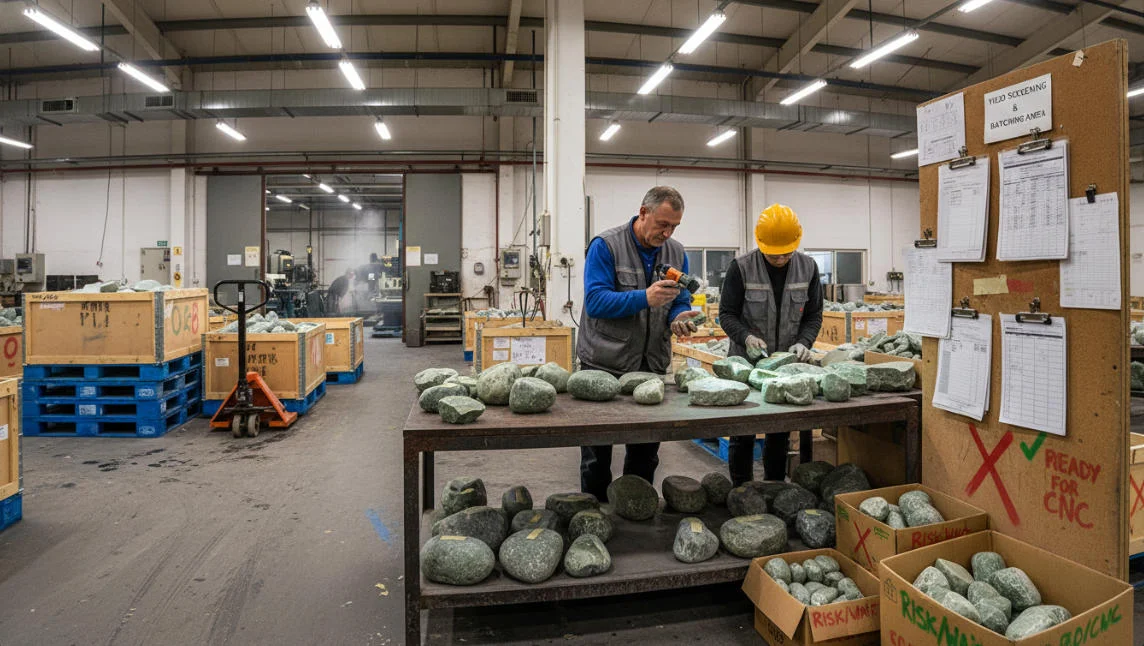
The evidence assembled across the preceding chapters converges on a single operational conclusion: in jade manufacturing, the decision to implement systematic raw material screening is not a quality program decision — it is a production system architecture decision. It determines whether your facility operates with its primary production variable under active management or outside your control. It determines whether your yield rates are outcomes you can project or outcomes you discover after the fact. It determines whether your CNC crystal cutting lines run at planned utilization rates or absorb the unplanned downtime generated by material-origin failure events that a screening protocol would have prevented. It determines whether your batch output is consistent enough to support stable supply chain relationships or variable enough to generate the supplier qualification reviews that inconsistent quality inevitably triggers. And it determines whether your production data accumulates into an increasingly precise management instrument or remains a collection of individual batch records without the linkage structure needed to generate actionable insight.
A jade manufacturer that understands these dependencies does not evaluate material screening as an optional quality enhancement. It implements screening as the foundational step of the jade process — the step that makes every subsequent step operate within a defined and manageable parameter range rather than against an unknown and uncontrolled material variable. The seven-step workflow, the data integration architecture, and the supplier evaluation capability described in this article are not theoretical constructs. They are operational realities in professionally managed jade processing factories that have recognized what the production economics make clear: the cost of systematic screening is fixed and front-loaded; the cost of not screening is variable, recurring, and compounds with production scale. For any jade manufacturer evaluating this decision at any point in its operational development, the production data consistently supports the same conclusion — implement screening early, integrate its data completely, and allow the compounding intelligence value to build across every production cycle that follows.
FAQs About Jade Manufacturer Raw Material Screening
1. How does raw material screening improve jade yield rate in production?
Raw material screening identifies structural defects, inclusion density, and internal fractures before a stone enters the production line. By routing only structurally sound jade material to CNC crystal cutting operations, a jade manufacturer can achieve yield rates of 85–92% for Grade A material, compared to below 50% for unscreened stock — a difference that directly determines cost-per-unit across every production run.
2. What are the most common causes of CNC crystal cutting failure in jade processing?
The three primary failure modes in CNC crystal cutting are subsurface microcracks, localized density discontinuities, and mineral inclusion clusters. None of these are reliably detectable through surface inspection alone. Lamp inspection and slice testing conducted before the jade process begins are the most effective technical interventions for identifying and segregating high-risk material before it reaches the production line.
3. Why does unscreened jade material make production scheduling unreliable?
Without incoming material screening data, a jade processing factory has no yield coefficient to assign to raw stock entering the production queue. Daily output can fluctuate by 30–50% between batches of unscreened material processed on identical equipment by the same operator team — a variance range that makes any delivery commitment built on unvalidated yield assumptions structurally unreliable.