
In the jade process, no single operation concentrates more irreversible risk in less time than drilling. A 2-millimeter hole — drilled at the wrong speed, without adequate cooling, or through a structurally compromised zone — can reduce a finished jade piece worth thousands of dollars to manufacturing scrap in under thirty seconds. Production quality analysis compiled across multiple jade processing facilities consistently identifies drilling-related defects as responsible for 18% to 34% of total finished-goods yield loss, positioning jade drilling as the statistically highest-risk unit operation in the entire manufacturing workflow.
What makes this risk category so consequential is not its frequency, but its finality. In most steps of the jade process, errors carry some corrective margin: a rough cut can be refined, a grinding mark re-polished, a carving line adjusted. Drilling errors carry none. When a crack propagates outward from a drill hole, the stone’s structural integrity is permanently compromised. No subsequent operation in the jade process can reverse that damage — the loss is absolute, and it belongs entirely to the manufacturer who made the decision about timing, tooling, parameters, and cooling in the moments before the drill engaged the stone.
Table of Contents
Why Jade Drilling Is the Highest-Risk Operation in the Jade Process
Jade drilling is routinely categorized as a secondary or transitional step in the jade process — a minor operation that receives a fraction of the planning attention given to rough cutting, carving, or jade polishing. This categorization is operationally dangerous. Drilling is the only step in the entire jade process where a single mechanical action, lasting a matter of seconds, can permanently destroy the cumulative value of hours or days of prior craftsmanship.
The asymmetry of consequence is what distinguishes drilling from every other operation in jade processing. Most steps in the jade process offer measurable error tolerance: a carving imprecision can be corrected at the grinding stage, surface damage from grinding can be recovered through extended jade polishing, and minor dimensional deviations can be addressed in finishing. Drilling offers none of these corrective paths. Once a crack initiates and propagates through the stone, the material has structurally failed — and there is no re-fusing, re-firing, or structural repair available to a jade manufacturer working with natural stone. This means that every drilling decision you make carries the full weight of every process hour invested in the piece beforehand.
The Five Failure Modes That Define Drilling Risk in Jade Processing
Understanding how drilling fails is the mandatory prerequisite for preventing it. In production environments, five distinct failure modes account for the overwhelming majority of drilling-related defects in jade processing. Each mode has a specific physical mechanism, a distinct set of operational causes, and a different level of downstream consequence for the jade process.
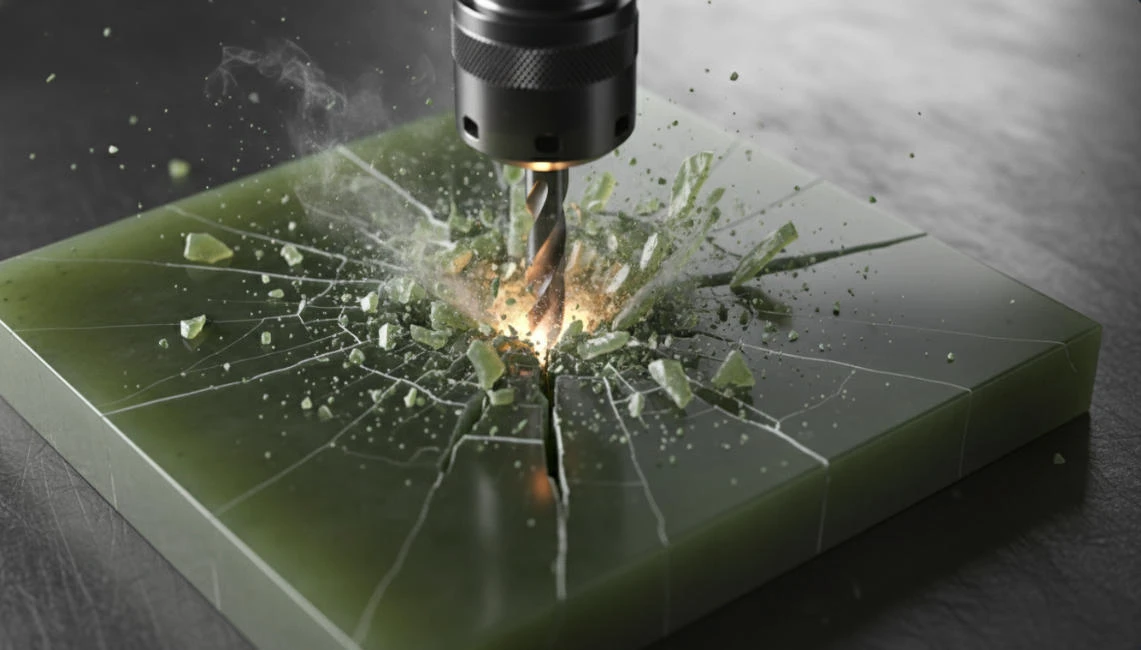
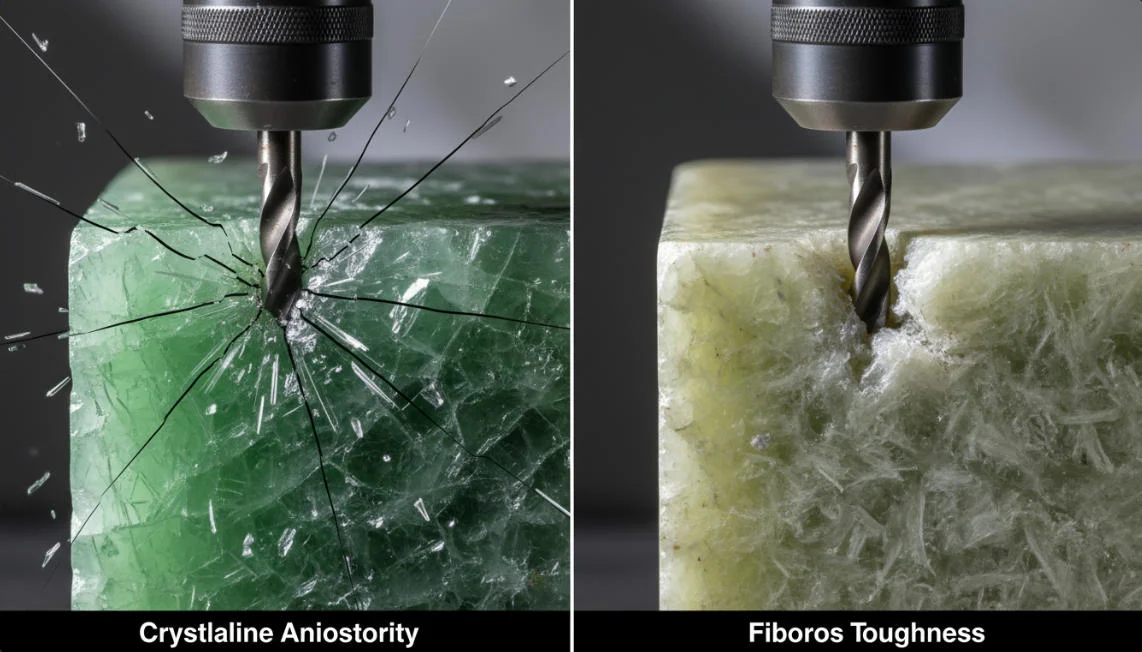
Cracking is the most severe failure mode in the jade process. When a crack initiates at or near the drill hole — as a result of stress concentration, thermal shock, or interaction with a pre-existing material defect — and propagates outward through the stone, the structural integrity of the entire piece is irreversibly compromised. This failure mode results in direct product loss, with no corrective path available to the jade manufacturer. All labor, tooling, and material cost accumulated to the point of drilling is destroyed. The GIA documents that jadeite’s characteristic interlocking granular microstructure, while providing high overall toughness, creates anisotropic stress pathways that can concentrate fracturing around drill openings under mechanical impact — a property that makes cracking risk highly material-dependent within the same jade process setup.
Chipping and blowout occur at the drill hole entrance or exit, where the stone surface fractures along the drill path, producing irregular edges, surface cavities, or missing material at the hole perimeter. While less immediately catastrophic than through-cracking, chipping downgrades the finished product’s quality classification and can represent substantial financial loss on high-value pieces. Exit-face blowout — where the drill breaks through the opposite surface with uncontrolled force — is particularly common in single-direction drilling operations and represents one of the primary operational arguments for dual-direction drilling methodology in the jade process.
Hole misalignment and deviation produce a drill channel that does not follow the intended axis through the stone. In production bead manufacturing, where uniformity across large batches is required, even a 0.3-millimeter deviation from the intended center can affect product consistency at scale. In dual-direction drilling — where the hole is advanced from both faces of the stone — misalignment between the two approaching channels creates an internal offset, producing a mechanical stress point inside the stone that can compromise the surrounding material and affect functional thread integrity over time.
Heat burn and surface degradation manifest as discoloration, whitening, or permanent loss of surface luster in the zone immediately surrounding the drill hole. The mechanism is thermal: sustained friction between the rotating drill bit and stone surface generates heat that, in the absence of continuous cooling, causes localized and often irreversible surface alteration. The International Gem Society (IGS) notes that heat exposure during mechanical processing is a documented cause of surface degradation in both nephrite and jadeite, affecting optical properties at the microscopic level. Although subsequent jade polishing can partially address heat-affected zones, the remediation adds process time and cost while typically not fully restoring the pre-damage surface quality — meaning heat burn increases your per-unit finishing cost while delivering a product that still falls below original quality specifications.
Latent crack activation is the most operationally insidious failure mode in the jade process because it is not immediately detectable. Internal micro-fractures that existed in the stone prior to drilling — or that were created by stress during the operation — may not propagate to the surface at the time of manufacture. They survive quality inspection. They pass through jade polishing and finishing. They appear days, weeks, or months later as the product is handled in distribution or by the end customer. From a jade manufacturer‘s perspective, latent crack activation surfaces as a downstream liability after the product has left the facility — making it the failure mode with the highest long-term cost implications within the jade process.
Root Cause Analysis — Why Drilling Failures Occur in Jade Processing
Drilling failures do not occur randomly. Each of the five failure modes described in the previous section has specific, identifiable physical causes that can be analyzed, measured, and controlled before the drill engages the stone. The discipline of a systematic jade process is built on intervening at the cause level — not attempting damage control after failure has already occurred. Jademago‘s 65-year production history has consistently reinforced that yield improvement in drilling begins with cause-level understanding, not tool-level adjustment.
Material Brittleness as the Starting Point of Jade Process Risk Assessment
Not all jade drills the same way. The physical properties of the material being processed — its brittleness coefficient, internal grain structure, natural fracture distribution, and mineral composition — are the primary determinants of drilling risk in the jade process. Jadeite, nephrite, quartzite jade, serpentine, and quartz crystal each behave distinctly under mechanical drilling stress. Higher brittleness directly correlates with higher cracking and chipping risk under equivalent drilling parameters. Drilling conditions appropriate for nephrite may be actively destructive when applied to high-brittleness jadeite or crystal — which means that any jade manufacturer applying uniform parameters to all materials is systematically accepting elevated risk on the more brittle portions of their material inventory.
A responsible jade process therefore begins not at the drill press, but at the material evaluation stage. Before a drilling plan is developed for any piece, the material’s brittleness profile, visible and non-visible fracture distribution, and grain structure must be assessed and documented. The Swiss Gemmological Institute SSEF maintains jade classification documentation that includes structural integrity assessment protocols, providing a foundational reference framework for material-specific risk profiling in jade processing. Applying this kind of pre-drilling assessment is the difference between managing drilling risk proactively and discovering it reactively, one scrap piece at a time.
Grain Direction and Structural Anisotropy in Jade Processing
Crystalline and microcrystalline materials — including jadeite, nephrite, and quartz crystal — exhibit structural anisotropy: their mechanical strength is not equal in all orientations. The grain structure creates preferential fracture planes along which crack propagation requires significantly less energy than in perpendicular directions. In the jade process, drilling aligned with the grain direction consistently produces a cleaner, more controlled hole than drilling that crosses grain boundaries at an angle. Drilling perpendicular to preferred cleavage or fracture planes without compensating through adjusted speed, pressure, and cooling parameters is one of the most reliable predictors of cracking events in production environments. Recognizing and responding to material grain orientation is a core competency that separates systematic jade manufacturer operations from facilities that apply uniform parameters across all materials and accept the resulting variation in outcomes.
Stress Concentration — The Physics Behind Chipping in the Jade Process
When a drill bit contacts a hard, brittle stone surface, the applied mechanical load is distributed across the contact area between the bit and the stone. A smaller contact area — resulting from an undersized drill bit or an aggressive tip geometry — produces a higher stress concentration at the engagement point. When this localized stress exceeds the material’s fracture threshold at that location, localized fracturing occurs: this is the physical mechanism behind chipping and blowout events in the jade process. In practical terms, using an undersized drill bit on a high-brittleness material is mechanically equivalent to applying a controlled explosive impulse to the stone surface. Drill bit diameter, tip geometry, and engagement angle must be matched to the material’s specific fracture resistance profile — not selected based on availability or habit.
Thermal Stress Generation Without Cooling Systems
Heat is generated continuously during drilling as the rotating bit creates sustained friction against the stone surface. Without active cooling intervention, this heat accumulates in the zone around the drill channel. As temperature rises, the material undergoes localized thermal expansion. When the drill is withdrawn and the area cools, differential contraction creates tensile stress in the surrounding material. If this stress exceeds the stone’s tensile strength — which in brittle jade varieties is substantially lower than its compressive strength — a crack will initiate. This thermal cracking mechanism operates independently of mechanical drilling variables, representing a parallel and additive risk pathway in the jade process that requires its own dedicated control parameters. Research compiled by the IGS confirms that nephrite’s toughness, while notably high, does not make it immune to thermally induced fracturing under sustained mechanical processing without cooling — a caveat that applies equally across the jade processing material spectrum.
Process Path Errors That Amplify Every Jade Process Risk Factor
The drilling methodology itself — how the operation is approached, executed, and completed — can either contain or exponentially amplify every material and thermal risk described above. Single-direction drilling, where the drill advances from one face of the stone through to the opposite face in a continuous pass, generates maximum exit-face stress at the breakthrough point: the operational condition most likely to produce blowout. Non-uniform feed rates create irregular mechanical stress pulses that compound fracture probability at every point in the drill path. The absence of a pre-positioning step before drilling begins allows the drill bit to migrate across the stone surface before engaging, increasing misalignment probability and creating uncontrolled initial contact stress. Each of these procedural deficiencies is individually manageable within a disciplined jade process; in combination, they create conditions in which drilling failure is not a possibility — it is a pattern.
The Manufacturing Risk Mitigation Framework for Jade Drilling
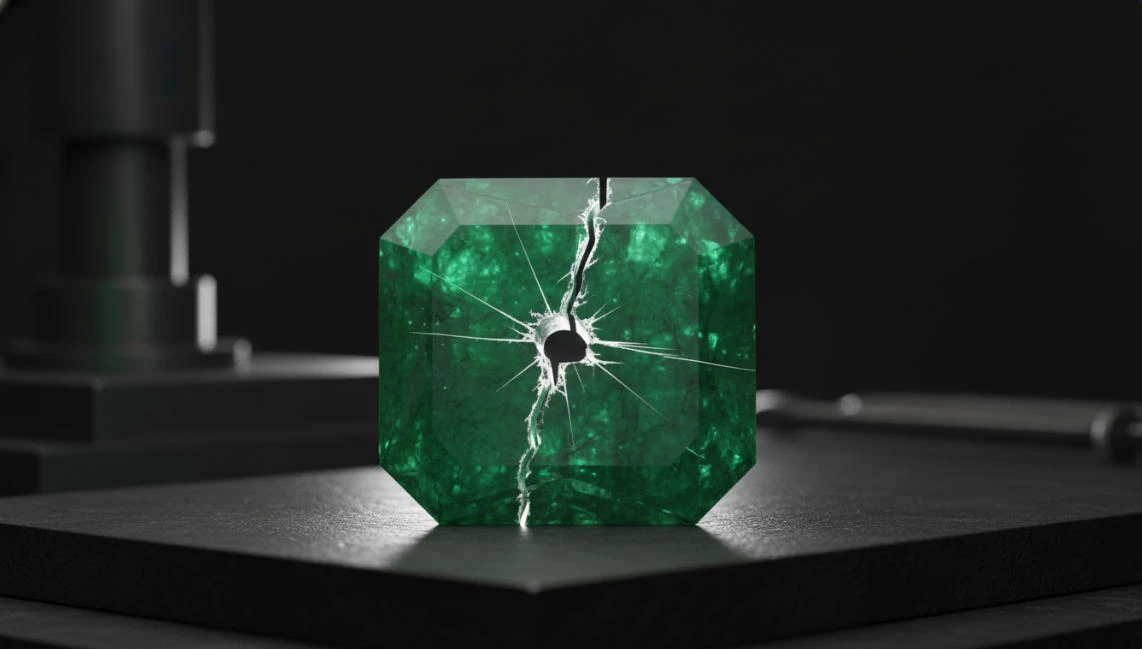
Risk mitigation in jade drilling is not a single corrective measure that can be applied after a process is already failing. It is a structured set of decisions — about method selection, parameter calibration, preparation steps, cooling configuration, and hole placement — that must be made correctly and in combination before the drill engages the stone. No single control measure compensates for deficiencies in the others. The following framework outlines what a production-grade jade manufacturer must implement to achieve consistent, predictable drilling yield across the jade process.
Drilling Method Selection in the Jade Process
The drilling method is the first and most consequential decision in any jade process drilling workflow. For standard production in jade processing, dual-direction drilling — advancing the hole from both faces of the stone in sequential passes — is the recommended baseline method. By eliminating the single-pass breakthrough event at the exit face, dual-direction drilling removes the highest-stress moment in conventional drilling from the operational equation. The critical execution requirement for this method is precision alignment between the two drilling axes: if the two entry paths are not collinear, the resulting internal offset creates a mechanical stress concentration point inside the stone that can compromise the surrounding material and produce the same misalignment failures it was designed to prevent.
For high-value jade products — pieces where the financial loss from a single drilling failure is disproportionately significant relative to production cost — ultrasonic drilling provides a technically superior alternative. Ultrasonic systems replace rotational mechanical cutting with high-frequency vibratory abrasion, applying far lower peak mechanical force to the stone at any given moment. This near-zero-impact engagement mechanism substantially reduces stress concentration, thermal generation, and crack initiation risk compared to conventional rotary drilling. The trade-off is capital cost: ultrasonic drilling systems require substantially higher equipment investment, and currently only a small proportion of jade manufacturer operations are configured with this technology. For facilities processing high-value materials at volume, the ROI calculation favors ultrasonic drilling when conventional-method drilling-related yield loss by unit value exceeds approximately 5% — at that threshold, the equipment cost begins to pay for itself through yield recovery alone.
Drilling Parameter Control in Jade Processing
Three operational parameters — rotational speed, applied pressure, and feed rate — function as an integrated control system in jade drilling. Adjusting one without compensating the others produces unpredictable results because the three variables interact to determine the mechanical stress profile at the drill-stone interface at every moment of the operation. The guiding principle for parameter design in any jade process is that the objective is to abrade material progressively away from the drill path — not to force the drill through the stone mechanically.
Rotational speed should be maintained at a medium-to-high range, generating sufficient surface velocity to abrade material efficiently without accumulating excessive frictional heat. Applied pressure must remain low — substantially lower than operator instinct typically suggests when progress appears slow. Excess pressure collapses the safety margin between controlled abrasion and fracture initiation, and is a primary cause of unexpected cracking events in otherwise well-configured jade processing environments. Feed rate — the speed at which the drill advances into the stone — must be uniform and continuously controlled throughout the operation. Any abrupt increase in feed rate creates a mechanical shock event that is functionally equivalent to a momentary high-intensity impact on the stone structure at the drill tip. In practical terms, feed rate uniformity discipline is one of the highest-return process investments a jade manufacturer can make within its drilling workflow, because its effect is continuous across every millimeter of the drill path.
Pre-Chamfering — The Preparatory Step Most Jade Process Operators Skip
Pre-chamfering is the process of creating a shallow, angled bevel at the drilling target location before the primary drill bit engages. This preparatory step is performed with a small-diameter, angled tool that removes a minimal amount of surface material to create a controlled entry geometry at the drill contact point. Despite its simplicity, pre-chamfering addresses two of the most common initiating conditions for drilling defects in the jade process simultaneously, making it one of the highest-return preparation investments available to a jade manufacturer.
First, by eliminating the flat, sharp surface edge at the drill entry point, pre-chamfering removes the stress concentration geometry that makes initial drill contact mechanically aggressive — the specific geometric condition most associated with entry-side chipping events. Second, the angled bevel creates a self-centering geometry that prevents the drill bit from sliding laterally across the stone surface during initial engagement: the primary physical mechanism behind hole misalignment and off-center positioning. The additional time required for pre-chamfering adds approximately 3% to 5% to total drilling operation time per piece. In return, jade processing facilities that have standardized this step within their workflow consistently report measurable reduction in entry-side chipping rates. This means your overall drilling cost per acceptable finished unit decreases, even though the operation takes slightly longer per piece — a favorable yield-adjusted economics outcome that compounds across production volume.
Cooling System Requirements for Jade Drilling
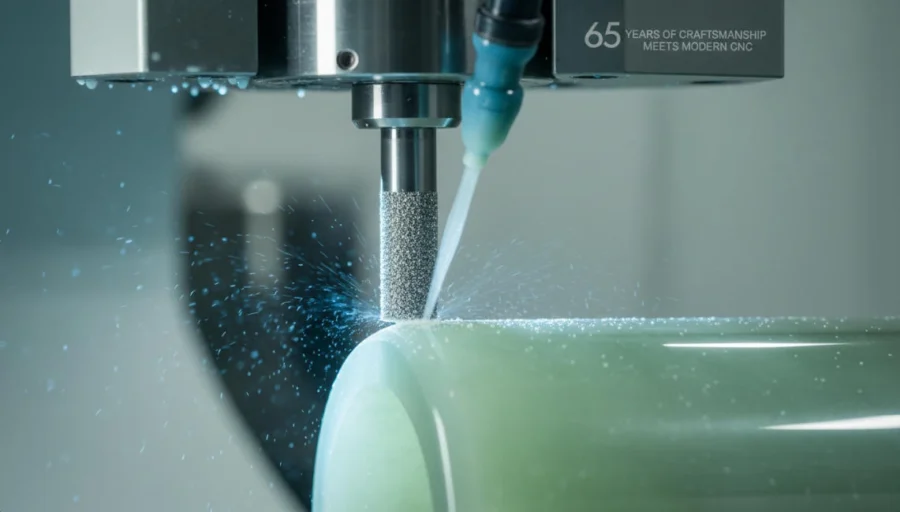
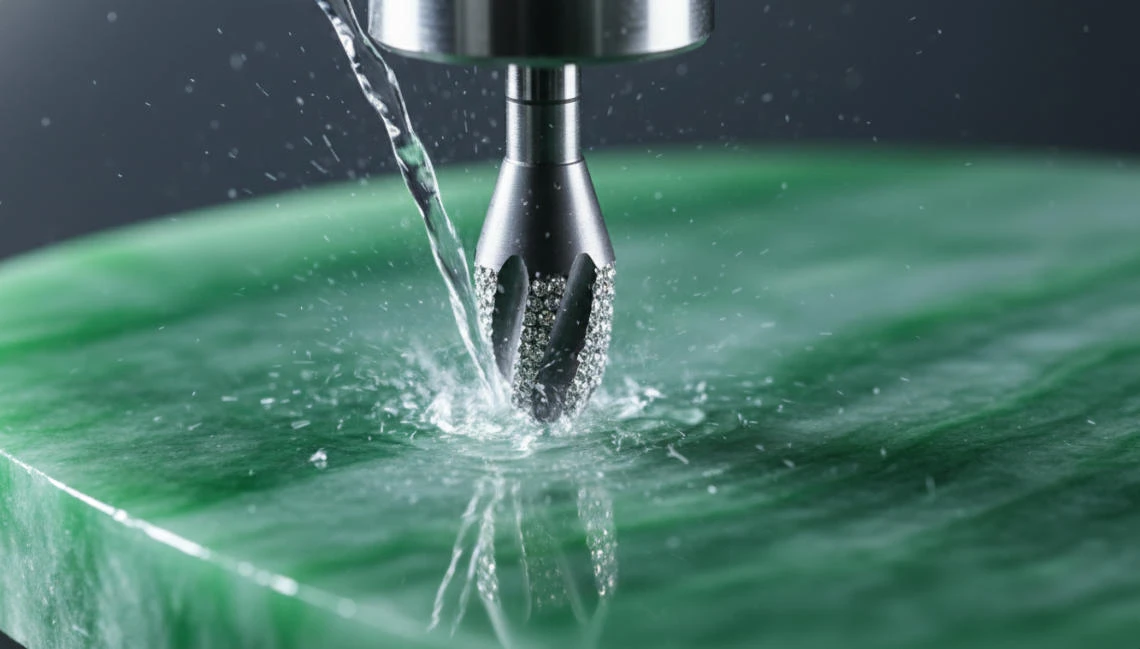
Continuous cooling is not an optional enhancement in jade drilling. It is a non-negotiable baseline operational condition with direct, predictable consequences for product quality when absent. The function of the cooling medium — whether water or oil — is to prevent heat accumulation at the drill-stone interface by continuously conducting thermal energy away from the contact zone throughout the entire drilling operation. This is not a condition that can be managed intermittently or applied reactively only when visible heat discoloration appears, because by the time surface discoloration becomes visible, thermal damage to the material’s internal stress state has already occurred and the associated cracking risk has already been accepted.
Water cooling is the more widely implemented method in jade processing production environments due to its accessibility, low operating cost, and adequate thermal capacity for most drilling speeds and material combinations. Oil cooling provides superior lubrication at the drill-stone interface, reducing friction-generated heat at the source rather than only dissipating accumulated heat after it has already formed. For high-speed drilling operations or materials with elevated brittleness profiles, oil cooling is technically preferable. What is operationally unacceptable — under any material, speed, or production schedule condition — is conducting jade drilling without an active, continuously maintained cooling system. Any jade manufacturer operating without this baseline is accepting a level of thermal cracking risk that a systematic jade process must not permit.
Hole Position Planning as a Risk-Reduction Tool in the Jade Process
The placement of the drill hole within the piece is a structural engineering decision with risk implications entirely independent of how well the drilling itself is subsequently executed. Every piece of jade raw material contains zones of varying structural integrity: visible and non-visible internal fracture lines, boundaries where different mineral compositions meet at color or texture transitions, and areas of reduced cross-sectional thickness that cannot sustain normal drilling stress without fracturing. Positioning a drill hole in any of these regions dramatically increases failure probability regardless of method quality, parameter discipline, or cooling configuration.
Effective hole position planning in the jade process requires systematic material inspection before drilling planning begins — not as the drill operator’s on-the-spot judgment at the press, but as a documented design decision made during the pre-production planning stage. When design requirements constrain hole position to a structurally compromised zone, that elevated risk must be explicitly assessed and mitigated through adjusted parameters, alternative drilling methods, or supplementary preparation steps. Proceeding with standard jade drilling in a known weak zone without deliberate risk assessment is not a manufacturing decision — it is a predictable path to yield loss.
Post-Drilling Jade Polishing as a Jade Process Quality Step
Even in a well-executed drilling operation, the inner surface of the drill channel and the material immediately surrounding the hole entrance and exit carry a degree of surface roughness and micro-level mechanical disruption that is incompatible with finished goods standards. The post-drilling finishing sequence — fine grinding followed by jade polishing — addresses this systematically as the final quality recovery operation in the jade process. Skipping either step leaves the drill hole as the weakest visual and textural element in an otherwise finished piece — a quality inconsistency that cannot be justified in production at any tier.
Fine grinding smooths the channel interior and refines hole edge geometry, removing the micro-fracture surface layer that drilling mechanics inevitably create at the cut interface. Jade polishing then restores surface luster to the entry and exit zones, ensuring that the finished hole integrates visually and texturally with the surrounding polished surface. In cases where minor heat discoloration or light chipping occurred during drilling, the fine grinding and jade polishing sequence provides corrective capacity for defects within the surface material depth that grinding can reach. This corrective capacity — its availability and scope — is precisely why the timing of drilling within the overall jade process sequence matters so fundamentally, a subject addressed directly in the following chapter.
Process Sequence Design — Where Drilling Must Sit in the Jade Process
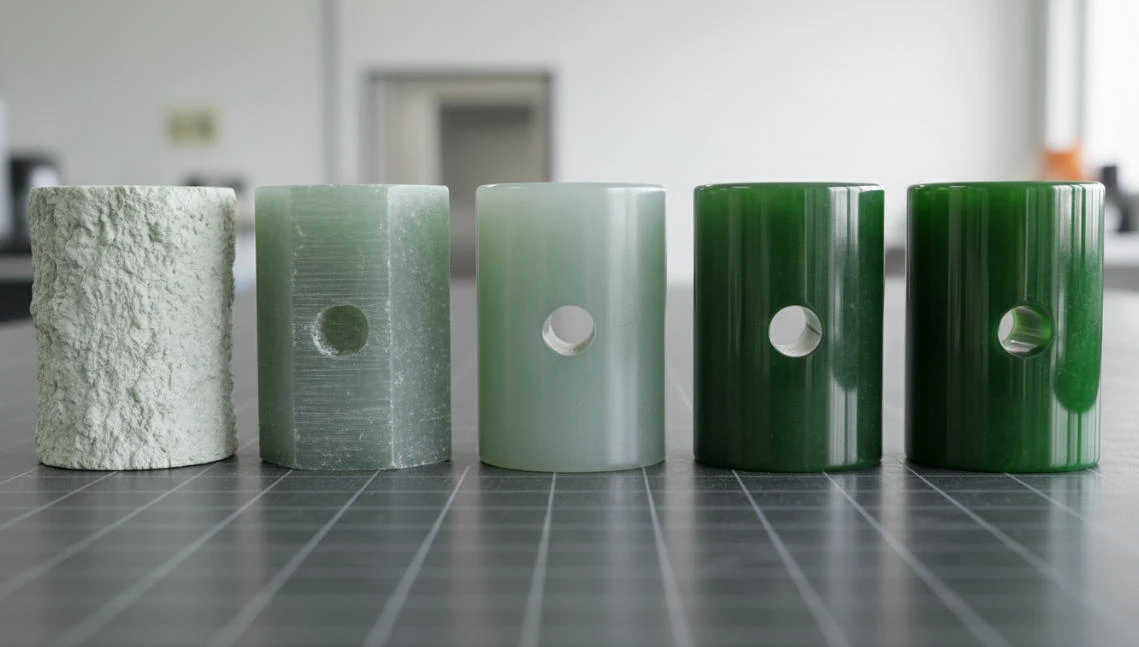
The position of jade drilling within the manufacturing sequence is not a scheduling preference or a matter of operational convenience. It is a structural variable that directly determines how much corrective margin exists if a drilling defect occurs, and whether the full accumulated value of all prior operations is unnecessarily exposed to unrecoverable risk. The wrong sequence position can eliminate error correction options that the correct position preserves — and in the jade process, where every corrective option has quantifiable cost and the absence of any option has absolute cost, this is not an abstract distinction.
The Standard Five-Stage Jade Process Sequence
The manufacturing sequence that systematically protects against drilling-related yield loss follows five defined stages: rough cutting, semi-polishing, drilling, fine grinding, and jade polishing. This jade process architecture places drilling at the precise point in the workflow where three critical manufacturing conditions are simultaneously satisfied — and critically, only at this specific point in the sequence can all three conditions be met together.
By the time semi-polishing is complete, the piece has a defined final shape, enabling drill positioning to be executed with precision relative to the finished product geometry. The rough cutting and semi-polishing operations have progressively dissipated a significant portion of the residual internal stress present in the raw material, reducing the stone’s susceptibility to stress-induced cracking during drilling. And the surface condition — semi-polished but not final-polished — retains sufficient material depth to allow the subsequent fine grinding and jade polishing stages to correct minor surface disruptions resulting from the drilling operation. These three conditions — geometric certainty, partial stress relief, and remaining corrective surface depth — define the optimal drilling window in the jade process. The standard five-stage sequence is designed specifically to position drilling at the intersection of all three.
Why Drilling Too Early Amplifies Risk in Jade Processing
Drilling during or immediately after rough cutting removes all three protective conditions simultaneously. The stone’s geometry is not yet final, making precise hole positioning unreliable relative to the finished product form. The internal stress state of the material is at its maximum, making the stone most susceptible to crack initiation under the mechanical impact of drilling. And every subsequent grinding and finishing operation following early-stage drilling will apply mechanical and thermal stress to the structure surrounding the drill hole, potentially activating latent cracks that the drilling step created. In the jade process, drilling too early converts a contained, one-time risk into a cumulative risk that compounds across every subsequent operation. The probability of a pre-drilled hole contributing to a downstream failure increases with every process step it survives before reaching jade polishing — making early drilling not a time-saving decision, but a risk-compounding one.
Why Jade Drilling After Final Jade Polishing Eliminates All Recovery Options
If drilling too early in the jade process increases compounding risk through the production pipeline, drilling too late — after the final jade polishing stage is complete — eliminates the possibility of recovery entirely. At this stage, the piece represents the full accumulated value of every preceding operation: every hour of carving, every grinding pass, and every stage of jade polishing work is embedded in the product’s current state. There is no remaining grinding or jade polishing stage that could remediate a chipping event, a heat burn mark, or a surface crack produced by drilling at this point. Any drilling defect after final polishing results in total loss of all accumulated labor, tooling, and material cost.
Is it reasonable to subject a fully finished product — representing dozens of hours of skilled manufacturing work — to the highest-risk operation in the entire jade process with zero remaining error correction capacity? Every jade manufacturer that drills after final jade polishing accepts this exposure on every piece, every time a drill engages a finished stone. Semi-polishing, as the optimal drilling window, exists precisely to eliminate this exposure while maintaining the manufacturing precision that the final sequence stages require.
This article analyzes the physical mechanisms behind jade drilling failures, the operational causes that enable them, and the systematic controls that a production-grade jade manufacturer must implement to reduce drilling-related yield loss to manageable levels. The framework described here reflects the manufacturing standards developed over more than 65 years of continuous production at Jademago, a source-level jade manufacturer specializing in jade and crystal processing, design, and precision finishing. Technical material property references throughout this article draw on documented gemological science from the Gemological Institute of America (GIA), the International Gem Society (IGS), and the Swiss Gemmological Institute SSEF.
FAQs for Jade Drilling in Jade Process
1. What is the most dangerous risk in the jade drilling process?
Cracking is the most severe and irreversible failure mode in jade drilling. Once a crack propagates outward from the drill hole, no subsequent step in the jade process can repair the damage — the piece is lost entirely, along with every hour of labor invested before drilling began.
2. When should drilling be performed in the jade process?
Drilling should always be performed after semi-polishing and before fine grinding. At this stage in the jade process, the piece has a confirmed final shape, internal material stress has been partially released, and enough surface depth remains for jade polishing to correct any minor drilling-related surface damage.
3. Why is pre-chamfering important before jade drilling?
Pre-chamfering creates a shallow angled bevel at the drill entry point before the main bit engages. This eliminates the stress concentration geometry responsible for entry-side chipping and prevents the drill from sliding off-center during initial contact — two of the most common causes of drilling defects in the jade process, addressed with minimal additional time.
4. Is a cooling system really necessary for jade drilling?
Yes — continuous cooling is a non-negotiable operational requirement, not an optional upgrade. Without an active water or oil cooling system, friction-generated heat accumulates around the drill channel, triggering thermal expansion and contraction cycles that induce internal cracking. By the time surface discoloration becomes visible, the thermal damage has already occurred.
5. What makes ultrasonic drilling better for high-value jade products?
Ultrasonic drilling replaces rotational mechanical cutting with high-frequency vibratory abrasion, applying near-zero peak impact force to the stone at any given moment. This dramatically reduces stress concentration, heat generation, and crack initiation risk compared to conventional rotary methods — making it the technically preferred choice for high-value pieces within a precision jade process, where the cost of a single drilling failure far exceeds the equipment investment.