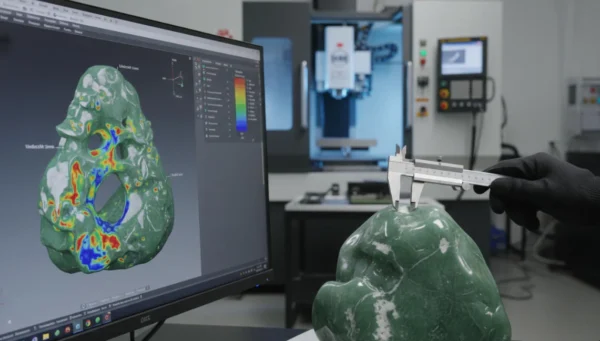
When buyers first approach a jade manufacturer with an OEM request, most assume the hardest part is finding a supplier willing to take the job. The reality is the opposite. According to production data tracked across industrial gemstone manufacturing, over 40% of OEM jade orders encounter significant quality deviations — not because of poor intention, but because the manufacturer lacked the technical depth to translate a design concept into a physically producible jade piece. OEM jade products demand a manufacturing partner who can read material behavior, audit design feasibility, and replicate results across every unit in a batch. This article walks through exactly how that process works — and what you should expect at each stage.
Table of Contents
Why OEM Jade Products Manufacturing Is More Demanding Than Most Materials Allow
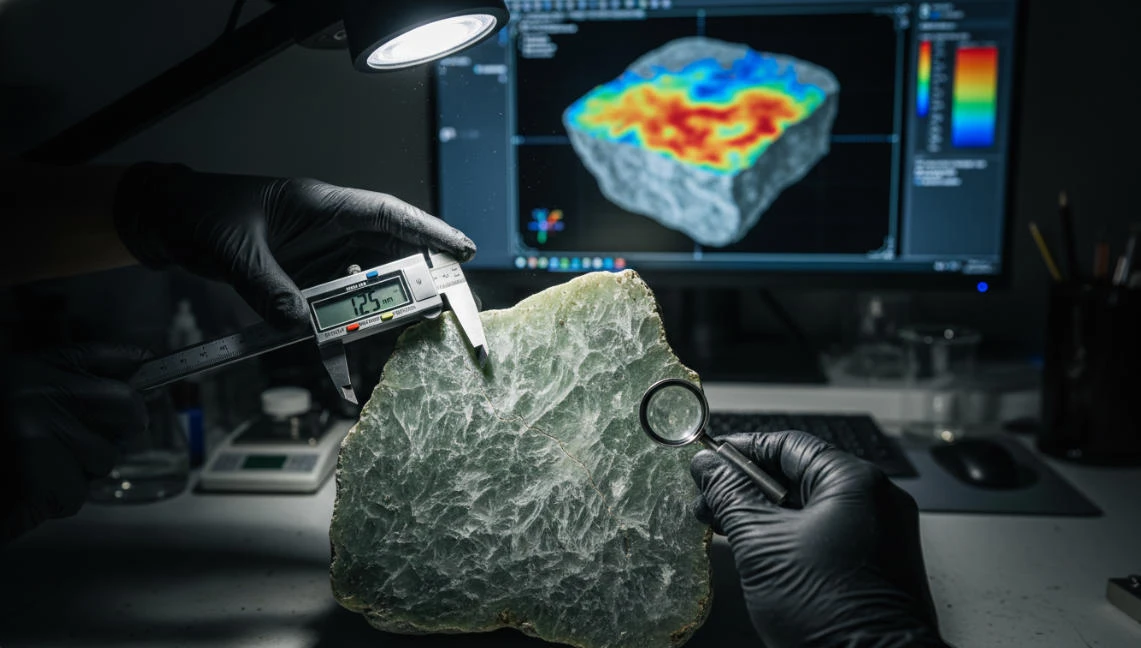
It is easy to underestimate jade as a manufacturing substrate. Compared to metals or resins, jade appears straightforward — you cut it, shape it, polish it. But that assumption is responsible for a significant portion of failed or underperforming OEM orders. The truth is that jade’s physical properties introduce layers of complexity that simply do not exist in conventional manufacturing materials, and any jade manufacturer who fails to account for them at the start of a project will pay for that oversight later — typically in the form of wasted material, extended timelines, or rejected batches.
The Physical Reality of Working With Jade
Jade — whether nephrite or jadeite — registers between 6.0 and 7.0 on the Mohs hardness scale, placing it in a range where it resists standard tooling yet remains brittle under improper stress application. According to the Gemological Institute of America (GIA), jadeite in particular exhibits a tightly interlocked granular structure that gives it toughness, but that same microstructure makes it highly sensitive to the direction and speed of machining forces. This means that the cutting parameters used successfully on one piece may produce micro-fractures on another — even from the same raw block — depending on how the natural grain aligns with the tool path.
What does this mean for your project? It means that a jade manufacturer who applies standardized machining parameters without analyzing the grain structure of each raw block is gambling with your material — and your delivery schedule. Identifying grain orientation before any cutting begins is not a procedural formality; it is the decision that determines whether your material survives the jade process intact.
Natural Variation as a Manufacturing Variable
Beyond hardness, jade presents another challenge that synthetic materials never impose: natural internal variation. Color distribution, fibrous texture, cotton-like inclusions, and hairline fissures are distributed unevenly across every raw stone. As noted by the International Gem Society (IGS), even within a single block of high-grade material, these characteristics shift — meaning that two pieces cut from the same raw stone may respond differently to polishing pressure or engraving depth.
For OEM jade products production, this variability is not a defect — it is a condition that must be engineered around. A manufacturer without a structured material assessment protocol will find that batch consistency becomes nearly impossible to guarantee beyond small sample sizes. You can expect color deviation, surface texture inconsistency, or uneven translucency across units if material variation is not accounted for from the raw selection stage. Managing this requires systematic pre-production grading, not optimism.
Why the Complexity Starts Before Any Machine Is Switched On
The compounding effect of hardness sensitivity, grain directionality, and natural inclusion distribution means that jade CNC machining decisions must be made before a single tool touches the material. This pre-production analysis phase is where a capable jade manufacturer separates itself from one that simply processes orders. The Swiss Gemmological Institute SSEF documents how material-level assessment — including identification of structural weaknesses and natural fissures — directly affects the feasibility and yield of any precision cutting operation on jadeite or nephrite.
If you are sourcing OEM jade products for a commercial product line, this complexity is precisely why the manufacturer’s analytical capability matters more than their price list. A lower quote built on skipped pre-production assessment will cost more by the time the first batch comes back with a jade material yield rate below 60%. The true measure of a manufacturing partner is whether they can walk you through their material evaluation protocol before quoting — not after problems emerge.
1 — Interpreting the Client’s Design: The First Real Test of a Jade Manufacturer
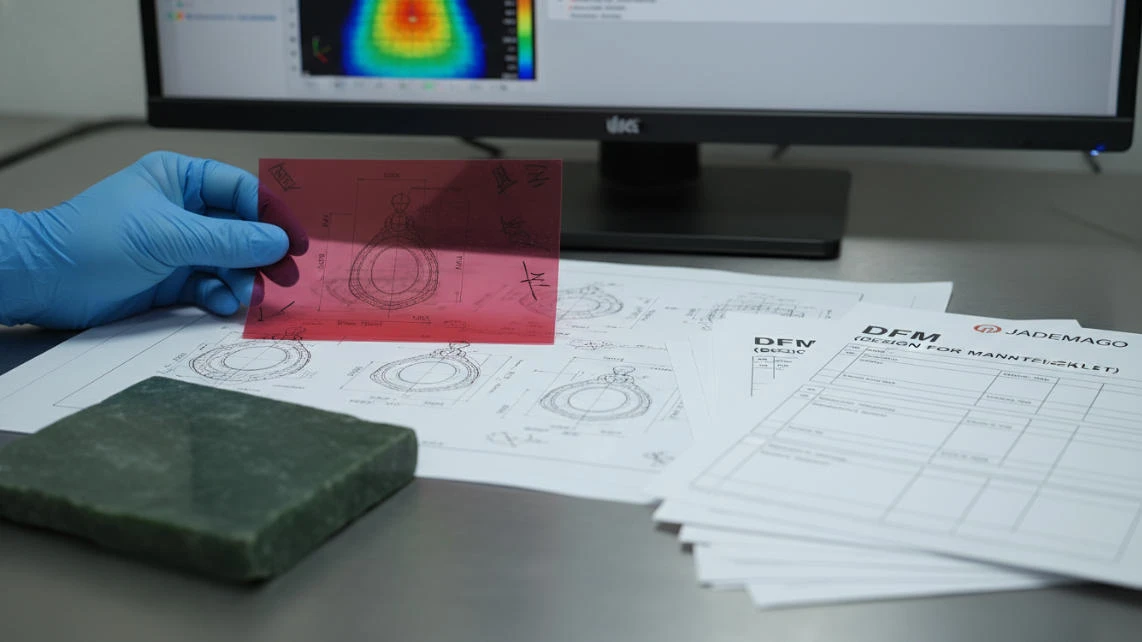
Most buyers submit a design file and expect production to begin shortly after. That expectation is reasonable when working with injection-molded plastics or laser-cut metals. It is not reasonable when working with jade. The jade process begins long before any machine is programmed, because the design itself must first be evaluated against the physical constraints of the material. A drawing that works perfectly in CAD software may be structurally incompatible with jade’s grain behavior, hardness profile, or natural fissure patterns. A jade manufacturer who does not catch these incompatibilities at the intake stage will either produce a non-conforming part or return to you weeks later requesting design changes — after material has already been consumed.
This is not a rare scenario. It is the single most common cause of OEM project delays in gemstone manufacturing. Catching design-material conflicts at the interpretation stage — before sampling, before raw material selection, before any CNC programming — is the fastest and least expensive place to resolve them. The question you should ask any prospective custom jade manufacturer is not “can you make this?” but “what specifically did you identify in my design that required modification, and why?”
What a Design File Doesn’t Tell You About OEM Jade Products Feasibility
A complete design file typically conveys geometry, dimensions, surface finish specifications, and material designation. What it does not convey — and what no CAD file can — is how those specifications interact with the specific jade material being used. Wall thickness that is structurally sound in metal becomes a fracture risk in jade when it falls below approximately 3–4mm in nephrite or 2.5–3mm in jadeite, depending on the cutting direction relative to grain orientation. Engraving depths that look proportional on screen may intersect with an internal fissure line invisible to the naked eye but detectable through pre-production inspection.
For OEM jade products, the design interpretation phase must therefore include at minimum four assessments. First, structural wall thickness must be evaluated relative to the jade type specified. Second, engraving geometry — particularly the ratio of depth to width in recessed elements — must be checked against the material’s fracture behavior under tool vibration. Third, surface transition angles must be reviewed, because sharp internal corners concentrate stress during polishing and are a leading cause of post-production breakage in finished jade pieces. Fourth, the overall part geometry must be mapped against realistic raw block dimensions to assess material utilization before procurement begins — a step that directly determines the jade material yield rate achievable on the order.
Reading the Design With a Material Scientist’s Eye, Not Just a Machinist’s
There is a meaningful difference between a manufacturer who reviews a design for production convenience and one who reviews it with genuine material knowledge. A machinist looks at geometry and asks whether the tool can reach the surface. A material-informed reviewer asks whether the geometry, once achieved, will survive polishing pressure, structural stress during transport, and the mechanical behavior of the specific jade grade selected. These are not the same question, and only the second one protects you as the buyer.
When JADEMAGO receives a design file for an OEM jade products project, the review protocol evaluates all four structural dimensions described above, cross-referenced against the jade type and grade specified in the order. Where a design element presents a manufacturing risk, the review produces a specific written recommendation — not a blanket rejection. The goal is always to preserve the original design intent while identifying the minimum necessary modification that makes the part producible at target quality. This distinction matters: a manufacturer who simply rejects problematic designs is protecting their own yield rate. A manufacturer who proposes targeted solutions is protecting your product.
Why Early-Stage Design Conflicts Cost Less Than You Think — If They Are Caught Early
The cost structure of design conflicts in jade manufacturing is sharply front-weighted. A design change identified during the interpretation phase costs time — typically two to five business days for a revised drawing review — but no material. The same conflict identified after raw material has been cut into blanks costs material, machine time, and potentially the entire blank if the geometry cannot be salvaged. Identified after sampling, it costs all of the above plus sample production labor. Identified after batch production has begun, it is a financial write-off and a relationship-defining failure.
This is why the jade process at a capable custom jade manufacturer places disproportionate time investment at the front of the project. Spending three extra days on design interpretation is not inefficiency — it is risk compression. For buyers managing product development timelines, this front-loaded diligence translates directly into more predictable delivery schedules and fewer revision cycles. You are not waiting longer; you are eliminating the delays that would otherwise occur mid-production, when they are most disruptive and most expensive.
2 — Design Review & Optimization: Protecting the Original Vision While Making It Manufacturable
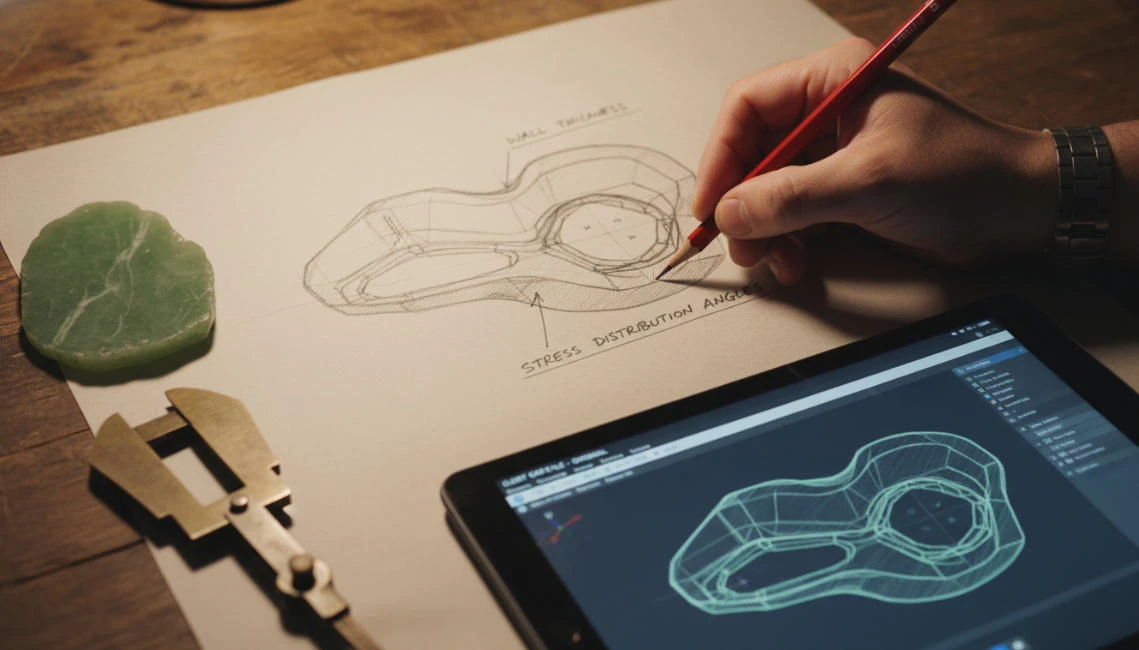
Receiving a design file and producing a part that matches it dimensionally is the minimum expectation of any manufacturing relationship. It is not, however, sufficient for OEM jade products production. The real test of a jade manufacturer at this stage is whether they can identify the gap between what a design specifies and what jade as a material will actually allow — and then close that gap without dismantling the design intent that made the product worth producing in the first place. This requires a different kind of competence than machining skill. It requires a structured review methodology, material-informed engineering judgment, and the communication discipline to bring the client into the solution rather than presenting them with a fait accompli.
What separates a capable custom jade manufacturer from one that simply processes drawings is the quality of this review phase. A passive manufacturer waits for problems to surface during production. An active one surfaces them on paper, resolves them collaboratively, and locks the producible version of the design before any material is touched. The financial and timeline implications of these two approaches are not marginal — they are the difference between an OEM project that delivers on schedule and one that generates revision cycles, material waste, and eroded trust.
What a Structured Design Review for OEM Jade Products Actually Covers
A thorough design review in jade manufacturing is not a visual inspection of the drawing. It is a systematic cross-examination of every design element against three axes: structural survivability, process compatibility, and batch replicability. Structural survivability asks whether the finished part — at the specified dimensions and geometry — will withstand the mechanical stresses of polishing, assembly, and end-use without fracturing. Process compatibility asks whether the geometry can be achieved within the capabilities of the available jade CNC machining equipment and hand-finishing tools. Batch replicability asks whether the design, once successfully produced as a sample, can be reproduced consistently across the full order quantity without relying on individual craftsman improvisation.
Each of these three dimensions must pass review before the design is considered production-ready. A part that is structurally sound but geometrically incompatible with five-axis machining will require excessive hand-finishing time, driving per-unit labor cost up and batch consistency down. A part that machines cleanly but cannot survive polishing pressure will produce a sample that impresses and a batch that disappoints. Understanding which dimension is at risk — and why — requires a reviewer with genuine jade process experience, not simply CAD proficiency.
When the Design Needs to Change — And How That Conversation Should Work
Design modification is a sensitive subject in OEM manufacturing. Buyers have often invested significant time and resources in their design files before approaching a manufacturer, and being told that the design requires changes can feel like a challenge to that investment. A jade manufacturer who handles this conversation poorly — either by overstating the required changes or by making modifications silently without client involvement — creates the conditions for a fractured working relationship before production has even begun.
The correct approach is specific, documented, and collaborative. When JADEMAGO‘s design review identifies a modification requirement, the output is a written technical note that identifies the specific design element at risk, explains the material or process reason for the conflict, and proposes one or more targeted solutions that preserve the original design intent to the greatest extent possible. This is not a negotiation — it is an engineering consultation. The client retains final decision authority over the design. What the manufacturer provides is the technical basis for an informed decision, not a unilateral revision.
According to production records across comparable gemstone OEM categories, designs that undergo structured pre-production review and targeted optimization show an average yield rate improvement of 18–25% compared to designs that proceed to production without review. For a mid-volume order of 500 to 2,000 units, that yield improvement translates directly into measurable material savings and a proportional reduction in per-unit cost — without any change to the design specification that the client actually cares about. This means you are receiving a better product at lower effective cost, simply by investing time in the review phase.
Prototype Sampling — Why a Physical Sample Is Non-Negotiable Before Full-Run OEM Jade Products Production
After the design review is complete and a producible version has been agreed upon, the next non-negotiable step is prototype sampling. No amount of CAD simulation or material analysis fully predicts how jade will behave under actual machining conditions, because the material’s internal structure — its grain direction, inclusion distribution, and micro-fissure network — is only fully revealed once cutting begins. A prototype sample produced from the same material batch as the planned production run is the only reliable mechanism for validating that the reviewed design will perform as expected at scale.
The prototype phase serves three distinct functions that compound in value. First, it validates the jade process parameters — tool paths, feed rates, cutting depths, and polishing sequences — against real material behavior rather than modeled behavior. Second, it produces a physical reference standard — a golden sample — against which all subsequent batch production units can be compared. Third, it surfaces any remaining design-material conflicts that survived the paper review, at a cost limited to a single unit’s worth of material and labor rather than an entire batch. For OEM jade products buyers managing commercial product timelines, the prototype phase is not a delay — it is the step that makes the subsequent production run reliable enough to plan around.
At JADEMAGO, prototype samples for new OEM jade products orders are produced using the same equipment configuration, material grade, and operator assignment as the planned production run. This is a deliberate practice: samples produced under different conditions than the production run create a false baseline and undermine the entire purpose of sampling. When your sample arrives, it should represent exactly what your batch will look like — not an optimized showcase piece assembled under ideal conditions that cannot be replicated at volume. That distinction is what makes a prototype genuinely useful rather than merely reassuring.
3 — Raw Material Selection: How the Right Jade Stone Determines Everything Downstream
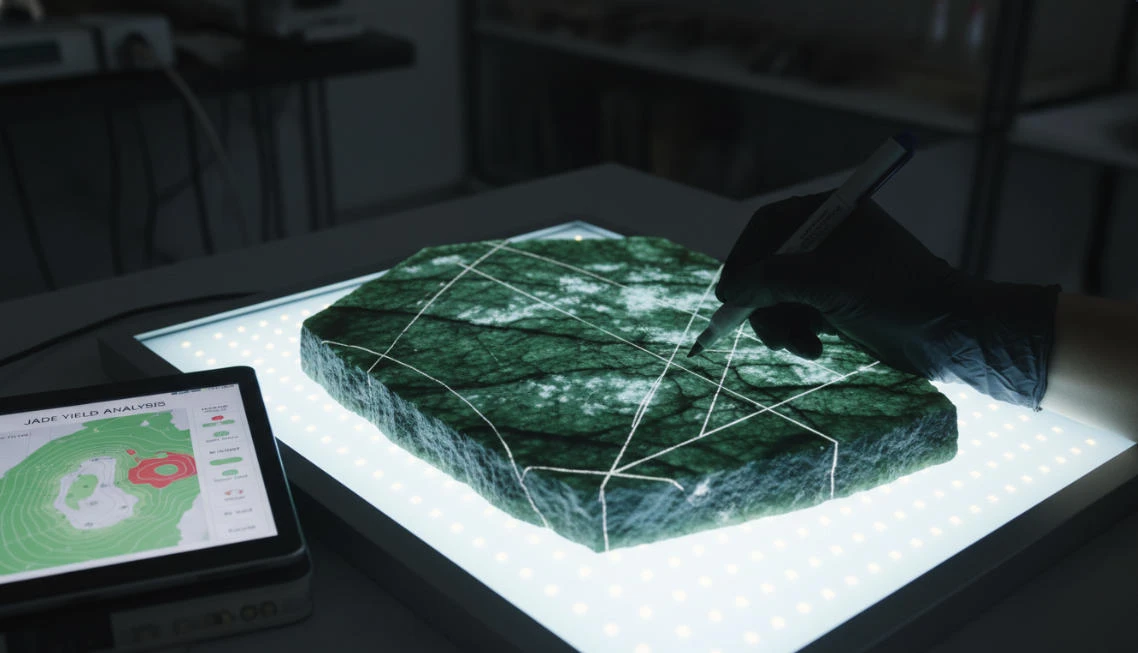
Raw material selection is the decision that sets the ceiling on everything that follows. No amount of precision jade CNC machining, skilled hand-finishing, or rigorous quality inspection can recover the quality that is lost when the wrong material enters the production line. Yet raw material selection is consistently the stage that receives the least structured attention in OEM procurement conversations — buyers focus on design files, unit prices, and delivery schedules, while the material decision gets reduced to a grade designation on a specification sheet. For OEM jade products, that approach is a structural risk. The material choice does not just affect how a piece looks; it determines how the jade process unfolds at every subsequent stage, from blank cutting through final polishing.
A capable jade manufacturer treats material selection as an engineering decision, not a procurement formality. The relevant variables extend well beyond visual grade. Grain structure uniformity, natural fissure density, color distribution consistency, and the ratio of usable material within a raw block all influence what is achievable in production — and at what cost. Making this decision well at the start compresses risk across the entire project. Making it poorly means paying for the consequences repeatedly: in tool wear, in machining time, in rejected units, and ultimately in a jade material yield rate that undermines the economics of the entire order.
Matching Jade Material to OEM Jade Products Design Requirements
Not all jade is appropriate for all designs. This sounds obvious, but the practical implications are frequently underestimated. Jadeite and nephrite differ not only in appearance but in their mechanical behavior under machining. As documented by the GIA, jadeite’s interlocking granular structure gives it greater toughness relative to nephrite’s fibrous composition — meaning jadeite is generally better suited to designs with fine engraved detail, while nephrite’s fibrous structure provides greater resistance to impact fracture, making it preferable for thin-walled or structurally stressed geometries.
Beyond the jade type, the specific grade within that type must be matched to the design’s geometric demands. A design with deep relief carving and fine surface detail requires a material with highly uniform grain structure and minimal internal inclusions — because any inclusion that intersects with a carving line becomes a fracture initiation point under tool vibration. A design that prioritizes color uniformity across a flat polished face requires raw material with consistent color saturation through the full depth of the blank, not just at the surface. These requirements cannot be met by selecting material from a photograph or a standard grade description. They require physical inspection of the raw block against the specific design being produced.
For your OEM jade products project, this means you should expect a competent custom jade manufacturer to specify not just the jade type and grade, but the selection criteria applied to each raw block entering production — and to document how those criteria connect to the specific design requirements of your order. If a manufacturer cannot articulate that connection, the material selection is being made on habit or availability rather than engineering judgment.
Raw Material Quality Inspection Before Production Begins
Material that passes a visual grade assessment at the supplier level may still contain internal features that disqualify it from production use. Hairline fissures invisible to the naked eye become stress fractures under machining forces. Color saturation that appears uniform in diffuse lighting reveals banding under directional illumination — banding that will be visible in the finished product. Inclusions that register as minor imperfections in an uncut block can intersect with critical geometry in a cut blank, forcing the blank to be scrapped entirely.
This is why pre-production material inspection at the manufacturer level is a necessary step, not a redundant one. The International Gem Society identifies internal structural assessment — including fissure mapping and inclusion distribution analysis — as a fundamental competency for precision jade fabrication. At JADEMAGO, incoming raw material undergoes a two-stage inspection before it is approved for production use. The first stage is visual and tactile — surface examination under controlled lighting conditions, with particular attention to surface-breaking fissures and color uniformity across the block face. The second stage involves examining the block under transmitted light to identify internal inclusions and fissure networks that would not be visible under surface illumination alone.
Blocks that pass both stages are then graded and catalogued by type, color range, and structural quality rating before being allocated to specific orders. This pre-allocation grading system means that when an order is confirmed, the material assigned to it has already been evaluated against the production requirements — not selected from general inventory and hoped to be adequate. For OEM jade products buyers, this translates into a more predictable jade material yield rate from the start, because the material entering the production line has been qualified against the design before the first cut is made.
How Material Yield Rate Affects the True Cost of Your OEM Jade Products Order
The jade material yield rate is one of the most commercially significant metrics in gemstone manufacturing, and one of the least discussed in buyer-manufacturer conversations. Yield rate refers to the proportion of raw material that ends up in finished, sellable product — expressed as a percentage of the total raw material input. In jade manufacturing, yield rates for complex OEM designs typically range from 45% to 75%, depending on design geometry, material grade, and the manufacturer’s process efficiency. The remaining material becomes cutting waste, polishing debris, and rejected blanks.
Why does this matter to you as a buyer? Because raw jade material is priced by weight, and a yield rate difference of 15 percentage points on a mid-volume order can represent a substantial difference in effective material cost per finished unit — even if the raw material price and the manufacturing labor rate are identical between two suppliers. A jade manufacturer who achieves a jade material yield rate of 70% on your design is delivering meaningfully more finished product per kilogram of purchased material than one achieving 55% — and the difference flows directly into your per-unit economics.
Yield rate is not fixed for a given design. It is influenced by how intelligently the raw block is oriented for cutting, how precisely the blank nesting is planned relative to the block’s internal structure, and how effectively the jade CNC machining parameters are optimized to minimize kerf loss and surface damage. JADEMAGO‘s pre-production material planning process includes explicit yield optimization as a design output — meaning before production begins, the planned blank layout and cutting sequence are modeled against the approved raw blocks to project the achievable yield rate for the specific order. This projection is shared with the client as part of the pre-production confirmation package, giving you a documented basis for evaluating the material efficiency of the production plan before it is executed.
4 — Jade CNC Machining & Craftsmanship: Precision Equipment Meets Skilled Hands
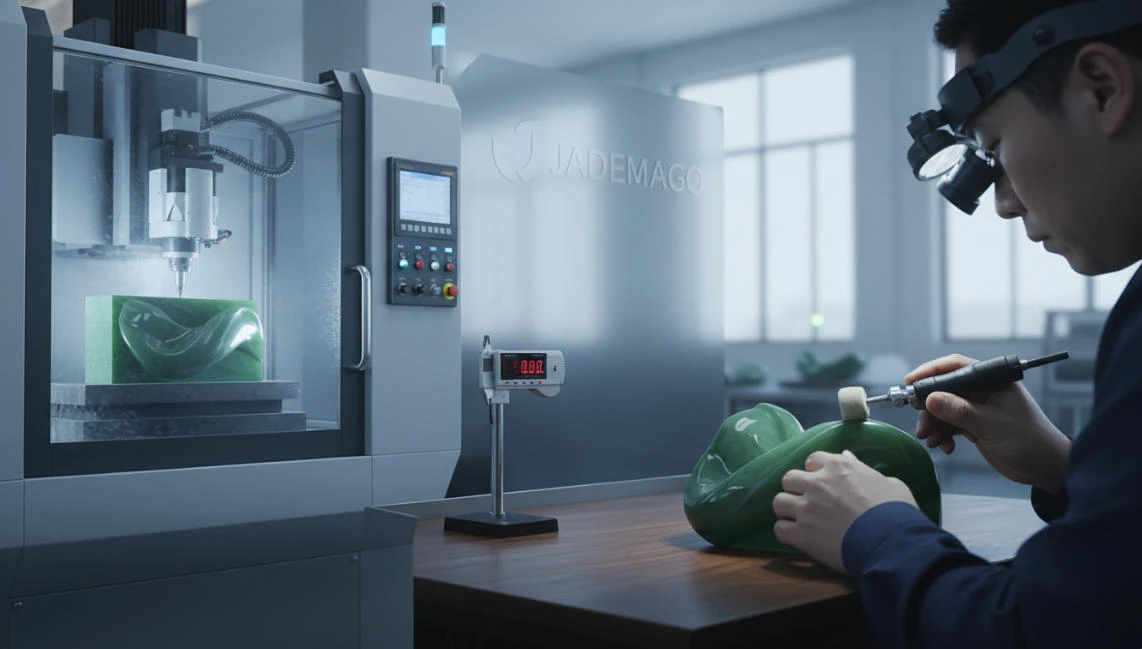
The machining stage is where the accumulated decisions of every prior phase either pay off or unravel. A well-reviewed design, correctly selected material, and precisely planned blank layout all create the conditions for successful production — but those conditions are only realized through the actual execution of the jade process on the workshop floor. This is the stage that most buyers visualize when they think about manufacturing, and it is where the gap between capable and incapable jade manufacturers becomes most visibly apparent. Equipment capability, operator expertise, and the intelligent integration of mechanical and hand processes are not interchangeable variables. Each one contributes something the others cannot replace, and the absence of any one of them produces a characteristic pattern of quality failures that experienced buyers learn to recognize.
For OEM jade products production specifically, the machining stage carries an additional burden beyond producing a single piece correctly: it must produce every piece in the batch correctly, consistently, and within the tolerance envelope established by the approved prototype. This is a fundamentally different challenge from one-off custom work, and it requires a production architecture — equipment configuration, process documentation, operator assignment, and in-process monitoring — that is explicitly designed for repeatability rather than individual craftsmanship. Understanding what that architecture looks like, and what it costs when it is absent, is essential context for evaluating any jade manufacturer‘s production capability claims.
5-Axis vs 3-Axis Jade CNC Machining — What the Difference Means for Complex OEM Jade Products
The distinction between three-axis and five-axis jade CNC machining is not primarily about speed, though five-axis systems are generally faster on complex geometries. The more significant difference is in geometric capability and dimensional accuracy — two factors that directly determine what designs can be produced to specification and how consistently they can be reproduced across a batch.
A three-axis CNC system moves the cutting tool along three linear axes: X, Y, and Z. This configuration is adequate for flat or gently curved surfaces, simple relief carvings, and geometries that can be fully accessed from a single orientation. The limitation emerges with complex three-dimensional forms — curved undercuts, compound-angle surfaces, and deep relief details that require the tool to approach the workpiece from multiple directions. On a three-axis system, achieving these geometries requires the workpiece to be repositioned and re-fixtured multiple times during production. Each repositioning introduces a potential alignment error. Across a batch of several hundred units, these accumulated alignment errors produce dimensional variation that can exceed the tolerance envelope of the approved design — even when each individual repositioning is performed carefully.
A five-axis CNC system adds two rotational axes to the three linear ones, allowing the cutting tool — or the workpiece, depending on the machine configuration — to be oriented at any angle relative to the cutting surface without interrupting the machining cycle. The practical consequences of this capability are significant for OEM jade products production. Complex three-dimensional geometries that would require three or four separate setups on a three-axis machine can be completed in a single continuous operation on a five-axis system. This eliminates the alignment errors associated with repositioning, reduces per-unit machining time on complex parts, and produces surface transitions between adjacent machined faces that are geometrically continuous rather than visibly stepped at the junction points.
For buyers, the operational implication is direct: designs that would be geometrically impossible or economically unviable on three-axis equipment become routinely producible on five-axis systems. At JADEMAGO, five-axis jade CNC machining is the standard configuration for all OEM jade products orders involving compound curves, deep relief carving, or dimensional tolerances tighter than ±0.1mm. This means your design is evaluated against five-axis capability from the design review stage — not retrofitted to three-axis limitations after the fact. You receive a product that matches your design intent, not a simplified version of it constrained by equipment that was never adequate for the geometry you specified.
The Role of Hand Carving in Modern Jade CNC Machining Production
It is a reasonable assumption that advanced CNC equipment has largely displaced hand carving in industrial jade manufacturing. That assumption is partially correct — and importantly wrong in the cases where it matters most. Five-axis jade CNC machining can produce dimensional accuracy, surface consistency, and batch repeatability that no hand process can match at scale. What it cannot fully replicate is the adaptive judgment that an experienced carver applies when working a surface that requires response to the material’s natural behavior rather than execution of a fixed tool path.
Jade’s natural grain structure, inclusion distribution, and micro-surface texture vary continuously across a workpiece in ways that no pre-production material assessment can fully map. An experienced hand carver detects these variations through tactile feedback during cutting and adjusts pressure, angle, and tool selection in real time — adaptations that keep the tool path aligned with the material’s actual structure rather than a modeled approximation of it. This adaptive capability is particularly valuable in three specific production contexts. First, in the final finishing passes on surfaces with complex organic geometry, where small deviations from the ideal tool path produce visible surface quality differences. Second, in the correction of minor surface irregularities that emerge during CNC machining — not from equipment error, but from the material’s natural response to cutting forces. Third, in the production of decorative elements where the visual quality of the carving line itself is a primary product attribute.
According to research published by the GIA on lapidary craftsmanship standards, the integration of precision mechanical processes with skilled hand finishing represents the current benchmark for premium gemstone fabrication — neither process alone achieves the combination of dimensional consistency and surface quality that demanding applications require. At JADEMAGO, hand finishing is applied as a defined production step — not an improvised correction — with specific scope, quality criteria, and operator qualification requirements. This means you can expect the hand-finished elements of your OEM jade products to meet the same consistency standard as the CNC-machined elements, because both are governed by documented process parameters rather than individual operator discretion.
Maintaining Consistency Across Large-Volume OEM Jade Products Batches
Producing a single jade piece that matches the approved prototype is a demonstration of capability. Producing five hundred that match it is a demonstration of manufacturing process control — a fundamentally different and more demanding achievement. Batch consistency in OEM jade products production depends on four interrelated mechanisms, each of which must be actively maintained throughout the production run rather than assumed to be self-sustaining once established.
The first mechanism is the golden sample standard. The approved prototype — produced and client-confirmed before batch production begins — serves as the physical reference against which every subsequent unit is compared. This comparison is not subjective. Specific dimensional checkpoints, surface finish parameters, and visual quality criteria are extracted from the golden sample and documented as measurable inspection targets. Operators and quality inspectors reference these documented targets, not their memory of the sample, which degrades in reliability over time and across personnel changes.
The second mechanism is process parameter fixation. The machining parameters — tool selection, feed rates, cutting depths, spindle speeds, and polishing sequences — that produced the golden sample are recorded and locked before batch production begins. Parameter drift during a long production run is one of the most common sources of gradual quality deviation in CNC-based manufacturing. A unit produced on day one of a three-week production run and a unit produced on day fifteen should be dimensionally identical. Achieving that requires documented parameters, not operator memory.
The third mechanism is same-batch material allocation. Where possible, JADEMAGO allocates material from the same raw batch — same source block, same grade lot — to the entire production run of a single OEM jade products order. Material variation between lots is one of the factors most difficult to compensate for mid-production, because it can shift the optimal machining parameters in ways that are not immediately apparent until quality deviation has already occurred across multiple units. Keeping material consistent keeps the process variables stable.
The fourth mechanism is structured mid-run inspection. Rather than relying solely on end-of-run quality inspection, production batches at JADEMAGO include defined inspection checkpoints at intervals of approximately every 50 to 100 units, depending on order size and design complexity. Units sampled at these checkpoints are measured against the documented golden sample targets and the results are logged. If dimensional or surface quality drift is detected, the production run is paused for parameter recalibration before the drift compounds across additional units. This approach limits the maximum exposure from any single process deviation to a fraction of the total batch — rather than discovering the deviation when the entire run has been completed and the damage is irreversible.
For buyers placing mid-to-large volume OEM jade products orders, these four mechanisms collectively determine whether the units arriving in your final shipment match the prototype you approved. A jade manufacturer who cannot describe their batch consistency protocol in specific, documented terms is likely relying on individual operator skill and end-of-run inspection — a combination that produces acceptable results on small batches and unreliable results on large ones. The architecture described above is what makes consistency a system property rather than a personnel-dependent variable.
5 — Quality Inspection: The Standards That Define Whether an OEM Jade Products Order Is Truly Finished

Quality inspection is the stage that either confirms the integrity of every preceding decision or exposes the cost of skipping them. In OEM jade products manufacturing, inspection is not a gate at the end of the production line — it is a continuous verification system that runs parallel to production, surfaces deviations while they are still correctable, and produces the documented evidence that gives buyers confidence in what they are receiving. A jade manufacturer whose quality system consists primarily of a visual check before boxing is not running quality control; they are running a shipping filter, and the defects that pass through it become your problem after delivery.
The distinction matters practically. End-of-line visual inspection catches obvious failures — visible cracks, gross dimensional deviations, surface damage. It does not reliably catch the subtler quality issues that are most common in precision jade fabrication: dimensional drift that accumulates gradually across a long production run, surface finish inconsistency between units produced on different days, or hairline fissures that are not yet surface-breaking but will become so under the mechanical stress of product assembly or end-use. Catching these issues requires a structured, multi-layered inspection system with documented criteria, calibrated measurement tools, and inspection intervals timed to the production rhythm rather than the shipping schedule.
Three-Layer Inspection Framework for OEM Jade Products
The inspection framework applied to OEM jade products at JADEMAGO operates across three distinct layers, each targeting a different category of quality attribute and using appropriate measurement methods for that category. Together, these three layers cover the full range of quality characteristics that determine whether a finished jade piece meets its specification — and whether it will continue to meet it through the demands of its intended application.
The first layer is surface and appearance inspection. Every unit is examined under controlled, standardized lighting conditions — both diffuse and directional — to evaluate surface finish consistency, color uniformity, carving line quality, edge sharpness, and the absence of visible defects including scratches, tool marks, polishing burns, and surface-breaking fissures. The criteria for this inspection are not subjective assessments against a general quality standard; they are specific, documented parameters extracted from the approved golden sample. An inspector does not ask “does this look good?” — they ask “does this match the documented surface finish rating, color range, and carving depth of the reference standard?” The difference between these two questions is the difference between consistent quality and inconsistent impressions of quality.
The second layer is dimensional inspection. Key dimensions — those specified in the client’s design file or identified during the design review as functionally critical — are measured using calibrated instruments appropriate to the required precision level. For tolerances in the range of ±0.1mm to ±0.3mm, digital calipers and optical comparators provide adequate resolution. For tighter tolerances, coordinate measuring equipment is used. Dimensional inspection is performed not only on finished units but on blanks at intermediate production stages, because catching a dimensional deviation before finishing operations saves the labor invested in those operations. As the SSEF notes in its precision fabrication guidelines, dimensional verification at intermediate production stages is a recognized best practice in gemstone manufacturing precisely because the cost of remediation increases with each subsequent operation applied to a non-conforming part.
The third layer is structural integrity inspection. This layer specifically targets the failure modes that are unique to jade as a material — hairline fissures, micro-fractures introduced by machining stress, and thin-wall areas where the material’s natural grain structure may have been compromised during cutting. Structural inspection uses transmitted light examination, which reveals internal features invisible under surface illumination, and tactile examination of edges and transitions where stress concentration is highest. Units that pass visual and dimensional inspection but show evidence of structural compromise at this layer are rejected — because a piece that looks correct and measures correctly but contains an internal fissure will fail in the field, and a field failure is significantly more damaging to a buyer’s product reputation than a manufacturing rejection.
How Tolerance Standards Are Applied When the Client Has No Specification for OEM Jade Products
A common situation in OEM jade products procurement is that the client’s design file specifies geometry and appearance requirements in detail but does not include explicit dimensional tolerances. This is not negligence on the buyer’s part — many buyers are not manufacturing engineers, and specifying tolerances requires knowledge of what is achievable and what is necessary that buyers cannot reasonably be expected to have. The question is how the jade manufacturer responds to this situation.
The inadequate response is to apply whatever tolerance the production process naturally achieves and hope it matches the buyer’s unstated expectations. This approach produces a mismatch whenever the buyer’s application has functional requirements that imply tighter tolerances than the manufacturer’s default — and the mismatch surfaces at incoming inspection or, worse, during product assembly or end-use. The adequate response is to apply a documented internal tolerance standard, communicate that standard to the client before production begins, and confirm that the standard is appropriate for the intended application. This approach converts an ambiguous specification into a defined and agreed-upon quality target — protecting both parties from the disputes that arise when expectations are not aligned before production.
At JADEMAGO, when a client’s design file does not specify dimensional tolerances, the production order is assigned tolerances from JADEMAGO‘s internal standard — a graded tolerance system that applies tighter limits to functionally critical dimensions and standard limits to non-critical ones. This assignment is documented in the pre-production confirmation package shared with the client before production begins. If the client’s application requires tighter tolerances than the internal standard specifies, that requirement can be accommodated — but it must be identified and agreed upon before production, not discovered afterward. This process gives you, as the buyer, a clear understanding of exactly what standard your OEM jade products are being produced to — before you commit to a production run.
What Separates a Capable Jade Manufacturer From One That Simply Takes Orders
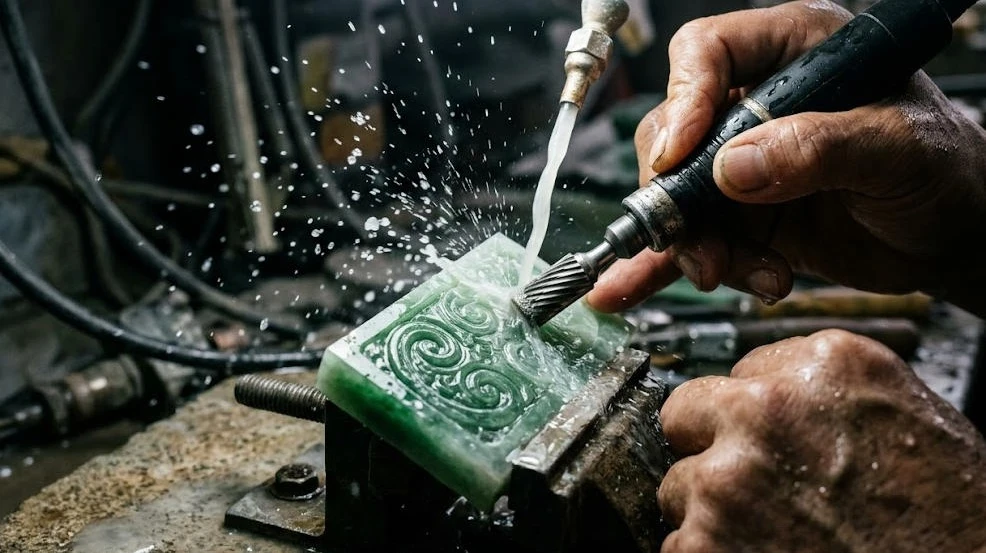
The six stages described in this article — design interpretation, design review and optimization, raw material selection, machining, craftsmanship integration, and quality inspection — are not a checklist of services. They are a description of an integrated manufacturing system in which each stage creates the conditions for the next one to succeed. A manufacturer who executes any one of these stages well but treats the others as procedural formalities will produce inconsistent results — good on some orders, problematic on others, without a reliable way to predict which outcome a given project will yield.
The buyers who have the most productive OEM manufacturing relationships are not necessarily those with the most detailed specifications or the most aggressive quality requirements. They are the ones who evaluate manufacturers on the integrity of their production system rather than the attractiveness of their price list — and who understand that the difference between a 55% and a 70% jade material yield rate, or between three-axis and five-axis jade CNC machining, or between end-of-line visual inspection and a three-layer structured quality system, translates into real product quality and real cost differences that accumulate across every order they place.
JADEMAGO‘s OEM Jade Products Manufacturing Capability — Built on 65 Years of Jade Process Experience
JADEMAGO has been processing jade and crystal as a source manufacturer for over 65 years. That duration represents not just accumulated production volume but accumulated material knowledge — the kind of understanding of how jade behaves under different machining conditions, in different grade ranges, and in response to different design geometries that cannot be acquired quickly or replicated by sourcing better equipment alone. The production system described throughout this article reflects that accumulated knowledge: structured where structure prevents errors, flexible where flexibility serves the material’s natural variability, and documented throughout so that results are repeatable rather than dependent on which operator handles a given order.
For custom jade manufacturer relationships, what this means practically is that your design file enters a system designed to protect it — from the first design review through the final inspection checkpoint. Where your design has vulnerabilities relative to jade’s material constraints, those vulnerabilities are identified and resolved collaboratively before they cost you material or time. Where your specifications create production challenges, those challenges are addressed through process engineering rather than passed back to you as excuses for deviation. The goal at every stage is a finished OEM jade products batch that matches the approved prototype, ships on the agreed schedule, and performs in your application exactly as specified.
As the IGS notes in its gemstone manufacturing standards guidance, the benchmark for evaluating a gemstone fabrication partner is not the quality of their best work — it is the consistency of their standard work. Any manufacturer can produce an impressive sample under ideal conditions. The question worth asking is whether that sample represents what you will consistently receive across every order, at every volume level, under normal production conditions. If you are evaluating jade manufacturers for an upcoming OEM jade products project and want to understand how a specific design would be handled through the process described here, the most useful next step is to share your design file for a technical review — not a price quote. Understanding the production implications of your design is the information that makes every subsequent conversation more productive.
FAQs About OEM Jade Products Manufacturing
1. How long does the design review stage typically take before production can begin?
For standard OEM jade products designs without significant complexity flags, the design review and client confirmation cycle runs approximately three to seven business days. Designs with multiple structural risk factors or requiring prototype sampling before batch confirmation may extend this to two to three weeks inclusive of sample production and client review time. This front-loaded timeline investment consistently reduces total project duration by eliminating mid-production revisions.
2. What is a realistic jade material yield rate for a complex OEM design?
For designs with deep relief carving, compound curves, or thin-wall elements, a realistic jade material yield rate range is 50% to 65% under standard production conditions. Simpler geometric designs on high-quality, structurally uniform material can achieve yields of 70% to 80%. Pre-production yield modeling — mapping the planned blank layout against the approved raw blocks — provides a project-specific projection before material is committed to production.
3. When is five-axis jade CNC machining necessary versus three-axis?
Jade CNC machining on a five-axis system is recommended whenever a design includes compound-angle surfaces, undercut geometry, deep relief carving with approach angles that cannot be achieved from a single workpiece orientation, or dimensional tolerances tighter than ±0.1mm on curved surfaces. For flat-faced or simple curved designs with tolerances of ±0.2mm or wider, three-axis machining may be adequate — but this assessment should be made during the design review stage rather than assumed.