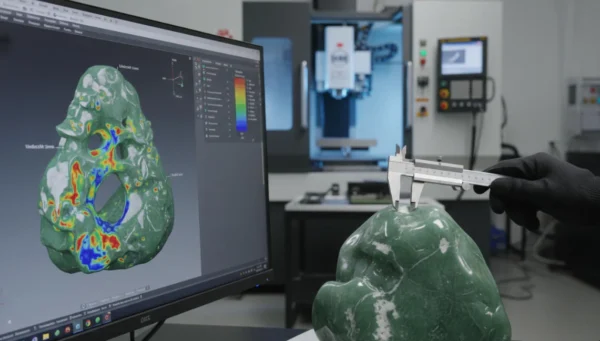
In custom jade carving, jade undercutting is the single most consistent cause of production failure — and in the vast majority of cases, it originates as a design problem before it becomes a manufacturing problem. Production data collected across experienced jade processing factories reveals a ratio that repeats regardless of order size or material grade: undercut zones, despite accounting for only 10% of a piece’s total carved surface area, routinely consume more than 50% of total carving labor hours. When internal structural characteristics inherent to natural stone — cotton inclusions, grain boundaries, and micro-fractures — are present in the raw material, breakage rates in undercut zones climb to levels that make high-volume production economically unviable. The Gemological Institute of America (GIA) has documented that these internal features are a fundamental property of natural jade, not a sourcing defect that can be eliminated. If your design contains deep recessed grooves, hollow-through structures, or movable ring components, jade undercutting complications are not a risk to manage — they are a certainty to plan for. This article examines jade undercutting from the production side: where it originates, what it costs, how it is assessed before production begins, and what solutions experienced jade manufacturers apply in practice.
Table of Contents
What Jade Undercutting Really Is — and Why It Decides Whether Your Design Can Be Produced
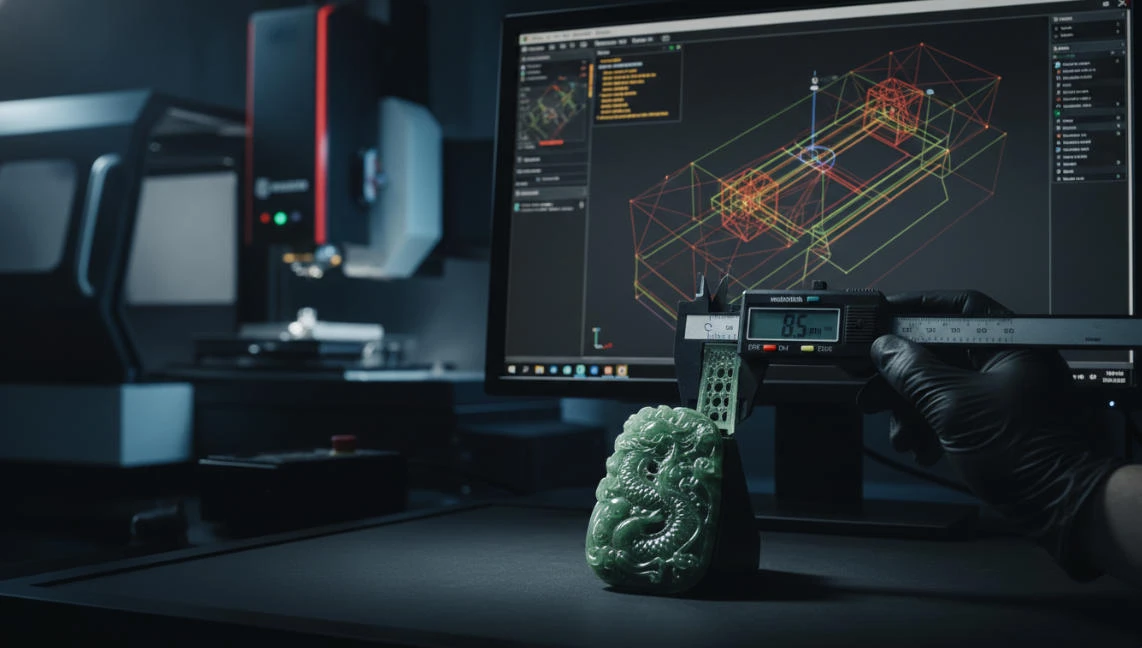
Jade undercutting describes any area within a carved jade piece where the local geometry prevents a cutting tool from reaching the target surface along a physically achievable approach path. In practical production terms, this means any region that sits beneath an overhang, inside a hollow cavity, behind a recessed wall, or at the interior angle of a concave form whose depth exceeds the tool’s penetration capacity. What makes jade undercutting particularly costly is that it is invisible in standard 2D design renderings and easily overlooked in 3D visualizations — yet it is structurally inevitable in certain design categories. A design that appears geometrically clean in a rendered image may contain multiple undercut zones that are physically unreachable by any standard carving tool configuration available in a jade processing factory.
The distinction that separates rigorous jade manufacturers from less structured operations is this: jade undercutting must be evaluated as a manufacturability problem, not as a machining challenge to solve after production begins. When buyers ask whether a design “can be made,” the honest answer requires a full undercut assessment — not a general capability statement. The International Gem Society (IGS) recognizes that jade’s two primary mineral forms — nephrite and jadeite — each present distinct structural behaviors in carving contexts. Jadeite, with its interlocking granular structure, is more prone to fracture in thin-section undercut areas; nephrite, while tougher in many applications, still fails under concentrated stress when approach angles become extreme. This means jade undercutting risk cannot be generalized across stone types — the specific material in use must inform every evaluation.
The 3 Carving Styles Most Likely to Cause Jade Undercutting Problems
Three carving categories account for the majority of jade undercutting complications encountered across the jade process. The first is complex three-dimensional relief carving: dragon motifs, phoenix compositions, and layered floral arrangements where individual carved elements overlap and create inaccessible gaps between structural components. The narrower the gap and the deeper the recess, the more severe the jade undercutting geometry becomes. A single traditional dragon carving may contain more than forty distinct undercut zones distributed across its scales, claws, and secondary decorative elements — each requiring individual tooling assessment before production can begin.
The second high-risk category is hollow-through carving: peace buckle patterns, open-work jade pendants, and lattice window structures. These designs require material removal through the full depth of the stone, leaving internal cavity walls surrounded by undercut faces on multiple sides. Both the carving tool and the subsequent polishing tool must navigate these internal geometries — and in many configurations, neither can do so without hand-finishing adaptation. This is not a marginal edge case in jade processing factories: it is the production reality for the majority of hollow pendant designs submitted as custom orders.
The third category is movable ring structures — interlocking chain links, rotating rings, and articulated pendant components carved from a single continuous piece of raw stone. By structural definition, these components cannot exist without jade undercutting: the moving element must be freed from the surrounding body while remaining physically continuous with the piece, requiring material removal from angles entirely inaccessible to standard tooling. This is why movable ring carvings carry some of the highest per-unit labor costs in any jade process — and why their production feasibility is entirely dependent on the hand-finishing capabilities of the manufacturing team. Can your current supplier document how they address this zone specifically? If not, the answer to that question is already visible in their rejection rate.
Why Undercut Geometry Defines Jade Process Feasibility Before a Single Cut Is Made
In a properly structured jade process, the first question a production team asks when reviewing a new design is not “how do we carve this?” but “can this design be carved to the required surface finish at an acceptable yield rate?” These are fundamentally different questions. The first assumes feasibility and selects a method. The second demands evidence of feasibility before any material or labor commitment is made. For buyers placing custom orders, this distinction carries a direct financial implication: a jade manufacturer that skips pre-production undercut assessment is committing your raw material and your timeline to a process it has not fully evaluated.
When jade undercutting zones are encountered mid-production without prior assessment, the available responses all carry significant cost. Stopping to modify the design means the already-cut stone may no longer accommodate the revised geometry. Proceeding despite the undercut means accepting reduced surface quality in those zones. Scrapping the piece means losing all material and labor invested to that point. None of these outcomes are recoverable in any practical sense for high-value custom orders, and none are outcomes that a professional pre-production review would allow to occur. This is why JADEMAGO‘s production workflow begins with formal undercut evaluation of every submitted design before any raw material commitment is confirmed — not as an optional advisory, but as a structural safeguard against preventable loss. This means that you receive a production quotation based on verified design geometry, not on assumptions that will be tested at your expense.
What Jade Undercutting Actually Costs in Production — Four Manufacturing Consequences
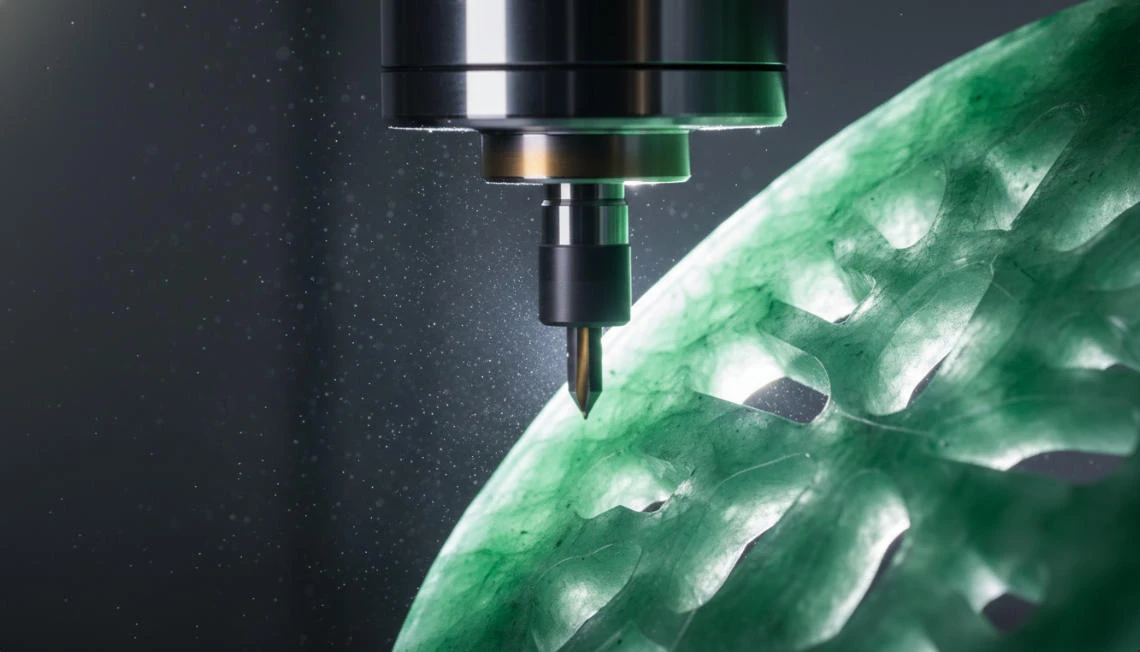
Jade undercutting does not produce a single, isolated failure mode. It generates a cascade of interconnected production problems that compound across every subsequent stage of the jade process. Understanding these four consequence categories helps you interpret why complex undercut designs carry premium pricing, extended lead times, and higher raw material attrition rates — and why those numbers are not negotiable by switching suppliers but only by modifying the design geometry itself. The cost is in the geometry, not in the factory.
Tool Access Failure in Jade Undercutting Zones
Standard carving tooling — diamond burrs, rotary grinding discs, and core drills — is designed to approach the workpiece along a relatively direct axis. In jade undercutting zones, the local geometry places the target surface behind an overhang or inside a cavity that the tool shank physically cannot enter without contacting the surrounding carved structure. The approach angle required is either mechanically impossible for the tool spindle or creates interference that prevents the cut from being completed. When tool access fails, the area cannot be machined by the standard process regardless of machine capability or operator experience — and no cnc jade machine configuration currently available in commercial production resolves a geometric access constraint through programming sophistication alone.
The practical response to tool access failure varies by zone depth and geometry. Shallow undercuts may be addressable with extended-reach or angled-shank tooling, which increases tool cost and reduces cutting rigidity, thereby introducing surface finish variability that must be compensated by downstream processing. Deep undercuts with narrow approach angles cannot be reached by any mechanical tooling and require hand-finishing by skilled artisans. This means that the cost structure of your order is determined primarily by how many jade undercutting zones exceed the threshold where mechanical access becomes geometrically impossible — not by the overall piece dimensions or total material volume.
Structural Breakage Risk During Jade Undercutting Operations
Jade undercutting operations concentrate mechanical stress at the precise locations where material cross-section is smallest. As carving progresses into undercut zones, the connecting walls between carved elements become progressively thinner and the structural support for overhanging or suspended features decreases. When natural jade contains internal inclusions — cotton-like fibrous structures, grain boundary discontinuities, or pre-existing micro-fractures — these features become stress concentration points the moment undercut machining applies lateral or torsional force to the thinning section. The Swiss Gemmological Institute SSEF has documented that internal structural characteristics are inherent to natural jade and vary significantly between individual stones, making breakage prediction in undercut zones probabilistic rather than deterministic even for experienced production teams.
In production terms, breakage rates in jade undercutting zones are statistically higher than in standard carving areas — not because of operator error, but because the geometry forces stress into structurally compromised cross-sections that exist in the stone regardless of how carefully the tool is applied. For buyers, this translates into two planning implications. First, yield rates on designs with extensive undercut zones will be lower, and raw material pricing should reflect an attrition buffer. Second, stone selection quality directly affects breakage frequency in undercut areas — sourcing lower-grade material to reduce unit cost typically amplifies total production expense rather than reducing it, because the increased breakage rate consumes more material and more labor per finished piece than the savings in raw stone cost.
The 10%/50% Rule — Time Cost Disproportionality in the Jade Process
One of the most practically significant and least communicated aspects of jade undercutting is its disproportionate impact on production time. Standard carving operations — removing material from convex surfaces, flat faces, and accessible concave areas — allow for continuous, high-rate material removal. A properly programmed cnc jade machine can process significant surface area in a single tool pass, and an experienced operator can sustain high-efficiency material removal across open geometry for extended periods. Jade undercutting zones eliminate this efficiency entirely: the geometry requires point-by-point material removal, constant tool repositioning, frequent approach-angle changes, and multiple passes to achieve the required form accuracy at each individual location.
Production records from experienced jade manufacturers consistently document a ratio that buyers should treat as a baseline planning assumption: undercut zones representing approximately 10% of a piece’s total carved surface area account for more than 50% of total carving labor hours. This ratio is not a function of operator skill level or equipment configuration — it is a direct consequence of the geometry. For a design with extensive jade undercutting, such as a hollow lattice pendant or a multi-layer relief carving, total production time is driven almost entirely by the undercut content rather than by the overall piece size. This means that your quoted lead time for a complex undercut design reflects the geometry of those specific zones — and that compressing it by requesting expedited production typically means reducing quality in precisely the areas that are already most difficult to process.
Polishing Dead Zones Created by Jade Undercutting
The consequences of jade undercutting do not end when carving is complete. Polishing — the stage that determines final optical quality and directly affects market value — faces the same access limitations as carving, and often more severe ones. Polishing tools are typically larger in cross-section than carving tools and require sustained, consistent surface contact to generate the progressive abrasion sequence necessary for a uniform finish. In jade undercutting zones with narrow cavities, deep recesses, or acute internal angles, mechanical polishing tools cannot maintain the required contact geometry, and the sustained pressure needed for effective material removal cannot be applied.
When mechanical polishing cannot reach a surface, three outcomes are possible: the area is left unpolished, creating a visible matte zone against an otherwise reflective surface; the area is polished by hand using shaped sticks and abrasive compounds, adding significant labor time and introducing gloss consistency variability; or mechanical polishing is attempted at the edge of tool access capacity, producing orange-peel texture, residual sand marks, or uneven gloss distribution across adjacent zones. All three outcomes represent a reduction in finished product quality relative to a design without jade undercutting in those locations. For buyers, this consequence is particularly significant because polishing defects in undercut areas frequently only become visible after delivery — when the piece is examined under directional lighting at the buyer’s facility. At that point, the production record is closed, and the defect cannot be corrected without re-entering the full finishing sequence. A jade processing factory that performs polishing access simulation during pre-production review eliminates this category of post-delivery dispute before it can occur. This means that the difference between a factory that does and does not perform this check is the difference between a predictable outcome and an expensive surprise.
CNC Jade Machine Capabilities and Hard Limits When Processing Jade Undercutting Structures
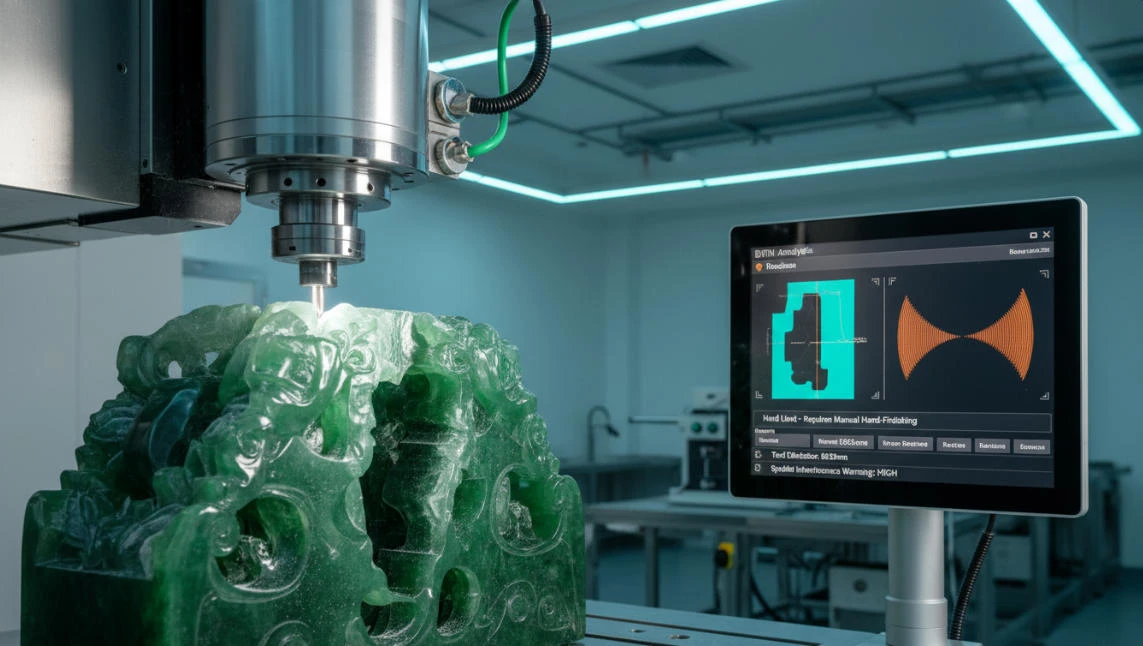
The expansion of cnc jade machine technology across the jade process has significantly improved production consistency, geometric precision, and throughput for standard carving operations. It has not eliminated jade undercutting as a manufacturing constraint, and it was never designed to. The physical constraints that create undercut limitations are geometric — they are properties of the design’s three-dimensional form — and no axis configuration currently available in commercial cnc jade machine systems removes those constraints entirely. Buyers who assume that more advanced machinery resolves the jade undercutting problem are operating on a fundamentally incorrect model of what CNC equipment does and does not do.
3-Axis CNC Jade Machines — Where Jade Undercutting Becomes Geometrically Impossible
A 3-axis cnc jade machine operates along three linear axes: X (left-right), Y (front-back), and Z (up-down). The cutting tool can be positioned at any coordinate within the machine envelope, but its orientation relative to the workpiece is fixed — the spindle always approaches vertically. For standard relief carving, surface profiling, and pocket milling, this configuration is efficient and produces consistent results. For jade undercutting zones — any area requiring the tool to approach from the side, from below, or at an acute angle relative to the local surface normal — 3-axis geometry provides zero mechanical capability. The tool cannot be rotated or tilted to access the undercut face, and no programming sophistication overcomes this constraint.
In practice, this means that any design submitted to a jade processing factory operating exclusively with 3-axis CNC equipment will have its undercut zones left entirely unaddressed by machine operations. The machine will complete the geometry it can reach; everything in the undercut zone must be completed by hand, regardless of design complexity or required precision. For buyers evaluating supplier capability, the relevant question is not whether a factory has cnc jade machine equipment, but what axis configuration that equipment supports and what percentage of the submitted design’s undercut zones fall outside the machine’s mechanical access envelope. A factory that does not know the answer to that second question has not evaluated your design.
4-Axis and 5-Axis CNC Jade Machines — Partial Solutions and Persistent Gaps in Jade Undercutting Coverage
A 4-axis cnc jade machine adds a rotational axis — typically allowing the workpiece or spindle to rotate around the A or B axis — permitting different faces of the carving to be presented to the tool without manual repositioning. A 5-axis system adds a second rotational axis, enabling simultaneous multi-axis movement and substantially expanding the range of surface orientations that can be machined in a single setup. For jade undercutting zones that are accessible from multiple sides and where undercut depth is moderate, 4-axis and 5-axis configurations can address many geometries that 3-axis systems cannot reach, which meaningfully reduces the hand-finishing workload on appropriately configured designs.
However, 4-axis and 5-axis cnc jade machine systems still encounter fundamental physical limitations in severe undercut scenarios. Tool length creates a moment arm: the deeper a tool must reach into a cavity, the greater the deflection under cutting load, which compromises surface accuracy and finish quality beyond a threshold depth. Tool diameter determines the minimum internal radius achievable in a recessed zone — no tool can machine an internal corner smaller than its own radius, regardless of axis count. And tool-workpiece interference — where the tool body or spindle housing contacts an adjacent carving feature — can prevent the required approach path entirely, even when the target surface falls within the machine’s theoretical rotational range. For jade undercutting zones that exceed these thresholds, hand-finishing remains the only viable production option regardless of CNC axis count or equipment cost. At JADEMAGO, pre-production geometric analysis is used to identify exactly which zones in each submitted design fall beyond 5-axis machine access, allowing hand-finishing labor to be allocated specifically to those areas before the production schedule is confirmed. This means that you receive a timeline built on the actual access geometry of your design — not on the assumption that the machine can reach everything.
The practical implication for buyers is straightforward: when a jade manufacturer quotes a price and timeline for a complex undercut design, ask specifically which zones will be machine-processed and which will require hand-finishing. A factory that can answer this question with zone-specific detail has done the pre-production analysis. A factory that cannot is quoting from a general assessment of piece complexity rather than from an evaluation of the actual geometry.
How to Assess Jade Undercutting Risk Before Production Starts — A Three-Dimension Evaluation Framework
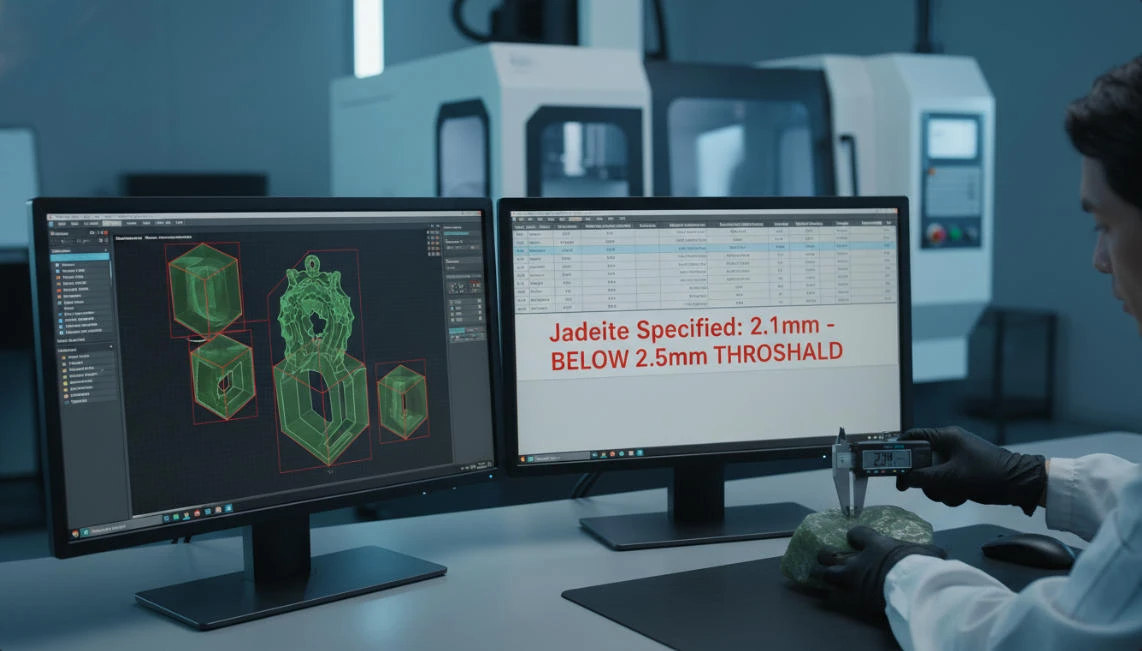
The question buyers most frequently ask at order submission is “can you make this?” The question they should be asking is “have you evaluated this design specifically for jade undercutting risk, and what did that evaluation find?” These are different questions with different implications. The first is a capability question; the second is a process question. Capability without documented process produces inconsistent results at unpredictable cost. A complete pre-production jade undercutting evaluation covers three mandatory assessment dimensions before any production commitment — material purchase, machine time allocation, or delivery schedule — is confirmed. If any of these three checks is absent from a factory’s intake process, the production risk has been deferred rather than managed.
Hidden Surface Detection in Jade Design Files Submitted to a Jade Processing Factory
The first assessment dimension is geometric: identifying every surface in the submitted design that is not directly accessible from above, from the front, or from other standard approach directions that correspond to available machine axes. These hidden surfaces include overhang structures — areas where carved material extends horizontally beyond the supporting column beneath it — hook-back contours that curve back toward the tool entry direction after an initial accessible section, and deep recessed grooves whose depth-to-width ratio exceeds tool reach capacity for any available tooling combination. In 2D design files, these features are typically invisible; in 3D models, they may be obscured by rendering surface materials, perspective angle, or ambient lighting in the visualization environment.
A jade processing factory conducting a rigorous undercut assessment will analyze the design in cross-section across multiple planes — typically at intervals of 2 to 5 millimeters depending on design complexity — to identify all hidden surfaces before confirming a quotation. If a factory provides a production price without requesting a three-dimensional model file, without requesting cross-section views of hollow or recessed areas, and without providing any specific feedback on undercut zones identified, the assessment has been skipped. The production risk is being transferred to you. For JADEMAGO, hidden surface detection is conducted on every submitted design as part of the standard intake process — not because complex designs are rare, but because undetected hidden surfaces are the leading cause of mid-production stoppage and raw material loss in custom jade orders.
Minimum Wall Thickness Standards by Jade Material — Why Jadeite, Nephrite and Agate Require Different Tolerances
The second assessment dimension is structural: verifying that the thinnest connecting sections in the design exceed the minimum wall thickness threshold for the specified stone material at every jade undercutting location. Different jade materials exhibit substantially different fracture toughness values, which directly determine the minimum wall thickness that can survive the mechanical stress of undercut machining. Based on production experience across multiple stone types documented by experienced jade manufacturers, jadeite requires a minimum wall thickness of 2.5 to 3 millimeters in undercut connecting sections; nephrite (hetian jade) and agate both require walls no thinner than 2 millimeters in structurally equivalent positions.
These figures represent the practical lower boundary below which breakage rates during jade undercutting operations rise to levels that make standard-quantity production economically nonviable. They are not conservative estimates with safety margin built in — they are the threshold at which the probability of breakage during undercut machining transitions from statistically manageable to statistically dominant. Buyers submitting designs to any jade manufacturer should include minimum wall thickness annotations for all narrow connecting sections in the design files. If a design does not specify minimum thickness and the factory does not request it, the production quotation is based on geometric assumptions that may not align with actual design intent — and the resulting breakage rate discussion will happen after material has been lost, not before.
Polishing Access Feasibility — The Most Frequently Skipped Check in Jade Process Evaluation
The third assessment dimension — and the one most frequently omitted from intake processes at less experienced jade processing factories — is verifying that polishing tools can physically access all carved surfaces expected to carry a polished finish in the final product. A design that passes carving tool access assessment may still fail polishing access assessment if its internal cavities are narrower than the minimum working diameter of available polishing media, or if its internal angles are too acute for a polishing tool to maintain consistent surface contact across the full area to be finished. These are not the same constraint, and a design can satisfy carving access requirements while failing polishing access requirements — producing a piece that is precisely carved but cannot be finished to the specified surface quality.
Sections of a carved jade piece that cannot be mechanically polished must either be hand-polished — which is feasible, time-intensive, and introduces consistency variability across large surface areas — or carry a substandard finish in those zones. A carving that cannot be fully polished cannot be delivered as a finished piece at the quality level that high-value custom orders require, regardless of how precisely the carving geometry was achieved. JADEMAGO‘s pre-production review explicitly includes polishing access simulation for all hollow-through and deep-recess design features, because the jade process does not end at carving — and a production plan that does not account for polishing access in jade undercutting zones is not a complete production plan. This means that before your order enters production, you can know with specificity which zones will be mechanically polished, which will require hand-polishing, and what the expected surface quality variance between those zones will be.
Three Production-Proven Solutions to Jade Undercutting Problems
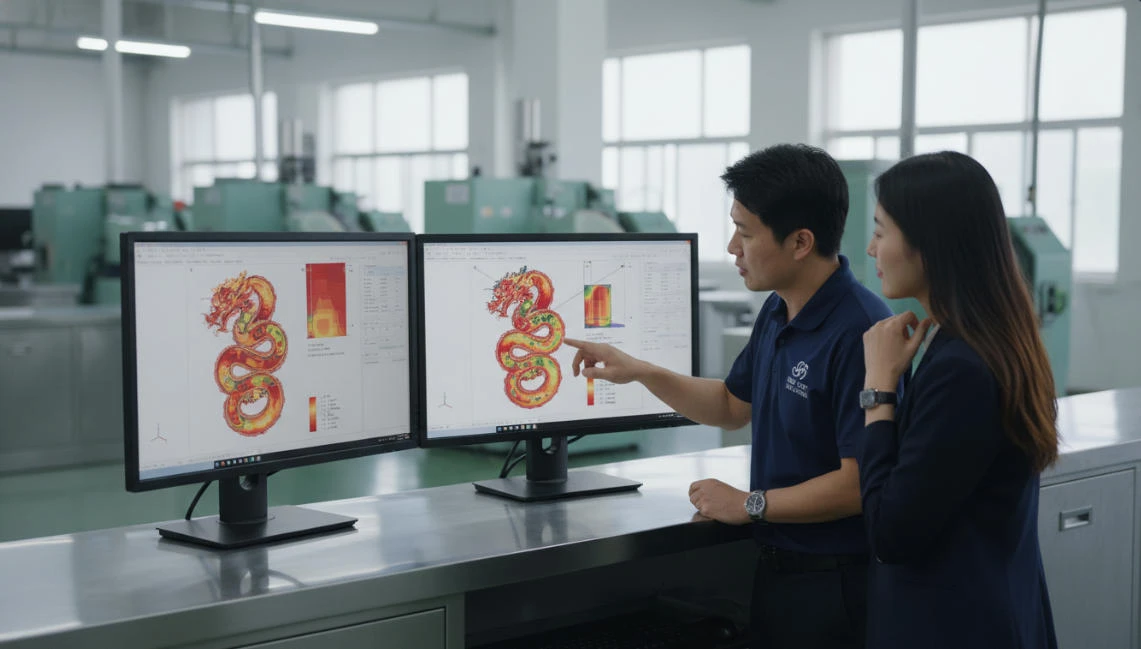
Jade undercutting is not an unsolvable manufacturing constraint. It is a design geometry problem with engineering solutions — each carrying a different cost profile, applicability range, and quality outcome. The three approaches described below are not mutually exclusive: experienced jade manufacturers apply them in combination, sequenced according to the severity and spatial distribution of undercut zones in a specific design. Understanding how each solution works — and what it cannot do — gives you a basis for evaluating supplier proposals and for making informed decisions when production options are presented.
Solution 1 — Design Modification: Reducing Jade Undercutting Severity Without Changing Visual Intent
The most cost-efficient approach to jade undercutting is to reduce its severity through targeted geometric adjustment before production begins. In most cases, this does not require redesigning the piece from scratch — it requires identifying the specific undercut zones where depth, angle, or wall thickness creates production risk, and applying localized modifications that resolve the manufacturing constraint while preserving the visual outcome. Common adjustments include increasing the internal corner radius at undercut transitions to allow tool entry (fillet radius modification), reducing the horizontal projection of overhanging elements to shorten unsupported spans, or opening the approach angle of a recessed groove to permit standard tooling to reach the base surface. These modifications typically occur at scales smaller than 2 millimeters and at locations that are not the visual center of the design — meaning the finished piece is indistinguishable from the original specification.
Buyers working with a jade processing factory for the first time are frequently surprised to find that design modification feedback is part of a normal, professional production intake process — not a signal that the factory cannot execute the original design. The professional jade process treats geometric adjustment as a collaborative engineering step that protects the buyer’s investment, not as a negotiation over deliverables. If a supplier characterizes pre-production design feedback as an obstacle or an exception rather than a standard intake procedure, that is a signal that systematic jade undercutting evaluation is not part of their workflow. This means that accepting a quotation without design feedback may indicate that the evaluation was never performed — not that the design passed it.
Solution 2 — Layered Carving: Achieving Complex Visual Effects Without Extreme Jade Undercutting Geometry
Some design effects that appear to require extreme jade undercutting can be produced through a fundamentally different production strategy: layered carving. Instead of carving the entire design from a single piece of raw stone — which would require deep, narrow undercuts to achieve the required spatial relationships between elements — the design is decomposed into multiple independently carved layers, each processed to the required geometry separately, and then assembled into the final composition. The visual result of a correctly executed layered carving is identical to a single-piece carving in the finished product, but the production geometry of each individual layer contains no undercut zones that exceed the access capacity of standard CNC and hand-finishing tooling.
Layered carving is particularly effective for hollow-through pendant designs, multi-depth landscape reliefs, and architectural lattice structures where the visual complexity is primarily a function of depth distribution across layers rather than of continuous undercut geometry through a single body of material. The approach does require precise dimensional control across all layers to ensure accurate positional registration when assembled, and the joining method must be appropriate for the stone type, the structural load the joint will carry, and the aesthetic requirements of the finished product. JADEMAGO develops layered carving sequences during the pre-production design review phase for designs where this approach is applicable, ensuring that the decomposition strategy is verified against the target finished geometry before raw stone is sourced or cut.
Solution 3 — CNC Roughing Combined With Hand Finishing: The Production Standard for Complex Jade Orders With Unavoidable Jade Undercutting
For designs where jade undercutting zones are unavoidable — where design modification would compromise the visual intent and layered carving is not geometrically applicable — the industry-standard production approach is CNC roughing combined with hand-finishing. The cnc jade machine completes all material removal in geometrically accessible zones at the precision and surface consistency level that only machine processing can deliver at commercial throughput. Skilled hand-finishing artisans then address the remaining jade undercutting areas: removing residual material, refining surfaces to the required contour and radius, and polishing to the final specification using shaped tools and graded abrasive compounds applied under direct visual control.
This approach is more expensive per unit than either CNC-only or hand-only production for the full piece, and its cost is directly proportional to the volume and severity of undercut zones requiring hand attention — which is why pre-production undercut assessment is a prerequisite for accurate quotation of this method. What it produces, however, is an outcome that neither process alone can achieve: the dimensional precision and surface repeatability of machine processing in accessible areas, combined with the geometric reach and real-time material sensitivity of hand craftsmanship in undercut zones. For buyers ordering high-value decorative pieces, collector-grade carvings, or certified gemstone pieces that will be submitted to authentication bodies such as the SSEF Swiss Gemmological Institute or verified against GIA jade quality standards, this combined approach is the production baseline — not a premium tier. JADEMAGO applies this combined workflow as the default method for all designs containing jade undercutting zones that exceed 5-axis CNC machine access capacity, with hand-finishing labor allocated zone-specifically based on the pre-production geometric analysis. This means that the hand-finishing hours in your quotation correspond to identified undercut zones in your specific design — not to a general complexity estimate.
Jade Undercutting as a Manufacturability Standard — What It Means Before You Confirm Your Next Custom Order
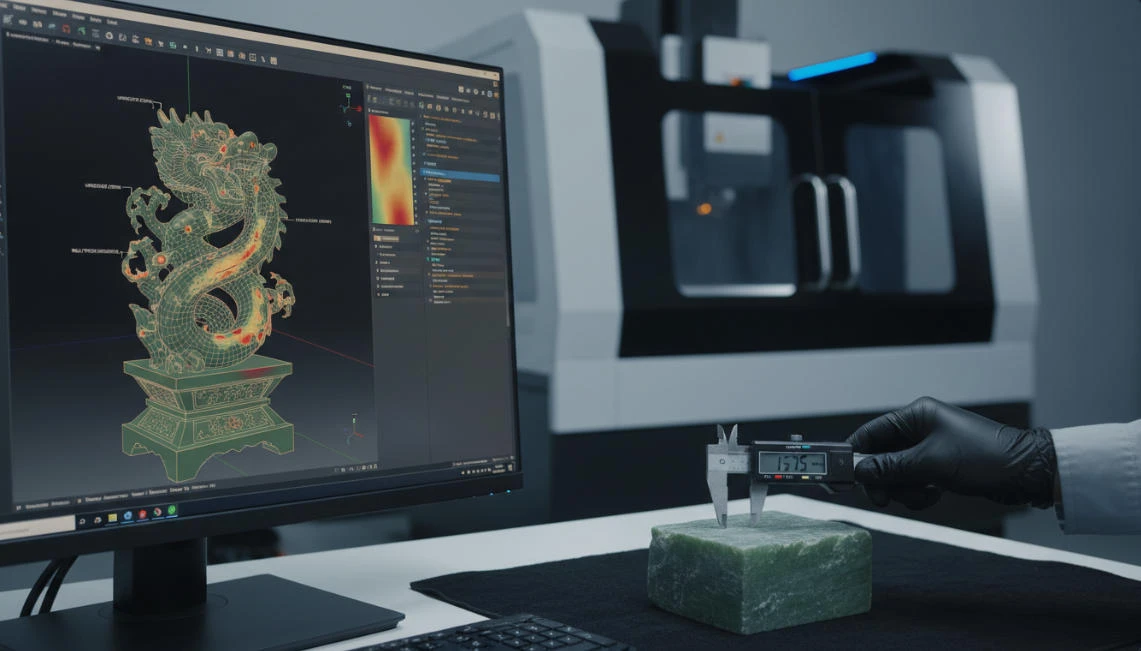
Jade undercutting is, at its core, a manufacturability problem — and that framing determines where the solution must be applied. A design that carries unresolved jade undercutting risk will not be produced better by a more expensive factory or a more advanced cnc jade machine. It will fail in the same locations, by the same mechanisms, at higher cost. The geometry determines the outcome. No production capability can compensate for a design that has not been evaluated against the physical constraints of the material and the tooling. This is the foundational principle that separates a managed custom jade process from a speculative one.
Why Jade Undercutting Assessment at the Design Stage Is the Most Cost-Effective Quality Control Available
Pre-production jade undercutting assessment has a measurable return on investment that is directly calculable from production data. At the design review stage, correcting an undercut zone — adjusting a radius, modifying a wall thickness, or restructuring a hollow cavity geometry — costs hours of design time and zero material. At the mid-production stage, the same correction costs the raw stone already cut, the machine time already expended, the production schedule already disrupted, and in many cases requires restarting the order from raw material sourcing. For high-value jade pieces, where raw material costs alone can represent a significant portion of total order value, the cost ratio between a design-stage correction and a mid-production stoppage is not marginal — it can represent the difference between a profitable order and a loss.
For buyers working with jade manufacturers on complex custom designs, the IGS’s guidance on jade material properties reinforces a practical implication: because jade’s internal structural characteristics cannot be fully predicted from surface inspection, and because those characteristics directly affect breakage probability in jade undercutting zones, the only risk management available at the production stage is geometric — ensuring that undercut depth, wall thickness, and approach angles stay within the material’s tolerance range. That management must happen at design review, not during machining.
What to Verify With Your Jade Processing Factory Before Production Is Confirmed
Before confirming a production order that contains jade undercutting zones, you should be able to receive clear answers to the following verification questions from your jade processing factory: Which specific zones in the submitted design have been identified as undercut areas, and at what severity level? Which of those zones will be addressed by CNC processing, and which require hand-finishing? What is the minimum wall thickness at the thinnest connecting section, and does it meet the threshold for the specified stone material? Have polishing tool access paths been verified for all internal cavities? What is the expected yield rate assumption for the specified stone type and undercut geometry? A factory that can answer these questions with zone-specific detail has performed the assessment. A factory that responds with a general confirmation of feasibility has not.
Faqs About Jade Undercutting
1. What is jade undercutting?
Jade undercutting occurs when a carved area’s geometry prevents cutting tools from reaching the target surface. It is most common in hollow-through designs, complex 3D relief carvings, and movable ring structures — and is fundamentally a design manufacturability problem, not a machining error.
2. Can a 5-axis CNC jade machine eliminate all undercut problems?
No. Even a 5-axis cnc jade machine faces physical limits — tool length, diameter, and interference constraints still prevent access to deep or severely angled jade undercutting zones. Hand-finishing remains essential for those areas regardless of equipment configuration.
3. What is the minimum wall thickness for jadeite in undercut areas?
For jadeite, connecting walls in jade undercutting zones must be at least 2.5–3mm thick. Nephrite and agate require a minimum of 2mm. Walls thinner than these thresholds carry significantly elevated breakage risk during the jade process.
4. Why does a small undercut zone consume so much production time?
Jade undercutting zones require point-by-point material removal rather than continuous passes. Production data shows that undercut areas covering just 10% of a piece’s total surface consistently consume over 50% of total carving labor hours in any jade processing factory.
5. When should undercut assessment happen — before or after ordering?
Always before. Design-stage jade undercutting assessment costs only review time. Mid-production discovery costs raw material, machine hours, and schedule delays. Any professional jade manufacturer should provide zone-specific undercut feedback before confirming your production order.