Every jade manufacturer that has scaled past 500 units per weekly batch has encountered the same cluster of production failures: unexpected breakage mid-cycle, inconsistent surface gloss across a single run, and dimensional drift that forces costly rework. The root cause in the vast majority of cases is not equipment failure — it is parameter mismanagement inside the tumbling polish gemstone workflow. Timing deviations of as little as four hours in the fine grinding stage can push surface tolerance beyond acceptable limits. A water-to-grit ratio error of just 20% above baseline reduces abrasion efficiency by nearly one-third. Tumbling polish gemstone is a four-stage mechanical process — coarse grinding, medium grinding, fine grinding, and final polishing — each governed by specific grit size, run time, load volume, and moisture parameters. Getting these parameters right is the operational difference between a 92% batch yield and a 60% batch yield. This article delivers the production-grade framework your jade polishing line needs to eliminate preventable losses at every stage.
Table of Contents
How the 4-Stage Tumbling Polish Gemstone Process Works
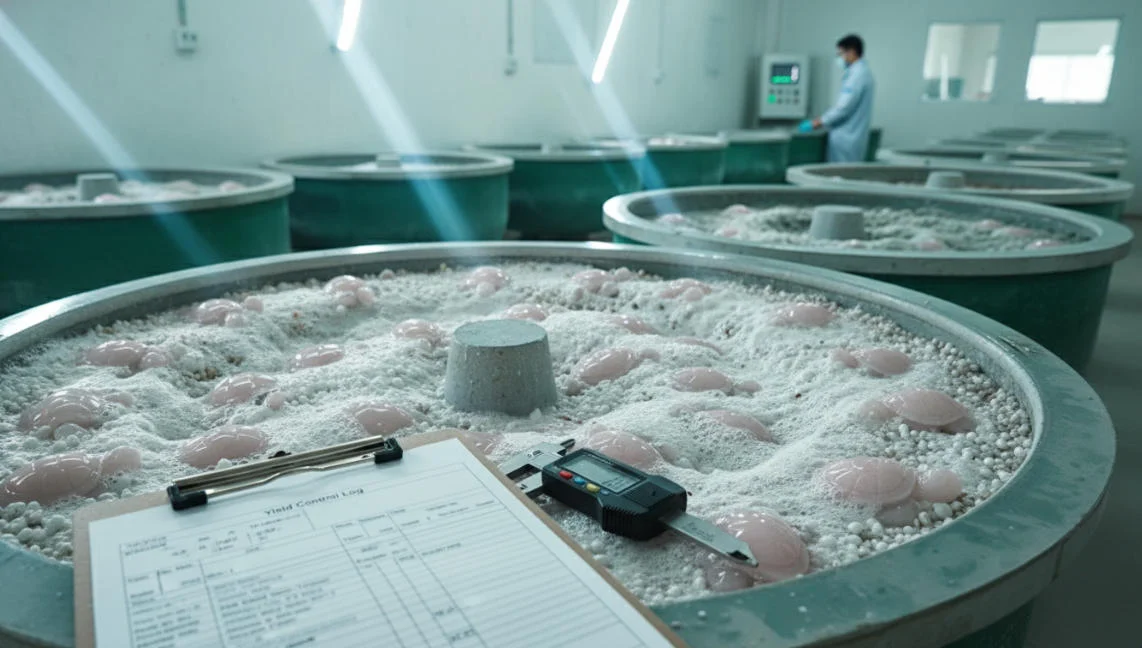
The mechanical principle behind tumbling polish gemstone is direct: abrasive media collides with and rubs against stone surfaces under controlled vibration, progressively removing material until the target surface finish is achieved. What makes the process operationally demanding is that each of the four stages targets a distinct abrasive threshold, and failure to hit that threshold within the correct parameters forces the entire batch back to the previous stage — doubling time costs and accelerating media consumption simultaneously. The International Gem Society identifies consistent staging and grit progression as the primary determinants of surface quality in mechanical gemstone finishing.
For any jade manufacturer running batches of 200 units or more, this is not a guideline — it is an operational constraint that governs scheduling, equipment allocation, and raw material loss rates. Understanding each stage’s parameters is the prerequisite to building any reliable jade process standard, and no amount of equipment investment compensates for a workflow that skips this discipline.
1 — Coarse Grinding (60–90 Grit): Shaping the Surface and Removing Structural Defects in the Tumbling Polish Gemstone Process
The coarse grinding stage performs two non-negotiable functions in any serious jade process: it removes gross surface irregularities — rough edges, shallow fractures, and casting marks — and it establishes the baseline geometry from which all subsequent stages work. The abrasive media specified for this stage is 60–90 grit silicon carbide or aluminum oxide powder. Run time sits between 8 and 12 hours, with harder materials such as jadeite (Mohs 6.5–7, as classified by the GIA Gem Encyclopedia) typically requiring the upper range, and softer stones such as serpentine (Mohs 3–4) requiring closer to the lower boundary. Load volume must not exceed two-thirds of the drum capacity — exceeding this threshold raises inter-stone collision frequency and stands as the leading mechanical cause of breakage at this stage.
Water level should be maintained at the point where stones are just covered; any measurable excess dilutes abrasive concentration and extends required run time by 15–25%. Are you running coarse cycles beyond 14 hours without a systematic mid-cycle inspection protocol? If so, you are not achieving a deeper finish — you are accumulating dimensional deviation that will compound through every subsequent stage. Dimensional variance introduced here makes stage-three tolerances significantly harder to meet, and the rework cost scales with every hour beyond the 12-hour ceiling.
2 — Medium Grinding (120–220 Grit): Eliminating Coarse Scratches Without Creating New Surface Damage
The function of medium grinding within the tumbling polish gemstone sequence is precise: remove the scratch pattern left by 60–90 grit media and replace it with a finer, more uniform scratch pattern that the fine grinding stage can erase. Many production operations underestimate this stage because its visible output — a matte, evenly abraded surface — looks similar to the coarse output to the untrained eye. The measurable difference, however, is significant: scratch depth produced by 120–220 grit media is roughly one-quarter of that left by 60–90 grit, which means the fine grinding stage faces a dramatically smaller material removal target and can achieve it within its specified time window.
Standard run time for this stage is 6–8 hours, making it the shortest of the four stages. This brevity creates one of the most common operational errors in jade polishing production: operators who under-ran coarse grinding attempt to compensate by extending the medium stage. This correction path does not work. Medium grit cannot remove deep coarse scratches — its removal range is physically bounded by particle size. If coarse grinding was insufficient, the batch must return to coarse processing, regardless of the time cost. The transition between these two stages also introduces a contamination risk that directly damages yield: any coarse grit carried into the medium stage on unwashed stone surfaces will produce irregular deep scratches that mimic coarse-stage under-processing. Inter-stage cleaning is therefore a quality control checkpoint — not a housekeeping step — and skipping it degrades your jade surface finishing consistency in ways that no downstream stage can correct.
3 — Fine Grinding (400–600 Grit)
Fine grinding is the stage where jade surface finishing quality is either secured or permanently compromised. The abrasive media shifts to 400–600 grit — either loose silicon carbide powder or a purpose-formulated fine grinding compound — and the mechanical objective is to erase the scratch pattern from the medium stage and produce a surface that, under 10x magnification, shows no visible scratch lines. This is the foundation the final polishing stage builds on, and if that foundation is uneven, no quantity of polishing compound or additional polishing time will produce a consistent mirror finish across the batch. The GIA’s technical documentation on gem surface quality makes clear that sub-surface scratch patterns not addressed in the fine grinding stage will re-emerge as haze or micro-texture inconsistency after polishing — a defect category that is both irreversible and commercially significant.
Run time for fine grinding sits between 18 and 24 hours, making it the longest single stage in the entire tumbling polish gemstone process. This extended run time creates the highest overgrinding exposure of any stage. For small-format pieces — beads under 8mm, cabochons under 10mm, or thin flat pendants — dimensional loss at this stage can reach 0.3–0.5mm if run time exceeds 24 hours without inspection. That level of material removal translates directly to weight loss, which affects pricing on sold-by-weight inventory, and dimensional non-conformance, which affects setting compatibility in jewelry production contexts. A mandatory mid-cycle inspection at the 16-hour mark is therefore non-negotiable: pull three to five representative samples, examine under direct light for residual medium-stage scratch lines, and make a data-supported decision on whether to continue or transition.
How to Manage Fine Grinding Time Across Different Jade Process Material Types
Not every material behaves the same way under 400–600 grit media, and a single fixed run time across all stone types is one of the most consistent sources of yield loss in high-volume jade polishing operations. Jadeite, at Mohs 6.5–7, resists fine grinding media effectively and typically requires the full 20–24 hour range to reach the required surface standard. Nephrite jade, slightly softer at Mohs 6–6.5, moves through fine grinding more quickly and can reach the transition threshold in 18–20 hours under standard conditions. Softer ornamental stones that share production lines with jade — such as aventurine (Mohs 6.5) or rhodonite (Mohs 5.5–6.5) — require separate timing protocols entirely and should never be processed in shared batches with jadeite.
Building a material-specific run time reference table for your jade process is a short-term operational necessity, not a long-term aspiration. Without one, operators are making judgment calls based on visual inspection alone — and visual assessment of fine grinding progress is unreliable without magnification. A production log that records grit stage, material type, load weight, run time, and mid-cycle inspection outcome for every batch gives you the data to reduce fine grinding variance from a range of ±6 hours down to ±2 hours within 30–40 production cycles. Your scheduling accuracy improves, your equipment utilization increases, and your per-batch dimensional conformance rate rises — without any additional capital investment.
4 — Final Polishing with Cerium Oxide and Soft Media
The final polishing stage is where the cumulative quality of all preceding stages becomes visible — and where it cannot be hidden. If coarse, medium, and fine grinding were executed correctly, a properly formulated polishing compound applied through a correctly loaded drum will produce a mirror-grade surface in 24–48 hours. If any previous stage was under-run, the polishing stage will reach a plateau — a point where additional run time produces no further gloss improvement — because the polishing compound is not designed to remove the material volume that grinding stages left behind. Understanding this ceiling effect is critical for any jade manufacturer diagnosing polishing stage underperformance: the solution is never more polishing time — it is returning to the stage where the parameter failure originated.
Polishing compound selection for tumbling polish gemstone final stages is not interchangeable. Cerium oxide (CeO₂) is the highest-performing compound for hard crystalline stones, including jadeite jade, producing the deepest and most optically consistent surface gloss of any commercially available tumbling polish compound. Aluminum oxide (Al₂O₃) polishing powder is effective across a wider hardness range and serves as the standard choice for mid-range jade polishing applications where unit economics favor a lower compound cost. Zirconium oxide offers a middle path — higher efficiency than aluminum oxide on hard stones, at a lower cost than cerium oxide. The GIA’s research on gemstone surface optics consistently links final surface reflectance values to compound purity and particle size consistency, which means sourcing polishing compounds from suppliers who provide batch-level purity certificates is a quality assurance step, not a procurement formality.
Why Soft Buffering Media Changes the Output Quality of Your Tumbling Polish Gemstone Final Stage
Soft buffering media — ceramic tumbling pellets, plastic shapes, or walnut shell granules — serves a function in the polishing stage that polishing compound alone cannot: it physically separates stones from direct contact with each other during the polishing cycle. Without buffering media, the drum contains a mass of stones in direct mutual contact, and every collision event between two stone surfaces generates a micro-scratch. At 24–48 hours of cumulative run time, the accumulated effect of those micro-scratches is measurable as surface haze, reduced reflectance, and inconsistent gloss distribution across the batch — exactly the quality failures that make the polishing stage appear to have underperformed when the actual failure was an inadequate media loading protocol.
The recommended ratio for buffering media in the polishing stage is approximately one part soft media to two parts stone by volume. Ceramic pellets are the preferred choice for hard stones such as jadeite because their surface hardness is sufficient to resist abrasion from the stone while remaining low enough to absorb rather than amplify impact forces. Walnut shell media is appropriate for softer ornamental stones but is not recommended for jadeite jade surface finishing — the shell material degrades over extended run times and introduces organic particulate contamination into the polishing slurry. Plastic tumbling shapes offer a cost-effective intermediate option, though their lower surface hardness means faster wear rates under jadeite contact, requiring more frequent replacement to maintain consistent buffering performance. Your buffering media selection is a material-specific technical decision that affects both output quality and per-batch consumable cost structure — it warrants the same deliberate analysis you apply to polishing compound selection.
Polishing Stage Run Time: How to Set Time Parameters Without Sacrificing Jade Surface Finishing Consistency
Run time for the final polishing stage spans 24–48 hours — a range wide enough that treating it as a fixed parameter would be operationally irresponsible. The primary variable governing actual required run time is the Mohs hardness of the material: harder stones require longer exposure to polishing compound because the compound removes material more slowly against a resistant crystalline surface. Secondary variables include drum rotation speed, compound concentration in the slurry, and the surface area-to-volume ratio of the stones being processed. Flat or faceted pieces expose more surface area per gram of material and typically reach target gloss values faster than spherical or heavily rounded pieces of equivalent mass.
A practical inspection protocol for the polishing stage involves pulling a sample of five to eight pieces at the 24-hour mark, drying them completely, and examining them under a direct incandescent light source at a 45-degree angle. A surface that has reached mirror grade will show a clean, undistorted reflection of the light source. A surface requiring additional polishing time will show a diffuse glow rather than a sharp reflection — this is the visual signature of residual fine-stage scratch patterns that the polishing compound has not yet fully erased. Document the inspection result against the batch record and continue in four-hour increments if needed, re-inspecting at each interval. This approach means you are making time decisions based on measurable surface behavior rather than elapsed time alone — a discipline that reduces both over-polishing waste and under-polishing rework across your entire jade polishing production line.
6 Production Faults in Tumbling Polish Gemstone Operations
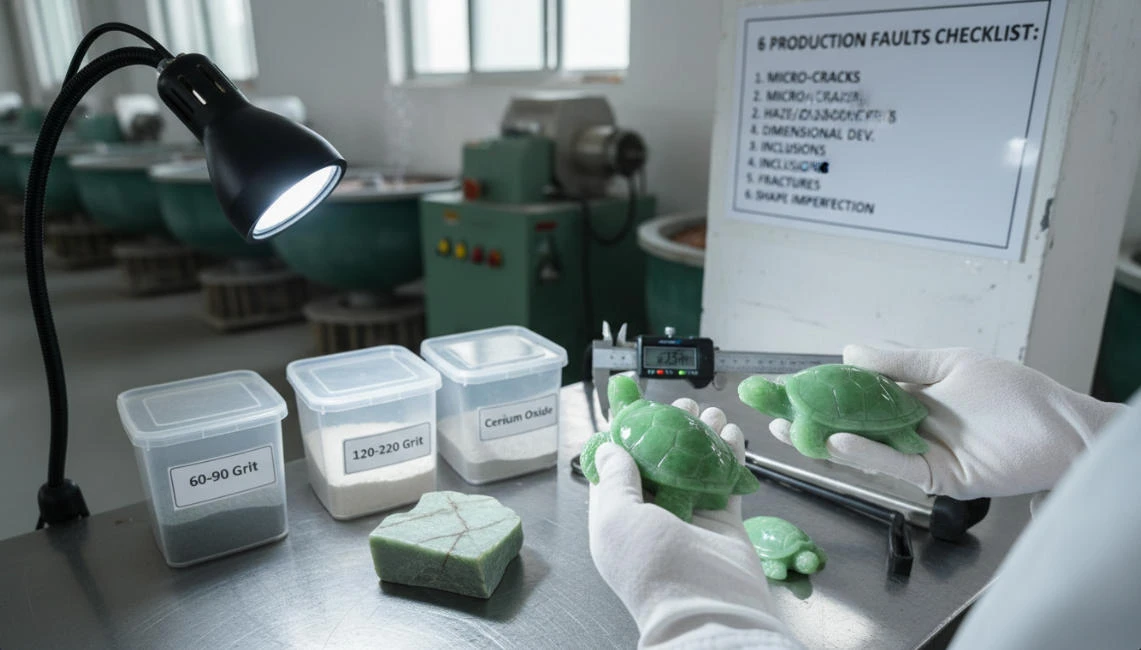
Yield loss in tumbling polish gemstone production is rarely random. Across high-volume jade polishing operations, the same six fault categories account for the overwhelming majority of preventable batch failures. What makes these faults particularly costly is not their individual impact — it is their compounding behavior. A hardness mismatch error in the loading stage does not simply damage a percentage of pieces in the current batch; it contaminates the abrasive media, introduces irregular particulate into the slurry, and degrades the surface quality of undamaged pieces sharing the drum. One upstream error propagates through every downstream stage. The International Gem Society’s production quality guidelines identify batch contamination from mixed-material loading as among the most common sources of quality inconsistency in mechanical gem finishing. Understanding these six fault patterns — their root causes, their failure signatures, and their corrective protocols — is a prerequisite to building a jade process that delivers predictable yield across production runs.
1 — Hardness Mismatch
Hardness mismatch is the single most mechanically destructive loading error in tumbling polish gemstone practice. When stones of significantly different Mohs hardness values share a drum, harder stones act as unintended grinding media against softer stones, removing surface material at a rate entirely uncorrelated with the intended abrasive stage. A jadeite piece at Mohs 6.5–7 sharing a coarse grinding drum with a nephrite pendant at Mohs 6 will produce measurable surface damage on the nephrite within the first four hours of operation — damage indistinguishable in character from coarse-grit abrasion marks and therefore difficult to diagnose without a loading record.
The manufacturing solution is non-negotiable: sort all incoming raw material by Mohs hardness before any batch is assembled, and establish a hard rule that stones with a hardness differential greater than 1.5 Mohs units do not share a drum at any stage. This requires a physical labeling and segregation system at the raw material intake point — not a verbal instruction to operators. Professional jade polishing facilities assign every material type a hardness classification record at intake, and batch assembly is cross-referenced against that record before loading proceeds. You eliminate the most destructive single variable in your yield before the machine is ever switched on, and your per-batch breakage rate drops in direct proportion to the consistency of your sorting discipline.
2 — Timing Deviation
Time control in tumbling polish gemstone operations has two distinct failure modes, and they produce opposite types of damage. Under-timing — running any stage short of its minimum threshold — leaves a residual scratch pattern from the current stage’s grit size that the subsequent stage’s media cannot remove. The batch appears to progress normally through later stages, but the sub-surface scratch structure remains intact and re-emerges during final polishing as haze, reduced gloss depth, or irregular reflectance patches. By the time this failure is visible, the batch has consumed the full run time of every subsequent stage — meaning the time loss from a single under-timed early stage cascades into a total workflow loss of 30–72 hours depending on which stage the error originated.
Over-timing produces a different category of damage that is in some ways more severe: irreversible dimensional change. Unlike surface haze, which might theoretically be addressed by returning to a previous stage, material that has been ground away cannot be restored. For sold-by-weight inventory, a dimensional loss of 0.4mm on a 12mm bead represents approximately 9% weight reduction — a direct pricing impact that compounds across every piece in the batch. For setting-dependent pieces such as cabochons or calibrated ovals, dimensional deviation beyond 0.3mm typically renders the piece non-conforming for its intended application. Your timing protocol must therefore include mandatory mid-cycle inspection points at defined intervals — not simply a timer that stops the machine — and operators must be trained to make go/no-go decisions based on surface inspection data rather than elapsed time alone.
3 — Water-to-Grit Ratio Deviation
Water-to-grit ratio is among the least visible variables in tumbling polish gemstone operations and among the most consequential. The slurry that forms inside the drum — a combination of water, abrasive media, stone surface particulate, and dissolved mineral content from the stones themselves — determines how efficiently abrasive particles contact and remove material from stone surfaces. When water volume is too high, abrasive particles are suspended in a dilute medium, inter-particle spacing increases, and the effective contact force between abrasive and stone surface drops measurably. A stage that should complete in 10 hours may require 14–16 hours to reach the same surface threshold — disrupting the entire production schedule downstream.
When water volume is too low, the slurry loses its lubricating and cushioning function, and stone surfaces come into direct high-energy contact with each other rather than interacting through the abrasive medium. At the coarse grinding stage, this produces chipping and fracture — particularly on thin-walled pieces or pieces with existing micro-fractures in the raw material. The industry-validated baseline ratio for jade surface finishing by tumbling is a stone load of approximately two-thirds drum capacity, with water added to the point where all stones are just submerged. In high-temperature production environments — where evaporation rates during a 10–12 hour coarse run can be significant — a water-level check at the four-to-six hour mark is standard operating procedure, not an optional inspection. Your water management protocol needs to be as formalized as your grit selection protocol, with documented baseline volumes and scheduled inspection intervals for every stage.
4 — Abrasive Contamination Between Stages
Abrasive contamination between stages is the fault type that most consistently produces diagnostic confusion on the production floor. When a batch transitions from coarse to medium grinding with inadequate cleaning of either the stones or the drum, coarse-grit particles in the 60–90 grit size range carry through into the medium grinding slurry. Once present, these particles are approximately four times larger than the intended 120–220 grit media, producing scratch marks inconsistent with medium-stage abrasion depth. When operators inspect the batch after medium grinding and find anomalous deep scratches, the standard incorrect diagnosis is that the medium stage was under-run. The batch is re-run through medium grinding — which accomplishes nothing, because the contaminating particles remain in the slurry and the actual source of the defect goes unaddressed.
The corrective protocol requires procedural enforcement rather than operator discretion. After every stage, stones must be rinsed under running water for a minimum of two complete rinse cycles with physical agitation, dislodging particles from surface texture and crevices. The drum must be wiped down and visually inspected for grit residue before the next stage’s media is loaded. Abrasive media for different stages should be stored in clearly labeled, physically separate containers to prevent cross-contamination during loading. In professional jade process operations, inter-stage cleaning is treated as a quality checkpoint with a documented inspection record — not as a transition step that can be abbreviated under production schedule pressure. The four minutes spent on thorough inter-stage cleaning protects the full economic value of the 6–24 hours of processing time that precede and follow it.
5 — Internal Fractures in Raw Material
Internal fractures in raw material represent a fault category that originates before the tumbling polish gemstone process begins — but its consequences are felt most destructively at the coarse grinding stage. Stones with existing micro-fractures or hairline cracks absorb vibration energy differently from structurally sound stones. Under the sustained mechanical stress of a 10–12 hour coarse grinding cycle, crack propagation is not a risk — it is a near-certainty. When a fractured stone breaks mid-cycle, fracture debris — sharp-edged fragments ranging from 2mm chips to larger shards — becomes part of the drum contents and acts as uncontrolled abrasive against all surrounding pieces for the remainder of the cycle. A single fractured stone in a 200-piece batch can damage 15–30 surrounding pieces before the cycle ends, converting a minor raw material loss into a significant batch-level yield event.
Pre-screening protocol for fracture detection should be mandatory before any stone enters the production workflow. Strong transmitted light inspection — holding each piece against a focused light source to identify internal fracture planes — detects the majority of hairline cracks invisible under ambient light. Acoustic inspection — lightly tapping each piece with a metal tool and listening for a dull rather than clear ring — identifies structural discontinuities that transmitted light misses. The GIA’s gemological assessment guidelines note that fracture identification prior to mechanical processing is the single most effective intervention for reducing processing-stage breakage rates. The labor cost of a systematic pre-screening protocol — typically 8–12 minutes per 100 pieces — is recovered within the first batch cycle where a cascade fracture event is prevented.
6 — Batch Size Grading Failure
Size grading failure is the fault type that most directly affects the economics of high-volume jade manufacturer operations, because its damage is distributed across an entire batch as differential surface finish quality rather than concentrated in individual piece breakage. When stones of significantly different sizes share a drum, larger, heavier stones carry more kinetic energy through each vibration cycle and deliver proportionally higher impact force to smaller pieces they contact. The result is a batch where large pieces reach their target surface finish within the specified time window while small pieces are simultaneously over-processed — showing dimensional loss and surface irregularity from the disproportionate mechanical energy they have absorbed.
The manufacturing solution requires a two-dimensional sorting protocol: size grading and hardness grading must both be applied before batch assembly. The operational guideline used in professional jade polishing facilities is that the largest and smallest pieces within a single drum load should not differ in their largest dimension by more than 50%. Tighter size banding of ±20–25% produces measurably more consistent surface finish outcomes in practice. Implementing strict size grading increases batch assembly time by approximately 10–15% per production cycle — however, the reduction in rework and reprocessing that results typically returns a net time saving of 20–30% over a monthly production horizon, because rework cycles consume disproportionate machine time relative to the number of pieces they correct. Your investment in size grading discipline at the loading stage pays dividends at every downstream stage of your tumbling polish gemstone workflow.
4 Operational Controls That Stabilize Tumbling Polish Gemstone Yield Across Every Production Run
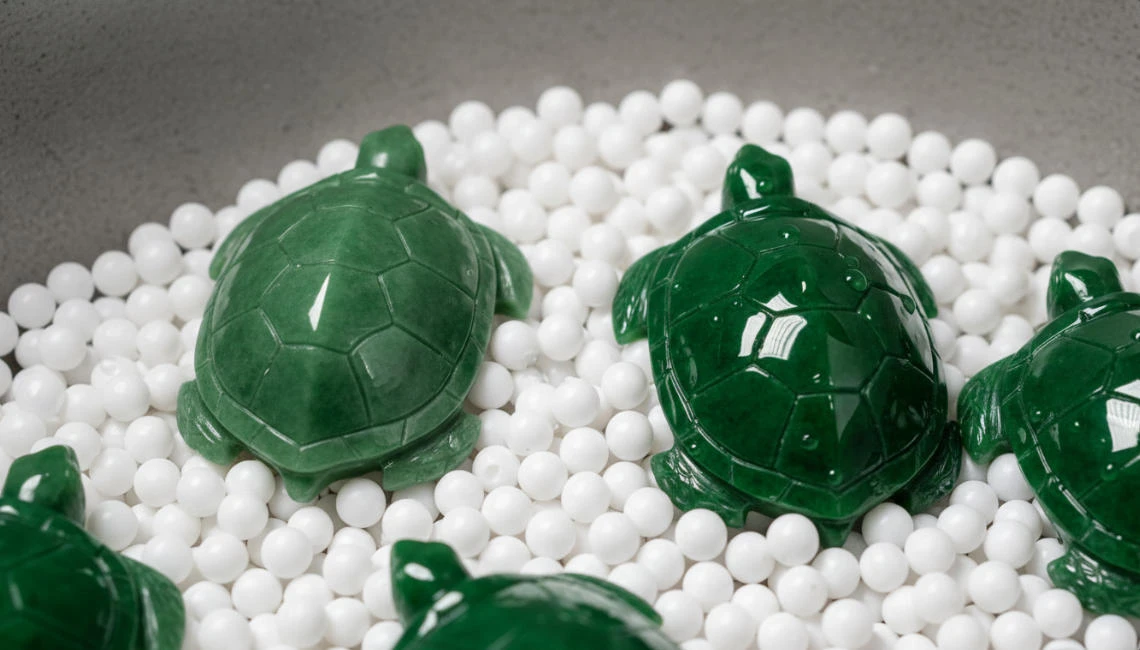
Fault prevention in tumbling polish gemstone production is not achieved through individual corrective actions applied after problems emerge — it is built into the workflow as a set of systematic operational controls functioning continuously across every batch cycle. The six fault categories in the previous section share a common characteristic: each one is detectable before it causes measurable damage, provided the right inspection and documentation systems are in place. What separates a jade manufacturer operating at 85–92% batch yield from one operating at 60–70% batch yield is rarely equipment quality or raw material sourcing — it is the consistency and formalization of these four operational controls applied at every stage of the jade process. According to production quality research published by the International Gem Society, the majority of yield losses in mechanical gem finishing are attributable to process control gaps rather than inherent material or equipment limitations.
1 — Pre-Run Raw Material Inspection
Pre-run raw material inspection is the operational control with the highest leverage-to-effort ratio in the entire tumbling polish gemstone workflow. Every piece of raw material that enters the production system without inspection carries an unknown probability of causing a batch-level failure event — fracture cascade, hardness mismatch damage, or size grading inconsistency — and that probability is not eliminated by downstream processing controls. It simply waits for the mechanical stress of the grinding cycle to convert it from a latent risk into an active yield loss. A structured pre-run inspection protocol transforms that unknown probability into a managed variable.
The inspection sequence for each incoming batch should cover three assessment dimensions. Structural integrity is assessed first: transmitted light inspection and acoustic tap testing for internal fractures, as described in the fault analysis section. Hardness classification follows: every material type entering the system should be assigned a documented Mohs hardness range at intake, with pieces of unknown classification tested using a standardized hardness reference set before batch assignment. Size and geometry assessment completes the sequence: pieces are measured and grouped into size bands before batch assembly, with any pieces falling outside the target band set aside for a separate run. This three-dimensional inspection protocol adds approximately 10–15 minutes to the preparation time for every 100-piece batch. Preventing a single cascade fracture event — which typically damages 15–30 pieces beyond the fractured piece itself — recovers that inspection time investment across approximately 8–12 batch cycles in a single incident.
2 — Inter-Stage Cleaning SOP
Inter-stage cleaning is the operational control most frequently abbreviated under production schedule pressure — and that abbreviation pattern is directly traceable in yield data as anomalous surface defects appearing in medium and fine grinding outputs. The economic logic that appears to justify shortening inter-stage cleaning — saving 3–5 minutes of transition time — consistently produces the opposite result: abrasive contamination events that require partial or full reprocessing of the affected stage, consuming 6–24 hours of machine time to correct a 4-minute omission. In jade polishing operations running multiple drums simultaneously, a single contamination event per week represents a measurable drag on total facility output that compounds across an entire monthly production cycle.
The standard inter-stage cleaning protocol covers three sequential steps. Stones are rinsed under running water with manual agitation for a minimum of two complete cycles, removing surface-adhered abrasive particles from the completed stage. The drum interior is wiped with a damp cloth and inspected visually for residual grit before the next stage’s media is loaded — a step that takes under 60 seconds but eliminates the most direct contamination pathway. Fresh media for the next stage is loaded from a clearly labeled, stage-specific storage container — using shared or unlabeled containers introduces a procedural contamination risk that is entirely preventable. Formalizing this protocol in a written SOP with operator sign-off at each stage transition converts inter-stage cleaning from a discretionary step into an auditable quality checkpoint, protecting your jade surface finishing consistency regardless of who is running the equipment on any given shift.
3 — Soft Media Buffering Protocol
Soft buffering media in the final polishing stage addresses a mechanical reality that polishing compound selection alone cannot resolve: in a drum containing only stones and polishing slurry, every vibration cycle produces direct stone-to-stone contact events, and those contact events generate micro-scratches on surfaces being simultaneously polished. The net result is a polishing stage working against itself — compound removing micro-scratches while stone contact generates new ones — and the equilibrium point of that dynamic is a surface finish level significantly below what the polishing compound is capable of delivering when stone separation is maintained.
Ceramic tumbling pellets are the preferred buffering media for hard stone jade polishing applications. Their hardness — typically in the range of Mohs 6–7 — resists abrasion from jadeite contact without generating contaminating debris, while their smooth surface geometry distributes impact energy rather than concentrating it. The operational loading ratio producing consistent results across hard stone polishing applications is one part ceramic pellets to two parts stone by volume, loaded simultaneously with the polishing compound charge. Walnut shell media, while effective for softer ornamental stones, degrades progressively over extended polishing cycles for jadeite applications, generating organic particulate that interferes with polishing slurry chemistry. Your buffering media selection is a material-specific technical decision affecting both output quality and per-batch consumable cost structure — it warrants the same deliberate analysis you apply to compound selection.
4 — Production Cycle Scheduling
The complete tumbling polish gemstone cycle spans 56 to 92 hours of active machine time across four stages, representing a 3–7 day elapsed production timeline depending on material type and target surface specification. For a single-drum operation, this timeline means the drum is committed to one batch for the majority of the production week, leaving minimal flexibility for priority orders or rush processing. For multi-drum operations, the challenge shifts to scheduling: how to stagger batch starts across drums to ensure continuous output flow rather than synchronized completion peaks that overwhelm downstream inspection and packaging capacity.
The staggered-start scheduling model assigns each drum a start offset of one stage duration relative to the previous drum. In a three-drum facility, drum one starts coarse grinding on day one, drum two on day two, and drum three on day three — producing a cadence where one drum completes its final polishing stage and becomes available for unloading, inspection, and reloading every day, rather than all three completing simultaneously at the end of day seven. This scheduling model increases effective facility throughput by 40–60% relative to synchronized batch operation without any additional equipment investment. Coupling this approach with a production logging system — recording stage start times, inspection outcomes, and completion timestamps for every batch — gives production management the data visibility needed to optimize drum allocation dynamically as material mix and order priorities shift. Your scheduling discipline is a throughput multiplier that operates independently of your equipment capacity, and its returns scale proportionally with the number of drums in your facility.
Tumbling Polish vs. Manual Polishing — Process Selection Logic for Jade Manufacturers
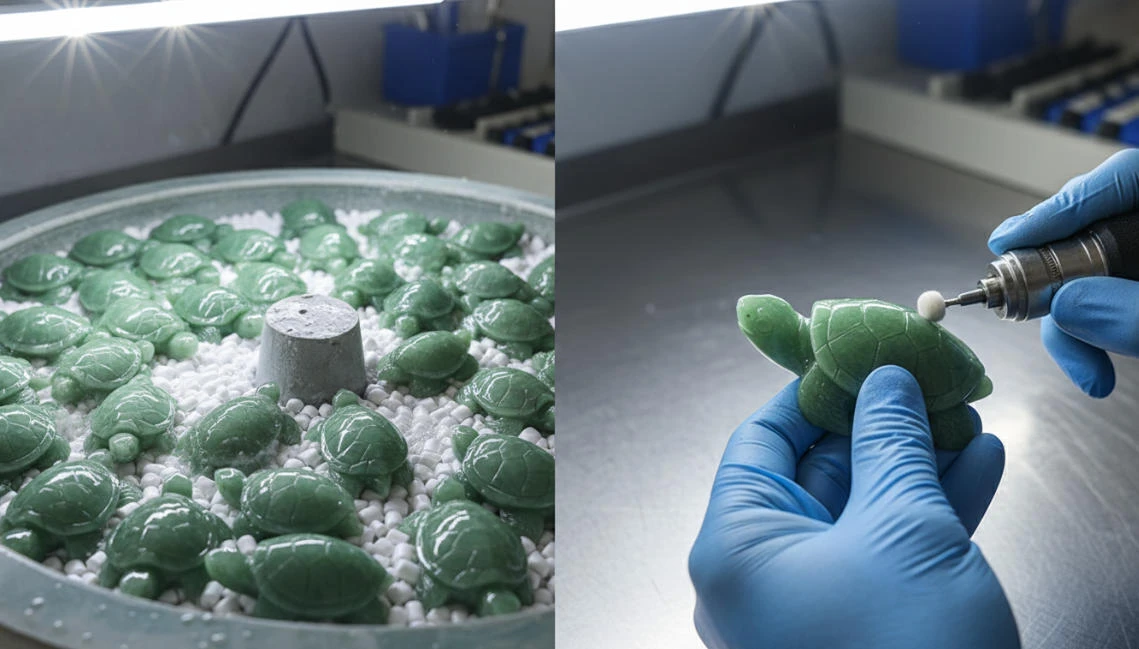
Choosing between tumbling polish gemstone processing and manual jade polishing is not a quality judgment — it is a production engineering decision that depends on batch volume, product geometry, value tier, and cost structure. Both processes produce commercially acceptable jade surface finishing outcomes within their appropriate application ranges, and both produce suboptimal outcomes when applied outside those ranges. The critical operational error is not choosing the wrong process in isolation — it is applying a volume-optimized process to a geometry or value profile requiring precision-optimized handling, or applying a precision process to a volume application where its cost structure makes it economically non-viable.
When Tumbling Polish Gemstone Processing Delivers Maximum ROI
Tumbling polish gemstone processing reaches its maximum economic efficiency at batch volumes of 200 units or above for standard geometries — rounds, ovals, free-form tumbled shapes, and calibrated cabochons within a defined size band. At these volumes, the labor cost per piece drops to a level that manual polishing cannot approach: a skilled jade polishing artisan working at full productivity finishes approximately 8–15 pieces per hour depending on complexity, while a single tumbling drum running a 200-piece batch of 12mm rounds requires approximately 3–4 hours of active operator time across a 60–90 hour total cycle — yielding an effective labor cost per piece that is 85–92% lower than manual processing at equivalent volume. For jade manufacturers running standardized product lines at consistent volumes, this cost differential is the defining economic argument for mechanical processing.
The geometry boundaries for tumbling polish optimization are equally important to understand. Standard rounded and oval geometries tumble efficiently because their curved surfaces present consistent contact geometry to abrasive media throughout the cycle. Flat-faced pieces, sharply faceted forms, and pieces with deep surface carving or relief work present inconsistent contact geometry — recessed areas receive significantly less abrasive contact than exposed surfaces, producing differential surface finish visible as gloss inconsistency between face planes. For these geometry types, tumbling can be used for bulk material removal in early grinding stages, but final jade surface finishing typically requires manual intervention to achieve consistent results across all surface planes.
When Manual Jade Polishing Remains the Technically Correct Choice
Manual jade polishing retains a clear technical advantage in three specific production scenarios that volume-optimized mechanical processing cannot address effectively. High-value individual pieces — collector-grade jadeite carvings, imperial green cabochons, and museum-quality sculptural forms — require surface finishing precision that mechanical batch processing cannot guarantee, because the value concentration in a single piece makes any batch-level quality variance economically unacceptable. A 0.3mm dimensional deviation that is commercially manageable across a batch of 200 standard beads is a significant quality failure on a single high-value carving where dimensional fidelity is part of the artistic specification.
Complex relief carving and deep intaglio work represent the second scenario where manual finishing is technically necessary. The recessed geometry of carved surfaces creates abrasive shadow zones in a tumbling drum — areas where media contact is physically blocked by surrounding stone geometry — and those shadow zones will not reach target surface finish regardless of run time or compound selection. Manual polishing tools — felt bobs, split laps, and point-tipped polishing attachments — access these recessed geometries directly, applying compound with controlled pressure and angle that no bulk mechanical process can replicate. The third scenario is small-batch custom production: orders of fewer than 20–30 pieces of a given specification, where the setup time, media cost, and cleaning overhead of a drum cycle represent a disproportionate cost per piece relative to manual processing time. For these application profiles, jade surface finishing by hand remains the economically and technically correct choice.
Hybrid Process Routing — Combining Both Methods to Maximize Output Quality and Production Efficiency
The most operationally sophisticated approach to jade polishing production is a structured hybrid routing system that assigns each product to the processing method most suited to its geometry, volume, and value profile — not a binary choice between tumbling and manual processing. This routing decision is best made at the order intake stage, where each product specification is assessed against a standardized routing matrix cross-referencing geometry type, batch quantity, target surface specification, and value tier. Standard geometries at volume route directly to the tumbling polish gemstone workflow. Complex geometries, high-value singles, and small-batch custom orders route to manual processing. Pieces benefiting from both — such as carved pendants requiring bulk material removal before detail finishing — are assigned split routing: tumbling through coarse and medium grinding for efficient bulk processing, then transferred to manual finishing for fine grinding and final polishing of carved surfaces.
Industry data from professional jade process operations running hybrid routing systems shows that hybrid-routed pieces achieve final surface specification conformance at a rate approximately 18% higher than pieces processed exclusively through mechanical tumbling, while consuming approximately 35% less manual labor time than pieces processed exclusively by hand. The economic logic is straightforward — each method performs the work it is most efficient at, and neither method is applied to a task profile where its limitations become the binding constraint on output quality. Your process routing decision, when structured correctly, is not a compromise between quality and efficiency — it is the mechanism through which you achieve both simultaneously.
The Process Knowledge Behind Consistent Tumbling Polish Gemstone Results
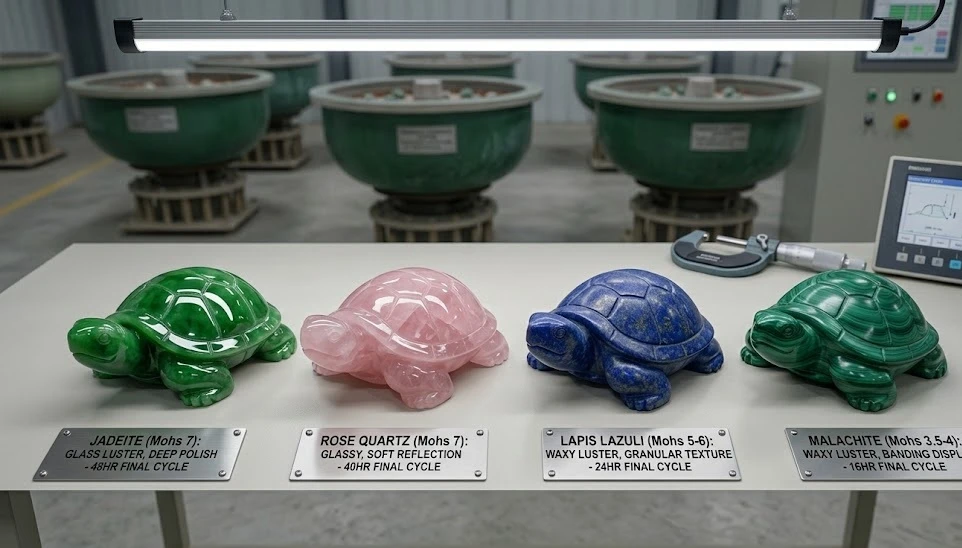
There is a specific category of production knowledge that does not transfer through equipment manuals, training courses, or supplier technical documentation — the kind that only accumulates through direct observation of how a given material behaves under mechanical stress across thousands of batch cycles, across dozens of material variants, and across the full range of seasonal and environmental variables that affect slurry chemistry, evaporation rates, and equipment performance. This is the category of knowledge that determines whether a jade manufacturer can consistently deliver 90%+ batch yield on a complex material like imperial jadeite, or whether yield on that material stays in the 65–75% range regardless of equipment investment.
The Gemmological Association of Great Britain (Gem-A) notes that jade — particularly jadeite — presents a uniquely demanding combination of physical properties for mechanical surface finishing: high hardness, interlocking crystalline microstructure, and significant natural variation in density and internal stress distribution between individual stones, even within a single geological source. These properties mean that jade polishing parameters that work reliably on a batch of nephrite from one source may produce inconsistent results on jadeite from a different deposit, even when Mohs hardness values are nominally similar. Developing reliable, source-specific process parameters for these material variations requires exposure to a volume of material that most production operations will not process in a decade of standard output.
Source Manufacturer Advantage
The structural advantage of working with a source jade manufacturer — as opposed to a processing intermediary sourcing finished or semi-finished material from multiple upstream suppliers — is direct, measurable control over every variable affecting output quality. When raw material is sourced, evaluated, and processed within a single production system, the feedback loop between raw material quality data and processing parameter adjustment is immediate. If a new raw material batch shows elevated internal fracture density during pre-screening, coarse grinding time ceiling and load volume can be adjusted before the first drum cycle runs — rather than after the first batch has produced a cascade fracture event. If a material variant shows unexpected resistance to fine grinding media, run time can be extended and slurry concentration adjusted based on real-time inspection data.
This integrated control structure covers the complete jade process chain: raw material procurement and geological sourcing assessment, pre-processing quality classification, tumbling polish gemstone parameter assignment by material type and product specification, inter-stage quality inspection, final surface specification verification, and post-processing dimensional and gloss measurement. Each stage produces documented data that feeds back into the material classification database and refines process parameters for subsequent batches of the same material type. The result is a jade surface finishing consistency rate — defined as the percentage of pieces in a batch meeting target surface specification without rework — that non-integrated processing chains structurally cannot match, because they lack the feedback velocity needed to correct parameter drift before it accumulates into batch-level yield loss.
How Production Documentation Reduces Your Supply Chain Risk in Jade Polishing Sourcing
Supply chain risk in jade and gemstone sourcing is not primarily a logistics problem — it is a quality consistency problem. The question that matters for buyers, brand specifiers, and production planners is not whether pieces will arrive on time, but whether the pieces that arrive will conform to specification consistently enough to be used without individual inspection of every unit. For high-volume applications — jewelry production lines, retail assortments, wholesale distribution — individual piece inspection at the receiving end is economically prohibitive and operationally impractical. The alternative is supplier qualification: establishing that a given jade manufacturer‘s production system delivers specification-conformant output at a consistency rate high enough that statistical sampling at receiving is sufficient quality assurance.
Batch-level quality records for every production run — including raw material classification data, process parameter logs for each stage, mid-cycle inspection outcomes, and final specification measurement results for surface gloss, dimensional conformance, and visual quality grade — provide the audit trail needed to verify process consistency across multiple order cycles without conducting on-site facility inspections. According to quality assurance frameworks published by the Swiss Gemmological Institute SSEF, traceable production documentation is increasingly recognized as a fundamental component of responsible gemstone supply chain management. Your supply chain due diligence process is strongest when it is supported by verifiable production data rather than manufacturer assertions — and the presence or absence of that documentation is one of the clearest indicators of whether a supplier’s quality claims reflect an actual process control system or an aspirational sales position.
The Long-Term Economics of Sourcing From a Source Jade Manufacturer
The economic case for sourcing from a source jade manufacturer with a formalized jade process control system is most clearly visible not in unit price comparisons but in total supply chain cost accounting. A supplier offering a 12% lower unit price on tumbled jade beads but delivering a 15% non-conformance rate at receiving generates a net landed cost higher than a supplier whose unit price is at market rate but whose non-conformance rate is under 3% — because the cost of receiving inspection, piece-by-piece sorting, return logistics, and production schedule disruption attributable to non-conforming material typically exceeds the unit price savings by a factor of 2–4x on an annualized basis.
For jade polishing applications specifically, the non-conformance categories generating the highest downstream costs are surface finish inconsistency — pieces passing visual inspection individually but showing gloss variation when assembled into a matched set — and dimensional drift, where pieces fall within individual tolerance but show systematic size bias affecting setting compatibility or matched-set appearance. Both failure categories are directly traceable to tumbling polish gemstone process parameter management: surface finish inconsistency to polishing stage under-run or polishing compound quality variation, and dimensional drift to over-run at fine or coarse grinding stages. A jade manufacturer with a formalized process control system and documented batch records can identify, trace, and correct both failure categories within a single production cycle. Your choice of manufacturing partner is therefore a supply chain risk decision with a quantifiable economic impact — and the correct framework for making that decision is total cost of quality, not unit price comparison.
What You Can Apply to Your Tumbling Polish Gemstone Production System Starting Today
The tumbling polish gemstone process, executed with parameter discipline across all four stages and supported by the six fault prevention protocols described in this article, is capable of delivering batch yield rates above 90% on standard jade geometries at production volumes that manual jade polishing cannot approach economically. The operational controls — pre-run inspection, inter-stage cleaning, soft media buffering, and staggered scheduling — require no capital investment beyond the time needed to formalize them into written SOPs and train operators to execute them consistently. The process selection framework — routing standard volume geometries to tumbling and complex or high-value pieces to manual or hybrid processing — requires analytical discipline at the order intake stage but produces measurable improvements in both output quality and per-unit processing cost simultaneously.
What cannot be transferred through a process article — but what determines whether these protocols produce 90% yield or 75% yield in your specific production environment — is the material-specific parameter calibration that comes from extended production experience with the exact materials, equipment configurations, and environmental conditions in your facility. The parameters cited throughout this article represent industry-validated ranges cross-referenced against published guidelines from the International Gem Society and GIA. Your specific optimal parameters within those ranges will be determined by your first 20–30 batch cycles with systematic documentation — provided you begin with the correct range boundaries and the inspection protocols to recognize when you are within them.
The jade process knowledge embedded in this article represents a starting framework. Your production data, collected with the documentation discipline described here, converts that framework into a facility-specific process standard. And that standard — built on validated parameters, documented inspection outcomes, and continuously refined material classification data — is what separates a jade manufacturer operating at sustainable scale from one managing quality problems reactively, one batch at a time. If you are building or refining a jade polishing production system and want to benchmark your parameters against established production standards, or evaluate source manufacturing partnerships for jade surface finishing at volume, JADEMAGO is available to discuss your specific production requirements and the process documentation that supports them.
Faqs About Tumbling Polish Gemstone
1. How long does a complete tumbling polish gemstone cycle take?
A full tumbling polish gemstone cycle runs 56–92 hours across four stages: coarse grinding (8–12 hrs), medium grinding (6–8 hrs), fine grinding (18–24 hrs), and final polishing (24–48 hrs) — totaling 3–7 days per batch. Facilities running multiple drums can eliminate the full-week wait by staggering batch starts across drums, increasing throughput by 40–60% without additional equipment investment.
2. Can different jade and gemstone types be tumbled in the same batch?
No. Stones with a Mohs hardness differential greater than 1.5 units should never share a drum — harder stones act as unintended grinding media against softer ones, producing surface damage that no downstream stage can correct. Always sort incoming material by both hardness and size before batch assembly. These are non-negotiable separation criteria, not loose guidelines.
3. Why does my final polishing stage produce inconsistent gloss even after full run time?
Inconsistent gloss after a complete polishing cycle is almost always an upstream problem, not a polishing stage failure. Scratch patterns left by insufficient fine grinding re-emerge as surface haze after polishing because compound cannot remove the material volume that grinding stages are designed to address. Inspect a sample under 10x magnification before extending run time — if fine-stage scratch lines are present, the batch needs to return to fine grinding. More polishing time will plateau with no further improvement.