In the global jade trade, jade wholesale risks carry a financial impact that buyers typically measure only after losses have already accumulated. According to the Gemological Institute of America (GIA), material fraud in jade — encompassing dyeing, resin filling, synthetic substitution, and outright material replacement — represents one of the most consistently documented sources of supply chain loss for wholesale buyers worldwide. A single fraudulent shipment substituting dyed glass for natural jadeite can generate direct buyer losses ranging from $50,000 to over $300,000 per transaction, before accounting for customer returns, inventory write-offs, and brand damage that compounds over time. The supplier absorbs none of that cost. Understanding how jade wholesale risks operate at the manufacturing level is not a theoretical exercise — it is a procurement prerequisite that determines whether your jade sourcing operation generates profit or absorbs predictable, preventable losses.
Table of Contents
Why Material Fraud Is the Core of Jade Wholesale Risks
Among all the variables that create jade wholesale risks, material fraud occupies a structurally distinct position. Currency exposure and logistics disruption are risks that unfold in real time — visible when they occur, with established resolution pathways. Material fraud is different. It enters your supply chain as a product, passes through your receiving inspection, moves into your retail channel, and surfaces only when your customers begin to notice degradation, discoloration, or abnormal weight. By that point, your financial losses are already locked in across multiple cost centers: the original purchase price, the cost of recall or product replacement, and the customer trust damage that a product authenticity failure generates.
The Cost Gap That Makes Jade Wholesale Risks Economically Persistent
The economic engine driving jade material fraud is a raw material cost differential that creates an incentive structure powerful enough to sustain the practice across multiple detection cycles. Natural jadeite of commercial grade is priced between $50 and $500 per kilogram at the raw stone stage, with high-color, high-transparency material reaching significantly higher valuations. Industrial glass, dyed quartzite, and synthetic resin compounds used in material substitution cost less than $2 to $5 per kilogram at manufacturing volume. That represents a cost compression ratio of 25x to 250x — a margin structure that allows a fraudulent supplier to price competitively, offer visible discounts, and still generate extraordinary profits on every shipment. Can your current receiving inspection reliably identify a substitution backed by an incentive this large? If the answer involves any uncertainty, your actual exposure to jade wholesale risks is higher than your procurement model currently accounts for.
What makes the situation more complex is that this cost differential creates budget for concealment, not just motivation for fraud. A supplier operating at 90% material cost reduction can invest in higher-quality dyeing processes, more sophisticated resin injection systems, and more convincing surface finishing — all specifically calibrated to defeat the inspection methods that buyers typically deploy. The International Gem Society (IGS) documents that many commercial jade treatment methods were developed iteratively in response to buyer inspection practices, not independent of them. The practical conclusion is direct: your existing inspection protocol may be a detection target that fraud has already been engineered to pass.
How Material Fraud Creates Jade Wholesale Risks Across the Supply Chain
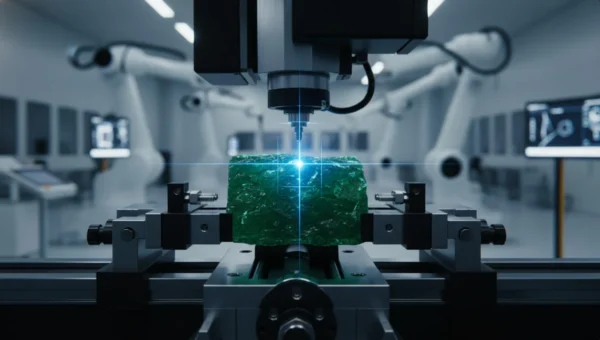
Material substitution is not introduced at the retail stage — it is embedded during the jade process at the manufacturing level, where cutting, treatment, and finishing decisions determine what is actually inside the product you receive. A dishonest supplier’s jade process may include dyeing baths, high-pressure polymer injection, surface sealing compounds, or adhesive-bonded assemblies — all applied before final polishing and all designed to present a visually coherent, commercially convincing finished product. By the time goods move through trading companies, export agents, and import consolidators, the jade process decisions are invisible, and multiple commercial layers separate you from the original material choices.
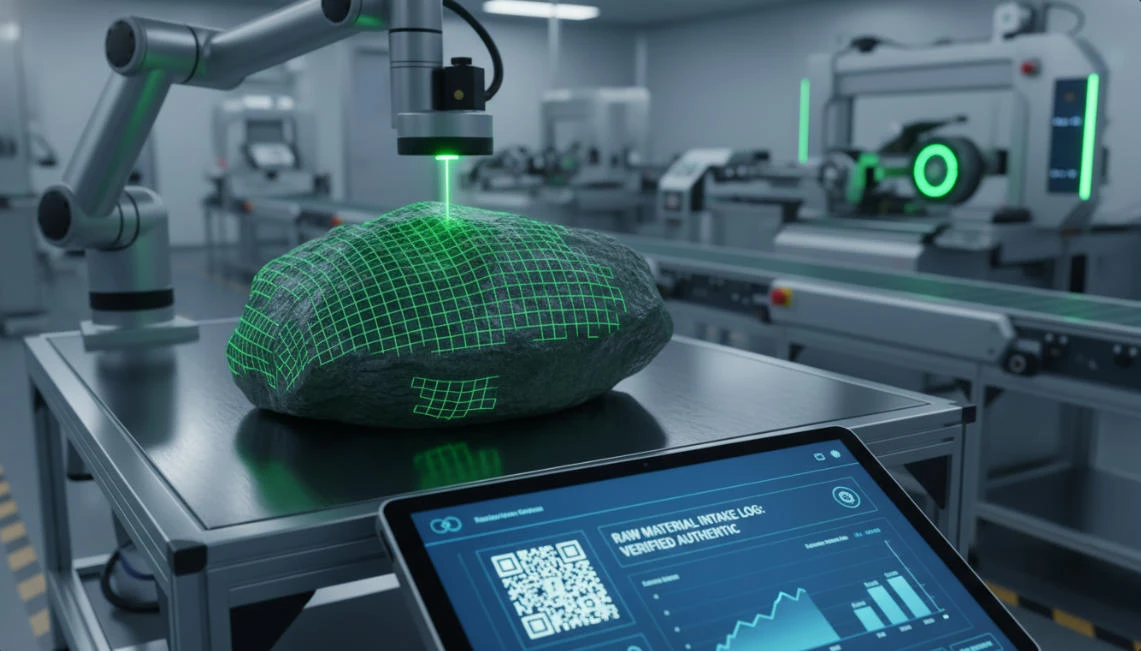
At JADEMAGO, raw material intake is logged against supplier documentation, and each stone batch is graded before entering the jade process production sequence. This creates a chain-of-custody record that connects the finished product back to its source material — a traceable structure that a jade manufacturer with documented operations can provide, and that a trading company structurally cannot. Working directly with a jade manufacturer that maintains raw material intake logs, production records, and treatment disclosure documentation moves your verification point to the earliest possible stage in the supply chain, where fraud prevention is operationally enforceable. This means you gain a procurement structure that makes jade wholesale risks visible before they become losses, rather than after.
5 Types of Jade Wholesale Risks: A Technical Breakdown by Manufacturing Method
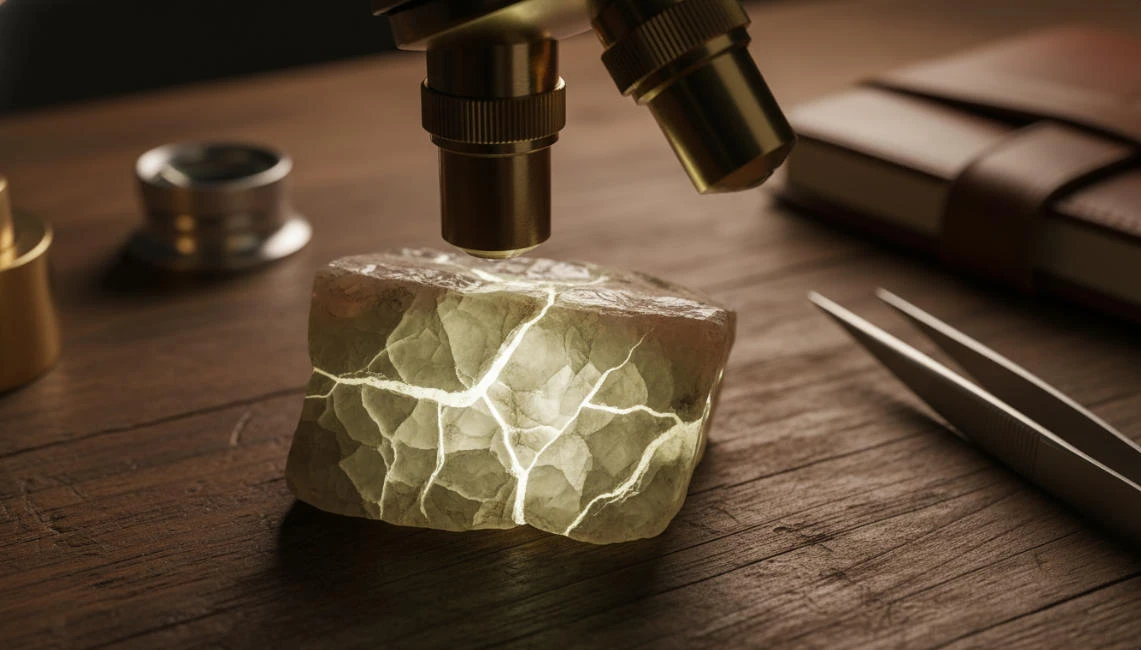
Understanding jade wholesale risks at the material level requires knowing how each fraud type is constructed, not just what it looks like from the outside. The following breakdown examines each fraud category from a manufacturing process perspective, because recognizing how fraud is made is the most reliable foundation for detecting it at the point of receipt.
1 — Dyed Jade: How Color Manipulation Creates Jade Wholesale Risks
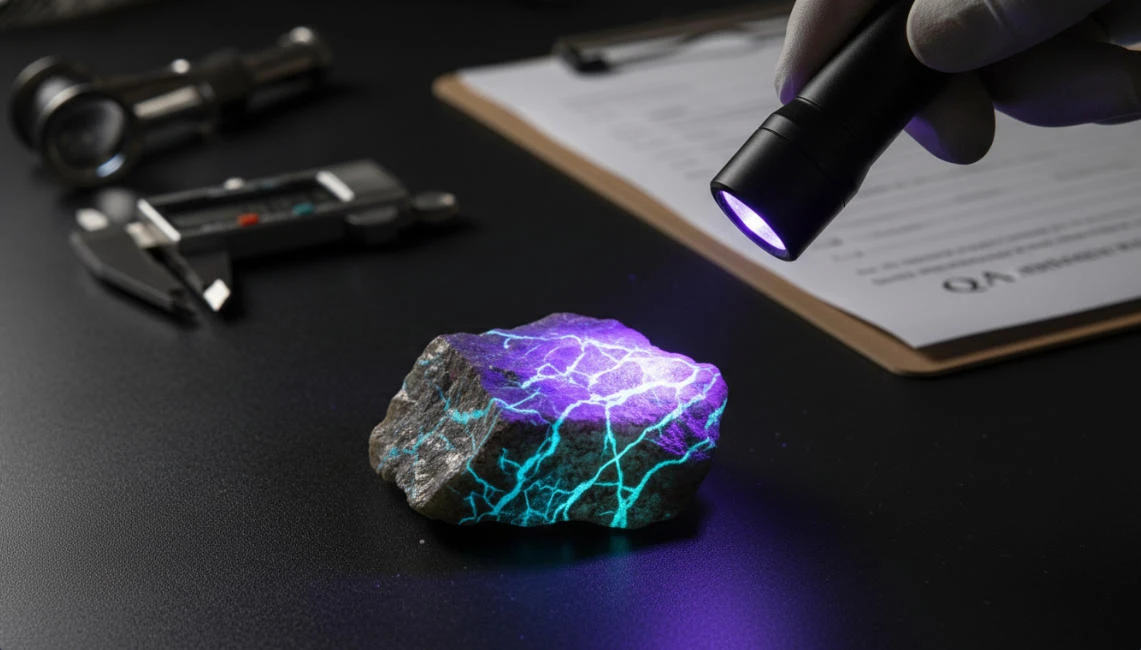
Dyed jade is the most economically accessible and most widely deployed form of material fraud in the jade wholesale market. The fraud targets low-grade jadeite, quartzite, white nephrite, and glass — materials with fractured or porous internal structures that allow dye penetration along crack networks and surface pores. By introducing color through the stone’s existing structural pathways, the treatment produces a visual effect that closely mimics the color saturation of natural jadeite’s characteristic green, lavender, or white tones, without altering the surface geometry of the finished product.
Three dyeing techniques are in active commercial use, distinguished by cost structure and the durability of the resulting color. Immersion dyeing submerges the stone in an organic or inorganic dye solution, allowing colorant to migrate along crack pathways by capillary action — the lowest-cost method, with the least durable result. High-temperature pressure dyeing uses elevated temperature and pressure to force dye deeper into the stone structure, producing more durable, visually convincing color penetration that resists surface abrasion. Surface spray or brush application treats only the exterior layer, requiring minimal equipment and generating the highest detection probability under careful inspection. As documented in GIA’s jadeite treatment research, color treatment in jadeite is a well-documented commercial practice with a decades-long history in the manufacturing sector, and remains one of the most frequently encountered treatments in commercially traded stones.
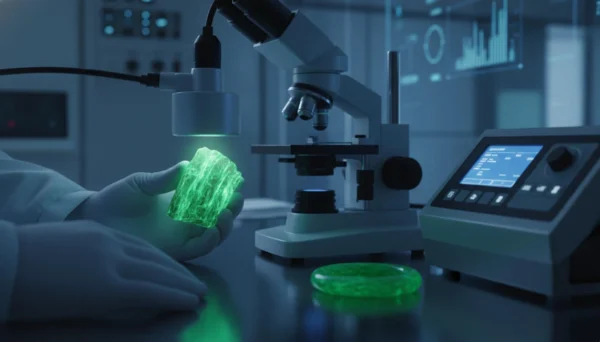
Naturally colored jadeite shows color distributed irregularly and gradationally — lighter and darker zones follow the mineral’s internal crystal growth patterns rather than appearing uniform across the surface. Dyed material frequently concentrates pigmentation along crack lines and structural boundaries, with color deepest at fracture networks rather than distributed through the body of the stone. Under long-wave UV illumination, synthetic organic dyes may produce a fluorescent response absent in most natural jadeite. This means you can deploy a portable UV lamp as a low-cost addition to your standard receiving inspection, flagging high-probability dyed stones for laboratory confirmation before accepting the shipment — a two-minute screening step that significantly narrows your exposure to this category of jade wholesale risks.
2 — Filled Jade: Concealing Structural Defects to Inflate Wholesale Value
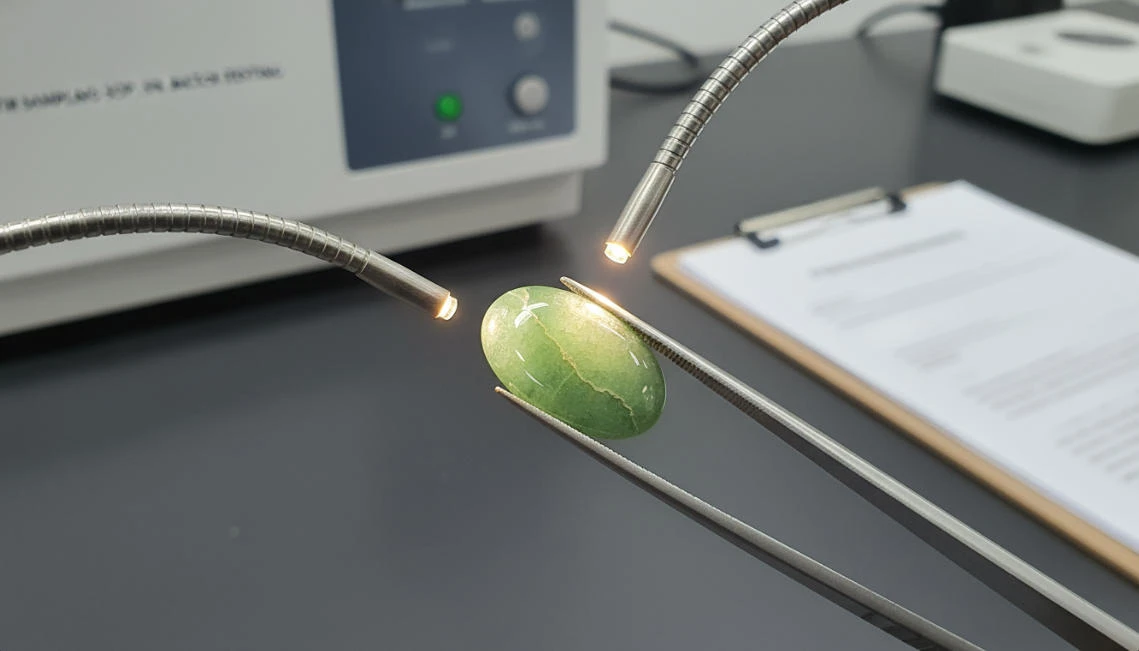
Resin filling targets stones with internal fracture networks — material that would be commercially unmarketable in its natural state due to structural compromise. By injecting polymer resin into the crack network, the treatment renders fractured material visually cohesive, improving its apparent transparency, surface quality, and marketable grade. In the gemological classification system for jadeite, this treatment category is designated “B-grade jade” — a status that requires explicit disclosure at every stage of the commercial transaction. In practice, undisclosed B-grade jadeite moves through jade wholesale channels at natural stone prices with consistent regularity, and represents one of the most financially damaging categories of jade wholesale risks for buyers who source without FTIR testing capability.
Two technical variants exist in commercial use. Standard resin injection introduces liquid polymer at ambient pressure, filling crack networks accessible from the stone’s surface and, in some applications, incorporating color concentrates to enhance visual effect simultaneously. High-pressure resin impregnation forces polymer deep into fine crack structures under elevated pressure, producing a thorough structural fill and a finished surface significantly harder to distinguish from natural material at the inspection stage. The SSEF Swiss Gemmological Institute has published documentation confirming that high-quality pressure-impregnated jadeite requires infrared spectroscopy (FTIR) to conclusively identify, because surface examination and UV inspection alone are insufficient to detect advanced treatment work at this quality level.
Crack edges in resin-filled material may show subtly uneven luster — a discontinuity between the polymer-filled zone and surrounding natural stone surface — but observing this reliably requires directed lighting and 10x to 20x magnification. If you are sourcing jadeite at commercial volumes, FTIR analysis on representative samples from each shipment provides the only conclusive evidence of resin treatment available below full laboratory analysis. This means you can implement a cost-proportionate sampling protocol — submitting five to ten percent of each order for FTIR testing — that reliably identifies B-grade fraud without requiring full-shipment laboratory analysis on every transaction.
3 — Synthetic and Lab-Created Jade: The Technically Advanced Jade Wholesale Risks
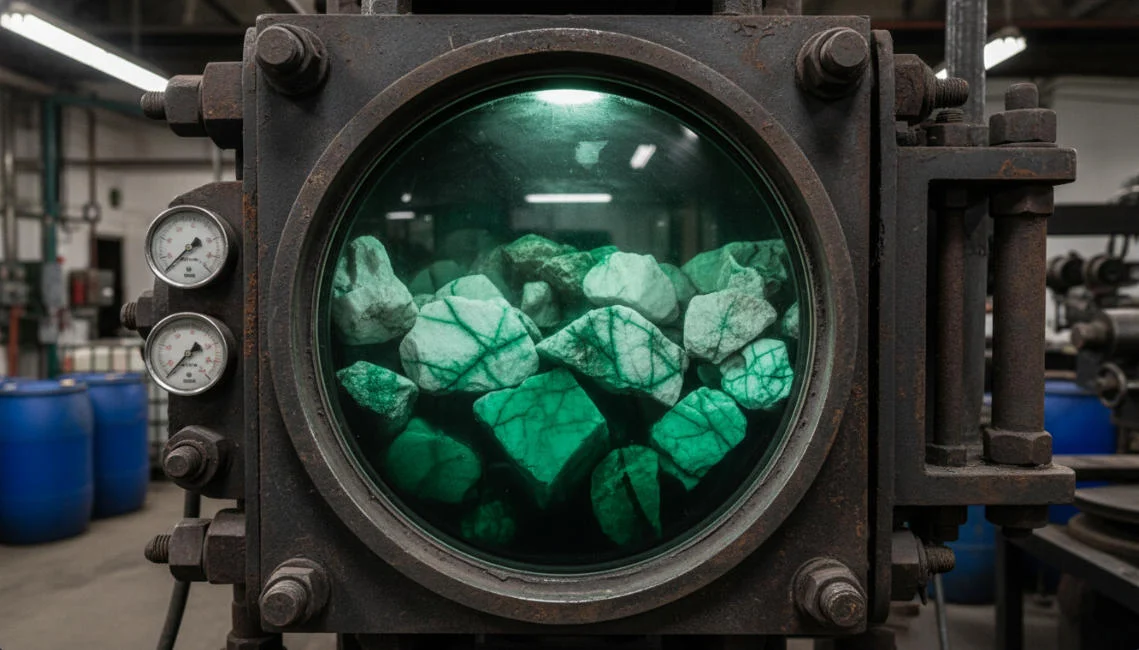
Synthetic jade represents the highest-complexity category of material fraud and the widest gap between visual inspection capability and actual detection requirement. Synthetic jadeite and synthetic nephrite are produced through laboratory processes that replicate the mineral composition and crystal structure of natural jade, using high-temperature high-pressure (HPHT) synthesis or hydrothermal growth methods analogous to those developed for synthetic diamond and synthetic corundum production. The resulting material is not a visual imitation — it is compositionally and crystallographically similar to natural jade, which is precisely what makes it undetectable through visual or simple physical testing.
Three primary manufacturing routes are in active use: HPHT crystal growth, which replicates geological pressure and temperature conditions; mineral particle compression and sintering, which bonds processed material into a coherent mass with jade-like density and surface characteristics; and hydrothermal synthesis, which grows crystals from a solution phase under controlled pressure and temperature. Each method produces material with different internal defect signatures, and each requires specific spectroscopic techniques to identify definitively. The GIA’s gemstone research program identifies spectroscopic analysis as the required authentication method for synthetic and treated jadeite, because surface-level testing cannot differentiate high-quality synthetic material from natural stone within acceptable confidence margins.
Synthetic jade can approximate natural jadeite’s refractive index range of 1.66 to 1.68, specific gravity of 3.30 to 3.38 g/cm³, and Mohs hardness of 6.5 to 7 — the three parameters most commonly applied in field testing — making those tests insufficient for definitive identification. Under microscopic examination, synthetic material currently shows crystal grain regularity consistent with controlled laboratory growth rather than the stochastic variation of natural geological formation, but this distinction diminishes as synthesis processes improve. This means you should establish a value threshold above which laboratory certification from GIA, NGTC, or SSEF is a non-negotiable condition of purchase — because this is the only authentication level that provides conclusive differentiation between natural and synthetic jade at current technology standards.
4 — Substitute Materials: When the Product Contains No Jade at All
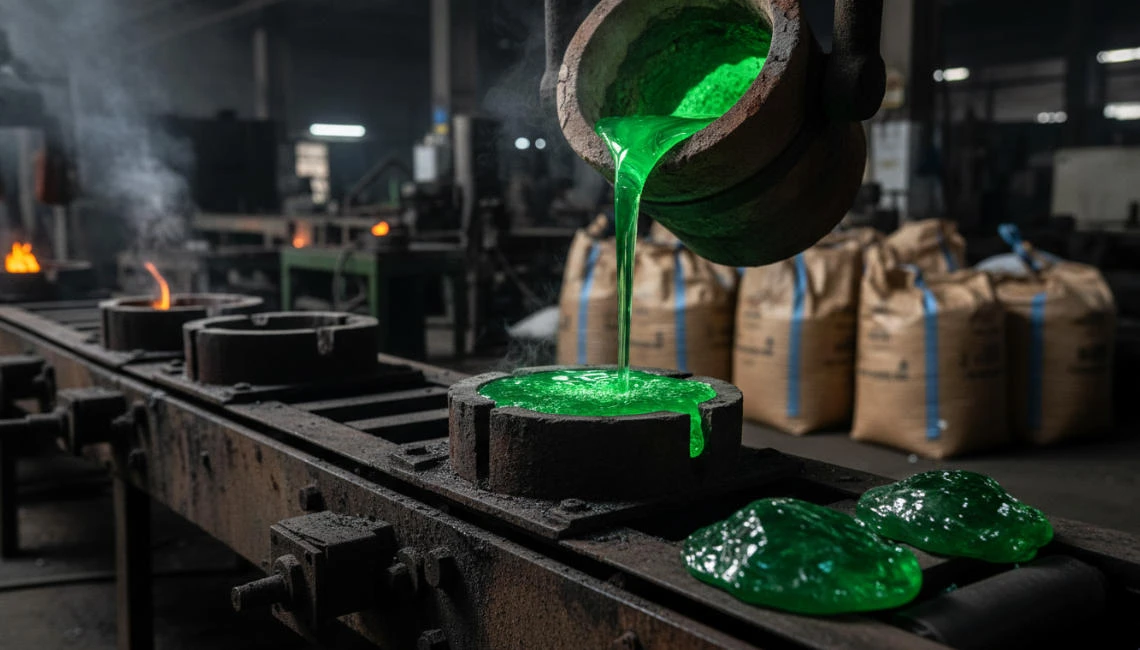
The most fundamental category of jade wholesale risks involves complete material substitution — replacing jade entirely with a non-jade material processed to replicate jade’s visual characteristics. Common substitutes include glass, plastic, resin compounds, quartzite, and serpentine, each selected for its combination of visual similarity, industrial availability, and production cost relative to the jade grade it is designed to mimic. Unlike dyeing or filling, which involve treating actual jade or jade-adjacent material, substitute fraud involves no jade content whatsoever in the finished product.
Glass is the most frequently encountered jadeite substitute, valued for its adjustable color, achievable transparency, and production cost below $2 per kilogram at industrial volume. Quartzite is commonly used to substitute nephrite, particularly in carved objects where texture and surface color can be engineered to convincing similarity under standard lighting. Serpentine, with its naturally greenish base color and moderate hardness, has served as a nephrite substitute commercially for decades and continues to enter jade wholesale supply chains at nephrite prices today. At JADEMAGO, material verification begins at the raw stone intake stage — before the jade process starts — because substitute fraud is most efficiently identified at the material assessment point, not after polishing has been completed and the product has been finished and packaged for shipping.
Detection of substitute materials is more accessible than detection of treatment fraud, because common substitutes deviate from natural jade on multiple measurable physical parameters simultaneously. Natural jadeite’s specific gravity of 3.30 to 3.38 g/cm³ is significantly higher than glass at approximately 2.50 g/cm³ and dramatically higher than most plastics at 1.10 to 1.40 g/cm³. Temperature response is equally diagnostic: natural jade conducts heat efficiently and maintains a cool sensation during extended hand contact, while glass equalizes within approximately fifteen seconds and plastic within five seconds or less. This means you can establish a weight-and-temperature rapid screening protocol that takes under sixty seconds per piece and identifies the majority of common substitute materials before any additional testing investment is committed.
5 — Composite and Spliced Jade: Assembling Low-Grade Material into Premium Appearance
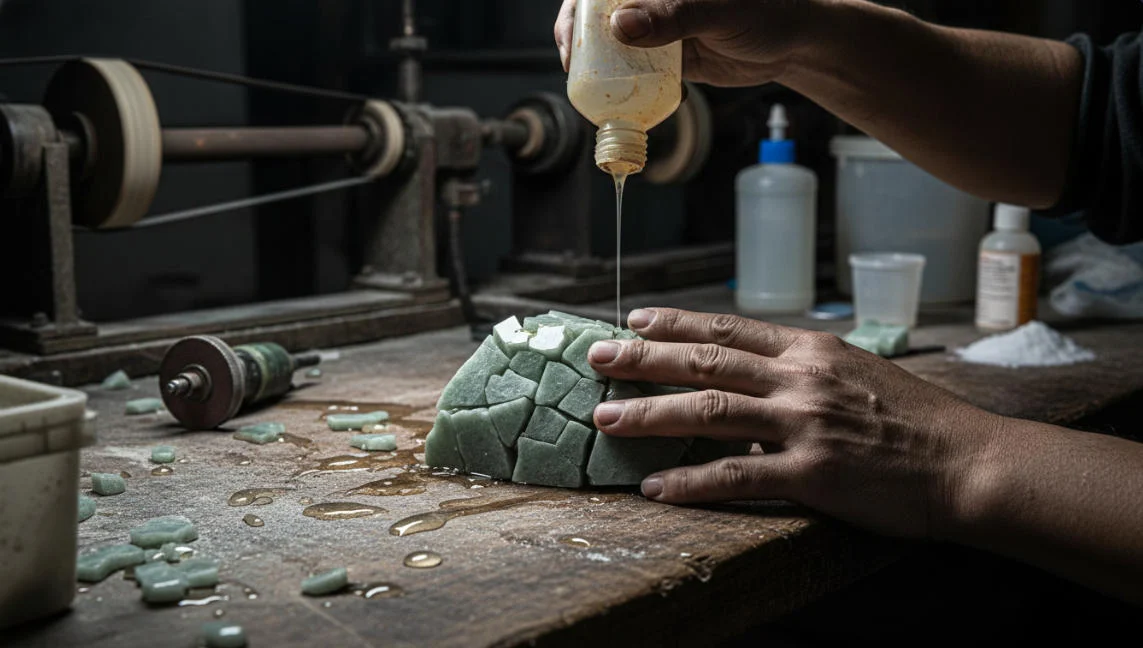
Composite jade fraud assembles fragments, offcuts, or low-grade stones using adhesives or resin to create an object that visually presents as a higher-grade, structurally intact piece. The economic logic is straightforward: jade raw material is priced partly by structural integrity and unbroken size, so assembling smaller pieces of acceptable-quality material into a larger composite form achieves the appearance of a premium piece at a substantially lower raw material cost. The risk this creates for buyers extends beyond the initial transaction, because composite assemblies are structurally weaker than intact natural stones — significantly more prone to failure under thermal stress, mechanical impact, and moisture exposure throughout the product’s commercial lifecycle.
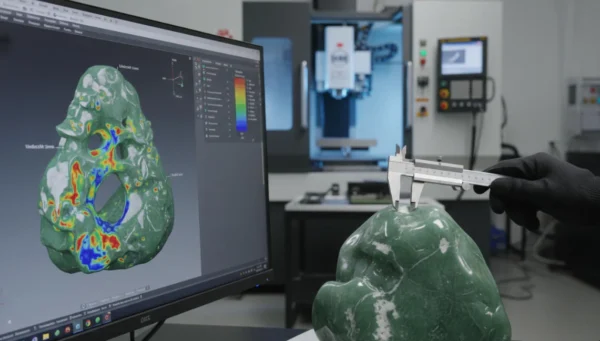
The jade process for composite construction typically involves selecting color-matched fragments, bonding with transparent or pigmented adhesive resin, grinding to produce continuous surface geometry, and polishing to eliminate visible joint lines at standard inspection distances. With careful color selection and skilled surface finishing, joint boundaries are invisible under standard lighting without magnification. Detection requires either 10x–20x loupe examination — which reveals crystal grain discontinuities at joint boundaries that polished surfaces conceal — or transmission light testing, in which strong illumination from behind the object reveals density variations and adhesive interfaces that surface examination consistently misses.
Composite jade products generate disproportionate after-sale failure rates: adhesive bonds deteriorate under conditions that intact natural stone tolerates without effect, producing returns, warranty claims, and customer disputes that surface months after the original purchase date. This means identifying composite construction during incoming inspection protects you not only from the initial material overpayment but from a category of after-sale liability that extends well beyond what standard product warranties are designed to cover.
Jade Authentication Methods: A Layered Approach to Jade Wholesale Risks Detection
No single testing method provides complete coverage across all five categories of jade material fraud. The effective strategy for managing jade wholesale risks is a structured, tiered authentication framework in which testing tools are matched to fraud probability, order value, and available resources at the time of inspection. The three-level framework below scales from zero-cost field observation to definitive laboratory analysis, and is designed to integrate into your standard procurement workflow without requiring specialist expertise at every stage.
1 — Field Screening: Immediate Assessment Without Equipment
Field screening provides the first filter in any incoming goods inspection and requires no equipment investment whatsoever. Applied systematically, it identifies the most direct forms of substitute fraud and low-quality surface dyeing before more resource-intensive testing is warranted. Color assessment is the primary tool: natural jadeite presents color that is irregular and gradational — lighter and darker zones follow the mineral’s internal structure, not the surface geometry. Dyed material typically shows color concentrated along crack networks and structural boundaries, with an evenness of distribution that does not occur in natural mineral coloring. Always assess color under multiple lighting conditions, including direct daylight, to counteract the effect of commercial display lighting calibrated to flatter the product’s appearance.
Luster type provides a secondary, rapid diagnostic at no additional cost. Jadeite presents a vitreous luster with a characteristic depth specific to its mineral density. Nephrite presents an oily or greasy luster. Neither should show the plastic-like surface sheen of resin compounds or the flat, spray-applied coating quality common in surface-treated substitutes. Temperature response completes the protocol: hold the piece in your palm for ten seconds and assess whether it retains a pronounced cool sensation or equalizes rapidly to skin temperature. Natural jade’s thermal conductivity produces a persistent cool feeling that glass matches only slowly and plastic does not replicate at all. These three rapid checks — color distribution, luster type, temperature response — establish a probability profile that determines where additional testing resources should be applied in subsequent inspection stages.
2 — Portable Tool Testing for Intermediate Jade Wholesale Risks Verification
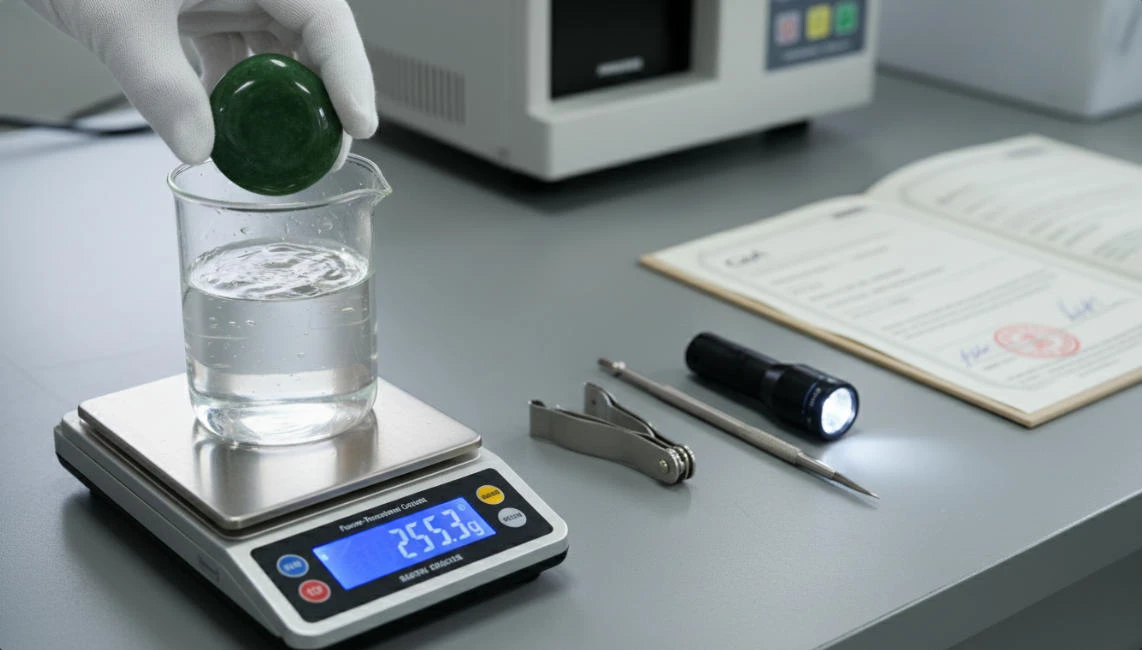
Portable testing tools extend detection capability substantially without requiring laboratory access or specialist instrumentation. A standard field toolkit for intermediate jade wholesale risks assessment should include a 10x–20x loupe, a UV lamp with long-wave and short-wave modes, a steel hardness probe, and a precision scale with a water displacement vessel for density measurement.
Density measurement using the Archimedes water displacement method is one of the most reliable portable tests available, taking approximately three minutes per piece and requiring only a gram-precision scale and a water container. Jadeite’s specific gravity range of 3.30 to 3.38 g/cm³ and nephrite’s range of 2.95 to 3.10 g/cm³ are well-separated from common substitute values — glass averages 2.50 g/cm³, quartzite approximately 2.65 g/cm³, and most plastics fall below 1.50 g/cm³. A density reading outside the expected range for the claimed material type is a definitive trigger for laboratory referral. UV examination under long-wave illumination is particularly effective for identifying organic dye fluorescence in dyed jade and detecting resin-filled zones that absorb UV energy differently from surrounding natural material. This means you can assemble a complete portable testing kit for under $200 that provides statistically meaningful fraud screening capability across the majority of field inspection scenarios your sourcing operation encounters.
3 — Laboratory Analysis: Definitive Authentication for High-Value Jade Wholesale Risks
For high-value orders, first-time supplier transactions, and any product category where synthetic jade is a realistic market risk, laboratory analysis is not an optional upgrade — it is the minimum standard that provides conclusive, legally defensible authentication results. Three analytical methods cover the full range of material fraud detection with definitive accuracy and are available at all accredited gemological testing facilities.
Fourier Transform Infrared Spectroscopy (FTIR) is the standard identification method for polymer resin in B-grade jadeite. Natural jade produces no organic absorption peaks in the FTIR spectrum; resin-impregnated material produces characteristic absorption peaks that confirm the presence of polymer fill at any quantity significant enough to affect commercial grade. The GIA identifies FTIR as the primary analytical tool for jadeite treatment identification in its gemological documentation, and the test is available as a routine analysis at all certified institutions. Raman spectroscopy provides mineral-level identification — distinguishing jadeite (NaAlSi₂O₆) from nephrite, and both from synthetic materials and common substitutes including glass, quartzite, and serpentine. X-ray fluorescence (XRF) analysis maps the elemental composition of the sample, identifying dyeing treatments through the presence of non-native metal elements introduced by synthetic colorants, including chromium and iron compounds used in commercial jade dyes.
For any purchase above a defined monetary threshold, require a certificate from GIA, NGTC, or SSEF as a condition of payment release — not as a post-receipt verification option. Certificates from these institutions record treatment status, natural versus synthetic origin, and, where determinable, geographic provenance: information that functions as a legal document in commercial dispute resolution. JADEMAGO recommends that buyers establish this threshold as a formal procurement policy reviewed annually, not a case-by-case judgment — because the transactions most likely to arrive without certification are also the transactions where material substitution risk is statistically highest. This means your certification requirement automatically concentrates verification effort on exactly the orders that need it most.
The Next Threat: How Synthetic Technology Is Reshaping Jade Wholesale Risks
The five fraud types described above represent the current operational landscape of jade wholesale risks. But this landscape is not static — it is advancing, driven by the same laboratory synthesis technologies that have already fundamentally changed authentication requirements in the diamond and colored stone markets. Understanding where fraud technology is heading is as important for your procurement strategy as understanding where it operates today.
Lab-Grown Jade and the Future of Jade Wholesale Risks
The trajectory of synthetic gemstone technology provides a reliable model for where jade wholesale risks are heading. Laboratory-grown diamonds, once identifiable through a range of physical and spectroscopic markers, became progressively harder to differentiate from natural diamonds as HPHT and CVD synthesis processes matured over two decades. The industry response required development of specialized instruments — including De Beers’ DiamondView system — that detect growth-pattern signatures invisible to conventional gemological testing. The jade market is at an earlier stage of the same technology trajectory.
Current laboratory synthesis of jade-analogous minerals uses HPHT and hydrothermal growth methods capable of producing material that closely approximates jadeite’s refractive index range of 1.66 to 1.68, specific gravity of 3.30 to 3.38 g/cm³, and Mohs hardness of 6.5 to 7 — the three parameters most commonly applied in buyer field testing. At the level of individual crystal grain morphology, synthetic material currently shows the regularity of controlled laboratory growth rather than the stochastic variation of natural geological formation, and this remains the most reliable visual indicator available to a trained examiner without spectroscopic equipment. However, as synthesis parameters are refined through commercial iteration, this morphological distinction will progressively diminish in accessibility.
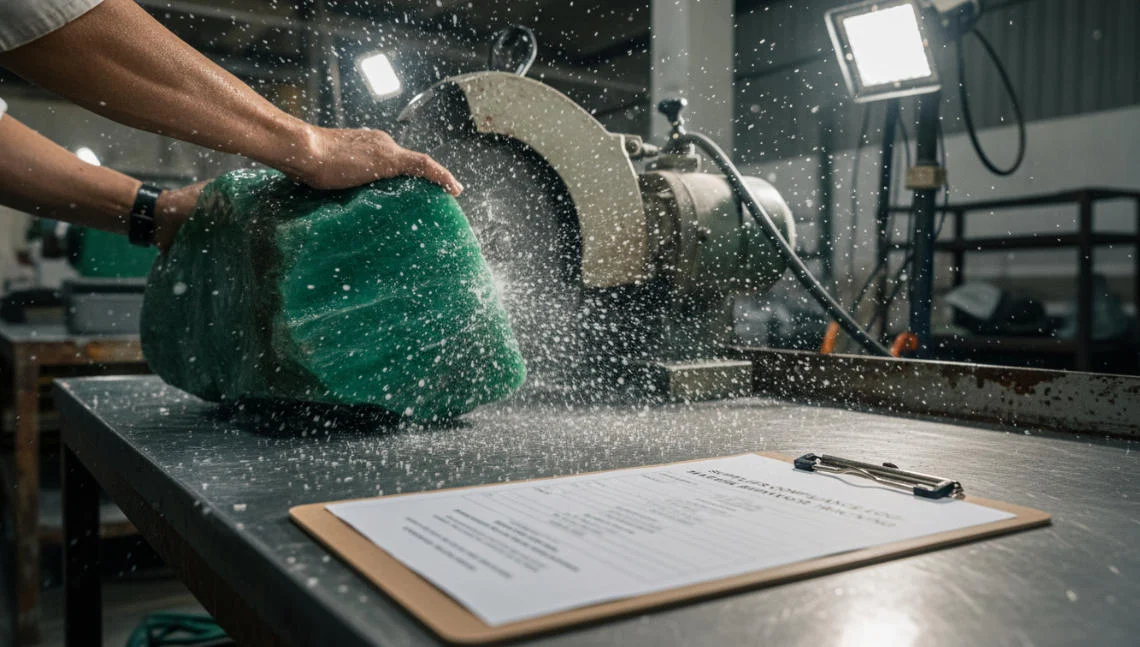
At JADEMAGO, manufacturing teams with accumulated jade process experience across decades of production have observed consistent behavioral differences between natural and laboratory-grown materials during the cutting and polishing stages — differences in cutting response, surface behavior under abrasive tools, and polishing rate that are not visible in finished products but are apparent during active jade process operations. This manufacturing-level perceptual knowledge represents a detection layer that a jade manufacturer with long production history applies at the earliest possible stage, before finishing conceals material differences that instrumentation later struggles to measure. It does not replace laboratory certification, but it adds an identification layer unavailable to buyers operating downstream from the manufacturing point.
What Advancing Fraud Technology Demands from Your Procurement Strategy
The practical implication of advancing synthetic jade technology is specific and actionable. Buyers who currently rely on visual inspection and basic physical testing as their primary fraud defense are operating with a shrinking margin of safety. Authentication methods adequate five years ago are being actively challenged by improving synthesis processes, and the detection gap will widen without deliberate investment in upgraded procurement protocols.
Three structural adjustments will maintain your protection as fraud technology evolves. First, establish a laboratory testing value threshold — the order value above which a GIA, NGTC, or SSEF certificate is required before payment release — and review that threshold annually as synthesis technology and market fraud patterns change. Second, build supplier qualification criteria that explicitly require documentation for raw material sourcing, treatment disclosure, and jade process chain-of-custody records; the absence of this documentation is a quantifiable risk indicator, not an administrative gap. Third, monitor published research from GIA, SSEF, and NGTC, all of which release updated detection guidance as new treatment methods and synthetic materials enter commercial circulation — and incorporate their findings into your inspection protocols as new methods become available. A jade manufacturer that facilitates your access to this certification infrastructure — by supporting third-party testing, maintaining production documentation, and disclosing treatments proactively — provides structural supply chain value that price-competitive trading companies cannot replicate.
A Practical Checklist to Manage Jade Wholesale Risks Before Placing an Order

Supplier Due Diligence: Identifying Process Transparency
The questions you ask a prospective supplier before placing an order reveal more about your actual material fraud exposure than any amount of product catalog review or sample photography. Transparency across the following areas identifies a jade manufacturer operating with documented production processes; opacity in any of these areas elevates jade wholesale risks in that transaction materially and measurably.
Begin by requesting raw material sourcing documentation — provenance records that trace the stone from mining origin through initial purchase, including supplier identification and, where available, geographic certification. Ask whether the supplier maintains jade process production logs that record any treatment steps applied during manufacturing — dyeing, filling, coating, or composite assembly — with disclosure as a standard operating requirement rather than an exception. Ask explicitly whether third-party testing is supported: will the supplier allow you to send representative samples to a laboratory of your choice before final payment is released? If a supplier declines third-party testing requests, that refusal is one of the clearest available signals that jade wholesale risks in that relationship are elevated beyond the standard baseline. Ask whether B-grade products — resin-filled jadeite — are offered as a separate, explicitly disclosed category at corresponding price points, or whether the supplier lacks the grading capability to differentiate between treatment levels at all. Finally, ask what remediation protocol applies if post-receipt laboratory testing identifies material discrepancies from the invoice description.
A supplier who answers these questions with specific documentation, clear policies, and operational transparency is providing the baseline accountability that a responsible jade manufacturer maintains toward its buyers. A supplier who defers, generalizes, or declines to engage is providing a reliable signal that jade wholesale risks are elevated — regardless of how competitive the pricing appears. At JADEMAGO, these questions are addressed through standard production documentation made available to buyers as part of the routine procurement process — a reflection of the accountability baseline that a jade manufacturer with documented process history maintains as operational standard, not as a competitive differentiator.
Matching Your Detection Investment to Your Actual Jade Wholesale Risks Exposure
Effective management of jade wholesale risks does not require laboratory testing on every shipment or every order. It requires rational allocation of authentication resources proportionate to transaction value, supplier qualification status, and product category risk profile.
For small-volume sampling orders from new suppliers, Level 1 and Level 2 field testing — visual color and luster assessment, UV examination, density measurement, and loupe inspection — provides a cost-appropriate first-stage filter that takes under thirty minutes per sample set. For mid-volume orders from partially qualified suppliers, add statistical laboratory sampling: submit five to ten percent of units from each shipment for FTIR and Raman analysis, selecting samples from the highest-value units in the batch. For high-value orders, for product categories with elevated synthetic jade risk (high-color jadeite, translucent white nephrite, fine carved jadeite), and for all orders establishing a new supplier relationship, require a GIA, NGTC, or SSEF certificate as a condition of payment release — not as a post-receipt verification option. The cost of laboratory certification at commercial order volumes is typically a fraction of one percent of the total transaction value, while the cost of a single fraudulent batch accepted without certification can represent the accumulated margin of multiple subsequent orders.
This framework does not eliminate jade wholesale risks entirely — no protocol achieves that. What it achieves is proportionate authentication investment, measurably reduced probability of undetected fraud entering your retail channel, and a documented due diligence record that provides commercial and legal protection when disputes arise. Every buyer in the jade wholesale market carries these risks. The distinction between buyers who manage them systematically and buyers who absorb them silently is, fundamentally, a matter of process discipline and documentation structure — not specialized product knowledge or exclusive supplier access. The information in this guide, applied consistently, gives you both the technical understanding and the operational framework to operate on the right side of that distinction.
This article reflects manufacturing-level technical knowledge developed through JADEMAGO‘s jade process operations and is provided as an educational resource for wholesale jade buyers and procurement professionals. For gemological certification and independent laboratory analysis, consult accredited institutions: GIA, SSEF Swiss Gemmological Institute, and NGTC.
Faqs About Jade Wholesale Risks for Material Fraud Detection
1. Why Material Fraud Is the Core of Jade Wholesale Risks
Among the jade wholesale risks, material fraud occurs frequently and is difficult to detect; moreover, it inflicts severe losses upon purchasers.
2. What are some common forms of material fraud?
Common forms of material fraud involve five techniques: dyeing, filling, synthesis, material substitution, and fragment splicing. Each method requires the application of a corresponding detection technique.
3. In what ways can one mitigate the material counterfeiting in jade wholesale risks?
While it is nearly impossible to completely avoid material counterfeiting, one can perform basic identification using several methods. These include observing whether the color transitions appear natural, examining the internal structure—preferably using a magnifying glass with a magnification of 10x or higher—to verify its natural appearance, and conducting density tests via the displacement method for comparison. The most accurate approach, however, is to have the material examined by a professional testing institution.