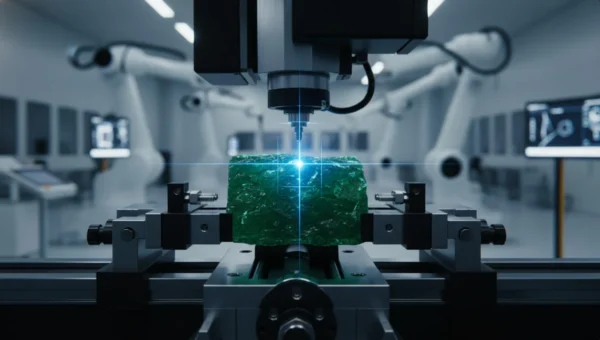
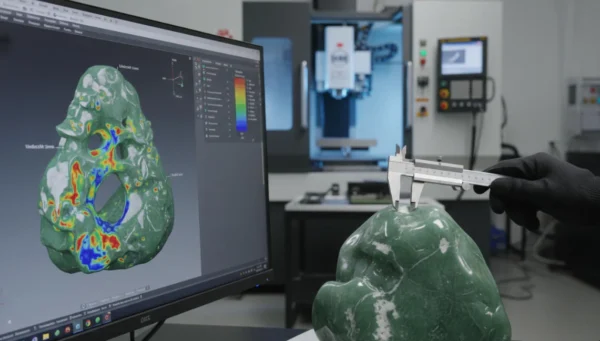
If you are sourcing from a jade manufacturer, the equipment running inside that factory shapes your business outcomes in ways that rarely appear on a product quotation sheet. At JADEMAGO, internal production data across multiple jade process runs shows that 5-axis CNC gemstone machining reduces chipping rates by 10% to 30% compared to conventional 3-axis equipment — a figure that translates directly into fewer defective pieces per batch, lower raw material waste, and a measurable reduction in your landed cost per unit. Beyond defect economics, 5-axis gemstone process technology unlocks a category of product complexity that 3-axis systems cannot physically achieve: deep-relief sculptures, multi-angle carved sets, internal concave structures, and dimensionally matched symmetrical pieces at export scale. For any jade process manufacturer serving B2B import buyers who depend on both design differentiation and batch consistency, the machine configuration behind the production line is not a technical footnote. It is a direct determinant of what you can order, how reliably it arrives, and what retail margin that product can support.
This article explains the operational mechanics behind that difference, where the measurable advantages of 5-axis jade process manufacturing show up in your supply chain, and — with equal clarity — the scenarios where 3-axis equipment remains the more rational production choice.
Table of Contents
The Core Divide in Jade Process: “Getting It Made” vs. “Getting It Made Right”
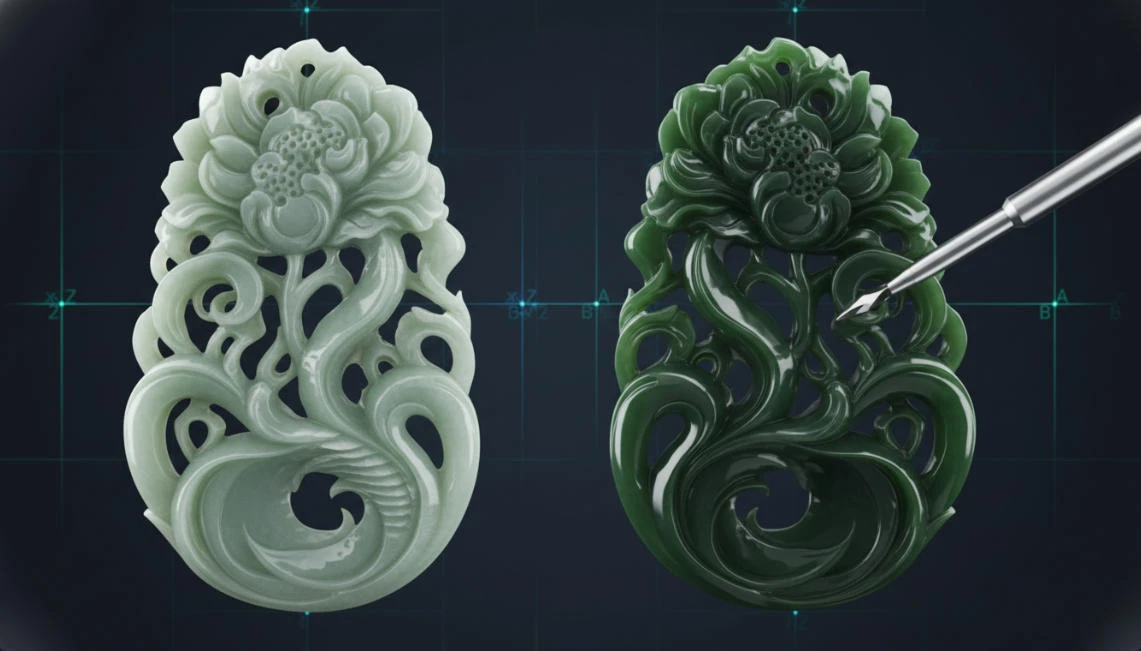
There is a working consensus among experienced lapidary engineers: 3-axis CNC equipment solves the problem of can it be produced, while 5-axis CNC gemstone machining solves the harder, commercially more significant problem of can it be produced consistently, at high complexity, and with controlled material loss. These are not incremental variations of the same problem. They define two different production ceilings — and for a jade manufacturer supplying export-volume B2B orders, the ceiling your equipment sets is the ceiling your buyers inherit.
A 3-axis CNC system operates across three linear axes: X (left-right), Y (forward-back), and Z (up-down). The cutting tool moves through these three dimensions in a fixed orientation relative to the workpiece. For flat surfaces, single-curved faces, and basic profile shapes, this geometry is sufficient. However, the moment a design requires the cutter to approach a surface from an oblique angle — or to machine an undercut, a deep concavity, or a multi-directional carved motif — the 3-axis configuration either requires manual workpiece repositioning between passes or leaves the geometry unachieved. Every repositioning step introduces dimensional error. Every unachieved geometry is a design that does not make it into your catalog.
How 3-Axis Constraints Define the Limits of Your Jade Product Range
The International Gem Society (IGS) documents how lapidary cutting angle directly affects surface quality and structural integrity in natural stone materials — a relationship that becomes especially consequential in jade, where internal structural heterogeneity means the material does not respond uniformly to fixed cutting approaches. When a 3-axis machine runs a fixed-angle toolpath across a jade piece with an internal grain direction or fracture plane running at an unfavorable angle to the cutter, there is no adjustment mechanism. The machine follows the programmed path. The material responds according to its internal structure. The result is visible in your reject pile.
For you as a buyer, this means the design limitations of 3-axis jade process equipment are not your supplier’s skill problem. They are your product range problem. If a design brief requires layered floral relief, a multi-face carved pendant pair with matched dimensions, or any form requiring the cutter to approach from angles outside the three linear axes, a jade manufacturer operating on 3-axis equipment alone will either decline the design or produce it through manual workarounds that sacrifice consistency. That constraint belongs to your sourcing relationship whether or not it appears in a capabilities document.
How 5-Axis CNC Gemstone Machining Removes That Production Ceiling
5-axis CNC gemstone machining adds two rotational axes — typically designated A and B — to the standard X/Y/Z linear configuration. The cutting tool, or the workpiece, can tilt and rotate in synchronized motion during the cutting sequence. This means the cutter maintains an optimal engagement angle continuously across complex curved surfaces, without interrupting the machining cycle to reposition the piece. Multi-angle synchronized cutting allows a jade manufacturer to execute 3D sculptural forms, deep-relief carvings, and internal concave geometries within a single uninterrupted machining sequence.
This is not a marginal improvement over 3-axis capability. It is a categorical expansion of what the gemstone process can deliver at production scale. For your sourcing strategy, that means your design conversations can start with what your retail market is asking for — not with a mental pre-filter shaped by your supplier’s machine geometry. That shift in the sourcing dynamic is worth quantifying, which is exactly what the next section does.
3 Measurable Advantages of 5-Axis Jade Process That Directly Affect Your Cost Per Unit
Technical capability descriptions are only useful to a B2B buyer when they connect to a number. The following three advantages of 5-axis CNC gemstone machining are drawn from JADEMAGO’s internal production tracking across jade and crystal material runs — not from equipment specification sheets. Each maps to a specific cost or risk variable in your procurement cycle.
1: Chipping Rate Reduced by 10%–30% — Why Natural Jade’s Internal Structure Demands Adaptive Cutting
Natural jade — whether nephrite or jadeite — is not a structurally homogeneous material. The Gemological Institute of America (GIA) classifies jadeite jade as a polycrystalline aggregate with interlocking crystal structures that vary in density, grain orientation, and internal cohesion across a single piece. In practice, this means that any given jade workpiece contains fracture planes, fiber inclusions, and internal tension zones that do not announce themselves on the surface. A cutting tool that approaches the material from a fixed angle — as 3-axis CNC systems do — has no mechanism to account for what lies beneath that surface.
The consequence of fixed-angle cutting against an unfavorable internal grain direction is a phenomenon lapidary engineers refer to as stress concentration along the fracture plane. When the cutter runs parallel to an existing internal crack, the mechanical force of the cutting pass propagates along that crack rather than through the surrounding material matrix. The result is chipping at the edge, subsurface fracture that only becomes visible after polishing, or catastrophic material loss that removes the piece from the usable batch entirely. None of these outcomes appear in your supplier’s quoted price per piece. All of them appear in your effective cost per sellable unit.
5-axis CNC gemstone machining does not eliminate this risk. Natural material variation cannot be fully engineered away at the machining stage. What 5-axis configuration provides is the ability to adjust the cutting approach angle dynamically — redirecting the toolpath in response to the programmed geometry so that the cutter engages the material from a direction less likely to run parallel to known fracture orientations. Across JADEMAGO’s tracked jade process production data, this adaptive angle capability produces a chipping rate reduction of 10% to 30% compared to equivalent 3-axis runs on the same material type. For a batch of 500 carved pendants, a 20% reduction in chipping means 100 additional sellable units from the same raw material input. That is not a machine specification. That is margin.
The 2023 JADEMAGO Comparative Test: Where the Chipping Rate Numbers Come From
The 10% to 30% chipping rate reduction figure cited above is not sourced from equipment manufacturer specification sheets or generalized industry benchmarks. It originates from a controlled internal production test conducted by JADEMAGO in 2023, carried out specifically to generate comparable, methodology-grounded performance data before committing to full-scale 5-axis CNC gemstone machining deployment across its jade process production lines.
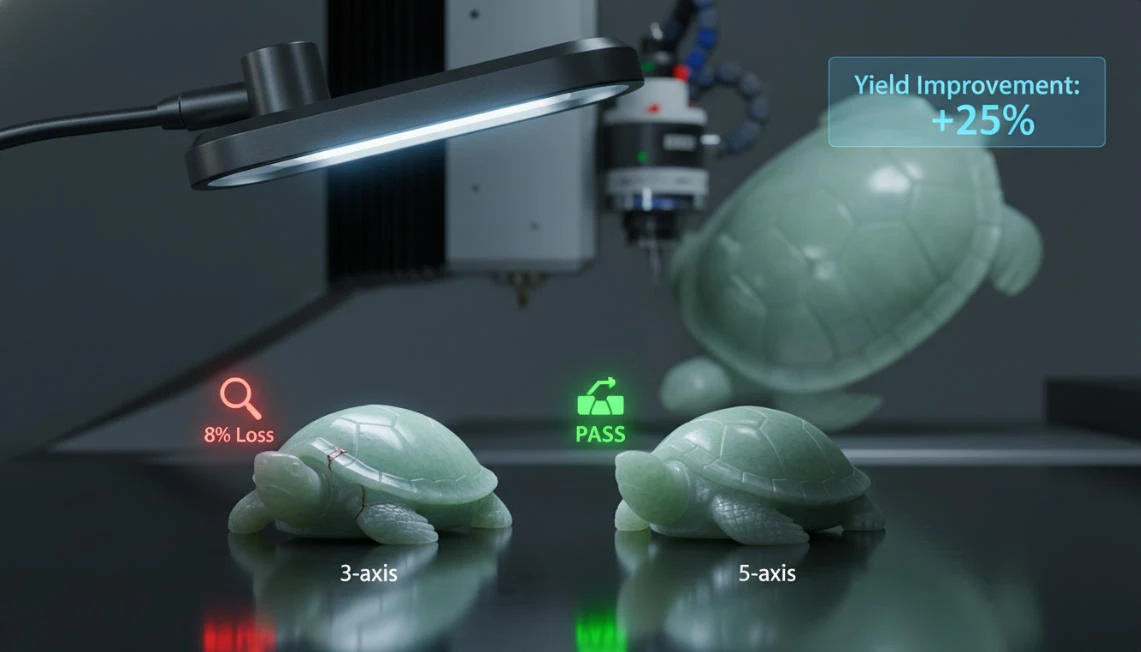
Before authorizing the capital investment required to transition from 3-axis to 5-axis equipment, JADEMAGO procured a single 5-axis CNC gemstone machining unit and ran it in parallel with an existing 3-axis machine on an identical production task: 100 units of a small-format three-dimensional turtle carving. This design was selected deliberately. Its compound-curved shell geometry, undercut limb structures, and fine surface detail place it in the category of carved jade forms where the geometric constraints of 3-axis fixed-angle cutting are most likely to produce measurable differences in material loss — making it a meaningful test case for evaluating chipping performance across machine configurations.
Across the 100-piece 3-axis production run, 8 units exhibited chipping, edge fracture, or structural damage sufficient to remove them from the sellable batch — an 8% material loss rate on a design that, by jade carving standards, sits at moderate geometric complexity. The equivalent 5-axis CNC gemstone machining run, conducted on the same turtle design and a comparable raw material grade, produced 6 units with equivalent damage — a 6% loss rate. The absolute reduction of 2 percentage points represents a 25% improvement in batch yield on this specific design, a result that falls within the 10% to 30% general performance range cited for varied design types and material grades across ongoing jade process production.
It is important to state what this data does and does not confirm. Both figures reflect the structural variability inherent in natural jade as a lapidary material: no machining configuration eliminates chipping risk on heterogeneous natural stone entirely, a material characteristic that the GIA’s technical research on jadeite structure attributes to the polycrystalline aggregate nature of the material and its variable internal cohesion across a single workpiece. What the 5-axis configuration delivers is a statistically meaningful reduction in the frequency of that loss — achieved through adaptive cutting angle control that redirects the toolpath away from unfavorable fracture plane orientations in ways the 3-axis fixed-axis system cannot replicate. For your procurement program, a 25% improvement in yield on complex carved forms translates directly into more sellable units from the same raw material input and the same production run cost. That is the commercial meaning of the number.
2: Complex 3D Geometry That Determines Whether Your Product Commands a Price Premium
There is a direct relationship between carving complexity and retail price achievable in the jade market. Flat or single-curve forms — the product range accessible to 3-axis jade process equipment — compete in a segment defined by commodity pricing pressure. Layered relief carvings, undercut floral motifs, multi-face dimensional pendants, and sculptural forms with internal concavities are the product categories that hold price in a competitive import market. The ability of your jade manufacturer to produce these forms consistently, at batch scale, determines which of those market segments your catalog can enter.
A 3-axis system can approximate some dimensional complexity through sequential repositioning of the workpiece — manually adjusting the piece between machining passes to present a new face to the cutter. Each repositioning introduces a cumulative dimensional error, and for symmetrical pieces such as matched earring pairs or bilateral carved motifs, that error compounds across both halves of the design. The result is a product that looks acceptable in isolation and inconsistent in a matched set. For the retail environments that drive B2B jade import volume — jewelry wholesale, gift and homewares buyers, cultural product distributors — matched consistency in paired and sets-format products is a baseline expectation, not a premium feature.
5-axis CNC gemstone machining executes multi-angle cutting within a single continuous machining sequence. The workpiece does not move. The cutter adjusts. Dimensional accuracy is maintained across the full geometry of the piece because there is no repositioning error to accumulate. This means that a jade manufacturer running 5-axis equipment can produce a 200-piece run of matched pendant pairs to a dimensional tolerance that survives retail quality inspection — not just sample approval. For your sourcing program, this translates into a reliable path to the higher-margin product categories that your market can support.
3: Single-Setup Machining Delivers the Batch Consistency That Export Orders Require
Dimensional consistency across a production batch is one of the least visible and most commercially consequential quality variables in jade manufacturing. A jade process manufacturer can produce a sample piece that passes every inspection criterion and still deliver a 1,000-unit batch in which piece-to-piece variation exceeds the tolerance your retail buyer will accept. When that gap exists, it almost always traces back to a multi-setup production process — one in which the workpiece is repositioned multiple times to complete a design, and each repositioning event introduces a small but cumulative alignment error.
3-axis CNC jade process for multi-face designs is inherently a multi-setup workflow. A piece requiring machining from three different angles requires three separate workholding configurations. Each configuration is accurate only to the precision of the clamping system and the operator’s ability to reproduce the alignment. Across a batch of hundreds or thousands of pieces, that variability accumulates into a measurable spread in finished dimensions. According to precision manufacturing research cited by the IGS on CNC tolerances in lapidary work, each additional workpiece setup in a multi-axis cutting sequence can introduce positional errors ranging from 0.05mm to 0.2mm depending on clamping method and operator repeatability — a range that is invisible on a single piece and commercially significant across a batch.
5-axis CNC gemstone machining resolves this at the architecture level. Because the rotational axes allow the cutter to approach the workpiece from multiple angles without physically moving the piece, a design that would require three separate setups on a 3-axis machine is completed in a single continuous machining sequence on a 5-axis system. The workpiece never leaves its original clamping position. Positional reference is maintained throughout the entire cut. For symmetrical pieces, the dimensional match between left and right — or between piece 1 and piece 1,000 in the batch — is governed by the machine’s programmed geometry, not by an operator’s ability to reproduce a manual alignment. This means you can present a 5-axis-produced jade batch to your retail buyer’s QC team with the confidence that the sample you approved reflects what the carton contains.
The Hidden Production Benefit: How 5-Axis CNC Gemstone Machining Cuts Polishing Time by Approximately 20%
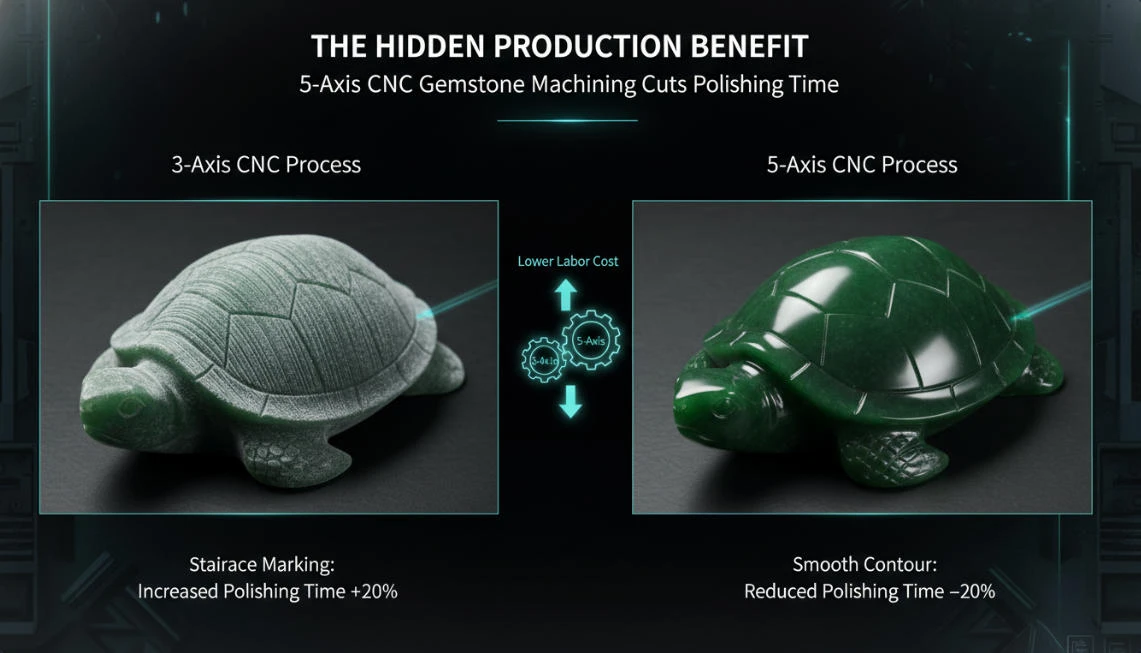
Most B2B buyers evaluate a jade manufacturer on two visible metrics: sample quality and quoted unit price. The labor cost embedded in the polishing stage rarely appears as a line item on a factory quotation — but it is one of the most significant variables determining whether a supplier can hold a price across a sustained production relationship or quietly erodes margin through extended finishing labor on every batch. Understanding where that polishing labor comes from, and how 5-axis CNC gemstone machining structurally reduces it, gives you a more accurate picture of your supplier’s true cost base and long-term pricing stability.
Why 3-Axis Jade Process Generates Polishing Labor That 5-Axis Eliminates at the Source
When a 3-axis CNC system machines a curved surface, the cutting tool maintains a fixed angular relationship to the workpiece throughout the pass. Because the cutter cannot tilt to follow the changing surface normal of a curve, the toolpath must approximate the continuous curve through a series of small linear steps. Each step leaves a microscopic flat facet on the surface. Across the full carved geometry of a jade piece, these accumulated facets produce what lapidary engineers call staircase marking — a regular ridged texture that is visible under oblique light and tactilely detectable on the finished surface before polishing.
Staircase marking is not a machining defect in the conventional sense. It is a geometric consequence of applying a linear-axis system to a curvilinear surface. The GIA’s technical documentation on lapidary surface finishing confirms that surface texture generated at the machining stage directly determines the abrasive sequence required to achieve a finished gem polish — meaning that a rougher machined surface requires more polishing stages, finer intermediate grits, and longer total polishing time to reach the same final surface quality as a cleaner machined surface. For a jade manufacturer running high-volume carved product lines, this is not a marginal time difference. It compounds across every piece in every batch.
The 2023 JADEMAGO Polishing Test: Methodology and the Numbers Behind the 20% Reduction Claim
The approximately 20% polishing time reduction figure cited in this section is drawn from the same 2023 JADEMAGO internal comparative production test that generated the chipping rate data above — specifically from the finishing stage of that test, which was designed to isolate machined surface quality as the variable determining polishing duration, independent of operator technique or hand-finishing variability.
This methodological decision matters. Hand-polishing time is highly sensitive to individual operator experience, fatigue, and technique consistency — variables that make it an unreliable basis for comparing the downstream finishing impact of two different machining configurations. To eliminate this source of variance, both the 3-axis and 5-axis machined turtle carving batches were processed through identical vibratory tumbling equipment, under identical polishing media, cycle parameters, and ambient conditions. Neither batch received any hand-polishing intervention between the machining stage and the vibratory tumbling stage. The only independent variable entering the polishing comparison was the surface condition of the machined pieces — the direct output of their respective machining processes.
Under these controlled conditions, the 3-axis machined batch required a total vibratory polishing cycle of 18 hours to reach the target surface finish standard applied uniformly across both batches. The 5-axis CNC gemstone machining batch reached the equivalent surface finish standard in 14.5 hours — a reduction of 3.5 hours, representing a 19.4% decrease in total polishing cycle time, rounded to approximately 20% in the general figures referenced throughout this article. The differential is attributable to the reduced staircase marking severity present on 5-axis machined curved surfaces: pieces entering the vibratory tumbling stage with a cleaner machined surface required fewer corrective abrasive cycles before the finishing polish stage could begin, shortening the total cycle without any change to equipment, media, or process parameters.
For you as a buyer, the methodological significance of the vibratory tumbling standardization is this: the 20% time reduction is a function of machined surface quality alone — not of finishing operator skill, equipment upgrade, or any other production variable. A jade manufacturer running 5-axis CNC gemstone machining on complex curved product lines is recovering that time saving on every batch, as a structural feature of the machining process rather than as an occasional performance outcome. Across a sustained supply relationship involving regular orders of complex carved jade product, that compounding efficiency in the finishing stage is part of what supports pricing stability — and what the GIA’s documentation on lapidary surface finishing standards confirms as a direct downstream consequence of machining surface quality entering the polishing sequence.
How 5-Axis CNC Gemstone Machine Path Contouring Reduces Surface Remediation Before Polishing Begins
5-axis CNC gemstone machining resolves the geometric origin of staircase marking by allowing the cutting tool to tilt continuously as it traverses a curved surface. Because the A and B rotational axes keep the cutter perpendicular — or at the optimal engagement angle — to the surface normal throughout the toolpath, the cutter follows the actual curve of the design rather than approximating it through linear steps. The result is a machined surface that more closely matches the intended geometry from the moment the piece leaves the machine, with measurably reduced surface texture variation compared to 3-axis output on equivalent curved geometry.
In JADEMAGO’s tracked jade process production data, the reduction in staircase marking severity achieved through 5-axis gemstone process toolpaths translates into a polishing workflow time reduction of approximately 20% compared to 3-axis machined pieces of equivalent design complexity. That 20% is not recovered through faster polishing equipment or higher operator throughput. It is recovered because the machined surface requires fewer corrective abrasive stages before the finishing polish can begin. Less remediation labor enters the piece at the polishing bench because less surface error exits the piece at the CNC stage.
For you as a buyer, this production efficiency has two direct implications. First, it supports more stable unit pricing across repeat orders — a supplier whose polishing labor input is structurally lower per piece has more pricing headroom to absorb raw material cost fluctuations without passing increases through to your order price. Second, it reduces the variability in surface finish quality across a batch, because hand-polishing remediation — the stage 5-axis machining partially eliminates — is the stage most subject to operator-to-operator variation. A cleaner machined surface entering the polishing stage produces a more consistent finished surface exiting it. That consistency is what your retail buyer’s QC inspection measures, and what your returns rate reflects.
The Compounding Effect: How Machining Precision Reduces the Total Labor Content of Every Jade Piece
It is worth stating explicitly what these numbers mean in aggregate. A jade process manufacturer running 5-axis CNC gemstone machining on a complex carved product line is capturing efficiency at two distinct points in the production sequence: at the machining stage, through reduced chipping and single-setup accuracy; and at the finishing stage, through reduced polishing remediation time. These are not alternative benefits — they occur simultaneously on every piece that moves through a 5-axis production workflow. The combined effect is a lower total labor content per finished piece, a more predictable cost base, and a finished product whose surface quality is determined more by machine geometry than by finishing operator skill level. For any jade manufacturer supplying export-scale B2B orders where consistency is a contractual expectation rather than an aspiration, that structural labor efficiency is what allows the production economics to work at volume.
When 5-Axis CNC Gemstone Machining Is NOT Always the Best Right Choice — An Honest Assessment From a Jade Manufacturer
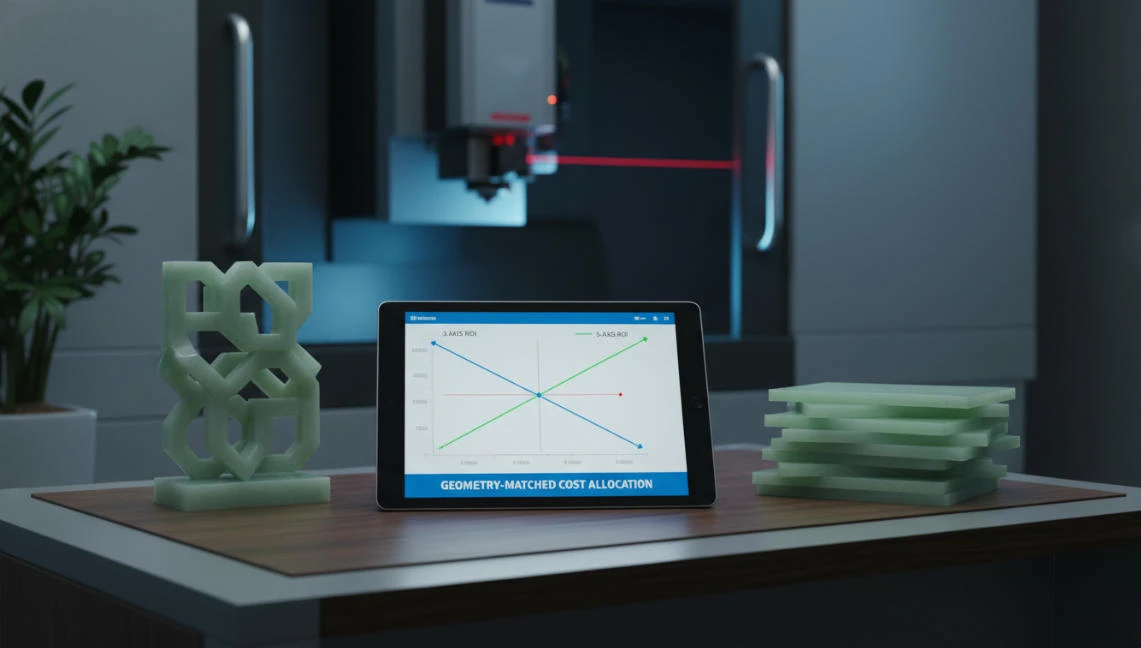
Any jade manufacturer that presents 5-axis CNC gemstone machining as the universal answer to every production requirement is either oversimplifying the technology or undersimplifying your sourcing needs. The honest position — and the more commercially useful one for your procurement decisions — is that 5-axis configuration carries specific cost and operational characteristics that make it the wrong tool for certain order profiles. Understanding those boundaries helps you evaluate supplier capability claims more accurately and ask better questions when assessing whether a jade process manufacturer’s equipment investment actually aligns with the products you need to source.
The Equipment Cost Reality: 5-Axis Gemstone Machines Run at 2x to 5x the Capital Cost of 3-Axis Systems
5-axis CNC gemstone machining equipment carries a procurement cost that typically runs two to five times higher than equivalent 3-axis CNC systems configured for lapidary work. That capital differential does not disappear from the production economics — it is amortized across the machine’s operational life and recovered through the unit economics of the products it produces. For a jade manufacturer running high-complexity, high-value carved product lines at export volume, the per-unit contribution of 5-axis capability — reduced chipping, single-setup accuracy, reduced polishing labor — provides a rational return on that capital investment. The machine earns its cost premium through what it enables the production line to deliver.
The same calculation does not hold for simple geometric forms, flat-face carvings, or low-relief surface work. A jade piece requiring only planar cuts, single-axis curved surfaces, or basic profile shaping does not benefit materially from 5-axis tool positioning. The 3-axis system produces an equivalent output on those geometries at lower machine operating cost. If your sourcing program is weighted toward simpler carved forms — standard cabochons, flat slab pieces, basic bangle profiles — sourcing from a jade manufacturer whose 5-axis investment is priced into every unit regardless of design complexity means you are paying a capability premium for a capability your product does not use. That is not efficient procurement.
The practical sourcing implication is this: a well-configured jade process manufacturer should be running both 3-axis and 5-axis equipment, allocating production to the appropriate machine type based on design complexity. If a supplier presents 5-axis capability as justification for a uniform price premium across all product categories regardless of geometry, that pricing structure warrants scrutiny.
Programming Complexity and Engineering Depth: What 5-Axis Gemstone Machine Process Actually Requires to Function Correctly
5-axis CNC gemstone machining is not a capability that scales automatically with machine acquisition. The operational value of 5-axis equipment depends entirely on the engineering depth of the team programming and maintaining it. Generating an effective 5-axis toolpath for a complex jade carving requires CAM software proficiency, material-specific cutting parameter development, and the accumulated process knowledge to anticipate how a given jade material type will respond to multi-axis cutting sequences at specific feed rates and spindle speeds. According to manufacturing engineering standards referenced by SME (Society of Manufacturing Engineers), 5-axis CNC programming requires significantly higher operator competency than 3-axis workflows — a skills gap that cannot be bridged by machine investment alone.
This matters to you as a buyer because it means that the presence of 5-axis equipment in a factory does not confirm 5-axis capability in the production output. A jade manufacturer operating 5-axis machines with undertrained programming staff will produce results that fall short of the geometry accuracy and surface quality that the equipment is theoretically capable of delivering. The machine’s specification sheet does not tell you whether the engineering team behind it has the depth to extract that capability on your specific product designs. What does tell you is the factory’s willingness to share toolpath strategies, cutting parameter rationale, and material-specific process documentation for your product category — the kind of technical transparency that distinguishes genuine process competency from equipment ownership.
Maintenance Requirements and Precision Drift: The Long-Term Stability Dimension of 5-Axis Jade Process
The rotational axes that give 5-axis CNC gemstone machining its geometric flexibility are also the mechanical subsystems that require the most rigorous ongoing calibration to maintain production accuracy over time. Each rotational axis operates through a precision bearing and drive system that is subject to wear, thermal expansion, and mechanical loading across its operational life. Without regular calibration cycles and proactive maintenance protocols, rotational axis systems on 5-axis CNC equipment experience what precision engineers refer to as accuracy drift — a gradual divergence between the machine’s programmed position and its actual cutting position that accumulates incrementally and may not be detectable on a single piece but becomes visible as dimensional spread across a production batch.
The National Institute of Standards and Technology (NIST) documents that multi-axis CNC systems require periodic geometric accuracy verification — including rotational axis positioning checks — to maintain the dimensional tolerances that define their production specification. For a jade manufacturer running 5-axis gemstone process equipment, this means that machine investment must be accompanied by a maintenance infrastructure: calibration schedules, axis geometry verification protocols, and the technical capacity to identify and correct drift before it reaches the production floor. A supplier that has acquired 5-axis equipment without building that maintenance infrastructure around it is operating a depreciating capability — one whose accuracy at the time of your order may not match its accuracy at the time of your sample approval.
When evaluating a jade process manufacturer’s 5-axis capability for sustained supply relationships, the relevant questions extend beyond machine model and axis count. How frequently are rotational axes calibrated? What is the facility’s protocol for detecting and correcting accuracy drift between calibration cycles? What dimensional verification is applied to batch output — not just first-article samples — to confirm that machine accuracy is holding across a production run? These are the questions that separate a 5-axis capability claim from a 5-axis production reality.
Why JADEMAGO Invested in 5-Axis CNC Gemstone Machine — The Manufacturing Philosophy Behind the Decision
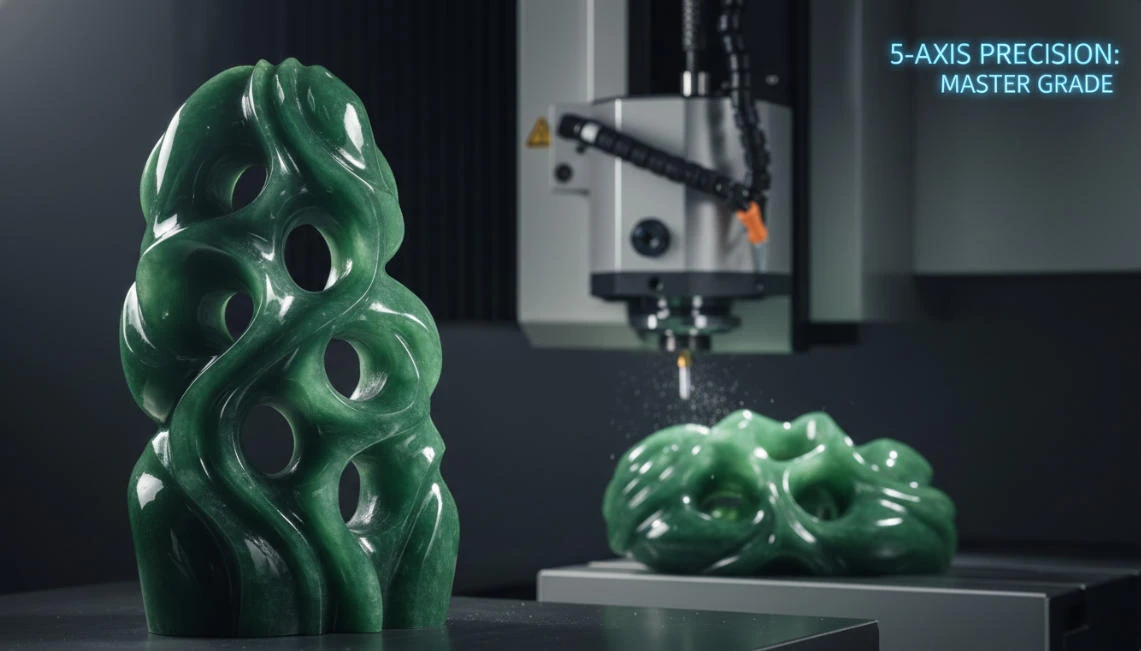
Equipment investment decisions inside a production facility reflect the commercial logic of the customers that facility is built to serve. JADEMAGO’s commitment to 5-axis CNC gemstone machining across its jade and crystal production lines was not a response to industry trend or a marketing positioning exercise. It was a conclusion reached through the operational reality of serving B2B export buyers whose product requirements — in design complexity, batch consistency, and dimensional accuracy — had outgrown what 3-axis jade process equipment could reliably deliver at scale. The equipment configuration inside the JADEMAGO facility is a direct expression of what the customers sourcing from it need to bring to their own markets.
How JADEMAGO Matched Machine Capability to the Products Your Market Is Actually Asking For
The jade and crystal product categories that command sustainable margin in B2B import markets are not the categories that 3-axis CNC jade process equipment produces most efficiently. Layered relief carvings, multi-face sculptural pendants, dimensionally matched set components, deep-concave decorative objects — these are the forms that retail buyers in jewelry wholesale, cultural product distribution, and premium gifting consistently reorder. They are also the forms that require 5-axis CNC gemstone machining to produce at the dimensional accuracy and batch consistency that export-scale supply relationships demand.
JADEMAGO’s decision to invest in 5-axis gemstone process capability was driven by a straightforward product logic: if the designs your retail market supports require 5-axis geometry to execute correctly, then the jade manufacturer in your supply chain either has that capability or becomes a constraint on your catalog development. The investment in 5-axis equipment removed that constraint from the supply relationship. What this means for your sourcing program is that design conversations can begin with what your end market will pay for — not with a pre-filtered version of that brief shaped by your supplier’s equipment ceiling.
What JADEMAGO’s 5-Axis Jade Process Capability Delivers Across Your Order Lifecycle
The practical benefits of sourcing from a jade manufacturer running 5-axis CNC gemstone machining do not concentrate in a single phase of the order relationship. They distribute across the full procurement cycle in ways that affect your cost base, your QC outcomes, and your ability to develop new product with confidence.
At the design and sampling stage, 5-axis capability means that the geometry your designer specifies is the geometry the sample reflects — without the dimensional compromises that multi-setup 3-axis production introduces into complex forms. You are approving an accurate representation of what the batch will contain, not a manually finished approximation of it. At the production stage, single-setup machining and adaptive cutting angle control mean that the dimensional accuracy of your approved sample propagates across the batch rather than degrading through accumulated repositioning error and fixed-angle material stress. At the finishing stage, the reduction in polishing remediation labor — approximately 20% lower than equivalent 3-axis production on complex curved forms — means that surface quality variation across a batch is governed more by machine geometry than by finishing operator consistency. Each of these outcomes compresses a specific cost or risk variable in your procurement cycle. Together, they define the difference between a supply relationship that holds its quality standard across sustained volume and one that holds it only at sample scale.
The JADEMAGO Production Infrastructure Behind Every Jade Order You Place
5-axis CNC gemstone machining delivers its full capability only when the engineering and maintenance infrastructure surrounding the equipment matches the precision demands of the production work. JADEMAGO’s jade process operations are supported by CAM programming teams with material-specific parameter libraries developed across jade, nephrite, crystal, and mixed-mineral product categories — the accumulated process knowledge that determines whether a 5-axis toolpath produces the surface quality the machine is theoretically capable of, or falls short of it through generic parameter application. Rotational axis calibration is conducted on scheduled cycles with dimensional verification applied to batch output — not only to first-article samples — ensuring that the accuracy documented at machine setup is the accuracy present in the carton your QC team inspects.
For B2B buyers evaluating jade manufacturers on sustained supply capability rather than sample performance, this infrastructure layer is what distinguishes a production facility from an equipment showroom. The machine specification is the starting point. The engineering depth, calibration discipline, and material process knowledge built around it are what determine whether that specification reaches your order.
About JADEMAGO — 65 Years of Jade and Crystal Manufacturing
JADEMAGO is a source-direct jade and crystal manufacturing brand with over 65 years of continuous operation in jade and crystal processing, design, and production. The facility integrates traditional lapidary craft knowledge with precision CNC gemstone process technology — not as a replacement of one by the other, but as a combination in which the accumulated material knowledge of decades of jade manufacturing informs how modern machining capability is applied to natural stone that does not behave like an engineering material.
The Gemmological Institute of America (GIA) and Swiss Gemmological Institute (SSEF) both document the structural complexity and material variability of natural jade as a lapidary material — variability that requires production experience, not just equipment capability, to navigate consistently at scale. JADEMAGO’s 65-year production history represents that accumulated experience: the material-specific process knowledge that determines cutting parameter selection for different jade grades, the quality inspection criteria that distinguish acceptable material variation from structural compromise, and the production sequencing that maintains dimensional consistency across batch sizes that range from boutique custom runs to large-format export orders.
If your sourcing program requires a jade process manufacturer whose equipment configuration, engineering depth, and production history can support complex carved product development at export scale — with the batch consistency and dimensional accuracy that your retail buyers’ QC processes will verify — the production infrastructure behind every JADEMAGO order is built to meet that standard. Your product brief is the starting point. Consistent, accurate, export-ready production is the outcome.
FAQs for 5-Axis CNC Gemstone Machine
1. What is the practical difference between 3-axis and 5-axis CNC gemstone machine for jade carving?
3-axis CNC systems cut across three linear dimensions — X, Y, and Z — and cannot adjust the cutting angle during a machining pass. This limits their output to flat surfaces, single-curve profiles, and basic contour shapes. 5-axis CNC gemstone machining adds two rotational axes, allowing the cutting tool to tilt and reposition continuously during the cut. For a jade manufacturer producing complex three-dimensional carvings, undercut structures, or dimensionally matched set components, this distinction determines whether a design can be executed accurately at batch scale — not just approximated at sample stage.
2. How much does 5-axis machining actually reduce chipping on natural jade?
In JADEMAGO’s 2023 internal comparative test — 100 identical three-dimensional turtle carvings run on both machine types — defect units dropped from 8% on the 3-axis run to 6% on the 5-axis run, a 25% yield improvement on that design. Across varied geometries and jade grades, ongoing jade process production data places the general chipping reduction range at 10% to 30%. No machining configuration eliminates chipping on natural stone entirely, but adaptive cutting angle control meaningfully reduces its frequency.
3. Does 5-axis CNC machining add cost to my order price?
5-axis equipment carries a capital cost two to five times higher than 3-axis systems — a real variable in any jade process manufacturer’s unit economics. On complex carved forms, efficiency gains partially offset that premium: up to 25% yield improvement reduces raw material waste per sellable unit, and approximately 20% lower polishing time reduces finishing labor per piece. On simple geometric forms, those offsets do not apply, and a well-configured jade manufacturer should price accordingly rather than applying a blanket 5-axis premium across all product categories.
4. How does JADEMAGO maintain 5-axis machining accuracy across large production batches?
Maintaining 5-axis CNC gemstone machining accuracy at batch scale requires more than equipment acquisition. JADEMAGO’s jade process operations apply scheduled rotational axis calibration cycles and dimensional verification to batch output — not only to first-article samples — to confirm that machining accuracy established at setup holds across the full production run. CAM programming draws on material-specific cutting parameter libraries developed across jade, nephrite, crystal, and mixed-mineral product categories, ensuring that toolpath design reflects the actual material behavior of each jade grade rather than applying generic parameters to a material that does not respond uniformly to fixed cutting approaches.
5. Is 5-axis CNC gemstone machining suitable for all jade product types?
No. 5-axis delivers its clearest advantages on complex three-dimensional carved forms: deep-relief sculptures, multi-face pendants, internally concave objects, and dimensionally matched set components. For standard cabochons, flat slabs, and basic bangle profiles, 3-axis equipment produces equivalent output at lower operating cost. The rational approach for any jade manufacturer is to match machine configuration to design complexity — not to treat either configuration as universally superior.