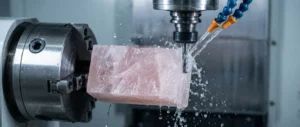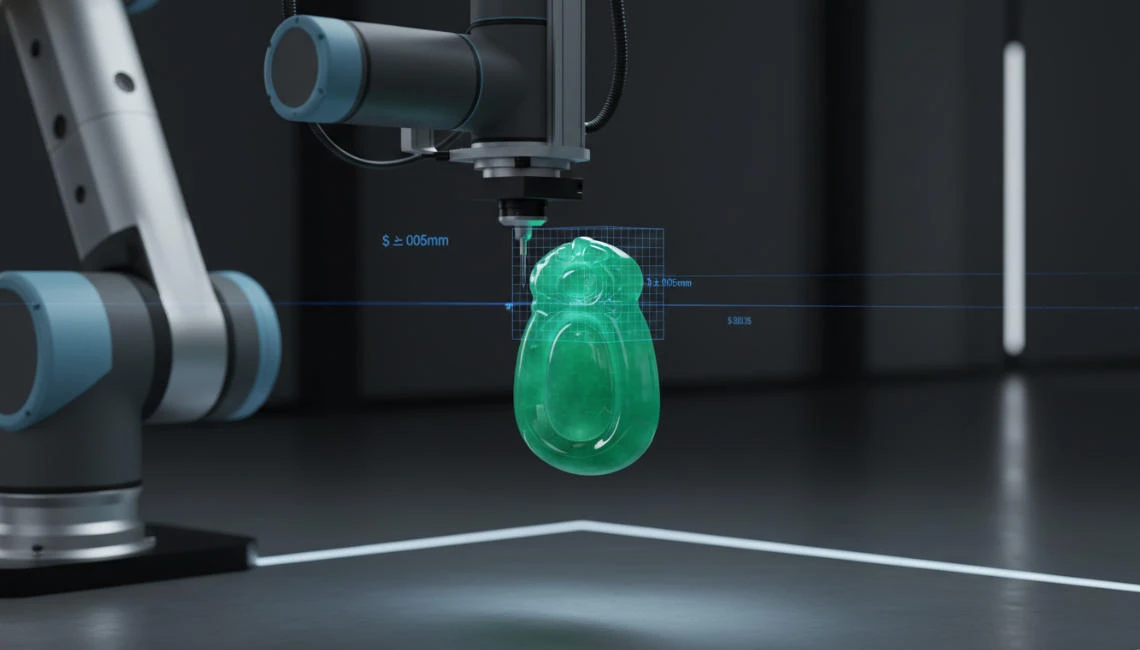

When a B2B buyer places an order for 5,000 jade pendants, the difference between a 92% yield rate and a 78% yield rate is not a minor technical footnote — it represents tens of thousands of dollars absorbed in waste, rework, and delayed shipments. Precision jade carving — a manufacturing system that controls dimensional tolerances to within ±0.01–0.05 mm — is the operational standard that separates a supply chain you can build on from one you are constantly managing around. Today, precision jade carving integrates five-axis CNC machining, CAD/CAM digital modeling, multi-stage polishing, and AQL-graded quality inspection into a single, traceable production workflow. If your current jade manufacturer cannot quantify their tolerance range in writing, that uncertainty is already embedded in your cost structure — and you are absorbing it whether you can see it or not.
This article explains what precision jade carving is, how its four-stage system operates, and — more importantly — what it means for your defect exposure, your per-unit cost, and your brand’s ability to scale a product line that holds its dimensional consistency from the first batch to the fiftieth.
Table of Contents
The Business Case First: What Precision Jade Carving Actually Delivers for B2B Buyers
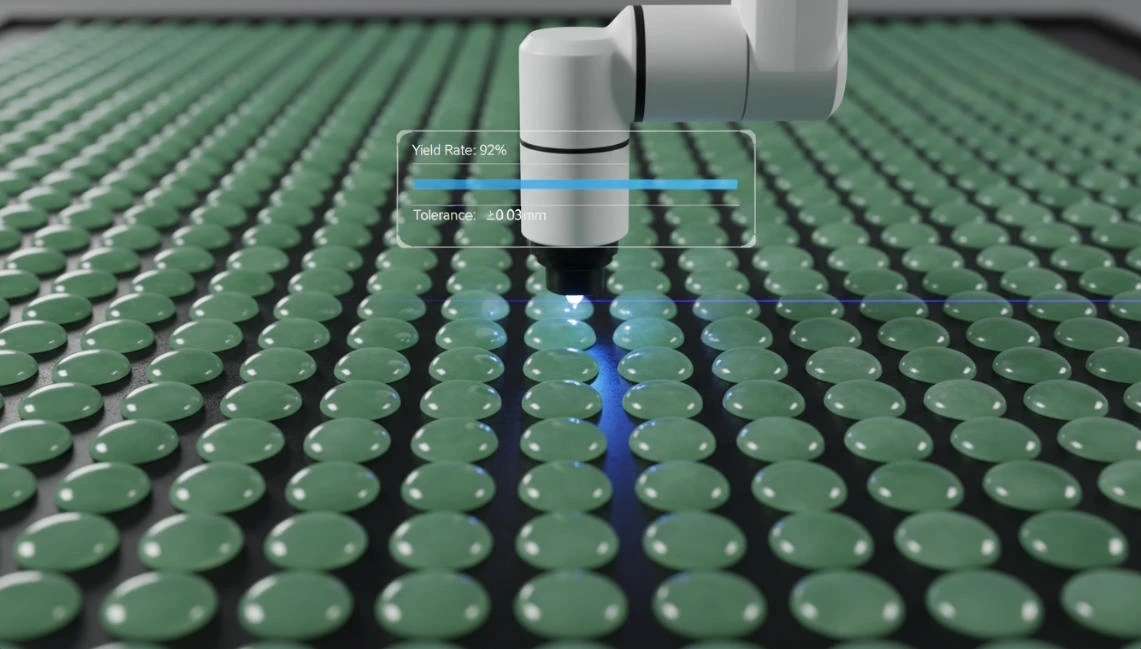
Before addressing processes and equipment, it is worth being direct about outcomes. Precision jade carving is not a marketing label applied to CNC-assisted workshops; it is a measurable manufacturing standard with specific, auditable results. The three areas where it creates the most immediate commercial impact are yield rate control, hidden defect elimination, and production repeatability — each of which directly affects your landed cost per unit, your quality assurance exposure, and your ability to reorder predictably at scale.
Yield Rate and Cost Control: The Hidden Arithmetic of Jade Sourcing
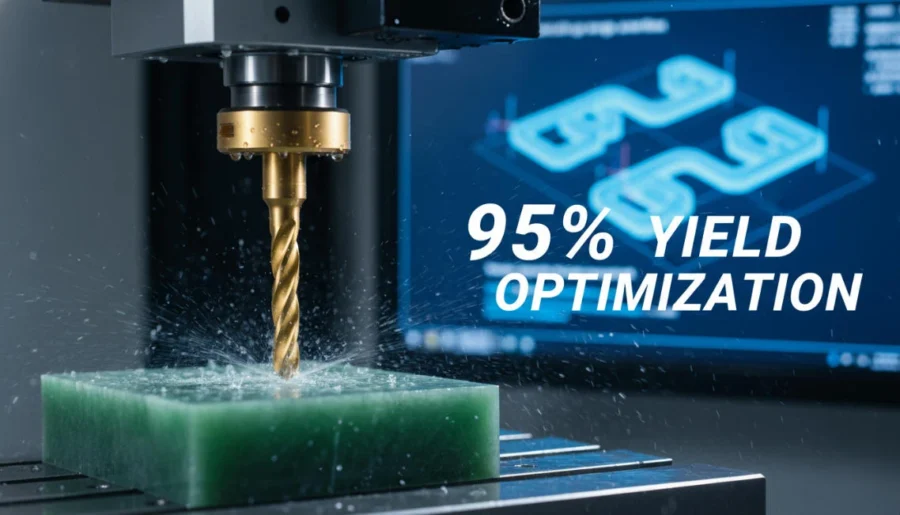
In conventional jade processing, yield rates fluctuate significantly depending on material variability, carver experience, and workshop conditions — factors that are difficult to audit from a distance and nearly impossible to contractually enforce. A jade process built on precision manufacturing changes this dynamic at the structural level. By combining CAD-defined dimensional tolerances with CNC-executed toolpaths, precision jade carving reduces rejected units and material waste at the point of production, not after the fact.
Research published in the Journal of Manufacturing Processes on CNC machining of hard and brittle materials documents that process-optimized toolpath strategies — controlling cutting speed, feed rate, and depth of cut relative to material fracture toughness — consistently reduce material rejection rates compared to unoptimized conventional cutting sequences. For jade and similarly structured hard stones, transitioning from manual carving to documented CNC process control shifts yield variability from an operator-dependent variable to a measurable, adjustable process parameter.
For every 1,000 units ordered, you receive measurably more sellable product from the same raw material investment. This means that your effective cost per finished unit decreases without requiring any renegotiation of unit price — the efficiency is built into the process itself.
Eliminating Hidden Fractures: The Quality Risk That Most Suppliers Cannot Quantify
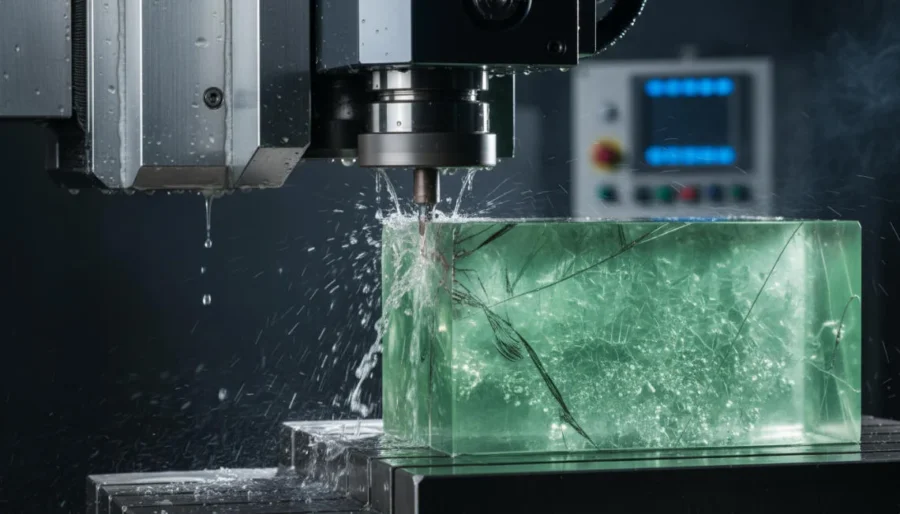
Subsurface fractures — micro-cracks and stress concentrations invisible to the naked eye — are the primary cause of post-shipment quality claims in jade and gemstone imports globally. The Gemological Institute of America (GIA) documents that internal fractures in jade directly affect structural durability and long-term wearability ratings, yet these defects are routinely missed by suppliers relying solely on visual inspection. Can your current supplier tell you, in quantified terms, how many hidden fractures per 1,000 units leave their facility? If not, that is a risk you are assuming on their behalf. Precision jade carving addresses this problem at the process stage, not the inspection stage. Through optimized CAM toolpath generation — which governs cutting angles, feed rates, and entry trajectories specific to each material profile — internal stress concentration is systematically reduced during machining itself. Fewer fractures are created in the first place, rather than identified and discarded afterward. This means that your defect-related return rate decreases before the shipment leaves the production floor — not after it reaches your customers or retail partners.
Repeatability at Scale: The Foundation for Sustainable Product Lines
Brand buyers managing seasonal collections or multi-SKU catalogs face a sourcing challenge that yield rate alone cannot resolve: the ability to reorder the same product — at the same dimensional specification, the same surface finish, the same visual standard — six or twelve months after the original production run. Traditional jade carving, regardless of its quality ceiling, depends on the availability and consistency of individual artisans. This is a structural limitation that no amount of craftsmanship can fully overcome at volume. Precision jade carving eliminates this constraint by encoding product specifications into verified 3D CAD files and executing them through locked, documented CNC programs. The same dimensional output is reproduced batch after batch without degradation in accuracy or surface quality. According to quality management frameworks applied in gemstone and hard material manufacturing, process-locked repeatability is the defining factor that allows brands to treat their supplier relationship as a long-term manufacturing asset rather than a per-order negotiation. This means that your design development investment — sampling costs, prototyping iterations, approval cycles, brand photography — retains its commercial value across multiple production cycles rather than expiring with a single run.
Production Case Reference in JADEMAGO — Jade Cabochon Component for Fine Jewelry Setting
Order volume: 2,000 units | Material: Type A Jadeite | Specified tolerance: ±0.03 mm | Date: 2025.04Pre-production sampling comparison (10 units per method):
- Traditional handcraft process
Achieved yield rate: 80% | Dimensional conformance rate: 75%
Defect classification: edge chipping (≈12%), dimensional deviation >0.03 mm (≈15%), surface asymmetry (≈8%)- Precision jade carving process
Achieved yield rate: 90% | Dimensional conformance rate: 89%
Defect classification: minor dimensional deviation (≈7%), micro-surface inconsistency (≈4%)(Full production documentation available upon NDA-governed request)
What Is Precision Jade Carving? Defining a Complete Manufacturing System
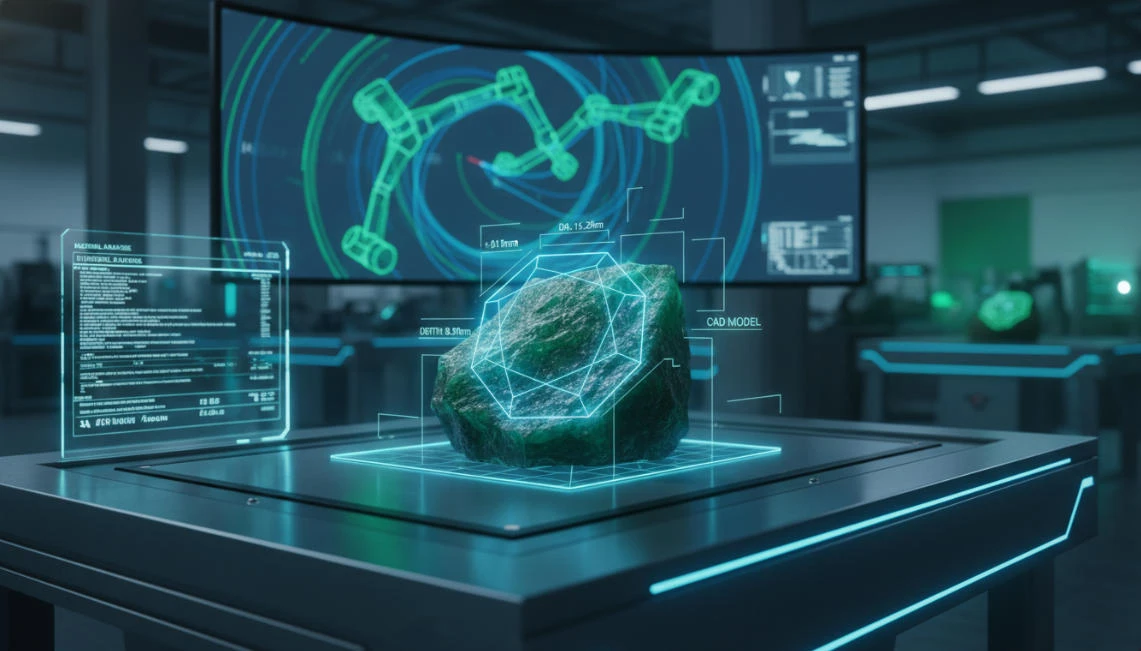
Precision jade carving is frequently mischaracterized as simply “using CNC machines to cut jade.” That definition is both technically incomplete and commercially misleading for any buyer trying to evaluate supplier capability. In practice, precision jade carving refers to a complete manufacturing system — a structured, sequential workflow encompassing digital modeling, computer-controlled machining, standardized post-processing, and metric-based quality inspection — in which every stage operates against a defined tolerance specification. The critical distinction is systemic, not equipment-based. A gemstone manufacturer that owns five-axis CNC machines but operates without integrated CAD/CAM planning, documented AQL protocols, or traceable inspection records is not running a precision jade carving operation. It is running conventional production with modern hardware — and the output consistency will reflect that gap.
How Precision Jade Carving Differs from Traditional Jade Carving
Traditional jade carving is a craft-driven process in which skilled artisans use rotating abrasive wheels, hand tools, and accumulated sensory experience to shape raw material into finished product. The quality ceiling of this approach is real and historically significant, but its consistency is structurally inseparable from the individual executing it. Precision jade carving replaces sensory judgment with quantified parameters at every critical decision point — from the tolerance fields defined in CAD software before the first cut, to the spindle speed and feed rate programmed into a five-axis CNC machine, to the surface roughness targets measured after polishing. According to the International Gem Society (IGS), jade’s interlocking crystalline and fibrous microstructure makes it particularly sensitive to mechanical stress and improper cutting geometry — which is precisely why process-level precision, not post-production screening alone, is the only structurally reliable path to consistent quality at production volume. Hand-finishing retains an important role within precision jade carving, but it functions as a controlled refinement stage with defined output parameters — not as the primary method of dimensional control.
The Four-Stage Architecture of a Precision Jade Carving System
The precision jade carving workflow is organized into four sequential and interdependent stages, each with its own measurable inputs, controlled parameters, and auditable outputs. These stages are: Digital Modeling and Toolpath Planning → Core Machining (CNC, Ultrasonic, Laser) → Post-Processing and Multi-Stage Polishing → Dimensional Inspection and Quality Control. Every stage in this architecture contributes to the final tolerance specification of ±0.01–0.05 mm, and no stage can be removed or bypassed without degrading the system’s overall precision capability. For a B2B buyer evaluating a jade manufacturer or gemstone manufacturer, auditing each of these four stages — not just observing the machining floor — is the only way to assess whether a supplier’s quality claims are genuinely systemic or merely situational. The following sections examine each stage in detail, with the specific parameters, technologies, and quality standards that define precision performance in a professional jade manufacturing environment.
1 — Digital Modeling and Toolpath Planning: Where Precision Jade Carving Actually Begins
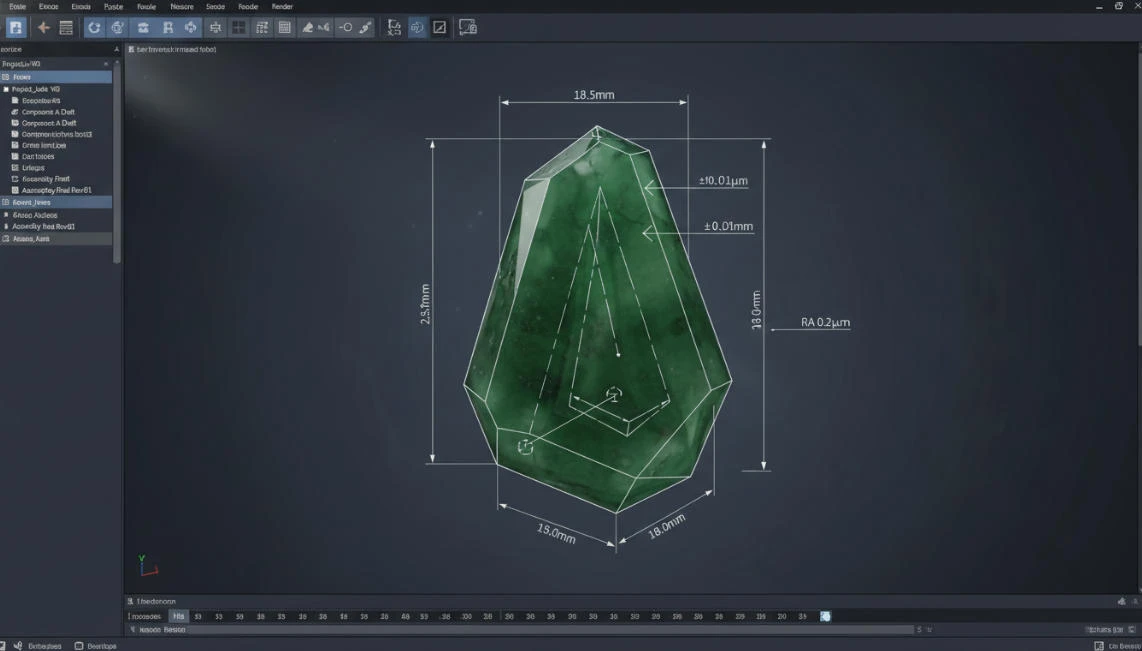
There is a common assumption in jade sourcing conversations that precision is primarily a machining problem — that if the cutting equipment is accurate enough, the output will be precise. This assumption is wrong, and acting on it leads buyers toward evaluating the wrong variables when qualifying a jade manufacturer. In a properly structured precision jade carving system, the tolerance of the finished product is largely determined before any physical material is touched. It is decided in the digital modeling and toolpath planning stage — the phase in which every dimension, every cutting angle, and every approach trajectory is specified, simulated, and locked into a reproducible program. If the digital foundation is imprecise or incomplete, no downstream machining technology can fully correct it. The errors are not created by the machine; they are inherited from the model.
CAD/3D Modeling in Jade Process: Defining Dimensions Before the First Cut
Computer-Aided Design (CAD) modeling in a precision jade carving workflow serves a fundamentally different function than rendering or visualization. Its primary purpose is dimensional specification — establishing the exact target geometry of every surface, edge, cavity, and feature in the finished piece, with explicit tolerance values assigned to each critical dimension. In a professional jade process environment, this means that before a single abrasive wheel contacts raw material, every critical measurement — outer diameter, wall thickness, setting depth, surface curvature — has already been defined in a format that can be directly transferred into machine control parameters. The CAD model also serves as the single reference document against which every downstream inspection measurement is evaluated. This means that your product specification is not stored in a carver’s memory or a workshop supervisor’s notes — it is encoded in a verified, version-controlled digital file that can be retrieved, audited, and reproduced independently of any individual operator. For buyers managing product lines across multiple seasons, this matters significantly: your dimensional standard exists as a durable, transferable asset rather than an institutional memory held by a single facility.
CAM Toolpath Optimization: The Technical Layer That Prevents Internal Fractures
Once the CAD model defines what the finished piece must be, Computer-Aided Manufacturing (CAM) software determines how the cutting tools will achieve it — and this “how” has direct, measurable consequences for the structural integrity of each jade piece. CAM toolpath generation in precision jade carving is not simply a matter of routing the cutter from point A to point B. It involves calculating cutting sequences, entry and exit angles, feed rates, stepover distances, and depth-of-cut increments specifically calibrated to the material properties of the jade being processed. Jade — whether jadeite or nephrite — is a brittle material with complex internal microstructures. According to the GIA’s gemological research on jade, jadeite’s interlocking granular texture and nephrite’s fibrous structure both create localized stress concentration points when subjected to improper cutting geometry. These stress concentrations are the origin of the subsurface micro-fractures that ultimately surface as post-production quality failures. CAM optimization directly addresses this by computing toolpaths that distribute cutting forces progressively and avoid the angular approaches most likely to initiate internal cracking. The result is a jade process in which structural integrity is engineered into the cutting sequence — not left to material luck or operator instinct. This means that the fracture risk embedded in your order is reduced systematically at the planning stage, before a single gram of raw material enters the machine.
2 — Core Machining Technologies: CNC, Ultrasonic, and Laser in Jade Manufacturing
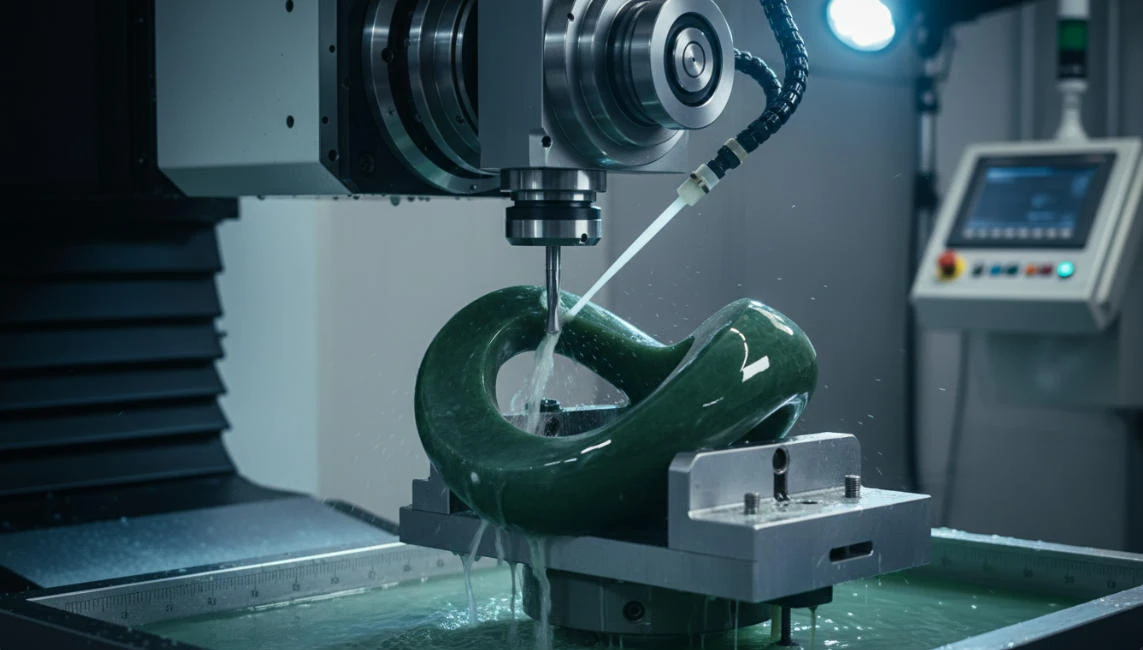
The machining stage is where the digital precision established in modeling becomes physical reality. In a professional precision jade carving operation, this stage is not defined by a single technology but by the coordinated deployment of multiple machining systems — each selected for its specific performance advantage with particular material profiles, geometric complexities, and surface finish requirements. A gemstone manufacturer capable of executing precision jade carving at production scale maintains at minimum three distinct machining capabilities: multi-axis CNC machining for primary geometry, ultrasonic machining for brittle and structurally complex material types, and laser processing for surface detail and branding applications. The selection of which technology — or which combination — is applied to a given piece is itself a precision decision, one that requires material knowledge, process engineering experience, and quality outcome data across a range of production scenarios.
5-Axis CNC Gemstone Mache: The New Benchmark in Precision Jade Carving
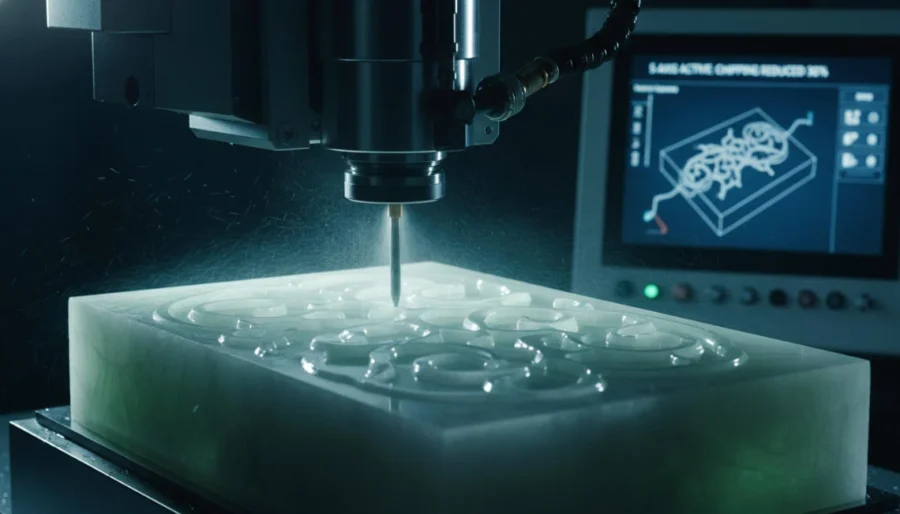
Five-axis CNC machining represents the current technical standard for precision jade carving at production volume. Unlike three-axis systems — which can only move cutting tools in X, Y, and Z linear directions — five-axis CNC platforms simultaneously control two additional rotational axes, allowing the cutting tool to approach any surface of the workpiece from any angle without repositioning the jade blank. This capability is not primarily an aesthetic advantage; it is a structural one. When complex geometries require multiple setups on a three-axis machine, each repositioning introduces a potential alignment error that accumulates across the part. On a five-axis platform, a component can be completed in a single setup, eliminating repositioning error as a tolerance variable entirely. For precision jade carving applications, this translates directly into tighter dimensional consistency across complex three-dimensional forms — cabochons with compound curvature, carved architectural elements, multi-level sculptural pieces — that would be technically impossible to produce to ±0.05 mm tolerance on conventional equipment. Industry quality benchmarks for CNC-based gemstone manufacturing, as referenced in precision hard-material machining literature, place five-axis capability as a prerequisite for achieving consistent sub-0.05 mm tolerances in jade and hard stone carving operations. This means that when you source from a jade manufacturer operating five-axis CNC systems within a full precision workflow, your complex design geometries are executed at a dimensional standard that three-axis equipment simply cannot reliably match — regardless of operator skill level.
Ultrasonic Machining for Brittle and Complex-Structure Jade Pieces
Not all jade pieces are best served by rotary CNC cutting, even when that cutting is executed with five-axis precision. For jade material with high internal brittleness, significant inclusions, or fine structural details that carry elevated fracture risk under conventional cutting loads, ultrasonic machining offers a technically superior alternative within the precision jade carving system. Ultrasonic machining operates on a fundamentally different mechanical principle: rather than removing material through continuous rotary cutting force, it delivers controlled high-frequency vibration — typically in the range of 18,000–40,000 Hz — through an abrasive slurry medium that erodes material progressively at the contact zone. Because the cutting force is distributed across millions of micro-impacts per second rather than applied as a continuous shear load, the stress imparted to the surrounding jade structure is dramatically lower.
Peer-reviewed research on ultrasonic machining of brittle ceramic and stone materials — published across materials science and precision engineering literature — consistently identifies subsurface damage depth reduction as a primary measurable advantage of ultrasonic over conventional rotary machining. A frequently cited study by Thoe, Aspinwall and Wise (1998), published in the International Journal of Machine Tools and Manufacture, established ultrasonic machining’s fundamental mechanical advantage in brittle material processing as a reduction in localized stress concentration — the same failure mechanism responsible for internal fractures in jade.
For jade specifically, the relevance of this mechanical principle is confirmed by the material’s microstructural classification: both jadeite and nephrite are brittle crystalline materials whose fracture behavior under cutting loads is governed by the same stress concentration dynamics documented in ceramics machining research.
For a jade process handling high-value raw material — where a single internal fracture can render an otherwise complete piece commercially unviable — this reduction in subsurface damage is not incremental; it is the difference between an acceptable yield loss and a manageable one. This means that your highest-value jade pieces, or those cut from material with complex internal structures, can be processed at precision tolerances with materially lower structural risk than conventional machining allows.
Laser Processing in Jade Manufacturing: Precision Branding and Surface Detail
Laser processing occupies a specific and well-defined role within the precision jade carving workflow — one that is frequently misunderstood as a replacement for CNC machining when it is, in practice, a complementary capability serving distinct production functions. In professional jade manufacturing, laser systems are applied primarily to two categories of work: brand identification engraving (logos, hallmarks, serial numbers, certification references) and fine surface decoration requiring detail resolution that exceeds the physical capability of rotary tooling. Laser engraving on jade operates through controlled thermal ablation — the laser beam removes micro-layers of surface material at a resolution measured in micrometers, producing crisp, burr-free mark geometry with no mechanical contact force applied to the surrounding jade surface. For brand clients requiring permanent, tamper-evident product identification on finished jade pieces, laser engraving delivers mark depth and edge definition that mechanical engraving cannot consistently replicate at scale. The Swiss Gemmological Institute SSEF references laser-based identification marking as a recognized method for applying permanent certification references to high-value gemstone and jade pieces without compromising surrounding surface integrity. For OEM clients working with JADEMAGO, laser capability within the precision production workflow means that your brand identity — logo, SKU reference, or certification mark — can be applied at the same dimensional standard as the rest of the piece, maintaining the visual and structural integrity of the finished product. This means that your branded jade products carry identification that is both commercially traceable and physically consistent with the precision manufacturing standard applied to every other aspect of the piece.
3 — Post-Processing: The Phase That Determines Market Value in Precision Jade Carving
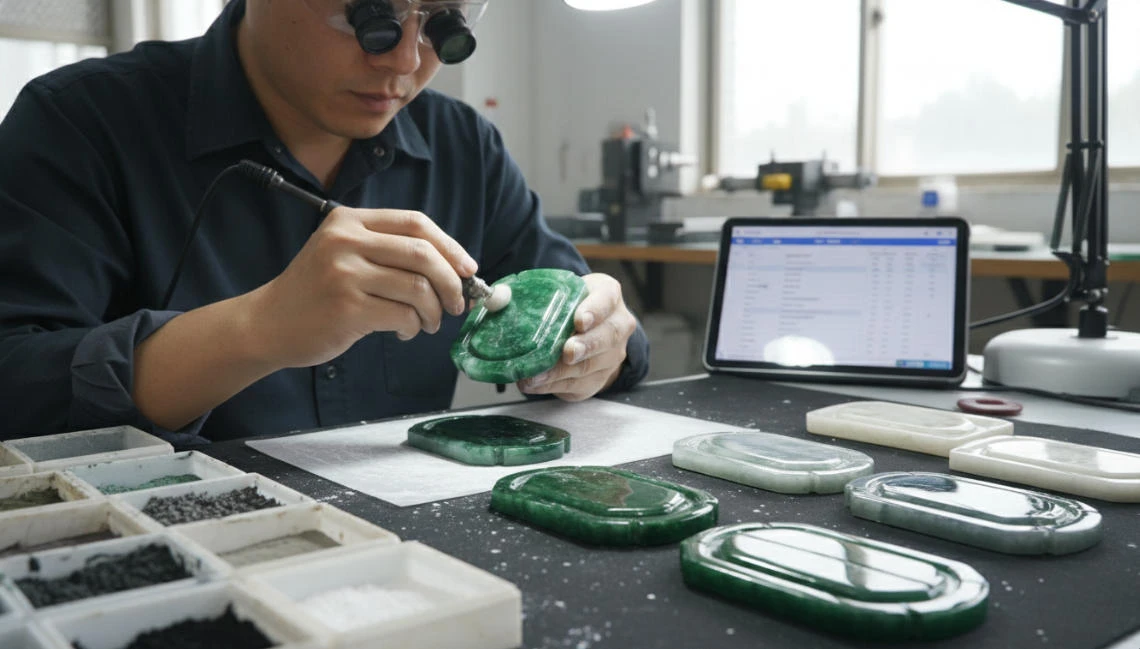
There is a persistent misconception in jade procurement that post-processing is a finishing step — a cosmetic procedure applied after the “real” manufacturing work is complete. In a precision jade carving system, this framing is both technically inaccurate and commercially consequential. Post-processing is the stage that converts a dimensionally accurate machined blank into a market-viable product. It determines surface reflectivity, tactile quality, optical depth, and the visual characteristics that buyers, consumers, and end-users evaluate first. More importantly, in the context of precision jade carving, post-processing must meet a higher and more exacting standard than in conventional jade manufacturing — because the dimensional precision achieved in machining creates surface conditions that require equally controlled finishing to preserve and express that precision in the final product. A piece machined to ±0.02 mm dimensional accuracy but finished with inconsistent polishing protocols will display surface irregularities that visually contradict the precision of its geometry. The finishing must match the machining — or the commercial value of the machining is partially lost.
Why Precision Jade Carving Requires a Multi-Stage Polishing Protocol
In conventional jade carving workshops, polishing is often a two-phase process: a coarse grinding pass to remove tool marks, followed by a final polish to achieve surface sheen. This approach is adequate for products where surface consistency is evaluated subjectively and batch-to-batch variation is accepted as normal. Precision jade carving operates under a fundamentally different requirement. Because the products exiting a precision manufacturing process are dimensionally consistent to within fractions of a millimeter, any surface inconsistency — a variation in gloss level, a micro-scratch pattern, a localized difference in reflectivity — becomes immediately visible by contrast. The surface must be as controlled as the geometry beneath it. A structured multi-stage polishing protocol in a precision jade process environment typically progresses through a sequence of abrasive grades, each stage removing the scratch pattern created by the previous stage and replacing it with a finer, more uniform surface texture. Grit progression in professional jade polishing operations commonly moves through five to seven discrete stages — from initial tool-mark removal at coarser abrasive grades, through intermediate refinement stages, to final polishing with sub-micron abrasive compounds that produce the characteristic translucent surface depth that defines high-quality jadeite and nephrite. Each stage is executed under controlled parameters — abrasive concentration, contact pressure, rotation speed, processing duration — rather than by operator tactile judgment alone.
The relationship between abrasive stage progression and surface roughness (Ra) reduction in hard stone and gemstone polishing is well-documented in precision surface finishing literature. Multi-stage abrasive protocols — progressing through sequenced grit grades from coarse material removal to sub-micron final polishing — achieve final Ra values orders of magnitude below the initial machined surface condition. The ASTM International standard for surface finish measurement (ASTM B46.1) provides the measurement framework within which these reductions are quantified and reported in professional manufacturing quality records.
This means that your finished jade products present a surface quality standard — in gloss consistency, scratch uniformity, and optical depth — that is reproducible across every unit in a batch, not dependent on which polishing operator handled each piece on a given production day.
Hand-Finishing in Precision Jade Carving: Controlled Craftsmanship, Not Variable Artistry
Hand-finishing within a precision jade carving workflow occupies a carefully defined role — one that is easy to mischaracterize if the distinction between controlled refinement and open-ended artisanal interpretation is not clearly understood. In a precision manufacturing context, hand-finishing does not mean returning control of the product to individual judgment after the machine has done its work. It means applying trained manual skill to specific, bounded tasks that require a degree of tactile sensitivity and positional flexibility that current automated polishing systems cannot fully replicate — tasks such as polishing recessed channels, curved undercuts, interior surfaces of carved cavities, or transitional zones between geometric planes where automated tooling creates inconsistent contact pressure. These areas are identified in the production plan before hand-finishing begins, the target surface specification is defined in measurable terms (surface roughness target, gloss level range), and the output of hand-finishing is inspected against those defined parameters before the piece advances to final quality control. JADEMAGO’s production process integrates hand-finishing as a documented, parameter-governed stage — not as an undefined quality buffer applied when the machine results are insufficient. The 65-year accumulated craft knowledge embedded in JADEMAGO’s finishing team is not deployed as a substitute for process discipline; it is applied within a process framework that defines where human judgment adds measurable value and where it must be constrained by quantified output targets. This means that the areas of your jade products most difficult to reach with automated equipment — the details that most directly communicate quality to the end consumer — are finished to the same defined standard as every other surface, with the same traceability and the same inspection accountability.
4 — Inspection and Quality Control: The Metrics That Define Precision in Jade Manufacturing
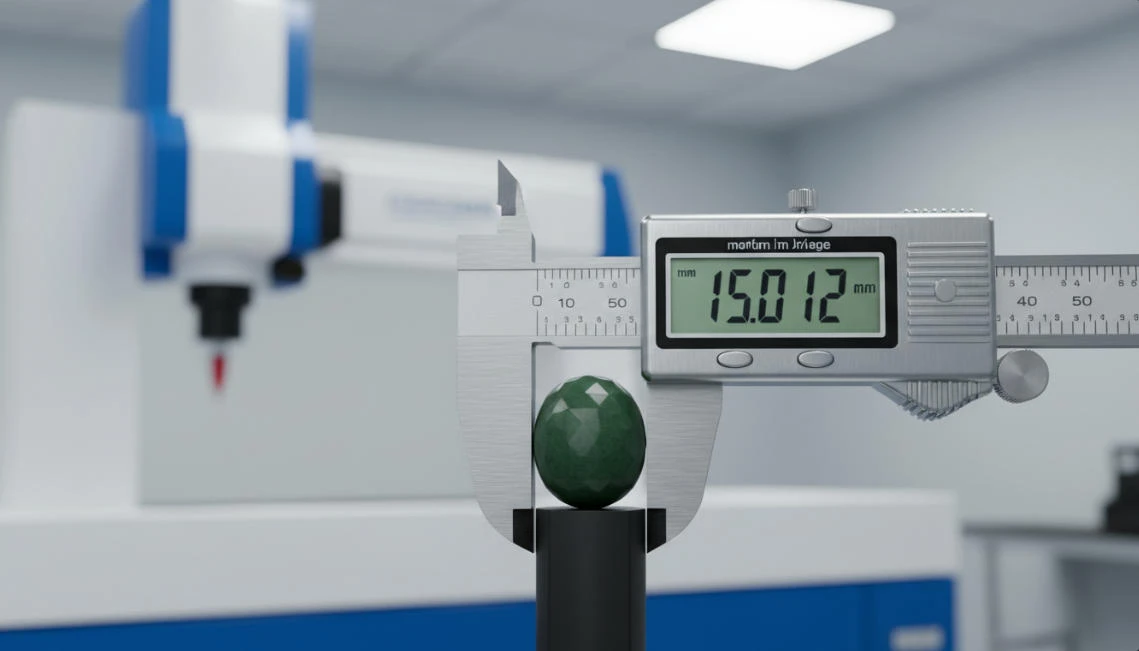
Quality control in a precision jade carving operation is not a gate at the end of production — it is a continuous measurement system embedded throughout the manufacturing process, with formal audit points at each stage transition and a final comprehensive inspection protocol applied to every finished batch before release. The distinction matters for B2B buyers because end-of-line inspection alone — regardless of how rigorous — can only identify defects that already exist. It cannot reduce the rate at which those defects are created. A precision jade manufacturing quality system integrates in-process measurement at the machining stage, surface assessment at the polishing stage, and final dimensional and structural verification at the completion stage, creating a multi-layered quality architecture in which each stage validates the preceding one and limits the propagation of any non-conformance through the system. For a gemstone manufacturer operating at production volume, this architecture is what allows dimensional consistency claims to be backed by data rather than asserted by reputation.
Dimensional Tolerance Standards: ±0.01–0.05 mm as the Measurable Benchmark of Precision Jade Carving
The tolerance specification of ±0.01–0.05 mm is the quantified definition of precision jade carving — and it is the first number you should request from any jade manufacturer claiming to operate at precision manufacturing standard. To understand why this range is significant, consider what it means in physical terms: ±0.05 mm is approximately the diameter of a fine human hair. Maintaining a finished jade dimension to within that deviation — across complex three-dimensional geometry, across brittle and structurally variable raw material, across production batches of hundreds or thousands of units — requires measurement capability, process control, and equipment calibration that conventional jade carving operations simply do not have in place. Dimensional measurement in a precision jade carving inspection system uses calibrated instruments — digital micrometers, coordinate measuring machines (CMM), optical comparators — capable of resolving measurements to 0.001 mm or better, ensuring that the measurement uncertainty itself does not consume a material portion of the tolerance budget. Every critical dimension on each piece — or on a statistically valid sample drawn from each production batch — is measured against the CAD-defined nominal values, and the resulting data is recorded as part of the production quality record. The GIA’s standards for gemstone measurement and grading establish dimensional accuracy as a foundational quality parameter for faceted and carved gemstones, noting that dimensional deviation directly affects setting compatibility, wearability, and product grading outcomes in fine jewelry applications. This means that when you specify a dimensional tolerance with JADEMAGO, that specification is verified against calibrated measurement data — not confirmed by a visual pass/fail assessment on the production floor.
Internal Defect Detection: Controlling Quality You Cannot See
Surface inspection, regardless of its rigor, cannot identify subsurface structural conditions — and in jade manufacturing, subsurface conditions are frequently the most commercially significant quality variable. Internal micro-fractures, stress concentrations, inclusion clusters, and material voids can all pass visual inspection without detection, yet manifest as structural failures, surface crazing, or wearability issues after the product reaches the end consumer. Can your current supplier provide you with documented internal defect detection data for your orders? If that data does not exist, you are making procurement decisions based on incomplete quality information. In a precision jade carving quality system, internal condition assessment is addressed through structured optical examination under controlled lighting conditions — including transmitted light inspection, cross-polarized light examination, and UV fluorescence assessment — which reveal subsurface structural features invisible under conventional surface lighting. The SSEF Swiss Gemmological Institute identifies transmitted light examination and UV fluorescence as standard diagnostic methods for evaluating the internal condition and treatment history of jade, noting their particular value in detecting fracture-filling treatments and structural discontinuities in both jadeite and nephrite. Internal inspection results are classified against defined acceptance criteria — with any piece presenting fractures, voids, or inclusions exceeding defined size or density thresholds rejected before reaching the polishing stage. This means that internal quality failures are intercepted in the production process — not discovered by your quality team after the shipment clears customs.
AQL Sampling Systems in Gemstone Manufacturing: Statistical Quality at Production Scale
For B2B buyers placing production orders at volume, the question of quality consistency is ultimately a statistical one: not whether any individual piece meets specification, but whether the batch as a whole — across hundreds or thousands of units — maintains the required quality level with a documented and auditable degree of confidence. Acceptable Quality Level (AQL) sampling systems provide the statistical framework for answering this question at production scale. An AQL system defines, for any given batch size and quality classification, the minimum sample size that must be inspected and the maximum number of non-conforming units that can be found within that sample before the entire batch is rejected for rework or 100% re-inspection. The AQL standard applied in a precision jade carving production environment — typically referencing ISO 2859-1, the internationally recognized attribute sampling standard for acceptance inspection — establishes both the sampling plan and the defect classification criteria (critical, major, and minor) against which each inspected unit is evaluated. At JADEMAGO, AQL inspection is applied to each finished production batch as a documented, record-generating process — not as an informal quality check. The resulting inspection data — sample size, defect counts by classification, batch accept/reject decision, and disposition of any non-conforming units — is retained as part of the production quality record and is available to clients as part of JADEMAGO’s quality documentation package. This means that when your order ships, the quality of what you are receiving is not a function of trust — it is a function of verified data, generated by a statistically valid sampling process, against defined acceptance criteria that you can audit before the shipment leaves the facility.
Precision, Consistency, Repeatability: The Three Pillars That Define the New Standard for Jade Manufacturing
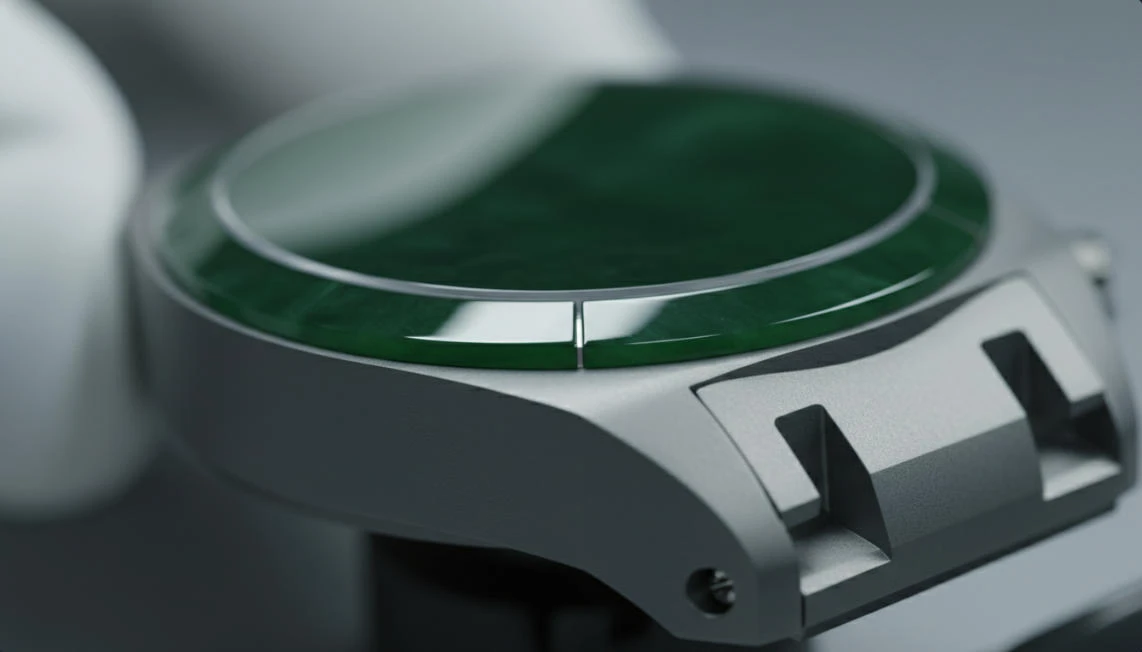
Precision jade carving is not a single technology, a single machine, or a single process step. It is the convergence of three measurable manufacturing capabilities — precision, consistency, and repeatability — into a unified production standard that can be audited, quantified, and contractually specified. Understanding each pillar separately, and understanding how they interact, is essential for any B2B buyer attempting to evaluate jade manufacturer claims with genuine rigor rather than relying on facility tours and sample quality alone. Each pillar addresses a different dimension of supply chain risk: precision governs your defect exposure at the unit level, consistency governs your quality variance at the batch level, and repeatability governs your operational risk at the product line level. A supplier who delivers on only one or two of these dimensions is not operating a precision jade carving system — they are operating a conventional system with selected precision elements, and the gaps will surface in your cost structure eventually.
Precision (±0.01–0.05 mm): Dimensional Control as a Supplier Qualification Standard in Precision Jade Carving
Dimensional precision — the ability to produce finished jade pieces that conform to specified measurements within a defined tolerance range — is the most immediately verifiable of the three pillars, and it should be the first metric you request from any jade manufacturer or gemstone manufacturer positioning itself as a precision supplier. The benchmark tolerance range for precision jade carving — ±0.01–0.05 mm — is not an arbitrary specification. It reflects the measurement capability of calibrated inspection equipment, the geometric accuracy of five-axis CNC machining platforms operating within their rated performance envelope, and the material removal consistency achievable through structured multi-stage polishing on hard stone. At the tighter end of this range (±0.01–0.02 mm), precision jade carving tolerance overlaps with the dimensional standards applied in precision optical component manufacturing and high-end watchcase production — industries where dimensional deviation has zero commercial tolerance. For jade applications, this level of precision is most critical in pieces designed for setting compatibility: a jade cabochon destined for a bezel setting, or a carved jade element designed to integrate with a metal framework, must conform to its specified dimensions to within a fraction of a millimeter or the assembly fails. According to the GIA’s gemological grading framework, dimensional conformity in carved and shaped gemstones directly determines setting suitability and therefore the commercial viability of the finished jewelry piece. This means that specifying ±0.05 mm or tighter on your jade components — and verifying that your supplier can demonstrate compliance through calibrated measurement records — directly reduces your assembly rejection rate and the rework costs embedded in your production downstream.
JADEMAGO maintains production quality records — including dimensional measurement data, inspection instrument calibration certificates, and AQL batch inspection reports — for all completed production orders. Prospective clients evaluating JADEMAGO’s precision jade carving capability are welcome to request a sample quality documentation package, which includes redacted measurement records from a completed production batch, demonstrating actual dimensional conformance data against specified tolerance targets. Contact JADEMAGO to request documentation.
Consistency: Why Batch-Level Uniformity Is the True Test of a Jade Manufacturer’s Precision Capability
A jade manufacturer that produces exceptional sample pieces but delivers variable production batches is not a precision manufacturer — it is a skilled workshop capable of high performance under conditions of concentrated attention. Batch-level consistency is the industrial proof of a precision jade carving system, because it demonstrates that the quality outcomes achieved are a function of process control rather than operator effort or management focus on any given production day. Consistency in precision jade carving is achieved through the same mechanisms that enable dimensional precision — locked CAD specifications, documented CNC programs, defined polishing protocols, calibrated inspection instruments — but it is measured and evidenced differently. Where precision is demonstrated by a single piece’s conformance to specification, consistency is demonstrated by the statistical distribution of measurements across an entire batch: the range, the standard deviation, and the percentage of units falling within the specified tolerance band. For buyers managing retail or wholesale product lines, this distinction carries direct commercial consequences. A product that varies visibly within a batch — in surface finish, in dimensional profile, in color presentation — requires additional sorting, regrading, or customer-level quality screening that adds cost and operational friction at every point in the distribution chain. A batch produced to a consistent precision standard ships, receives, and sells as a uniform product. This means that your inventory management, your quality assurance operations, and your customer-facing product presentation all benefit from the upstream consistency that a verified precision jade carving system delivers — without requiring you to invest additional resources in downstream sorting or quality recovery.
Repeatability: How Precision Jade Carving Enables Product Lines That Scale Across Seasons
Repeatability is the capability that transforms a single successful production run into a sustainable product line — and it is the pillar most directly tied to the long-term commercial value of your relationship with a jade manufacturer or gemstone manufacturer. In operational terms, repeatability means that a product produced today can be reproduced to the same dimensional specification, the same surface finish standard, and the same visual presentation in six months, twelve months, or three years — without requiring a new sampling cycle, a new approval process, or a renegotiation of production parameters. Conventional jade carving cannot reliably deliver this capability at production volume because it depends on variables — individual artisan skill, tool wear patterns, material lot characteristics — that shift continuously over time and cannot be fully re-standardized through instruction or supervision alone. Precision jade carving achieves repeatability by encoding product specification into durable, version-controlled digital assets: the CAD file defines the geometry, the CAM program defines the machining execution, the polishing protocol document defines the surface finish targets, and the inspection record for the original production run establishes the dimensional baseline against which all subsequent runs are validated. The International Gem Society notes that material consistency and process standardization are the two primary determinants of quality repeatability in carved gemstone production — both of which are directly addressed by the precision jade carving system architecture described throughout this article. This means that your design development investment — the prototype iterations, the approval cycles, the brand photography, the retail launch — retains its full commercial value across multiple production seasons, rather than being partially reset every time you reorder.
Why JADEMAGO: 65 Years of Jade Manufacturing Expertise Applied to Precision Standards
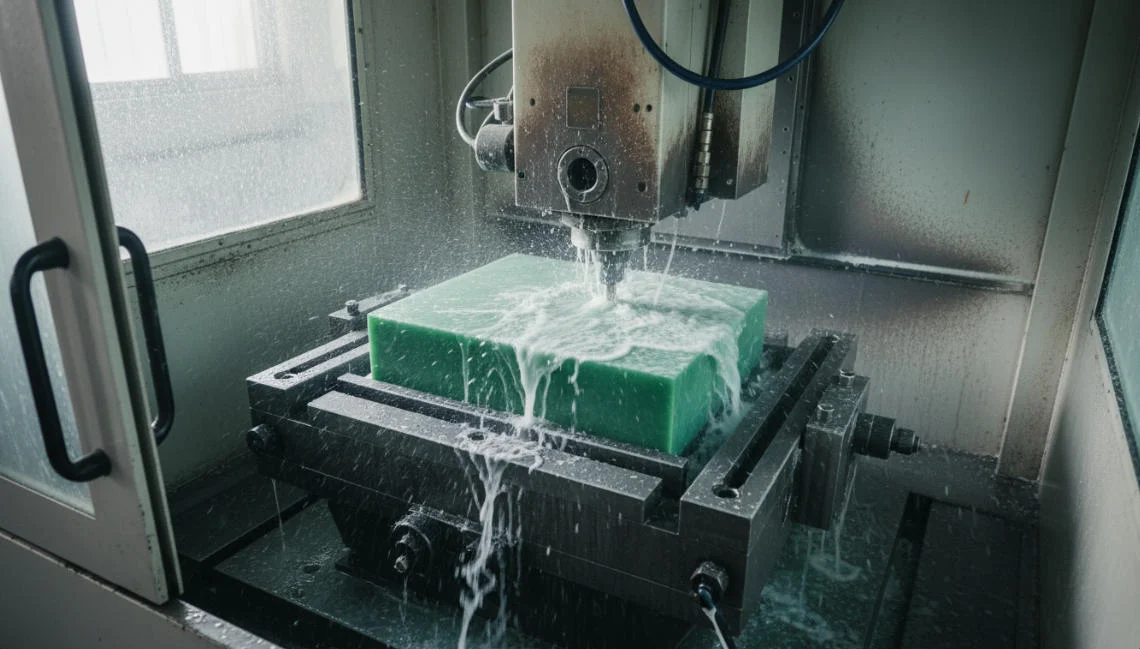
The commercial case for precision jade carving is clear in operational and financial terms. What remains is the practical question every B2B buyer must answer: which jade manufacturer can actually deliver this standard at your required volume, to your required specification, with the documentation and process transparency your quality assurance team can audit? JADEMAGO has been designing, processing, and manufacturing jade and crystal products for over 65 years — a production history that predates CNC machining in jade manufacturing and encompasses the full transition from craft-based carving to the integrated digital-physical production systems that define precision jade carving today. That history is not presented here as a credential in itself. It is relevant because it represents 65 years of accumulated knowledge about how jade behaves under machining stress, how different material varieties respond to polishing chemistry, and where the failure points in high-volume jade production are located — knowledge that informs every process parameter decision in JADEMAGO’s precision manufacturing operation.
From Source to Finished Product: JADEMAGO’s Vertically Integrated Jade Manufacturing Model
JADEMAGO operates as a vertically integrated jade manufacturer and gemstone manufacturer — meaning that your product’s journey from raw material selection through final inspection occurs within a single, controlled production environment rather than across a fragmented network of sub-suppliers and outsourced processing stages. Vertical integration in jade manufacturing carries specific quality implications that are worth understanding concretely. When raw material selection, initial blocking, precision CNC machining, multi-stage polishing, and final AQL inspection all occur within the same facility under a unified quality management system, the traceability of every quality decision is complete and unbroken. If a dimensional non-conformance is identified at final inspection, the production records allow that non-conformance to be traced back to its origin — whether in the CAM program, the machining setup, or a specific polishing stage — and corrected at the source rather than managed through increased inspection intensity at the end of the line. For buyers sourcing jade components for fine jewelry, home décor, or branded lifestyle products, this means that JADEMAGO’s quality accountability extends to every stage of your product’s production history — not just the final inspection certificate. Your supply chain audit does not stop at the factory gate; it extends through the entire production record of your specific order.
OEM and ODM Capabilities: Precision Jade Carving for Global Brand Partners
JADEMAGO’s precision jade carving infrastructure supports both OEM (Original Equipment Manufacturer) and ODM (Original Design Manufacturer) service models for brand clients across global markets — from fine jewelry brands requiring dimensionally precise jade components for metal settings, to lifestyle and wellness brands developing proprietary jade product lines under their own brand identity. Under the OEM model, your existing designs — provided as technical drawings, 3D CAD files, or approved physical samples — are translated into JADEMAGO’s precision production workflow: CAD specification verification, CAM program generation, five-axis CNC machining, multi-stage polishing, laser brand marking where specified, and AQL-graded final inspection. Every stage produces documented quality records that are provided as part of your delivery package. Under the ODM model, JADEMAGO’s design and engineering team works with your product brief — target application, material preferences, dimensional constraints, surface finish requirements, budget parameters — to develop original product concepts that are then executed within the same precision manufacturing framework. Whether you are sourcing against your own specification or developing a new product category with JADEMAGO’s design input, the precision jade carving standard — ±0.01–0.05 mm dimensional tolerance, AQL-verified batch consistency, documented process traceability — applies uniformly across both service models. If you are currently evaluating jade manufacturers or gemstone manufacturers for an upcoming product development or production program, you can contact JADEMAGO directly to discuss your specific requirements, request a capability demonstration, or initiate a sample production evaluation against your dimensional and quality specifications.
What a JADEMAGO Sample Evaluation Includes When you initiate a sample production evaluation, you receive: a finished physical sample produced against your dimensional specification; a dimensional inspection report showing measured values for all critical dimensions against nominal and tolerance; a material identification document confirming jade variety and structural condition; and a process summary identifying which machining technologies were applied to your specific piece geometry.
If you are conducting a supplier qualification process and require specific documentation — including equipment calibration records, quality management system documentation, or production process flowcharts — JADEMAGO can provide a supplier qualification package tailored to your procurement audit requirements.
Precision Jade Carving as a Supply Chain Standard, Not a Marketing Claim
Precision jade carving is not a term that should appear in a supplier’s marketing materials without being supported by specific, auditable evidence: documented tolerance specifications, calibrated inspection records, AQL sampling data, and a four-stage production architecture in which digital modeling, controlled machining, structured polishing, and metric-based inspection each operate against defined parameters. For B2B buyers, the practical implication of this standard is straightforward. A jade manufacturer operating a genuine precision jade carving system gives you lower defect exposure at the unit level, more uniform quality at the batch level, and more reliable reorder performance at the product line level — all of which reduce the total cost of your jade sourcing relationship over time, independent of unit price negotiations. The three pillars — precision (±0.01–0.05 mm), consistency (batch-level uniformity), and repeatability (season-to-season dimensional stability) — are not aspirational quality descriptors. They are measurable, contractually specifiable manufacturing outcomes that your supply chain is either receiving or not receiving from your current supplier. If you cannot verify them with data, you do not yet have them. JADEMAGO invites you to evaluate our precision jade carving capabilities against your specific production requirements — with sample production, documented quality records, and full process transparency at every stage.
FAQs for Precision Jade Carving
1. What tolerance defines precision jade carving?
Precision jade carving typically operates within a tolerance range of ±0.01–0.05 mm, ensuring high dimensional accuracy for B2B applications.
2. How does precision jade carving improve yield rate?
By using CAD/CAM and CNC-controlled processes, it reduces material waste and defects, increasing yield rates compared to traditional handcraft methods.
3. Can precision jade carving reduce hidden fractures?
Yes. Optimized toolpaths and controlled machining parameters minimize internal stress, reducing micro-cracks before they occur.
4. Is hand-finishing still used in precision jade carving?
Yes, but only in controlled areas. It follows defined standards and supports machine precision rather than replacing it.
5. Why is repeatability important in jade manufacturing?
Repeatability ensures that products can be reproduced with the same specifications across multiple batches, enabling stable long-term supply.