According to JADEMAGO’s internal purchasing data from 2025, only about 30% of all raw jade acquired that year could be used for jade bangle manufacturing — and fewer than 10% of total raw material met the threshold for high-grade bangle production. If you are exploring jade bangle wholesale sourcing and wondering why prices remain persistently high, that single statistic contains the entire answer. A bangle is not manufactured in the conventional sense — it is discovered within a raw stone, and the discovery rate is brutally low. This guide walks you through every stage of the jade manufacturing process that transforms a raw boulder into a finished bangle, so that your procurement decisions are grounded in technical reality rather than supplier claims.
Table of Contents
Why Are Jade Bangles the Most Expensive Jade Jewelry? The 3 Real Cost Drivers
Many buyers assume that wholesale bangle prices are inflated by brand positioning or market speculation. The evidence points elsewhere. Three structural factors, each rooted in material science and jade manufacturing physics, consistently push bangle costs above every other jade jewelry category. Understanding these three drivers is the most reliable way to protect your sourcing margins.
Low Material Yield: When 90% of Raw Stone Cannot Become a Bangle
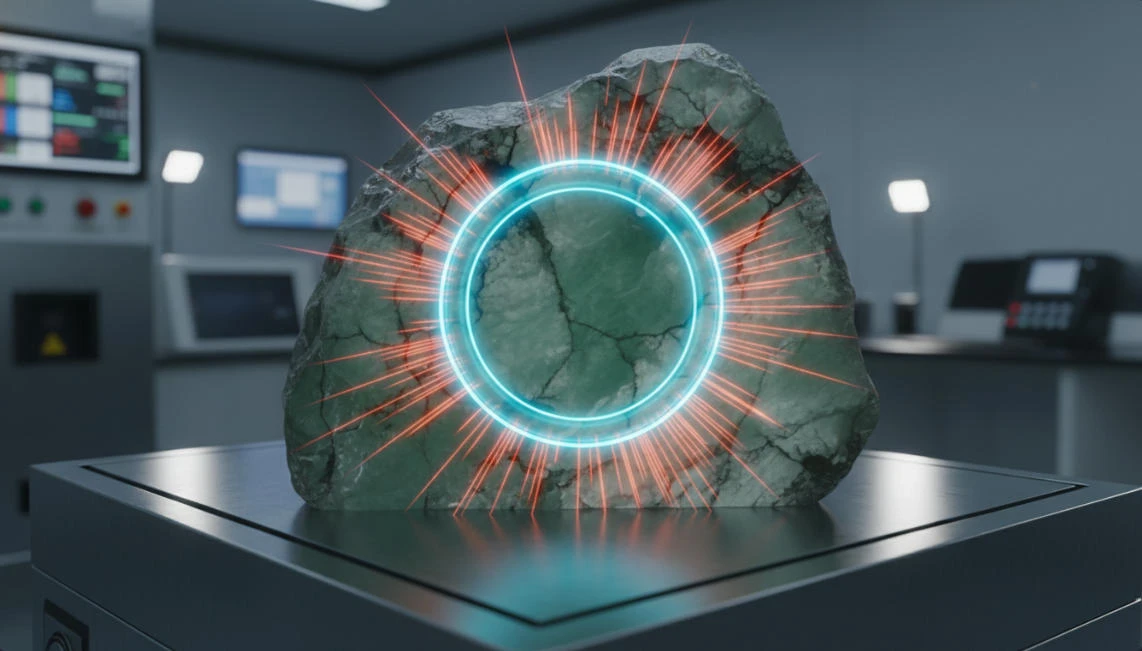
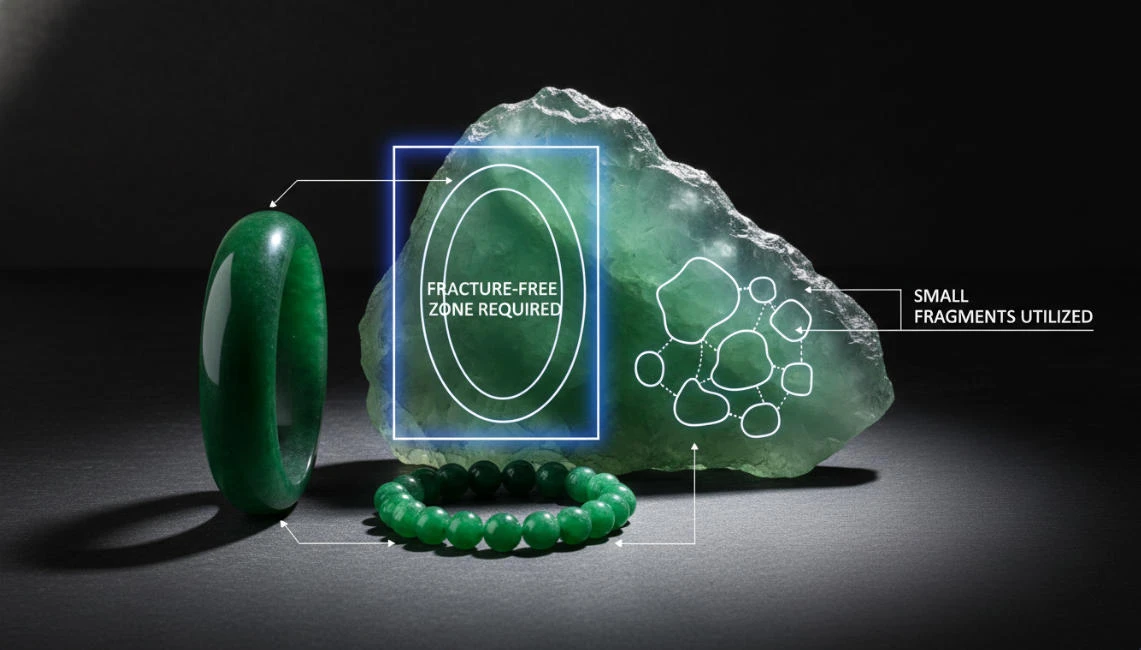
The closed-loop geometry of a bangle imposes a constraint that no other jade jewelry form shares. A pendant can be carved from an irregular fragment. Beads can be drilled from small offcuts. A bangle requires a continuous, unbroken ring — which means the raw stone must provide a section wide enough, thick enough, and internally clean enough to yield a complete circle. According to GIA’s foundational research on jadeite, the structural integrity of a finished piece depends directly on the absence of internal fractures along the cutting plane — a condition that dramatically reduces the number of usable zones within any given boulder.
JADEMAGO’s 2025 purchasing records make this concrete: less than 10% of total raw material met the internal quality standards required for high-grade production. When you purchase a wholesale bangle, you are effectively paying for the nine pieces of raw stone that were rejected in the process of finding the one that qualified. This is not a margin strategy. It is a material reality that shapes every jade bangle wholesale quote you will ever receive.
High Processing Risk and Uncompromising Raw Material Standards
Even when a suitable raw stone is identified, the path to a finished bangle runs through irreversible, high-stakes operations. Unlike metal jewelry, jade cannot be repaired after a structural failure — a crack introduced during cutting can render an entire stone commercially worthless in seconds. This processing exposure is one of the structural reasons why jade manufacturing costs remain significantly higher than those of other gemstone categories. Three material criteria — fracture mapping, color distribution, and translucency consistency — must be satisfied simultaneously in the specific zone where the bangle will be extracted. According to the International Gem Society’s documentation on jade grading, these same three properties are the primary value determinants in finished jade — and in bangle production, all three must be evaluated before a single cut is made.
A supplier quoting unusually low wholesale prices on bangles is either working with lower-grade raw material or absorbing losses that will eventually appear elsewhere in quality or reliability. The risk premium embedded in bangle pricing is real and unhedgeable — and understanding it is the first step toward evaluating supplier quotes with confidence.
The 8-Step Jade Bangle Manufacturing Process:
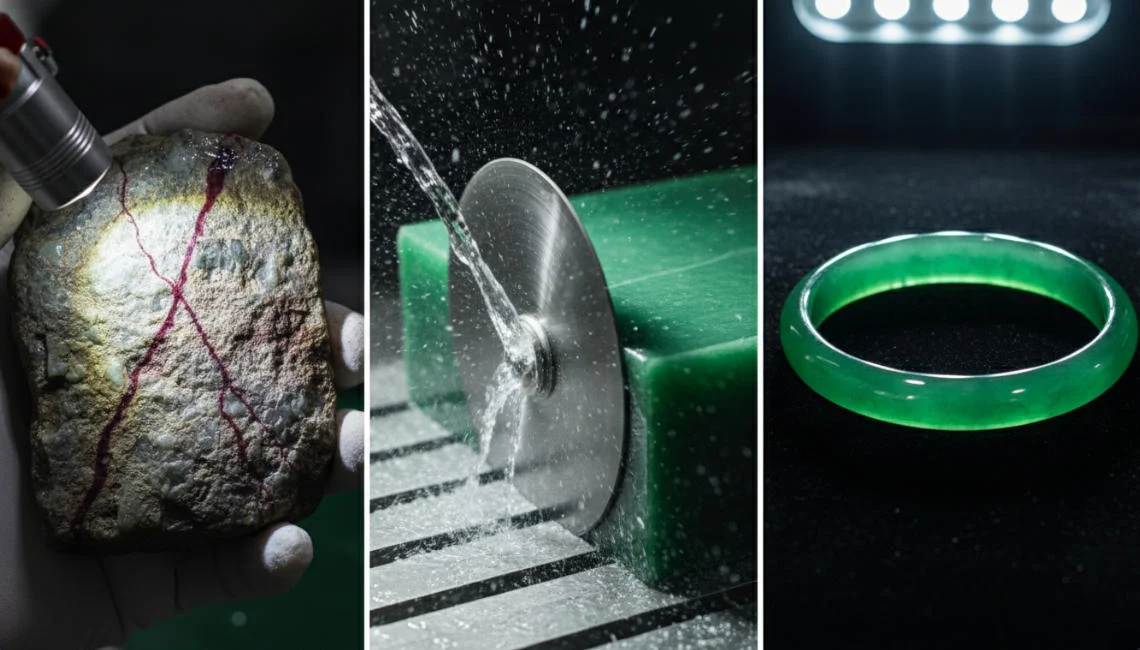
The production of a bangle follows a sequence refined over decades of jade manufacturing experience. Each step builds on the last, and the consequences of errors are cumulative and irreversible. What distinguishes a technically competent production facility from one that simply owns the right equipment is not the machinery — it is the depth of process knowledge applied at each decision point.
1 — Raw Material Selection: Where Quality Is Set, Not Built
Selection is where the manufacturing sequence actually begins, and it is the stage that most wholesale buyers never see. By the time a finished bangle reaches your hands, every quality characteristic visible in that piece was determined not at the polishing wheel, but at this first evaluation stage. No amount of skilled jade manufacturing downstream can recover quality that was not present in the raw stone at the moment of selection. This single fact has more bearing on the consistency of your wholesale supply than any other variable in the production chain.
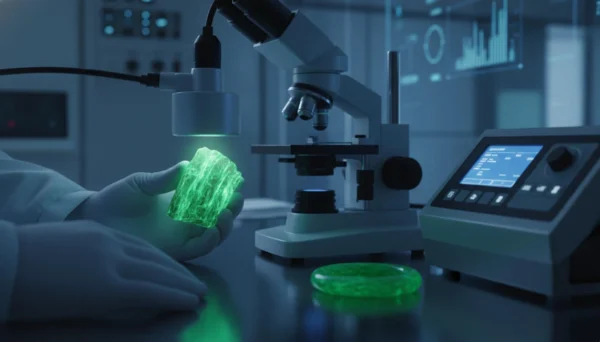
The selector works with a strong transmitted light source, evaluating three properties simultaneously: fracture mapping (the location and trajectory of any internal cracks), color distribution (how evenly color is spread across the cross-section at the planned bangle extraction depth), and translucency consistency (whether light passes through the material uniformly). According to GIA’s technical notes on jadeite fracture characteristics, even hairline fractures invisible under reflected light can propagate catastrophically under the mechanical stress of drilling. A selector who misjudges any of these three criteria sets in motion a chain of production operations that terminates in either a structurally compromised product or a complete production loss — which means your access to consistently graded inventory depends entirely on whether the manufacturer employs selectors with the experience to make this call correctly, every time.
2 — Slab Cutting: The Precision Discipline of Jade Manufacturing
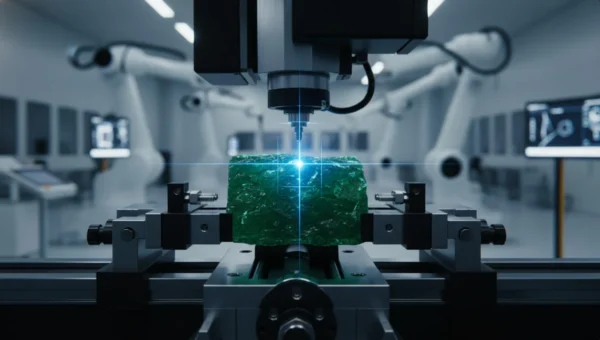
Once the raw stone has been approved and extraction zones mentally mapped, the stone moves to the cutting stage. The core challenge in this phase of jade manufacturing is that the cutting path must follow the plan established during selection while navigating around internal fractures that the blade cannot see. SSEF’s jade analysis protocols document that structural integrity is directly affected by the mechanical stress introduced during primary cutting — a stress amplified when cutting paths run parallel to existing fracture planes. A single misdirected cut can eliminate the entire value of the stone being processed. The instruction given to every cutter at a competent production facility is captured in a single word: steady.
3 — Circle Marking: The Geometry Decision That Determines Jade Bangle Wholesale Yield
With finished slabs in hand, the operator determines where bangle outlines will be drawn using circular templates. The complexity lies in the placement logic: each circle must be positioned to avoid fracture intersections, maximize the number of bangles extracted per slab, and account for color-quality zones across the slab surface. A skilled operator can consistently extract one additional bangle per slab compared to an average operator — and across a production run of several hundred slabs, that difference directly supports more competitive jade bangle wholesale pricing for buyers working with manufacturers who have invested in experienced personnel.
4 — Core Drilling: Why Inner Diameter Always Comes First in Jade Manufacturing
The core drilling stage — known in Chinese jade production as 套圈 (tào quān) — uses a hollow diamond-tipped core drill to liberate the bangle blank from the slab. The operation requires two passes, and the sequence is not interchangeable: the inner diameter must always be cut first. The inner diameter (圈口, quān kǒu) is the single most critical dimension of a finished bangle — it determines wrist fit, size grade classification, and whether the raw material zone can support a complete bangle at all. Cutting the outer diameter first generates three specific failure modes: eccentric boring (the inner cut loses its geometric reference and drills off-center, producing a bangle with uneven wall thickness), catastrophic fracture exposure (a thin outer ring shatters under the vibrational stress of the inner drill), and reduced production flexibility (the operator loses the ability to adjust size parameters in response to what the inner drill reveals about the stone’s internal condition).
According to GIA’s technical research on jadeite fracture behavior, internal fractures propagate preferentially under tensile stress — precisely the condition created when a thin outer ring is subjected to inner-drill vibration. For borderline raw material, experienced operators begin with a “probe bore”: a partial inner diameter cut at reduced feed rate, specifically to read the stone’s internal response before committing to the full drilling depth. This technique is one of the practical differentiators between a jade factory with deep process knowledge and one that executes drilling as a mechanical routine. The inner-first rule applies to approximately 99% of production scenarios; even in rare exceptions — ultra-high-value material or non-circular custom forms — the inner diameter remains the primary controlled variable.
The material removed during core drilling — the central plug extracted by the inner diameter cut and the irregular offcuts surrounding the outer diameter cut — is not discarded. These fragments are collected, sorted by size and quality, and directed into pendant, bead, and cabochon production. This zero-waste approach to secondary materials is one of the operational details that supports more sustainable wholesale bangle pricing for buyers working with manufacturers who manage their raw material economics with this level of discipline.
5 & 6 — Shaping and Grinding: From Raw Blank to Polishing-Ready Surface
The shaping step corrects dimensional deviations introduced by drill vibration, using grinding wheels to bring the bangle to its specified diameter targets. What makes this technically demanding is that jade is not uniform in its response to abrasion — jadeite registers 6.5–7 on the Mohs hardness scale but its interlocking crystalline microstructure creates local hardness variation across the surface of a single blank. An operator applying uniform grinding pressure will inevitably remove more material from softer zones and less from harder ones, creating a subtly irregular cross-section that becomes apparent in the finished piece. Skilled operators compensate by continuously adjusting pressure and contact angle as they work around the bangle. Your finished bangle’s dimensional consistency — the evenness of its wall thickness and the true circularity of its ring form — is a direct function of the operator’s tactile experience built over years of jade processing work.
The grinding step that follows progressively reduces surface roughness, moving through a sequence of abrasive grits — typically 120 mesh through 1200 mesh — before the surface is ready for polishing. According to IGS’s technical documentation on gemstone finishing, skipping grit stages to reduce processing time is one of the most common sources of polishing failure in gemstone production — residual deep scratches cannot be eliminated by polishing compound and manifest as permanent haze in the finished surface. For wholesale bangles, where the surface area is large and the visual impact of surface quality is correspondingly high, this discipline is non-negotiable. Every grit stage must fully complete its work across the entire bangle surface — inner face, outer face, and both lateral edges — before the operator advances.
7 — Polishing: Where Every Preceding Decision Becomes Visible
Polishing is the stage where the cumulative quality of every preceding production operation becomes visible all at once. A bangle that has been correctly selected, cut, shaped, and ground will respond to polishing by developing the deep, glass-like luster that commands premium pricing in wholesale and retail markets. A bangle where any preceding step was compromised will reveal those compromises — as persistent haziness, directional scratch patterns, or zones of differential reflectivity that no amount of additional polishing can fully correct. What you see in the finish of a completed bangle is the record of everything done — and not done — before it reached the polishing wheel.
The operation uses cerium oxide polishing compound applied at low rotational speeds. High-speed polishing generates frictional heat that can cause micro-cracking in the crystalline structure immediately beneath the polished face — producing a surface that looks acceptable initially but develops crazing over time. GIA’s gemological training materials on jade surface characteristics note that finished jadeite is evaluated for both its reflective quality and its subsurface optical character — how effectively it transmits and diffuses light through the body of the stone. Both properties are directly shaped by the discipline of the polishing operation. The surface durability you receive in a jade bangle wholesale shipment is a direct consequence of this process discipline, not just raw material quality.
8 — Grading and Quality Inspection: How Bangles Are Classified Before They Reach You
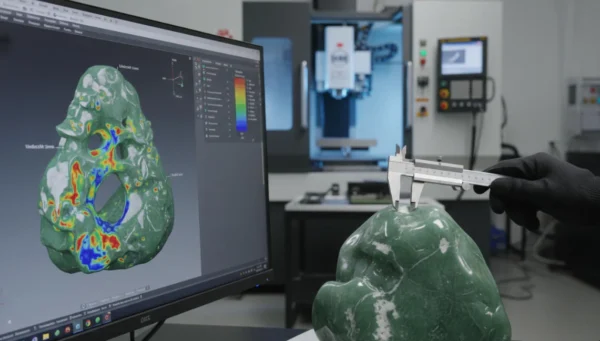
The grading stage is the one that directly structures the wholesale transaction. Every finished bangle passes through a structured four-parameter inspection before it is assigned a grade and made available for purchase. The four parameters are: structural integrity (examination under magnification and transmitted light for any processing-induced fractures), color consistency (evaluated under both daylight-equivalent and incandescent lighting to detect color shifts that may only appear under specific conditions), geometric precision (circularity of inner and outer diameter and uniformity of wall thickness), and surface finish quality (uniformity of polish, absence of residual grinding scratches or tool marks). According to SSEF’s jade testing and documentation standards, even processing-induced fractures that do not penetrate the full wall thickness represent a significant quality concern, as they create stress concentration points that increase the risk of fracture during normal use.
Bangles that pass all four criteria at the highest threshold are classified as high-grade and carry corresponding wholesale pricing. Pieces with multiple deviations or structural integrity concerns are removed from wholesale inventory entirely. Understanding what each grade classification represents — in terms of the raw material yield rate, the processing precision applied, and the inspection criteria enforced — puts you in a position to evaluate supplier pricing with genuine technical confidence. This is what it means to source jade bangle wholesale inventory intelligently rather than reactively.
Jade Bangle vs. Jade Bracelet: Key Differences Every Wholesale Buyer Should Know
The terms “jade bangle” and “jade bracelet” are used interchangeably in some wholesale catalogs, creating genuine commercial confusion that leads to mismatched inventory and pricing miscalculations. The two categories are structurally different, materially different, and economically different in ways that trace directly back to the jade manufacturing processes described in the preceding chapters. If you are sourcing either category, understanding the distinction precisely is a prerequisite for evaluating the quotes you receive.
Structure, Material, and the Real Price Difference
A jade bangle is a single continuous ring of jade — one unbroken piece of stone with no joints, clasps, or assembly points. A jade bracelet, by contrast, is an assembled piece: multiple jade elements connected by metal findings, elastic cord, or wire, where each component only needs to satisfy its own local size and quality requirements. This structural difference explains the material cost differential in jade processing. Bangle-grade raw stone must present a usable cross-section of at least 70–85mm — before accounting for material lost to the saw and drill — while bracelet components can be extracted from fragments as small as 15–20mm. The International Gem Society’s reference material on jade value factors confirms that raw jade pricing scales non-linearly with the size of usable sections — larger, internally clean zones command premiums that increase disproportionately with size.
When you compare jade bangle wholesale prices against bracelet prices of apparently similar visual quality, you are not comparing equivalent material investments. The bangle price incorporates the cost of raw material that was large enough, clean enough, and internally uniform enough to satisfy the closed-loop geometry requirement — a requirement that eliminated roughly 70–90% of the available raw material supply before the first cut was made. When a supplier presents both categories at similar price points, that alignment should prompt scrutiny. A price parity either reflects a quality difference in the bangle — lower-grade raw material, less rigorous jade processing — or a pricing error.
A Framework for Evaluating Jade Bangle Wholesale Pricing
Three structural relationships hold consistently across the wholesale bangle market. First, raw material yield rate determines per-unit material cost: a manufacturer working with 10% bangle-grade yield is embedding ten units’ worth of raw material acquisition cost into each finished piece. GIA’s pricing guidance for jadeite consistently identifies raw material quality as the primary driver of finished jade value — a relationship that no amount of processing skill can fully override. Second, processing precision determines defect rate: a facility with experienced selectors, disciplined cutters, and thorough graders produces fewer defects per batch, supporting competitive pricing without quality compromise. Ask any prospective supplier for their production yield data — the ratio of finished, graded wholesale pieces to raw material input — before you commit to an order. Third, grading transparency determines inventory predictability: a supplier with clearly defined, consistently applied grade classifications allows you to build predictable retail inventory at each price point, while grading opacity creates downstream returns and reputational cost that consistently exceeds any short-term price saving.
Why Source Your Jade Bangles from JADEMAGO: What 65 Years of Jade Manufacturing Actually Delivers
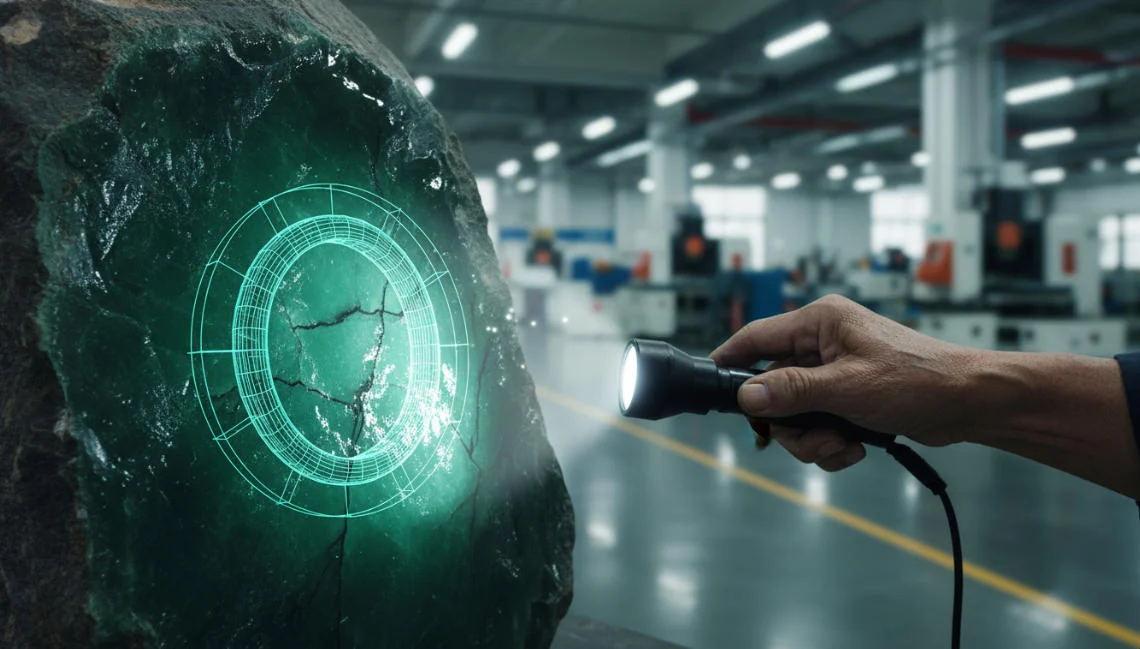
What follows is a specific account of what JADEMAGO’s manufacturing structure actually does — in measurable, verifiable terms — and what that means for the economics of your jade bangle wholesale sourcing operation. You should evaluate every claim here against the technical framework established in the preceding chapters, because that framework is precisely the standard against which any jade factory‘s capabilities should be measured.
65 Years of Jade Manufacturing Experience and Full Vertical Integration
JADEMAGO has accumulated more than 65 years of continuous operational experience in jade sourcing and production. In jade manufacturing, that tenure is a proxy for something technically specific: the depth of pattern recognition that experienced selectors bring to the raw material evaluation stage. Raw jade does not come with a certificate of internal quality — every boulder’s fracture geometry, color distribution, and translucency characteristics must be read from the outside and interpreted in terms of what exists inside. A selector with two years of experience is working from a mental library built on hundreds of stones. A selector with twenty years is working from a library built on tens of thousands. You benefit from this not as an abstract quality promise, but as a concrete reduction in the rate of post-delivery quality discrepancies — the kind that generate return requests, damage supplier relationships, and erode the margin you expected when you placed your order.
JADEMAGO operates as a vertically integrated manufacturer, maintaining direct operational control from raw material procurement through finished product grading. The selector who evaluates a raw stone and the grader who inspects the finished bangle are operating within the same quality management system, against the same standards, with the same accountability structure. There is no intermediary who purchased finished product purchased from a third-party processor and relabeled them. For your sourcing operation, vertical integration delivers a specific and quantifiable benefit: inventory consistency. When you place a reorder for a grade classification that performed well in your retail environment, you receive product that matches your initial order because the jade manufacturing process is still running to the same parameters — not because a supplier searched the spot market for similar pieces.
Raw Material Standards, Custom Production, and Grading Transparency
JADEMAGO’s raw material procurement applies the three-criteria evaluation framework — fracture mapping, color distribution assessment, and translucency consistency analysis — as a hard filter at the sourcing stage, before material enters the jade processing facility. Raw stone that does not meet bangle-grade thresholds on all three criteria is redirected to pendant and bead production or declined entirely. This pre-production filtering is what makes JADEMAGO’s 10% high-grade yield figure meaningful: it is the output of a deliberate standard that accepts the material economics of bangle-grade sourcing rather than working around them. The practical consequence for your procurement is direct — the raw material cost embedded in each piece reflects genuine bangle-grade selection criteria, and that transparency is what allows for consistent grading output across every order you place.
For buyers with requirements outside standard catalog specifications — custom interior diameter ranges, specific color characteristics, or tighter grade consistency thresholds — JADEMAGO’s vertically integrated production structure accommodates these needs through a direct specification process. Interior and exterior diameter tolerances, color requirements, and grade thresholds can all be set to your specified parameters, with production planned from the raw material selection stage. Grading documentation for each order includes a grade breakdown showing the distribution of pieces across classification levels and the results recorded for each inspection parameter. In jade bangle wholesale sourcing, documentation of this kind is not standard practice across all suppliers. When you find a manufacturer that provides it consistently, you have found a supplier whose quality commitments are structured to be verifiable rather than merely asserted — and that difference is worth more than any single price concession.
What Understanding the Manufacturing Process Is Worth to Your Sourcing Operation
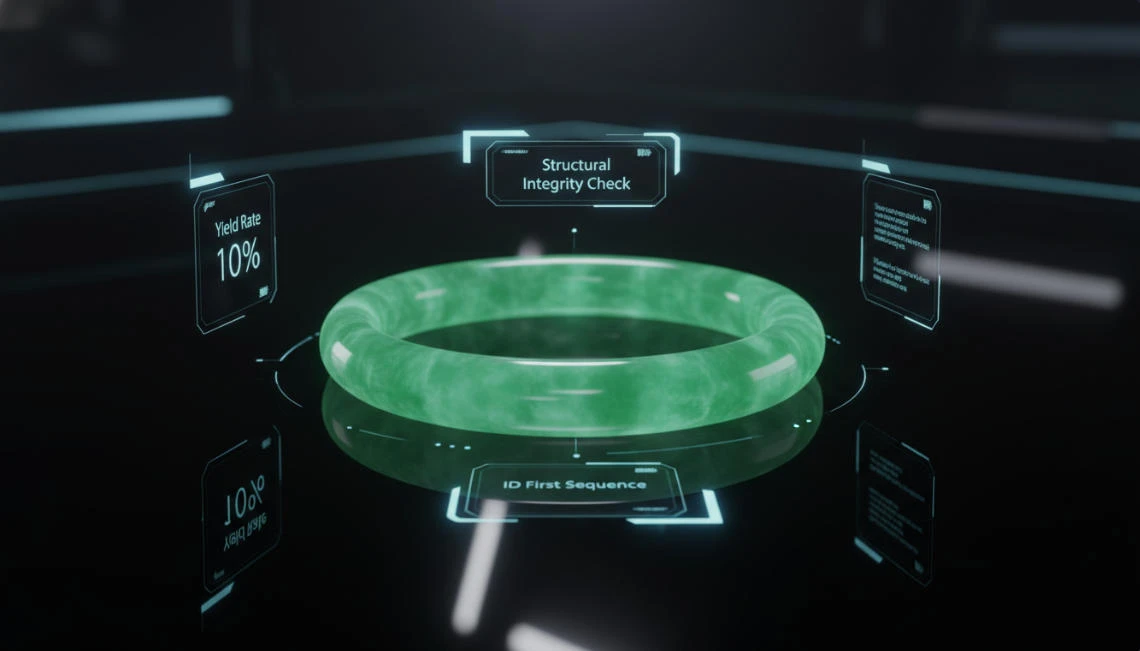
This guide has covered eight production stages, three primary cost drivers, four inspection parameters, and the structural distinction between jade bangles and jade bracelets — not because the production process is intrinsically interesting to a wholesale buyer, but because understanding it changes the quality of every sourcing decision you make from this point forward.
When you understand that fewer than 10% of raw jade qualifies for high-grade bangle production, a supplier offering high-grade inventory at commodity pricing stops looking like a good deal and starts looking like a question that needs answering. When you understand that the inner diameter must be drilled before the outer diameter — and why that sequence is mechanically non-negotiable — you have a specific technical question you can use to verify any prospective manufacturer’s process competence. When you understand that polishing quality is the visible output of every preceding stage’s discipline, you know that a poor surface finish is not a cosmetic detail — it is a signal about process integrity at every step upstream.
JADEMAGO’s 65-year manufacturing history, vertically integrated production structure, and documented raw material sourcing standards represent one answer to the question of where to source jade bangle wholesale inventory with confidence. But the more important output of this guide is the analytical framework that allows you to evaluate any answer to that question — including ours — against the technical reality of what jade manufacturing actually requires. If you have sourcing requirements you would like to discuss, or if you would like to request samples evaluated against the grading parameters described in this guide, the most productive next step is a direct technical conversation with our wholesale team.
Faqs About Jade Bangle Wholesale and Manufacturing Sourcing
1. What percentage of raw jade is actually usable for bangle production?
Based on JADEMAGO’s 2025 internal purchasing data, approximately 30% of all raw jade acquired during the year was suitable for bangle production at any grade level, and fewer than 10% of total raw material met the thresholds required for high-grade jade bangle wholesale inventory. When a prospective supplier quotes yield figures significantly higher than 30%, that figure warrants investigation — a higher claimed yield almost always reflects a lower quality threshold applied at the selection stage, not a genuine improvement in the underlying material economics. Your safeguard here is to ask for the yield figure as a ratio of finished, graded wholesale pieces to raw material input — not as a percentage of stones that made it to the cutting stage.
2. What is the difference between jadeite and nephrite in bangle production?
Both minerals are commercially marketed as jade and both are used in bangle production, but they differ in ways that affect jade manufacturing requirements and wholesale pricing. Jadeite is the higher-value mineral, prized for its broader color range — including the imperial green associated with the finest Burmese material — and its capacity for glass-like translucency. Nephrite is typically more muted in color, with a waxy rather than vitreous luster. From a production standpoint, jadeite’s interlocking pyroxene crystal structure makes it harder and more brittle than nephrite’s fibrous tremolite-actinolite structure — meaning jadeite requires more precise mechanical stress management throughout the drilling and shaping stages. The SSEF’s technical documentation on jade identification provides detailed mineralogical profiles of both materials. For wholesale buyers, the practical implication is that jadeite bangles carry both a higher raw material premium and a higher processing risk premium than nephrite bangles of equivalent visual dimensions — a cost structure difference that should be reflected in any legitimate price differential between the two material types in a wholesale catalog.
3. What documentation should I request, and how do I evaluate a new supplier?
At the product quality level, request a grade specification sheet for each order that defines the classification criteria applied, the inspection parameters assessed, and the grade distribution of the shipped pieces. For buyers supplying the United States market, U.S. Customs and Border Protection guidelines on gemstone imports require accurate material identification and country-of-origin declaration on import documentation. When evaluating a new jade factory as a potential wholesale partner, ask specifically about raw material selection methodology, production yield data, and defect rate tracking. A manufacturer with genuine process depth will answer these questions specifically and with verifiable data. One without it will respond with general quality assurance language that does not engage with the technical substance. Request sample pieces before committing to a volume order, and evaluate them against the four inspection parameters described in Step 8 — paying particular attention to grading consistency across the sample set, not just the quality of individual pieces.