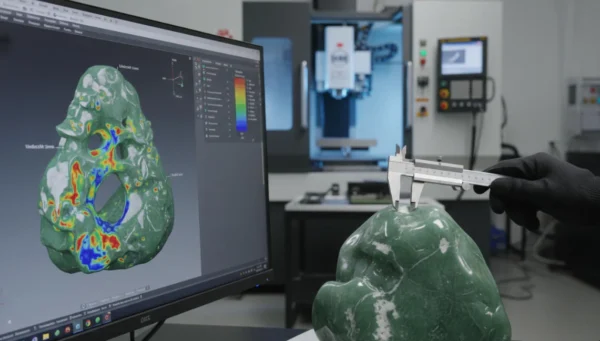
Every time you place a bulk order with a jade manufacturer, a significant portion of your procurement budget silently disappears — not into craftsmanship, not into design, but into sawdust, discarded off-cuts, and structurally compromised waste material. In a traditional, unoptimized jade process, raw material loss rates range from 40% to 70% — with jade bracelet production pushing toward the higher end of that range. That is not a manufacturing footnote. That is a cost structure embedded directly into every unit price you pay.
The data is difficult to ignore: according to JADEMAGO’s 2025 internal production records and cross-referenced benchmarking against peer jade factories, a systematically optimized jade process can compress the material loss rate from that 50%–70% baseline down to 20%–35% — while simultaneously increasing the total value yield of the raw material by more than 2x. This is not a theoretical improvement. It is a repeatable, design-stage outcome that any serious jade manufacturer should be able to demonstrate before your order is confirmed.
What separates a high-efficiency jade factory from an average one is not the cutting machinery. It is the design intelligence applied before a single blade touches the stone. This article breaks down the four core design principles that govern material efficiency in modern jade processing — and explains precisely how each one translates into lower procurement costs, higher product quality, and stronger supplier ROI for the buyers who choose wisely.
Data in this article is sourced from JADEMAGO’s 2025 internal production and industry peer benchmarking. Figures reflect real manufacturing conditions and are not independently audited industry statistics.
Table of Contents
Why Your Jade Procurement Cost Is Higher Than It Should Be: The Loss Rate Problem Nobody Talks About

When procurement teams evaluate jade suppliers, they typically compare unit prices, minimum order quantities, and lead times. Rarely does anyone ask: “What is your factory’s standard material loss rate — and how is it calculated?” That omission is expensive. The loss rate embedded in a jade manufacturer’s production workflow is one of the most direct, yet least scrutinized, drivers of the price you pay per finished piece.
Here is the structural reality: in a conventional jade process without systematic design optimization, raw material loss rates routinely sit between 40% and 70%. For jade bracelet and jade bangle production specifically, that figure trends toward the upper boundary — because the circular geometry of a bangle demands cutting away everything outside the ring form, leaving large volumes of potentially usable material as planned waste. Every gram of that discarded material has already been paid for in the raw stone purchase. Its cost does not vanish. It is redistributed — averaged across every sellable unit that exits the jade factory floor.
You Are Already Paying for Waste You Never Receive
This is the mechanism that makes loss rate a buyer’s problem, not just a manufacturer’s problem. Suppose a jade factory purchases a raw stone for $1,000. If the loss rate is 60%, only 40% of that stone becomes sellable product. The remaining $600 worth of material — in terms of purchase-weight cost — is absorbed into the pricing of the units that do ship. A jade manufacturer operating at a 60% loss rate is not absorbing that inefficiency out of goodwill. It is passed forward, unit by unit, into your cost of goods.
Now consider a factory operating at a 30% loss rate on the same raw material input. The cost redistribution drops substantially. The per-unit material cost decreases — not because the stone was cheaper, but because more of it was converted into revenue-generating product. This distinction is the foundation of what separates a design-intelligent jade manufacturer from a production-volume-only operation. The price difference you see in a competitive quote often has less to do with labor arbitrage and more to do with how efficiently raw material is being converted into finished goods.
Industry Loss Rate Benchmarks: Optimized vs. Unoptimized Jade Processing
| Production Scenario | Typical Loss Rate Range | Value Yield Multiplier | Primary Loss Driver |
|---|---|---|---|
| Conventional jade process (no design optimization) | 50% – 70% | 1.0x (baseline) | Fixed-template cutting, reactive crack handling |
| Jade bangle / bracelet production (unoptimized) | 60% – 70% | 1.0x (baseline) | Circular geometry waste + unplanned core discard |
| Partially optimized jade process (1–2 principles applied) | 35% – 50% | 1.3x – 1.6x | Residual sizing and modular gaps |
| Fully optimized jade process (all 4 principles applied) | 20% – 35% | 2.0x+ | Design-stage integration across all waste categories |
Source: JADEMAGO 2025 internal production records and peer benchmarking with five jade manufacturers in the same processing region. Self-reported, non-audited figures. Not statistically representative of the broader industry.
Material Yield vs. Value Yield: Two Metrics That Both Matter
Understanding loss rate optimization requires separating two distinct performance metrics that are frequently conflated in jade processing discussions. The first is Material Yield — the percentage of raw stone weight that is converted into any finished product. The second is Value Yield — the ratio of total commercial value of finished products relative to the cost of the raw input. A jade factory can improve Material Yield simply by cutting more pieces from a stone. But if those additional pieces are low-grade, unsellable fragments, the Value Yield may remain unchanged or even decline.
The most capable jade manufacturers optimize both dimensions simultaneously. The commercial value of a finished jade product is not determined solely by the weight retained through processing — it is shaped by the preservation of the optical, structural, and aesthetic properties that make a given stone commercially viable in its target market channel. GIA’s educational framework on colored stone quality factors identifies transparency, color distribution, and freedom from fractures as the primary value drivers in jade and nephrite evaluation — properties that are directly affected by how cutting and shaping decisions are made during the jade process. A design approach that maximizes weight retention while compromising these properties does not improve Value Yield; it redistributes the same raw material into lower-grade finished goods that command proportionally lower pricing.
It is worth noting that GIA’s framework was developed for gemological grading contexts rather than industrial manufacturing yield analysis — which means its direct applicability to bulk jade processing decisions has limits. What it provides is an externally validated set of value criteria consistent with the design priorities described in this article: preserving the properties that determine market value, not simply preserving weight. For B2B buyers sourcing at volume, this dual-metric framework reframes supplier selection entirely: the question is not only “how much do you charge per piece?” but “how much of the raw material’s potential value do you actually capture?”
The Design Stage Is Where Your Procurement Cost Is Set
Most buyers assume that manufacturing costs are locked in by equipment quality, labor rates, and overhead. In jade processing, a disproportionate share of the cost outcome is actually determined in the design phase — specifically, how a raw stone is mapped, segmented, and allocated to product categories before production begins. A jade factory that invests in design-stage planning can reduce loss rates by 30 to 50 percentage points compared to a facility that begins cutting without systematic pre-production analysis. That gap in efficiency is not visible in a factory tour. It is visible in the loss rate data — if you know to ask for it.
The four design principles outlined in the following sections represent the methodology that separates high-efficiency jade manufacturers from the industry average. Each principle targets a specific category of avoidable waste, and each carries quantifiable impact on your per-unit procurement cost. This means that understanding these principles gives you a concrete framework for evaluating any jade manufacturer’s true cost structure — before you commit to a sourcing relationship.
The 4 Design Principles That High-Efficiency Jade Factories Use to Minimize Material Loss

Design-stage decision-making is where material efficiency is won or lost in jade processing. The difference between a 65% loss rate and a 28% loss rate on the same raw stone is not primarily a function of machine precision — it is a function of how intelligently the stone was analyzed, mapped, and allocated before production began. The following four principles represent the core methodology that separates a design-driven jade manufacturer from a volume-first operation. They are sequenced here by their individual measured impact on loss rate reduction, from highest to lowest.
1 — Modular Design: Converting Every Off-Cut Into a Revenue-Generating Product (Loss Reduction: 15%–30%)
The single highest-impact design principle in jade processing is modular raw material allocation — the practice of treating a raw stone not as the source material for one product category, but as a multi-product input that can be mapped into several distinct output modules before cutting begins. In a conventional jade factory workflow, a raw stone is evaluated primarily for its suitability for the target product — a jade bangle, for instance — and the remaining material after that primary cut is treated as residual waste. In a modular design framework, that same remaining material is pre-planned as input for secondary and tertiary product lines.
The most commercially significant example involves jade bangle production. When a cylindrical bangle form is cut from a raw stone, the process inherently generates a central disc of material — the core removed to create the bangle’s hollow center. In a non-modular workflow, this disc is discarded or sold as low-value scrap. In a modular design system, that central disc is pre-assessed during the initial stone mapping phase and allocated to pendant or carved tile production. The finer off-cuts and edge fragments generated during the bangle cutting process are simultaneously allocated to bead production lines. The result is a cascading product matrix extracted from a single raw stone input.
Based on JADEMAGO’s internal production batch analysis using the weight-in / weight-out methodology described above, modular design implementation reduces raw material loss rates by 15% to 30% in jade processing operations where it is systematically applied. The lower end of that range reflects outcomes on raw stones with more irregular geometry or limited secondary allocation potential; the upper end reflects outcomes on stones with well-defined geometry and clear secondary material zones. For buyers, this translates directly into supplier economics: a jade manufacturer operating a modular design system is converting more of the raw stone’s purchased weight into sellable inventory, which reduces the per-unit material cost burden redistributed into your order pricing. This means that sourcing from a factory with mature modular design capability gives you access to a more favorable raw material conversion ratio — without paying a premium for it.
2 — Crack Avoidance Design: Protecting Both Material Integrity and Product Quality at the Source (Loss Reduction: 10%–20%)
Fracture lines represent the most irreversible category of material loss risk in jade processing. Unlike dimensional waste, which is a predictable byproduct of shaping, crack-related loss is catastrophic: a fracture intersecting a load-bearing zone of a finished jade bangle can render the entire piece structurally unsellable at the final quality inspection stage. At that point, the full processing cost — cutting, grinding, polishing — has been expended on a product that cannot be sold. The material loss and the labor cost are both unrecoverable.
A design-competent jade manufacturer addresses this risk at the earliest possible stage of the jade process. Before any production planning is finalized, the raw stone undergoes systematic crack mapping — typically combining strong transmitted light inspection with surface analysis — to identify the location, orientation, and depth of internal fracture networks. This crack map then directly informs the product allocation decisions: crack zones are routed away from structural positions in bangle geometry, away from the primary face planes of carved pieces, and away from any product form where fracture propagation under mechanical stress would cause failure.
The International Gem Society’s technical documentation on jade properties and workability identifies fracture orientation and density as primary determinants of yield outcome in jade cutting — consistent with the principle that pre-production fracture mapping reduces mid-production rejection rates. IGS does not quantify the specific loss rate impact of crack avoidance design, but the directional relationship between fracture pre-assessment and yield improvement is supported by the workability framework IGS describes. The measured impact on loss rate in JADEMAGO’s production batches is a reduction of 10% to 20% — with the range reflecting variation in raw stone fracture density across different material grades. The quality impact compounds that figure: structurally sound products command higher per-unit pricing and generate lower rejection rates at the buyer’s receiving inspection. For procurement teams managing quality-sensitive supply chains, crack avoidance design capability is therefore not just a loss rate metric — it is a defect rate metric, and a landed cost metric. This means that evaluating a supplier’s crack management process gives you visibility into two separate cost drivers simultaneously.
3 — Size Gradient Design: Matching Product Specifications to Raw Material Reality (Loss Reduction: 8%–15%)
A persistent source of avoidable waste in jade processing is the application of fixed-dimension product templates to raw stones with inherently variable geometry. Natural jade forms do not conform to standardized dimensions. When a jade factory operates with a rigid, single-size cutting template, the production team is forced to find the largest form that fits within the usable stone boundary and discard everything outside that boundary as waste. The stone is made to serve the template, rather than the template being adapted to serve the stone.
Size gradient design inverts this logic. Rather than maintaining a single product specification for a given product category, a design-intelligent jade manufacturer maintains a tiered specification library — multiple validated size standards for each product type, spanning a defined range of dimensions. When a raw stone enters the design phase, its actual usable geometry is assessed first, and the production team selects the closest matching size tier from the specification library that maximizes material utilization. The stone determines the product size; the product size does not determine how much of the stone is wasted.
GIA’s technical curriculum on colored stone cutting and IGS’s documented best practices in lapidary design both address the yield trade-offs inherent in fixed-template versus adaptive cutting approaches — frameworks that are conceptually consistent with the size gradient design principle, even though neither source addresses jade manufacturing specifically or quantifies the 8%–15% loss rate impact observed in JADEMAGO’s production data. That 8%–15% range, measured across beads, cabochons, and dimensional carving categories, reflects the portion of near-usable material that is recovered by matching product specifications to actual stone geometry rather than discarding material that falls outside a rigid template boundary. For buyers placing size-flexible orders or sourcing across multiple SKUs, working with a jade factory that operates a gradient sizing system means your orders are produced against a more material-efficient template architecture — and that efficiency is reflected in your unit economics.
4 — Color Band (Qiaose) Utilization: Transforming Natural Variation Into Commercial Differentiation
Not every design principle in jade processing operates primarily through loss rate reduction. The fourth principle — color band utilization, known in the industry by the traditional Chinese term Qiaose (俏色) — operates through a different mechanism: it converts material that would otherwise be treated as a liability into a product feature that commands a price premium. The net effect on material economics is significant, but it operates through Value Yield rather than Material Yield.
Natural jade stones frequently contain zones of distinct coloration — gradients, patches, or bands of contrasting hues within a single piece of raw material. In a conventional, non-adaptive jade process, these color variations are often treated as complications that interrupt the visual uniformity expected of standard product lines, and the affected zones are cut away to isolate the more homogeneous material. The discarded color-band sections represent real material loss — paid for in the raw stone purchase, but excluded from the finished product value.
Qiaose design discipline requires the carving artist or design team to analyze the color band distribution of the raw stone before production planning is finalized, and to develop product concepts that incorporate those color transitions as intentional design elements. A landscape carving that uses a brown-to-green color gradient to distinguish mountain rock from forest canopy. A figurative piece where a rust-colored inclusion becomes the focal detail of a character’s garment. A jade bangle design where a subtle color band is positioned to create a visual accent that differentiates the piece in a retail context. In each case, the color variation that would have been cut away is instead retained and elevated into a value-driving feature.
SSEF’s published research on natural color origin and enhancement detection in jadeite documents the market premium consistently associated with natural, unenhanced color characteristics in jade — the same natural color properties that Qiaose design principles are structured to preserve and showcase rather than discard. SSEF’s research is conducted in a laboratory certification context rather than a manufacturing yield context, but the premium association it documents provides external support for the Value Yield argument underlying this principle. For buyers building product lines for discerning retail channels, sourcing from a jade manufacturer with mature Qiaose design capability gives you access to a differentiated product tier — one that carries demonstrable uniqueness inherent to the material rather than applied through additional processing — that suppliers without adaptive design capability simply cannot replicate.
External Validation: How These Principles Align With Published Gemological Standards
The four design principles described in this article were developed through JADEMAGO’s internal production experience rather than derived from published research. Each principle has meaningful alignment with documented practices from the broader gemological and lapidary manufacturing community — alignment that provides an external reference point against which these claims can be partially evaluated.
The fracture-yield relationship described in Principle 2 is consistent with IGS’s workability framework for jade. The adaptive cutting logic underlying Principle 3 aligns with GIA and IGS’s documented trade-offs between fixed-template and adaptive cutting strategies. The color premium mechanism in Principle 4 is supported by SSEF’s natural color origin research. None of these external sources validate JADEMAGO’s specific loss rate figures — they provide conceptual and directional alignment, not independent audits of the quantitative claims. Buyers should treat the external citations as corroborating context, and the loss rate figures as directional benchmarks subject to the methodological limitations described in the data transparency section above.
The 4 Design Principles: Impact Summary for B2B Buyers
| Principle | Primary Mechanism | Loss Rate Reduction | Value Yield Impact | Best-Fit Product Categories |
|---|---|---|---|---|
| 1. Modular Design | Allocates off-cuts to secondary & tertiary product lines | 15% – 30% | High — expands sellable SKU portfolio from single stone input | Jade bangle, pendant, bead, carved tile |
| 2. Crack Avoidance Design | Maps fractures pre-production; routes cracks away from structural zones | 10% – 20% | Medium-High — reduces rejection rate & improves quality grade | Jade bangle, jade bracelet, small carvings |
| 3. Size Gradient Design | Matches product specification to actual stone geometry via tiered size library | 8% – 15% | Medium — reduces near-usable material discard | Beads, cabochons, dimensional carvings |
| 4. Color Band (Qiaose) Utilization | Converts color variation zones into design features rather than discarded material | Variable | High — natural color differentiation commands premium pricing in mid-to-high-end channels | Carved pieces, landscape ornaments, select jade bangle |
| Combined (all 4 principles) | Integrated pre-production design workflow | 30% – 50% reduction from baseline | 2x+ overall material value uplift | Full product range |
Loss rate reduction ranges reflect JADEMAGO’s internal batch analysis (weight-in / weight-out methodology, January 2024 – March 2025). Lower bounds reflect more challenging raw stone inputs; upper bounds reflect more favorable inputs. Combined figure reflects aggregate pattern across JADEMAGO’s optimized production period. Figures are directional benchmarks, not guaranteed outcomes. External sources (GIA, IGS, SSEF) provide conceptual alignment with the mechanisms described but do not independently validate these quantitative figures.
What Happens When All 4 Principles Work Together: The Compounding Effect of Design-Led Jade Processing
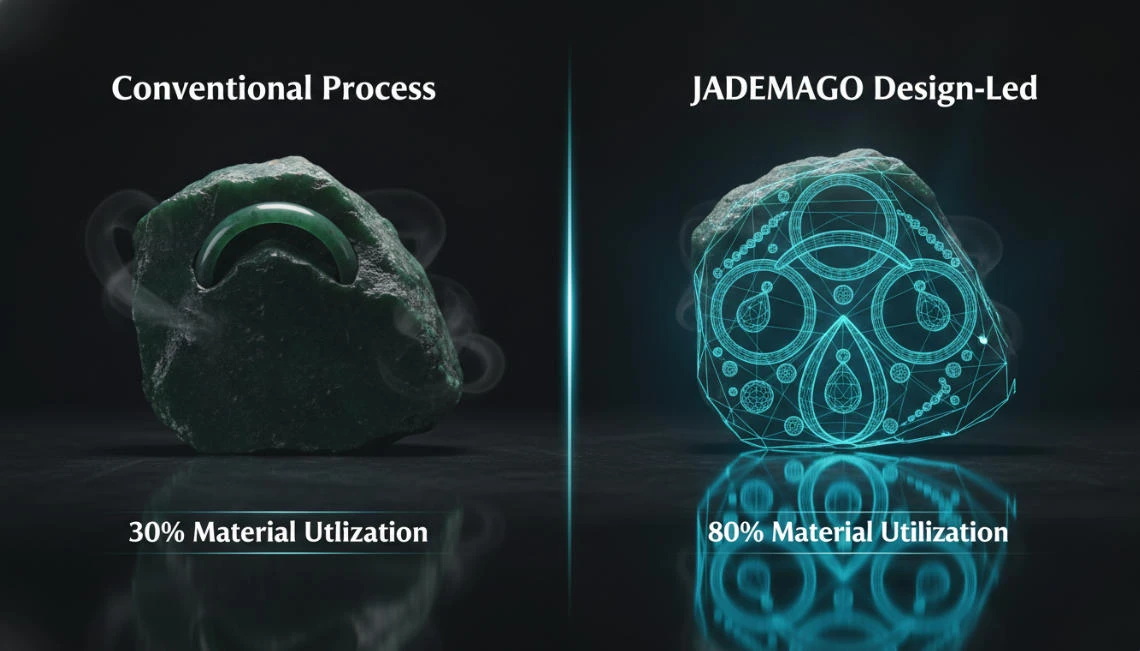
Each of the four design principles described above delivers measurable loss rate reduction when applied in isolation. But the more significant performance outcome emerges when they are integrated into a unified, design-first workflow — where crack mapping, modular allocation, gradient sizing, and color band analysis are all executed in sequence during the pre-production design phase, before a single cut is made. This is the operating model that defines a genuinely high-efficiency jade manufacturer, and its compounded impact on material economics is substantially greater than the sum of its individual parts.
JADEMAGO’s 2025 internal production data documents the aggregate effect: raw material loss rates that previously ranged from 50% to 70% under conventional, unoptimized jade processing conditions were reduced to a consistent 20% to 35% range after full integration of the four-principle design framework. Simultaneously, the total commercial value extracted from the same raw material inputs increased by more than 2x — driven not only by higher material yield, but by the value uplift generated through modular product diversification and Qiaose design premiums. These are not marginal refinements. They represent a fundamental restructuring of how a jade factory converts raw stone investment into sellable output.
Before vs. After: What the Comparison Is Based On
The production comparison below is a structured illustration derived from a specific batch comparison conducted within JADEMAGO’s operations during Q3 2024, in which two production runs processing raw stones of comparable quality grade and weight were executed — one under the conventional workflow that predated JADEMAGO’s systematic design optimization program, and one under the fully integrated four-principle design framework.
The raw stone inputs used in the comparison batch were nephrite material sourced from the same supplier lot, assessed at equivalent quality grade by JADEMAGO’s internal grading team prior to production. The $2,000 input value used in the table below is a normalized figure — actual batch values have been proportionally adjusted to a common base for comparability, but the ratio relationships between input cost, output value, and loss rate reflect the actual measured outcomes of that production comparison. Several contextual factors limit the generalizability of this comparison: the two runs were not fully controlled experiments; the value yield figures reflect JADEMAGO’s internal wholesale pricing, not independently verified market transaction prices; and a single batch comparison is not a statistically robust basis for the 2x+ value yield claim cited elsewhere — that figure represents the directional pattern observed across multiple production periods. What this case provides is a traceable production context: evidence that the Before/After comparison reflects a real operational observation rather than a hypothetical construction.
Before vs. After: Design Optimization Impact on a $2,000 Raw Stone Input
| Metric | Factory A — Unoptimized | Factory B — Design-Optimized (JADEMAGO Model) |
|---|---|---|
| Raw stone purchase cost | $2,000 | $2,000 |
| Pre-production design process | None — direct to cutting | Crack mapping + modular allocation + gradient sizing + Qiaose analysis |
| Material loss rate | 62% | 27% |
| Primary product output | Jade bangle (single SKU) | Jade bangle (primary) |
| Secondary product output | None — core off-cut sold as scrap | Pendants (from bangle core) |
| Tertiary product output | None | Beads (from edge fragments) + 1 Qiaose carving (from color band zone) |
| Aggregate commercial value of output | ~$3,200 | ~$5,800 |
| Value yield ratio (vs. raw material cost) | 1.6x | 2.9x |
| Per-unit material cost burden | High — distributed across fewer units | Low — distributed across larger, higher-value portfolio |
Figures are based on JADEMAGO Q3 2024 production batch comparison. Commercial values reflect internal wholesale pricing. Ratio relationships are production-measured; absolute values are normalized to a $2,000 base for comparability. Not a controlled experiment. Actual outcomes vary by stone quality, product category, and design complexity.
The Procurement Cost Implication Is Direct and Quantifiable
The gap between these two production outcomes does not stay inside the jade factory. It flows directly into the per-unit pricing that each factory must charge to recover its raw material costs. The first factory, converting its raw stone at a 1.6x value ratio, must distribute higher material costs across fewer sellable units. The second factory, converting at a 2.9x ratio, recovers its raw material cost across a larger, higher-value product portfolio — and can price individual units more competitively as a result.
For buyers evaluating jade manufacturers on price alone, this dynamic is systematically invisible — until it shows up as unexplained unit price differentials between quotes that appear, on the surface, to be for identical products. Understanding the design efficiency gap between suppliers gives procurement teams the analytical framework to ask the right questions: not just “what is your price per piece?” but “what is your loss rate on this stone category, and what does your pre-production design process look like?” Those two questions will reveal more about the true cost structure of a supplier relationship than any line-item price comparison. This means that developing fluency in loss rate evaluation gives you a durable procurement advantage that compounds across every order you place.
How to Evaluate a Jade Manufacturer’s Design Efficiency Before You Place Your First Order
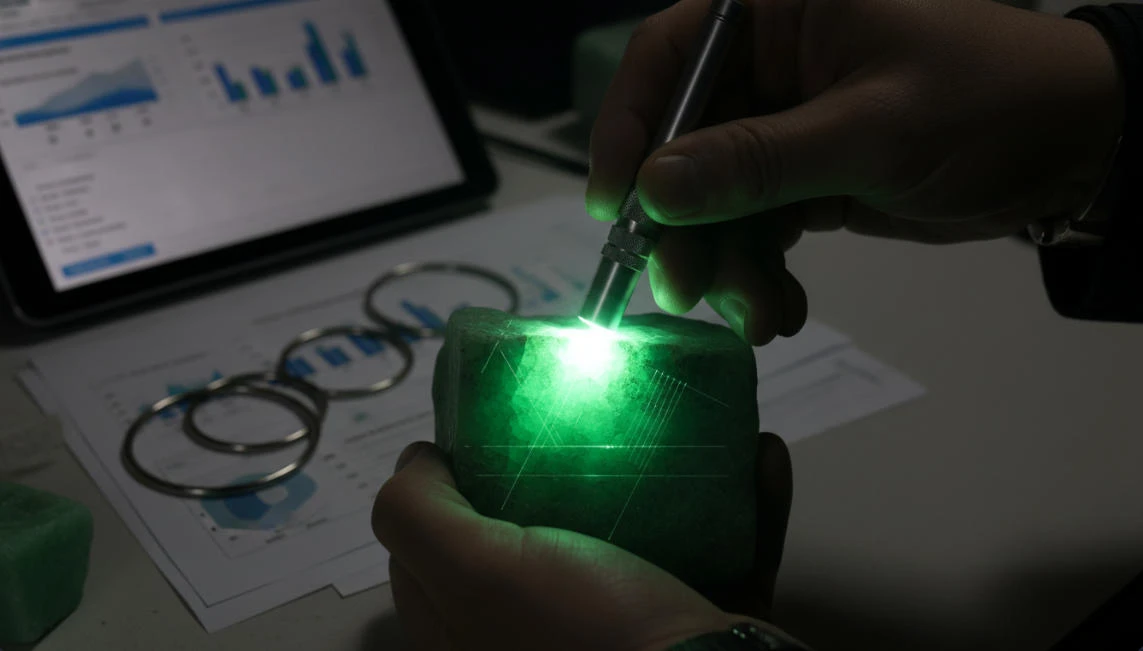
Knowing that design-stage optimization exists is only useful if you can identify which jade factories actually practice it — and which ones describe it in sales conversations but do not operationalize it in production. The gap between the two is not always visible during a factory visit or a product sample review. It requires asking a specific set of questions that probe the pre-production workflow directly, and knowing how to interpret the answers you receive.
The following framework is targeted specifically at the design efficiency variables that determine material loss rate outcomes — the metrics that most directly govern the per-unit procurement cost embedded in your jade manufacturer’s pricing structure.
The First Question to Ask Any Jade Factory: “What Is Your Standard Loss Rate by Product Category?”
A jade manufacturer that has invested in systematic design optimization will be able to answer this question with category-specific data. They will distinguish between loss rates for jade bangle production, carved pieces, bead lines, and other product categories — because each category has a different material geometry and therefore a different efficiency profile. A factory that responds with a single aggregate figure, or that cannot produce loss rate data at all, is signaling that material efficiency is not tracked or managed at the design stage.
Acceptable answers from a high-efficiency jade factory will typically reference a loss rate range of 20%–40% for standard product categories under optimized conditions, with bangle production at the higher end of that range due to the inherent geometry of circular cutting. If a supplier quotes a loss rate significantly above 50% for standard product lines without a clear explanation tied to raw stone quality or product category specifics, that figure represents recoverable inefficiency — and its cost is already embedded in the prices you are being quoted. This means that identifying and selecting lower-loss-rate suppliers gives you access to structurally lower unit costs without negotiating a single line item on the price sheet.
Probe the Pre-Production Process: Crack Mapping and Stone Assessment
Ask specifically whether the factory conducts systematic crack mapping before production planning is finalized on each raw stone. A jade process that includes pre-production fracture analysis will involve a described inspection methodology — light transmission assessment, physical surface examination, or both — and the results of that inspection will visibly influence which product categories a given stone is allocated to.
If a jade factory cannot describe its crack assessment methodology, or if the answer is that crack-related losses are handled reactively during cutting rather than proactively at the design stage, that operational gap translates directly into elevated rejection rates and unplanned material losses — both of which are recovered through your unit pricing. GIA’s technical resources on inclusions and fractures in colored gemstones provide a useful external reference point for understanding why pre-production fracture assessment is considered standard practice in professional gem manufacturing environments. You should expect your jade manufacturer to meet that same standard — and be able to describe the methodology in operational, not just aspirational, terms.
Evaluate Modular Design Capability Through a Specific Product Example
Rather than asking abstractly whether a factory practices modular design, request a concrete demonstration: ask the supplier to walk you through how they handle the core off-cut material generated during jade bangle production. A factory with genuine modular design capability will describe a defined downstream allocation process for that material — pendant production, bead lines, carved tile output, or similar. A factory without modular capability will describe the core off-cut as scrap, waste, or low-value secondary material with no defined product pathway.
This single question is one of the most efficient diagnostic tools available for assessing a jade factory’s design maturity, because the bangle core off-cut scenario is universal — every jade factory that produces bangles generates this material — and the way it is handled reveals whether the factory’s design framework extends beyond the primary product to capture secondary and tertiary value. IGS’s documented best practices in lapidary yield optimization support the principle that systematic material allocation planning across product tiers is a recognized standard in professional lapidary manufacturing — a standard that applies directly to industrial-scale jade processing at volume.
Assess Size Flexibility and Gradient Specification Capability
For buyers placing orders across multiple SKUs or sourcing size-flexible product categories, ask the factory whether they maintain a tiered size specification library for their core product lines. A jade manufacturer operating a gradient sizing system will be able to describe the size tiers available within a given product category and explain how raw stone geometry influences size selection during pre-production planning.
This capability matters for your procurement process in a specific and practical way: if you are sourcing beads, cabochons, or carvings where slight dimensional variation is commercially acceptable, a factory with gradient sizing capability can produce a more material-efficient output from your allocated raw stones — meaning more finished units from the same raw material input, at a lower per-unit material cost. Factories without this capability will cut to a fixed template and discard the remainder, regardless of how close that discarded material comes to a usable specification.
The Benchmark Standard: What a Design-Mature Jade Manufacturer Should Be Able to Provide
Before confirming a sourcing relationship, a design-mature jade manufacturer should be able to provide a pre-production yield estimate for your specific order — an assessment of the raw stone category, the expected product allocation across primary and secondary product lines, the projected loss rate range, and the design rationale behind those projections. This is not an unusual request. It is the output of a design process that a genuinely high-efficiency jade factory is already running internally. If a supplier cannot produce this estimate, it is not because the information is unavailable — it is because the pre-production design analysis was never conducted in the first place.
Holding your jade manufacturer to this standard of design transparency gives you a concrete, auditable basis for comparing supplier efficiency. More importantly, it transforms the loss rate claims any supplier makes from static assertions into testable predictions — a meaningful step toward the supply chain transparency that serious B2B procurement relationships require.
What This Article Has Established — and What You Should Do With It
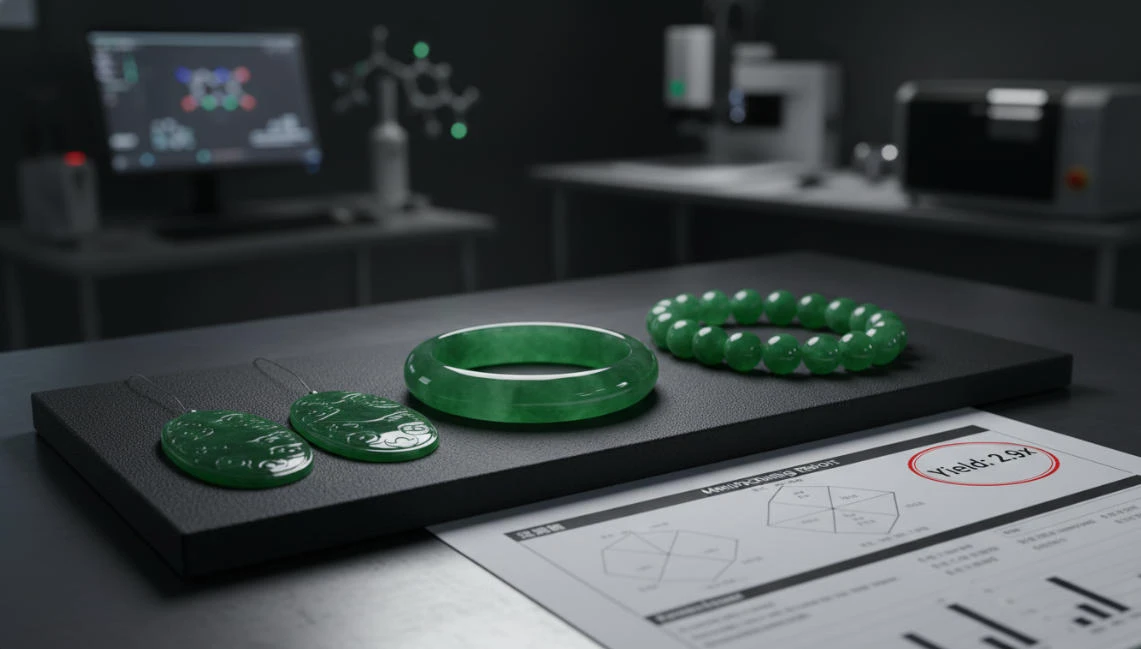
The core argument of this article is simple: material loss rate is not a manufacturing problem — it is a procurement cost problem. In an unoptimized jade process, 50%–70% of the raw stone you pay for never becomes sellable product. That waste is not absorbed by the factory. It is redistributed into every unit price you pay.
The four design principles documented here — modular allocation, crack avoidance mapping, size gradient specification, and Qiaose color band utilization — collectively reduce that loss rate to 20%–35%, while increasing the total value extracted from the same raw material input by more than 2x. The efficiency gap between a factory that applies these principles and one that does not is wide enough to materially change your unit economics.
Two actions follow directly from this. First, ask your current jade manufacturer for category-specific loss rate data. The answer — or the inability to provide one — will tell you more about their true cost structure than any price comparison. Second, request a pre-production yield estimate before confirming your next order. A jade factory operating a genuine design-optimization framework can produce this. One that cannot is asking you to fund inefficiencies you cannot see.
The design tools exist. The loss rate gap is measurable. The only variable is whether you choose a jade manufacturer whose design capability is already working in your favor.
Data Disclaimer: Loss rate figures and yield data cited throughout this article are sourced from JADEMAGO’s 2025 internal production records (weight-in / weight-out methodology, January 2024 – March 2025) and peer benchmarking with five jade manufacturers in the same processing region (self-reported, non-audited). The Before/After comparison is derived from a Q3 2024 JADEMAGO internal production batch; values are normalized to a $2,000 base and reflect internal wholesale pricing. All figures are directional benchmarks reflecting real manufacturing conditions observed across specific production runs. They do not constitute independently audited industry statistics and should not be interpreted as guaranteed outcomes across all raw stone categories and production scenarios.
4 Major Principles of Jade Processing and Design Faqs
1. What is a typical material loss rate in jade processing?
In unoptimized jade processing, loss rates range from 40% to 70%, with jade bangle production trending toward the higher end due to circular geometry cutting. A systematically optimized jade process can reduce this to 20%–35%.
2. How does material loss rate affect my procurement cost?
Directly. Every percentage point of waste generated during jade processing is a cost that manufacturers redistribute into finished unit pricing. A lower loss rate jade factory can offer structurally more competitive unit costs from the same raw material input — without you negotiating a single line item.
3. Which design principle delivers the highest loss rate reduction?
Modular design has the highest single-principle impact, reducing material loss by 15%–30% by allocating jade bangle off-cuts and core material into secondary product lines such as pendants and beads, rather than discarding them as scrap.
4. How do I know if a jade manufacturer actually practices these principles?
Ask one specific question: “What happens to the core off-cut material from your bangle production?” A factory with genuine modular design capability will describe a defined downstream allocation process. A factory without it will describe the material as waste or scrap.
5. Are the loss rate figures in this article independently verified?
No. All figures are derived from JADEMAGO’s internal production batch analysis and peer benchmarking with five jade manufacturers, conducted between 2024 and 2025. They are directional benchmarks based on real production conditions — not independently audited industry statistics.