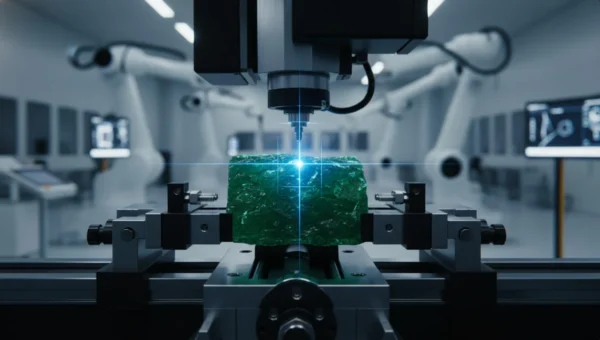
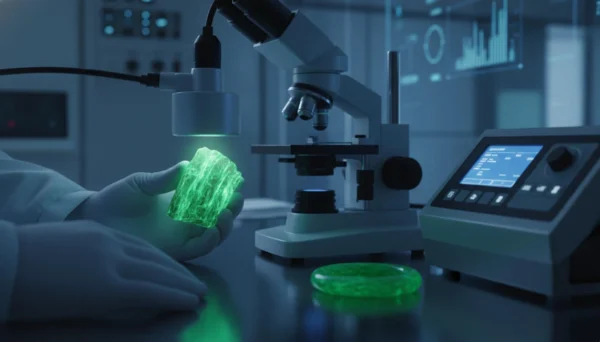
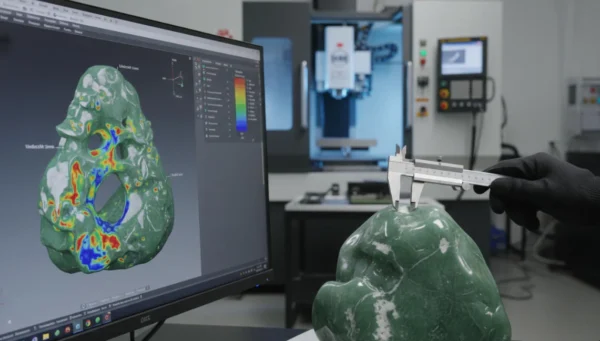
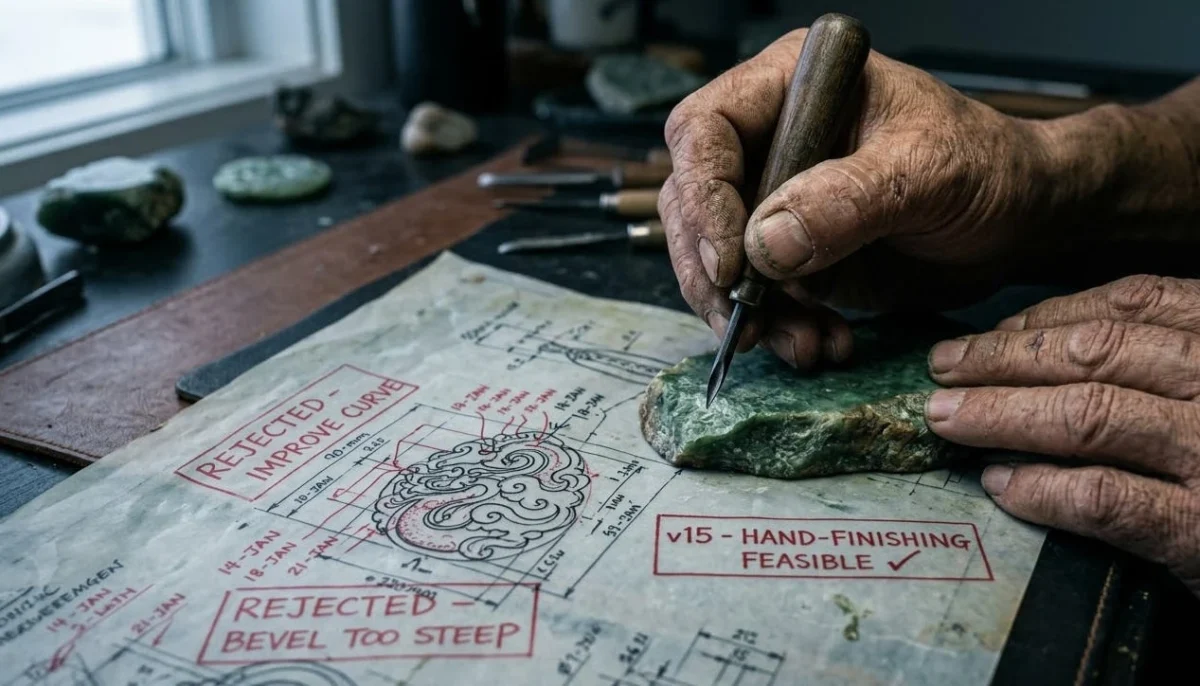
Here is what real production data reveals: across 113 custom jade carving orders documented throughout 2025, the average project required 15 rounds of concept revisions before design approval, 12 blueprint adjustments during the model-development phase, and 9 rounds of fine-tuning before a physical sample met production standards. From first brief to confirmed sample, total elapsed time ranged between 10 and 30 days. Not one of those revision rounds was caused by insufficient carving skill. Every single delay — every discarded draft, every reworked blueprint — traced back to the gap between what a buyer imagined and what a given piece of raw jade could actually become.
This contradicts the assumption most buyers carry into a custom jade carving project without ever questioning it. When evaluating a potential custom jade carving supplier, buyers consistently focus on portfolio quality, tool precision, and carving experience. Those elements are real, but they are not where the risk in your project actually lives. The constraint that most reliably determines whether your custom jade carving succeeds — on time, on budget, and true to your original vision — is not the carver’s hand. It is the design process that happens before the carver ever touches the stone.
This article explains why that design process is structurally difficult in ways that carving is not, what real production numbers tell you about honest timelines, and how to use that knowledge to evaluate any custom jade carving manufacturer before placing your next order.
Table of Contents
The Common Misconception: Why Buyers Consistently Overvalue Carving Skill
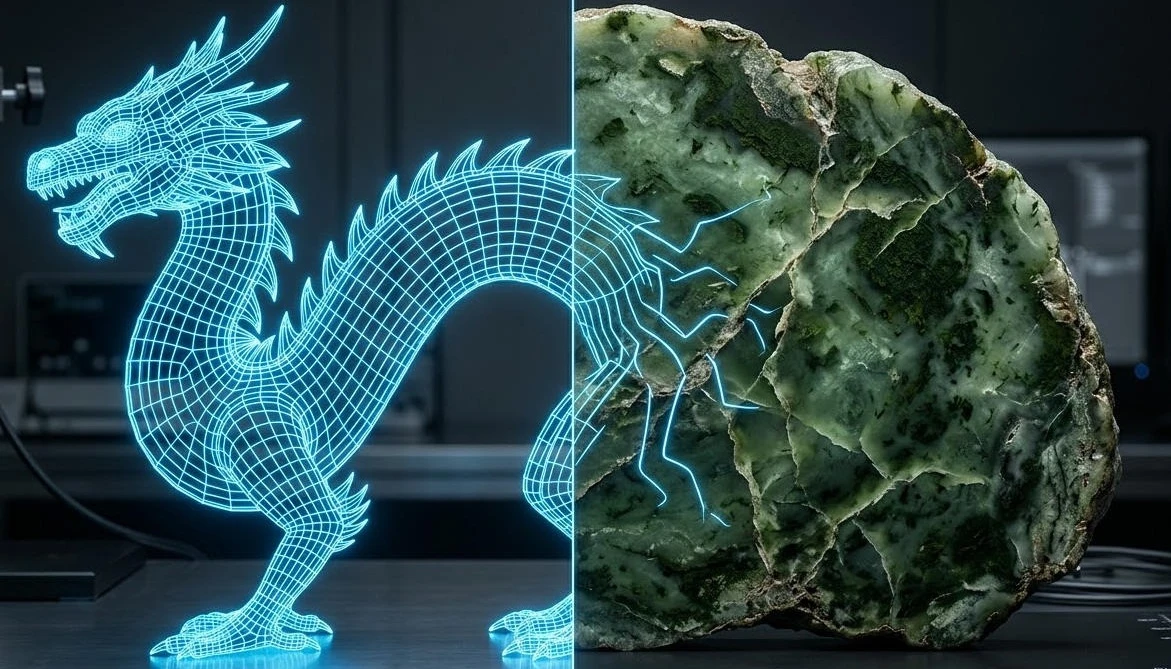
Walk into any first conversation about custom jade carving with a procurement buyer, and the questions cluster in a predictable zone: How experienced are your carvers? What tools do they use? How intricate can the work get? These are not unreasonable questions. The visible drama of stone carving — the spinning wheel, the fine dust, the emerging form — makes craftsmanship the obvious place to look. But this is an outsider’s view of where value is created and where risk concentrates in a production cycle.
Carving skill, at any serious level of custom jade carving production, operates within a well-defined and trainable space. Its parameters — wheel speed, cutting angle, tool pressure, finishing sequence — can be documented, standardized, and replicated across a skilled workforce. When a carver makes an error, the error is identifiable and correctable. When a workshop needs to scale output, it trains additional carvers. The ceiling of carving skill is genuinely high, but the path to competence has been mapped for centuries. Is that really the variable your sourcing decision should center on?
The Gemological Institute of America (GIA) notes that the structural and optical properties of both nephrite and jadeite vary significantly even within a single rough stone — which means that material assessment must precede any meaningful design decision. Even the most technically accomplished carver cannot compensate for a design that asks a stone to do something its internal structure prohibits. Skill executes. Design determines whether execution is even possible.
Carving Skill Can Be Trained. Material-Design Alignment Cannot.
A carver’s development path follows a reproducible arc. With structured instruction and sufficient practice, a craftsperson reaches measurable precision benchmarks within a defined period. This capability can be quality-controlled, benchmarked, and continuously improved through structured feedback. It is also, critically, replaceable at scale — additional skilled carvers can be added to a workshop to expand output volume.
Material-design alignment operates on entirely different logic. Every piece of raw jade is physically unique. Its color distribution, internal fracture patterns, grain orientation, and structural density are unrepeatable from one specimen to the next. A design that achieves an excellent result on one stone cannot be identically reproduced on the next specimen from the same quarry, the same grade, the same lot. The International Gem Society (IGS) describes jade as a material whose carving potential depends as much on internal structure as on surface appearance — a distinction that requires professional assessment, not surface observation. For every new custom jade carving project, the design-material relationship must be evaluated from scratch. That is what makes it the hardest part of the process. Not skill. Not equipment. Non-standardizable judgment, applied to a non-standardizable material. This means that when you identify a jade manufacturer with genuine material-assessment capability, you are gaining access to the one skill in the supply chain that cannot simply be hired or trained on a standard timeline.
The Real Bottleneck: Translating a Concept Into a Physical Custom Jade Carving
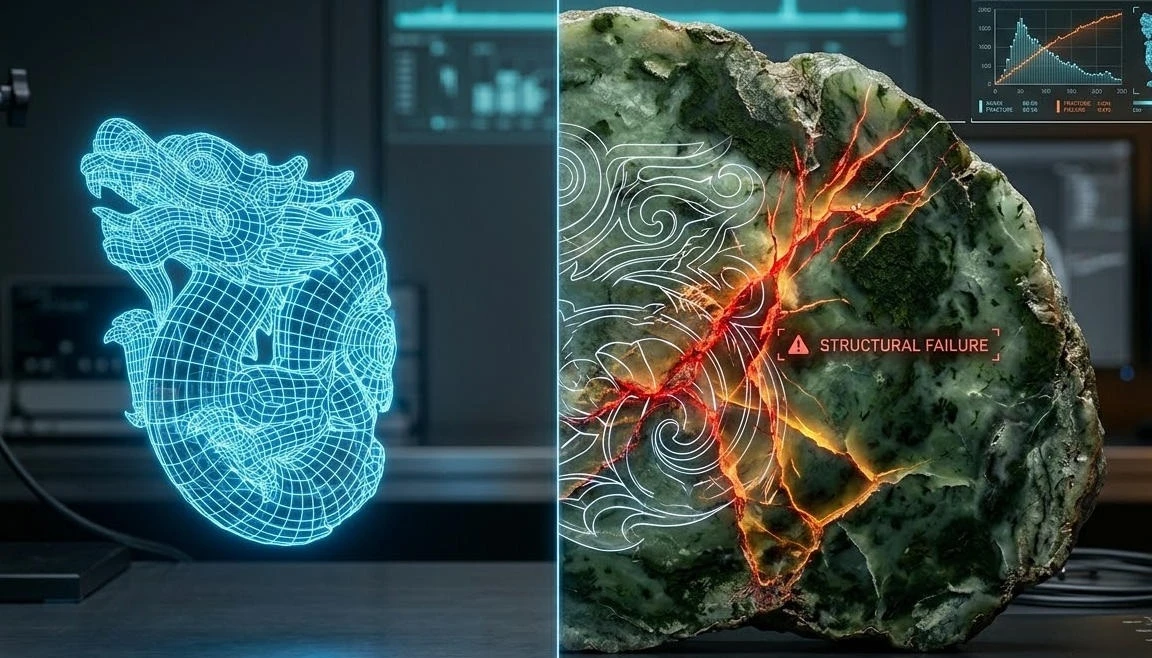
If carving skill is not the primary constraint, then where does the risk in a custom jade carving project actually concentrate? The answer is the translation process itself — the structured sequence of steps required to convert a buyer’s concept, which exists only as an idea, into a physical object producible from real jade material. This is where the majority of delays, cost overruns, and design compromises originate. It is also where the difference between a capable custom jade carving manufacturer and an average supplier becomes measurable in actual project outcomes.
The challenge is not mechanical in the conventional sense. It is not a matter of having better equipment or more experienced hands. It is a matter of managing compound uncertainty that arises when three variables must be reconciled simultaneously: what the buyer wants, what the available stone can structurally do, and what a carver can execute within the required tolerances. Each variable contains its own uncertainty range. When they interact across multiple revision cycles, the complexity multiplies. Managing that compound complexity — across dozens of iteration rounds, without losing the buyer’s original design intent — is the hardest operational skill in the entire custom jade carving supply chain.
Why “Design First, Find Material Later” Is a Production Failure Mode
The most common error in custom jade carving project planning is treating the design as fixed and the material as a variable to be sourced afterward. Buyers arrive with a clear mental image: a specific form, specific proportions, a specific color profile. They have often already named a material preference. The problem is that jade does not behave like metal, resin, or ceramic. You cannot simply mill it to a specification regardless of internal structure.
The correct operational sequence, consistently applied by any competent custom jade carving supplier, is the reverse: assess the available material first, understand its structural limits and aesthetic properties, and then develop a design that works with those properties rather than against them. This is not a compromise of your vision. It is what makes your vision producible. Skipping this sequence does not save time — it generates a compounding rework cycle that typically costs three to five times as much to correct as it would have cost to prevent. This means that when you select a supplier who insists on material assessment before design commitment, you are not paying for procedural delays — you are purchasing protection against the most expensive category of failure in custom jade carving production.
The Client-Material Mismatch Problem Every Serious Supplier Must Solve
Most buyers who approach a custom jade carving project do not have formal training in jade material science. This is entirely expected — material science is not the buyer’s domain. Buyers know what they want the final object to look like, and they may have a material preference based on color, regional association, or price point. What they typically cannot independently evaluate is whether the material they have named — at the grades realistically available for their order volume and budget — can structurally produce the form they have in mind.
Research published by the Swiss Gemmological Institute SSEF demonstrates how significantly the physical properties of jade can vary across specimens that appear visually similar at the surface, which directly explains why surface-level material selection consistently generates downstream carving problems. This mismatch between buyer material specification and actual material carving potential is one of the most frequent project-level risks in custom jade carving production. A jade manufacturer with genuine technical depth identifies this mismatch at the design stage, proposes a documented modification, and explains the reasoning in terms the buyer can evaluate. That is not an obstacle to your order. That is the supplier protecting the value of your investment before production costs are committed.
From 0 to 1: What Real Production Data Reveals About Custom Jade Carving Timelines
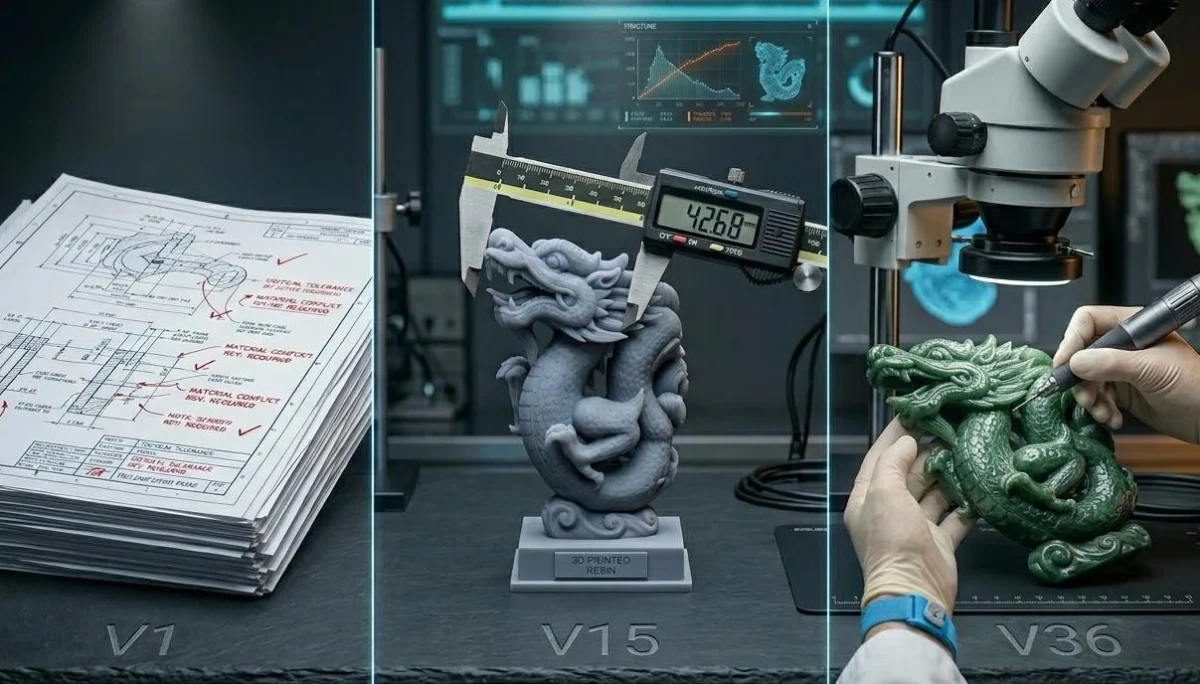
Understanding the structural difficulty of the concept-to-product translation process becomes more actionable when grounded in actual production data. The 113 custom jade carving orders documented across 2025 provide a statistically meaningful sample of what the zero-to-one development phase genuinely requires in terms of iteration rounds, elapsed time, and decision points. These numbers should change how you plan your next custom jade carving project and what questions you ask suppliers before committing to any order.
The headline figure is this: from the moment a buyer’s concept enters development to the moment a confirmed physical sample is approved for production, median elapsed time ranged between 10 and 30 days — depending on design complexity, material availability, and the specificity of the buyer’s initial brief. This is not slow by any meaningful industry standard for serious custom jade carving work. It is what quality-controlled development actually requires when conducted correctly. Buyers who expect a confirmed sample in two to three days are not compressing a timeline — they are accepting a supplier who is skipping revision cycles that exist for documented, quantifiable reasons.
| Phase | Avg revisions | Timeline |
|---|---|---|
| Concept → Blueprint | 15× | 3 – 10 days |
| Blueprint → 3D model | 12× | 2 – 5 days |
| Model → Physical sample | 9× | 5 – 15 days |
| Total | ~36× | 10 – 30 days |
1 — Concept to Blueprint: 15 Revision Rounds, 3 to 10 Days
The first phase of custom jade carving development — moving from a buyer’s concept to an approved design blueprint — generated an average of 15 revision rounds across the 2025 dataset. When buyers provided no prior artwork or reference files, this phase required 3 to 10 days to reach approval. When reference artwork was provided upfront, the elapsed timeline compressed, but revision count did not drop proportionally — it shifted from form discovery to material-feasibility calibration, a different problem of similar complexity.
This revision density reflects a fundamental reality of custom jade carving design: the designer is not simply illustrating what the buyer describes. They are simultaneously evaluating, for each design variant, whether the proposed form is achievable in the available material at an acceptable yield rate. Every revision is a negotiation between aesthetic intent and stone physics. Buyers who arrive with clear reference materials, defined scale parameters, and genuine openness to material-informed design modifications reduce their revision count measurably and enter the next phase faster. This means that a structured design brief — prepared before your first supplier conversation, not during it — can realistically compress your Phase 1 timeline by five to seven days.
2 — Blueprint to Model: 12 Adjustments, 2 to 5 Days
Once a blueprint is approved, the next phase converts the two-dimensional design into a three-dimensional reference model. The 2025 data records an average of 12 adjustment rounds during this phase, with typical elapsed time of 2 to 5 days. The modeling method used by the supplier has a direct and measurable impact on both the precision of output and the cost of each adjustment round.
Traditional custom jade carving production has historically relied on carved stone reference models — small-scale prototypes cut from inexpensive rock — as the production baseline. This method is functional but limited: stone reference models are expensive to modify, time-consuming to produce, and carry imprecision that propagates into the carving phase. The integration of 3D printing technology into the prototype modeling workflow changes this equation structurally. A 3D-printed model can be adjusted in software before printing, brings dimensional accuracy to within fractions of a millimeter, and costs a fraction of a stone reference per iteration. This means that when your design requires a geometric adjustment between the model and the final carving, you absorb a software modification cost rather than a new carved reference — a difference that compounds across 12 average adjustment rounds and shifts total development cost measurably in your favor.
3 — Model to Physical Sample: 9 Fine-Tunings, 5 to 15 Days
The third development phase — translating an approved three-dimensional model into a physical sample carved from actual jade — is the most time-intensive stage in the custom jade carving development cycle. The 2025 data records an average of 9 fine-tuning rounds during this phase, with elapsed time ranging from 5 to 15 days. This variation correlates directly with design complexity and the specific structural characteristics of the material batch in use for each order.
It is worth being precise about why this phase cannot be compressed or merged with the model phase. A 3D-printed prototype, regardless of its dimensional accuracy, does not replicate the physical behavior of jade under a carving tool. The stone’s grain direction, its response to different cutting pressures at different depths, and the way natural internal variations affect the final surface are all properties that emerge only in direct contact with real material. For any buyer planning a volume order — whether that means 30 units or 300 — the physical sample phase is where the production standard gets established and locked in. Every fine-tuning round completed here is a direct investment in the consistency of every subsequent production unit. This means that the 5 to 15 days spent on sample development are not a delay in your schedule — they are what makes your schedule a reliable commitment.
From 1 to 100: Why Front-End Development Investment Creates Downstream Production Efficiency
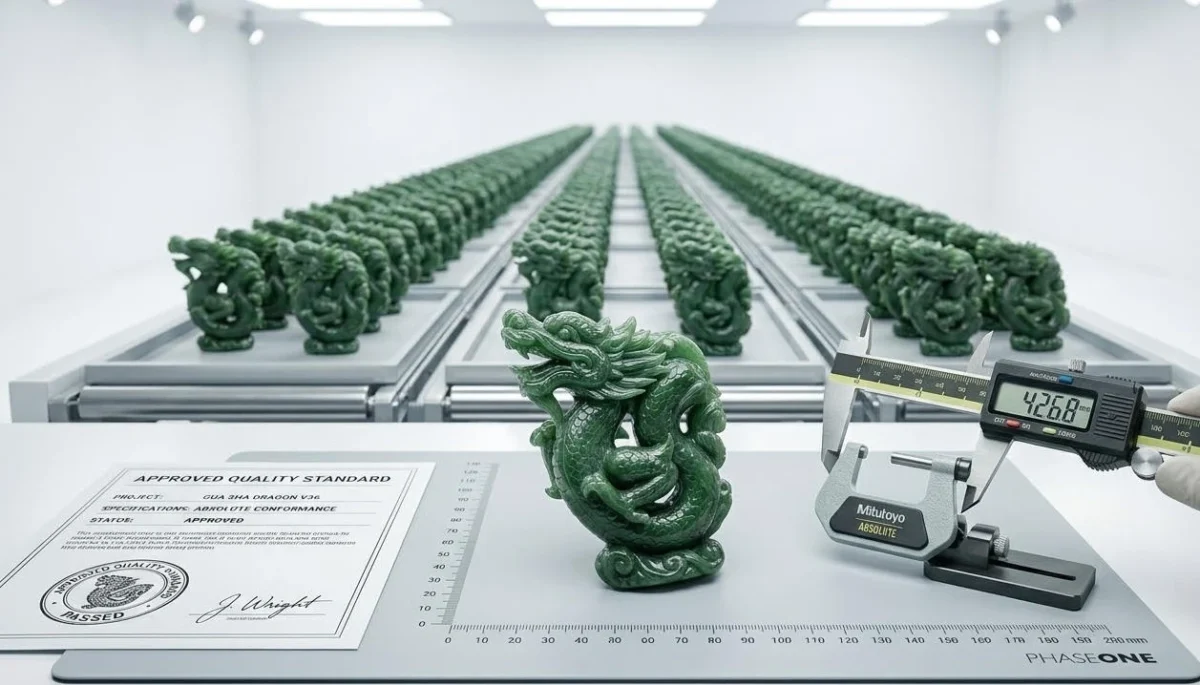
The cost structure of custom jade carving development is routinely misread by buyers who evaluate the zero-to-one phase in isolation. The correct framework evaluates front-end development cost in direct relationship to what it produces: a confirmed physical sample that functions as a repeatable, quality-consistent production standard. Once that standard exists, the economics of the entire order shift fundamentally.
Across the 2025 dataset, the time required to produce 100 confirmed units from an approved standard sample was consistently and substantially shorter than the time required to produce the first confirmed sample — across every order category, regardless of design complexity or material grade. The approved sample is not merely a reference object. It is a production protocol in physical form. It encodes the material selection criteria, the carving sequence, the finishing parameters, and the quality acceptance thresholds for every unit that follows. When a carver works from a confirmed sample, they are not making judgment calls — they are executing a defined, documented process. That is why batch production moves at a fundamentally different pace than initial development.
How a Confirmed Sample Becomes a Repeatable Production Standard
When a physical sample is confirmed for production, that confirmation triggers a documentation process capturing every relevant production parameter: the material grade and lot specification, the approved 3D model file, the surface finish standard referenced against the physical sample, and the quality checkpoints each unit must pass before leaving the production floor. This documentation becomes the production standard for the entire order run. Every carver working on that batch works from the same reference. Every quality check compares against the same confirmed benchmark, eliminating the interpretation variance that causes unit-to-unit inconsistency.
For buyers with repeat or ongoing custom jade carving requirements, this system creates a compounding efficiency advantage over time. A design that has completed the full zero-to-one development cycle has already absorbed all of its front-loaded complexity cost. When you reorder that design from the same jade manufacturer, you pay for production, not for re-development. This means that buyers who invest in a rigorous first-run process — and who select a supplier capable of conducting that process correctly — achieve a lower effective per-unit cost across the lifetime of the design, not just on the first order. The front-end investment is a one-time cost. The production efficiency it creates is a permanent structural advantage.
What Separates a Capable Custom Jade Carving Manufacturer From One That Will Cost You More Than Expected
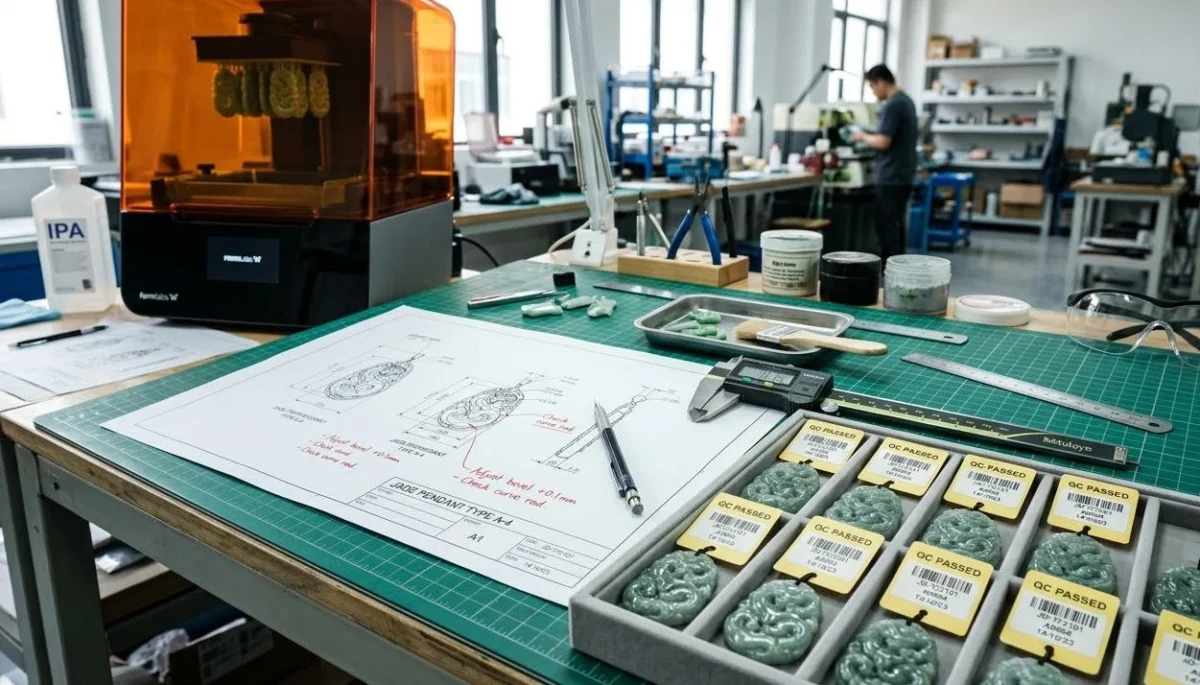
Given everything that production data reveals about the true structure of custom jade carving development, the practical question becomes: how do you identify which suppliers have the process discipline to manage this complexity, and which ones are likely to skip steps whose cost you will absorb downstream? The answer is not in the portfolio. A portfolio shows you what a supplier’s best work looks like under favorable conditions. It does not show you how they handle material-design mismatches, how they manage an underspecified brief, or how they document revision decisions across a multi-phase development process. Those capabilities are what determine your actual project outcome — and they are precisely what most supplier presentations never address.
The correct evaluation framework probes the supplier’s process, not their output. Three questions, asked directly and evaluated on the quality of the answer rather than the confidence of its delivery, will reveal more about a custom jade carving supplier‘s real capability than any portfolio review of any depth.
Three Questions to Ask Before Placing Your Order
The first question concerns material-design compatibility: when a buyer’s material specification is structurally incompatible with their requested design form, what is your documented process for identifying and resolving that conflict? A custom jade carving manufacturer who answers with a structured workflow — material assessment, feasibility analysis, written modification proposal with supporting rationale — has solved this problem at an operational level. A supplier who responds with reassurance that they can “handle anything” has not examined the problem, which means you will encounter it in production at full cost.
The second question concerns modeling infrastructure: do you use physical stone reference models, 3D-printed prototypes, or both, and at which phases of development? The answer tells you directly about their precision investment and their per-adjustment cost structure. A jade manufacturer using 3D-printed prototypes across the blueprint-to-model phase absorbs adjustment costs in software rather than material and labor. Across an average of 12 adjustment rounds per project, that structural difference has a measurable impact on your total development timeline and cost.
The third question concerns production documentation: when a sample is confirmed, what specific documentation do you generate to ensure batch consistency across the full order volume? If the custom jade carving supplier cannot describe a defined documentation protocol — or if the answer amounts to “our senior carver knows the standard” — you are accepting significant quality consistency risk on any order above single-digit quantities. Production quality that depends on individual carver memory rather than auditable, documented standards is not scalable. That is not a risk you want to discover after your first volume delivery.
How to Evaluate ROI Before Committing to a Custom Development Process
For cost-sensitive buyers, the relevant comparison is not the development investment measured against zero — it is the development investment measured against the cost of a failed first production run. Projects where material-design compatibility was validated before production commenced showed substantially higher first-pass sample acceptance rates than those where validation was bypassed. The cost of a single failed production batch — in raw material loss, rework labor, and schedule delay — typically exceeds the cost of multiple correctly conducted development cycles. This means that the development phase is not a cost to minimize. It is an insurance mechanism with a quantifiable return, and a custom jade carving manufacturer who helps you understand that structure is protecting your budget, not inflating it.
About JADEMAGO: 65 Years of Source Manufacturing in Jade and Crystal
JADEMAGO has operated as a source jade manufacturer of natural jade and crystal products for more than 65 years, maintaining direct control across the full production chain — from raw material selection through design development, carving, finishing, and quality inspection. As a custom jade carving manufacturer, JADEMAGO’s development process is built around the material-first design principle described throughout this article, supported by 3D prototype modeling infrastructure and structured revision documentation at every phase of the zero-to-one development cycle.
The 2025 production data referenced throughout this article was drawn from JADEMAGO’s internal order tracking system, covering 113 custom jade carving orders across buyer categories that include jewelry brands, corporate gift distributors, and institutional reproduction clients. That data is shared here as a production-planning resource for buyers who need accurate timeline expectations and an evidence-based account of what custom jade carving development actually requires — not as a guarantee that your project will match any specific figure.
If your next custom jade carving project is still in the planning stage, the most valuable action available to you right now is to assess whether your current material specification is compatible with your design objectives — before development begins, not after your first sample is rejected. That assessment, conducted at the right stage by a qualified custom jade carving supplier, will do more to protect your timeline and your investment than any other single decision in the project.
Faqs About Custom Jade Carving Difficulty
1. How long does a custom jade carving order take from concept to sample?
Based on 113 orders tracked in 2025, the full development cycle — from first brief to confirmed physical sample — takes between 10 and 30 days, depending on design complexity and material availability.
2. Why does the design phase take longer than the carving phase?
Carving follows a defined, repeatable process. Design requires reconciling your concept with the physical limits of the specific stone in hand — a non-standardizable judgment call that changes with every piece of raw material.
3. Can I specify my preferred jade material before the design is finalized?
You can express a material preference, but final material selection should happen before design is locked, not after. A design built around an incompatible material will require costly revision once production begins.
4. Does a 3D-printed model replace the need for a physical sample?
No. A 3D prototype establishes dimensional accuracy but cannot replicate how jade responds to carving tools. A physical sample carved from actual jade material is always required before batch production is confirmed.
5. Once a sample is approved, how quickly can bulk production begin?
Immediately. The approved sample functions as a complete production standard — material spec, carving parameters, and quality benchmarks are all locked in. Replicating from 1 to 100 units consistently takes less total time than the initial zero-to-one development cycle.