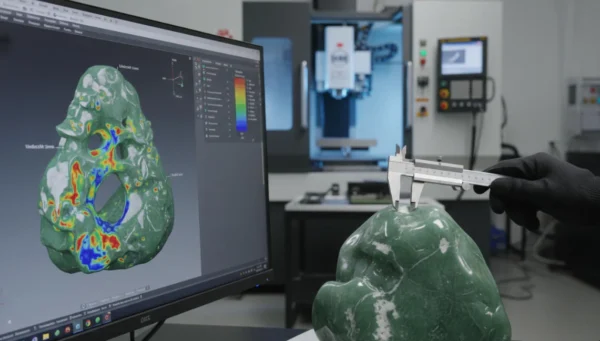
Every year, B2B gemstone buyers absorb losses averaging 8–12% of total procurement value due to defective products, inconsistent batch quality, and transit damage — losses that a structured gemstone manufacturing quality control system could have intercepted before the order ever shipped. If your most recent supplier batch passed sample inspection but arrived inconsistent at scale, the problem did not originate at a single production step. It was the cumulative result of unmonitored risk accumulating across multiple stages of the gemstone manufacturing process, with no systematic mechanism to catch it.
The core truth of modern gemstone manufacturing is that quality cannot be retrofitted at the end of a production line. According to the Gemological Institute of America (GIA), the defining quality factors of a finished gemstone — color, clarity, cut, and surface finish — are shaped and constrained at every stage, from raw crystal selection through final polish. This means your finished product’s quality ceiling is set not by polishing capability alone, but by the cumulative integrity of every step that precedes it.
JADEMAGO is a source-origin gemstone manufacturer with over 65 years of expertise in crystal and jade processing, design, and manufacturing. The company operates a four-stage quality control architecture — spanning raw material control, manufacturing process control, multi-step inspection protocols, and packaging verification — built to deliver a measurable, repeatable quality outcome with every order. This article deconstructs each stage of that system in technical detail, giving your procurement team the benchmarks and process checkpoints needed to evaluate any gemstone factory before committing to a contract.
Table of Contents
1: Raw Gemstone Quality Control — Why Your Finished Product’s Ceiling Is Set Before Gemstone Manufacturing Begins
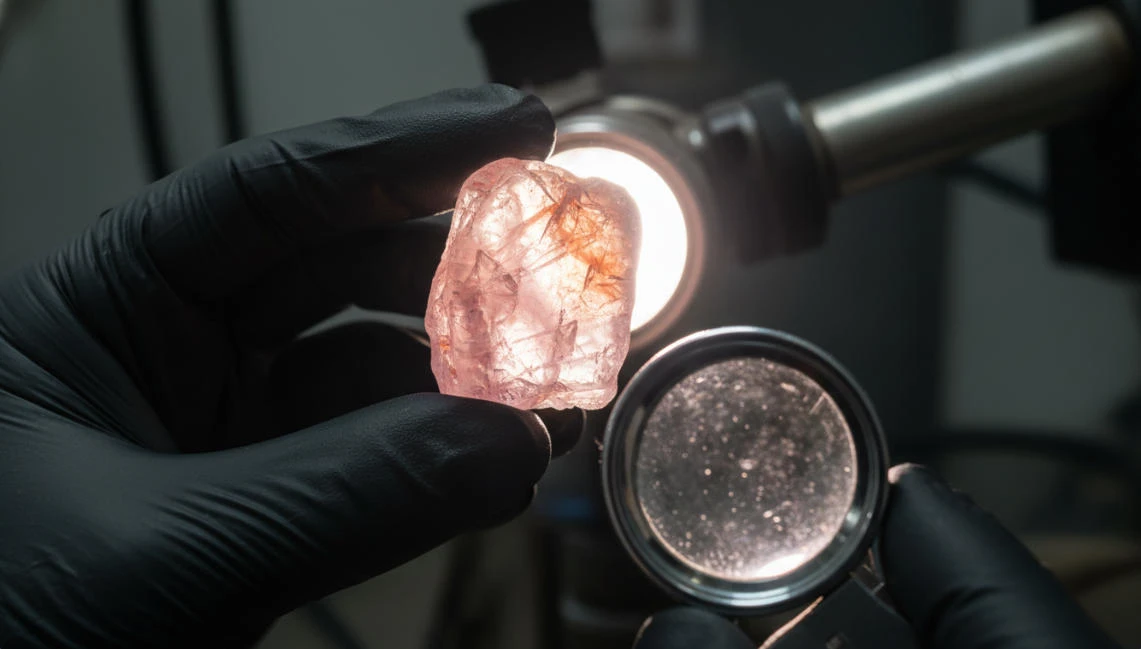
Most procurement teams evaluate a gemstone factory by its equipment inventory, production capacity, or sample quality. What they rarely audit — and what matters most — is how that factory controls the quality of its incoming raw materials. The finished quality of any gemstone product is fundamentally constrained by the raw stone it originated from. No cutting precision, shaping technique, or polishing process can recover value from a structurally compromised crystal. This is why raw material quality control is not a preliminary formality in gemstone manufacturing quality control — it is the foundational layer upon which every downstream quality outcome depends.
Sourcing-Stage Inspection: Controlling Quality Where Natural Variation Is Greatest
Natural gemstones are, by definition, inconsistent. Color saturation, internal clarity, fracture density, and mineral composition vary not just across different geological sources, but between individual stones extracted from the same deposit and the same extraction event. Research published by the International Gem Society (IGS) confirms that color — one of the primary commercial value drivers for colored gemstones — can shift measurably even within a single rough crystal, depending on orientation and depth of measurement.
This natural variability means the sourcing stage carries the highest inherent quality risk in the entire gemstone manufacturing chain. A gemstone factory that procures rough material from unverified intermediaries, or accepts mixed-grade incoming stock without structured incoming inspection, will produce inconsistent results regardless of how sophisticated its production line may be. JADEMAGO operates one of the few proprietary raw material trading platforms among Chinese gemstone manufacturers, importing directly from verified, high-yield production regions worldwide. Incoming rough is evaluated against internal acceptance benchmarks covering color uniformity, inclusion grade classification, and fracture mapping before any material is accepted into inventory. This approach eliminates the majority of quality variance at the earliest possible point — meaning your finished product starts from a verified quality baseline, not a procurement gamble.
Pre-Production Secondary Inspection: Why Surface Appearance Alone Cannot Qualify a Raw Stone
Passing sourcing-stage incoming inspection does not automatically qualify a raw stone for production scheduling. This is a critical gap that many gemstone factories overlook, and it is one of the most reliable generators of avoidable downstream defects. For large-format rough materials in particular, the internal structure of a crystal can diverge significantly from what its exterior surface suggests. A stone that presents clean, uniform, and inclusion-free on the outside may harbor internal fracture lines, stress concentration zones, or inclusion clusters that only become visible — and consequential — once cutting begins.
When this internal structure surprise occurs mid-production, the outcomes are consistently negative: material loss from cracked blanks, structural failure during shaping operations, dimensional nonconformance in finished units, or reduced yield per raw stone input. To close this gap, a secondary pre-production inspection must be conducted on each raw stone before it enters the cutting queue. This evaluation targets internal structure specifically — identifying material that does not meet either the client’s specified quality grade or JADEMAGO‘s internal classification standard — and removes nonconforming stones from the production batch before any machining investment is made. The SSEF Swiss Gemmological Institute identifies systematic pre-processing material assessment as a recognized best practice in precision gemstone manufacturing, directly correlated with downstream consistency in cut quality and dimensional stability. The practical implication for your procurement operation: your finished products are cut from structurally pre-verified material, reducing your defect rate before a single production step begins.
2: Manufacturing Process Quality Control — The Five Steps Where Gemstone Quality Is Built or Destroyed
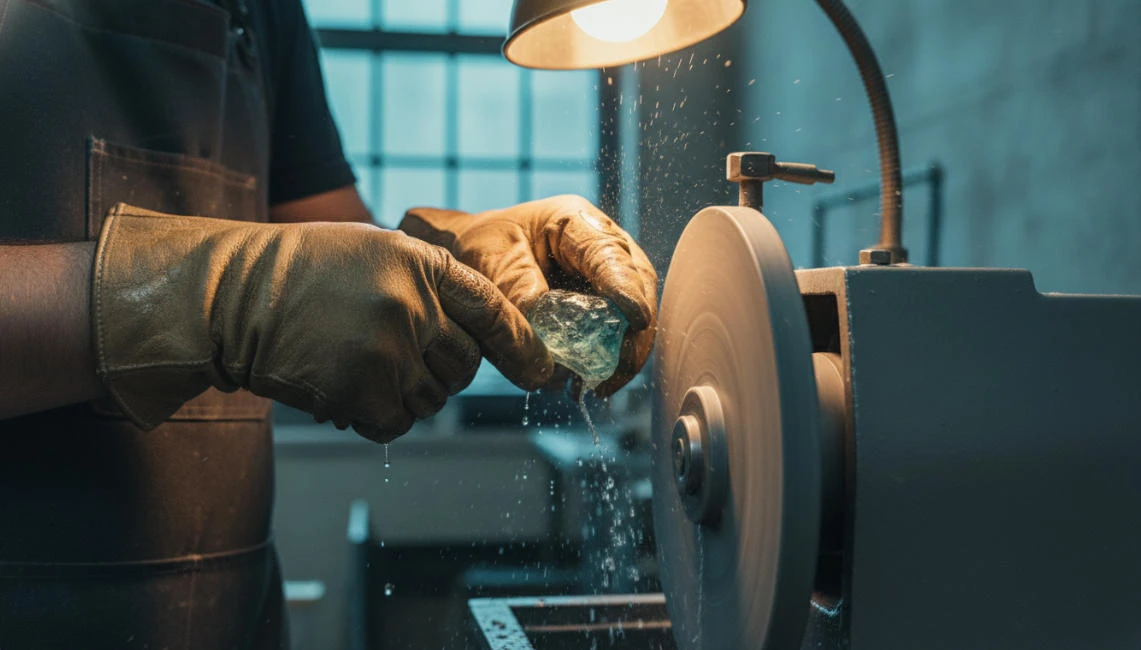
Raw material quality control establishes the ceiling of what your finished product can become. The manufacturing stage determines whether that ceiling is actually reached — or whether preventable process failures bring it down. Of all four stages in gemstone manufacturing quality control, the production phase is simultaneously the most technically complex and the highest-risk. Five sequential operations — cutting, shaping, grinding, polishing, and cleaning — must each be executed within controlled parameters, because defects introduced at any step do not simply stay contained to that step. They propagate forward, compounding through each subsequent operation until they surface as finished product failures.
Understanding what disciplined quality control looks like at each of these five stages is essential for any procurement team evaluating a gemstone manufacturer. It is also the clearest diagnostic for distinguishing a gemstone factory that produces consistent results at scale from one that performs well on samples and deteriorates on volume orders.
1: Cutting — Managing Fracture Risk in a Material That Cannot Tolerate Stress
Gemstone materials are, as a category, structurally brittle. Quartz crystal, jade, and most colored gemstone materials exhibit low tensile strength relative to their hardness, which means that cutting operations introduce stress in a substrate that has limited capacity to absorb it. The dominant failure modes at the cutting stage are fracture propagation along pre-existing internal stress lines and complete material rupture — both of which result in immediate, unrecoverable raw material loss. This is precisely why the pre-production secondary inspection described in Stage 1 carries direct downstream value: stones with mapped internal fractures can be cut along compensatory orientations, or removed from production entirely, before any machining investment is made.
Beyond upstream material screening, cutting quality control in gemstone manufacturing requires adherence to three non-negotiable technical principles. First, low-speed cutting with water-cooled blade systems must be maintained throughout the operation. Heat accumulation during high-speed cutting generates thermal stress that dramatically increases fracture probability, particularly at crystal boundary zones. Second, the cut orientation must follow the crystal’s natural grain direction wherever structurally possible. Cutting across grain lines rather than parallel to them generates shear stress that the material is mechanically ill-equipped to resist. Third, feed rate — the speed at which the saw advances through the material — must be dynamically modulated based on real-time material resistance feedback rather than preset at a fixed value. A gemstone factory that applies uniform feed rates across heterogeneous raw materials is systematically underperforming on yield and fracture control. The result for your production batch: a measurable reduction in cracked blanks, improved per-stone yield ratios, and a more stable input volume entering the downstream shaping operation.
2: Shaping — Where Artisan Judgment Determines Per-Stone Yield
The shaping operation is the production stage most dependent on individual technical skill, and the most resistant to standardization through equipment alone. Unlike industrial metal fabrication, where CNC machining can execute dimensionally identical operations across homogeneous material stock, gemstone shaping requires dynamic human judgment because no two rough blanks are dimensionally or structurally identical. Grain direction, residual stress distribution, localized hardness variation, and micro-fracture topology all differ between stones — even stones cut from the same rough block — and all of these variables influence how a given blank must be approached to yield a dimensionally accurate, structurally sound shaped piece with minimum material loss.
A skilled gemstone artisan does not apply a fixed shaping protocol to every piece. Instead, they assess each blank individually — evaluating its specific characteristics — and adjust both their technique and their operational tempo to match what that particular stone requires. This adaptive approach is the difference between a shaping operation that achieves 85%+ usable yield from a production batch and one that delivers 65–70% while generating excess shaped-but-nonconforming rejects. For your procurement operation, this means that when you source from a gemstone manufacturer with a technically developed artisan workforce, you are not just purchasing manufacturing labor — you are purchasing yield optimization and dimensional consistency that directly reduces per-unit material cost embedded in your pricing.
3: Grinding — Resolving the Quality-Efficiency Tension That Volume Orders Expose
Grinding is the stage at which surface accuracy is developed from the rough geometry established in shaping. It is also the production stage where the quality-efficiency tension becomes most operationally visible. In small-batch or sample production, a gemstone factory can afford to prioritize quality over throughput — allocating extended grinding time per piece without concern for downstream schedule impact. At the production volumes typical of B2B gemstone orders, however, that trade-off becomes financially and logistically unsustainable. Excessive grinding time per unit compounds across order quantities to create delivery timeline failures and unit cost overruns that erode the profitability of the procurement relationship for both parties.
The resolution to this tension is not a compromise that sacrifices quality for throughput, or throughput for quality. It is the development of a calibrated technical judgment — knowing, for each material type and product specification, the exact grinding parameters that achieve the required surface accuracy in the minimum necessary time. This is a skill that accumulates through experience rather than being extractable from process documentation, and it represents one of the most meaningful competitive differentiators between gemstone factories that have long production histories with specific material types and those that do not. JADEMAGO‘s artisan team, operating across 65 years of accumulated production experience with crystal and jade, has developed this calibrated judgment across a broad product and material range. What this means operationally for your orders: production schedules hold, per-unit costs remain predictable, and surface quality meets specification without extended rework cycles.
4: Polishing — The Stage That Separates Conforming Products from Market-Ready Ones
If cutting, shaping, and grinding collectively establish the structural and dimensional foundation of a finished gemstone piece, polishing is the operation that determines its commercial presentation. Surface luster, reflection uniformity, scratch-free finish, and overall visual impression — the attributes that determine how your product is perceived and valued by the end customer — are all outcomes of polishing quality. A piece that passes dimensional inspection but fails on polish quality is a piece that fails market standards, regardless of how technically correct its geometry may be.
Effective polishing quality control in gemstone manufacturing is built on a single operational principle: progressive, staged abrasion from coarse to fine. Beginning with coarser abrasive compounds and advancing incrementally through finer grades allows each stage to address and eliminate the surface irregularities introduced by the previous one. Attempting to accelerate this sequence — skipping abrasive grades to reduce cycle time — consistently produces a specific failure mode: micro-scratching that is not visible under standard inspection conditions but becomes apparent under direct light or magnification, and that customers will notice. The GIA’s surface quality grading framework identifies surface finish as one of the primary visible quality attributes evaluated in colored stone grading, directly influencing both perceived grade and retail value positioning. A progressive polishing protocol — rigorously applied at every production stage — is what ensures your finished product arrives with the surface presentation your end market expects.
5: Cleaning — A Low-Decision Stage That Still Carries a Specific, Avoidable Risk
Cleaning is the final manufacturing operation before quality inspection begins, and it is correctly understood as the lowest-risk stage in the gemstone manufacturing process. It does not determine structural integrity, dimensional accuracy, or surface finish quality in the way that upstream operations do. However, it carries one specific, entirely avoidable failure mode that a disciplined gemstone manufacturing quality control protocol must address: surface scratching caused by abrasive residue particles remaining on the gemstone surface during the cleaning cycle.
When fine abrasive particles from the preceding polishing operation are not fully removed before or during cleaning, they act as micro-abrasives against the polished surface during mechanical or ultrasonic agitation — reintroducing surface scratches onto a product whose polish quality has already been achieved and verified. This is a particularly frustrating failure mode because it occurs at the very end of the production sequence, after all upstream value has been added, and it affects surface quality — the attribute most immediately visible to your end customer. The operational control for this risk is straightforward: a pre-cleaning rinse step that removes residual abrasive particles from all surface recesses before the primary cleaning cycle begins. It adds minimal cycle time and eliminates a defect pathway that, if unmanaged, will generate a consistent percentage of surface-scratched rejects in every production batch.
3: JADEMAGO‘s 3-Step Quality Inspection Protocol — From Production Line to Shipment
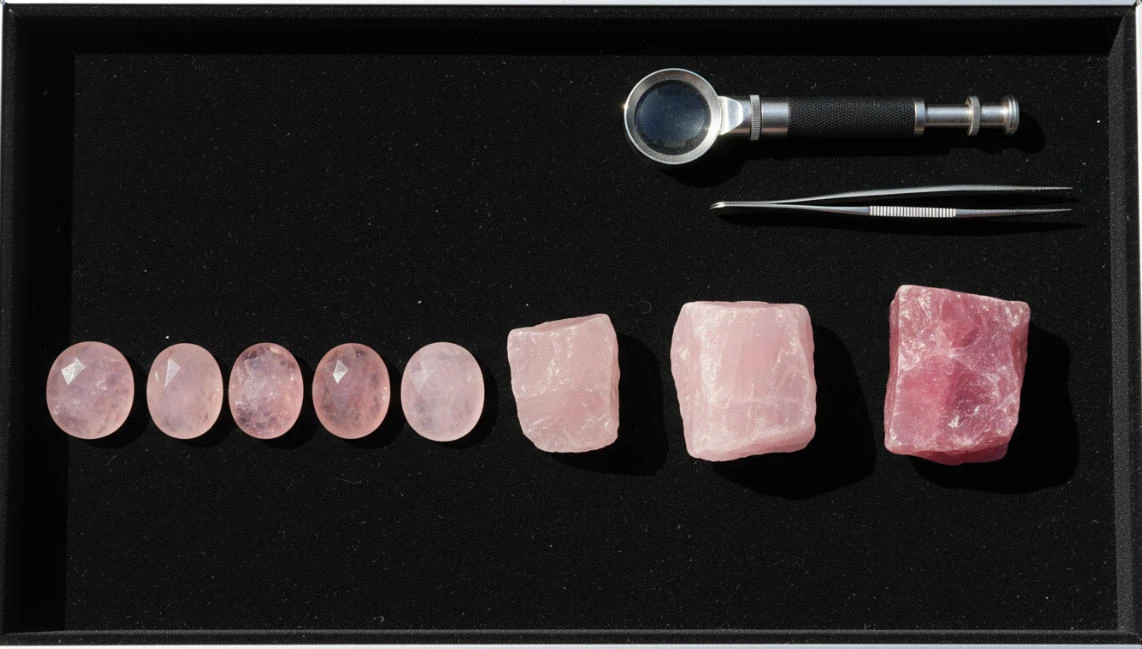
Quality inspection is the stage in gemstone manufacturing quality control that most procurement teams are familiar with — and most fundamentally misunderstand. The dominant mental model among buyers is that quality inspection is a gate that exists at the end of production: a final check performed on finished goods before they are approved for shipment. This model is not wrong, but it is dangerously incomplete. A final inspection gate can identify defective products. It cannot recover the raw material, labor, and production time already consumed in creating them. It cannot prevent a defect that originated in Step 2 of manufacturing from being compounded through Steps 3, 4, and 5 before it is finally detected at the end of the line.
The operational implication of this distinction is significant. A gemstone factory that relies exclusively on finished goods inspection will consistently generate a predictable volume of end-of-line rejects — products that consumed full production resources but cannot be shipped. The costs of those rejects are either absorbed by the factory, reflected in elevated unit pricing, or passed to the buyer in the form of delivery shortfalls and reorder delays. None of these outcomes serve your procurement objectives. The alternative — a multi-stage inspection architecture that intercepts defects at the earliest possible point in the production sequence — reduces total defect volume, reduces rework cost, and produces a more stable, predictable quality outcome across production batches.
JADEMAGO implements a structured three-step quality inspection framework: In-Process Inspection, Final Product Inspection, and Pre-Shipment Inspection. Each step targets a distinct phase of the production and logistics sequence, and each is designed to catch the specific defect categories most likely to emerge at that phase. Together, they create a continuous quality monitoring chain from raw material processing through to the moment your order leaves the facility.
1: In-Process Inspection — Intercepting Defects Before They Compound
In-process inspection (IPC) is quality verification conducted during active production, at defined checkpoints between manufacturing operations. Its function is to evaluate work-in-progress (WIP) output at each stage transition — confirming that the output of one operation meets the dimensional, structural, and surface quality requirements needed to enter the next — before committing that WIP to further processing investment.
The practical value of IPC is most clearly understood through its absence. Without production-stage inspection checkpoints, a shaped blank with an out-of-tolerance dimension will proceed through grinding, polishing, and cleaning — accumulating full processing costs at each stage — before the dimensional nonconformance is finally detected at finished goods inspection. At that point, the defective piece either requires rework (if the nonconformance is recoverable) or must be scrapped (if it is not). Either outcome represents a waste of manufacturing resources that IPC, positioned correctly in the production sequence, would have intercepted at the shaping stage — before grinding, polishing, and cleaning costs were added. According to quality engineering principles documented by the American Society for Quality (ASQ), defect detection cost increases exponentially the further downstream a defect is allowed to travel — making early-stage inspection not merely a quality practice but a direct cost-reduction mechanism. For your procurement operation, this means that a gemstone manufacturer with structured IPC delivers more consistent batch quality not because its production equipment is necessarily different, but because its quality architecture is designed to prevent defect accumulation rather than simply detect it at the end.
2: Final Product Inspection — Two-Dimensional Verification Against Specification
Final product inspection (FPI) is the verification stage applied to completed gemstone pieces before they are released from production status and transferred to packaging. Unlike in-process inspection — which evaluates intermediate outputs against internal process quality thresholds — FPI evaluates finished goods against the specific dimensional and appearance standards defined by the customer order or JADEMAGO‘s internal product grade classification.
FPI is structured across two independent evaluation dimensions: appearance and dimensional compliance. These two dimensions are assessed separately because they target fundamentally different quality attributes and require different inspection tools and criteria. Conflating them into a single undifferentiated visual inspection step — as many gemstone factories do — introduces the risk of dimension-passing pieces with appearance defects, or appearance-passing pieces with out-of-tolerance dimensions, both proceeding to shipment.
Appearance Inspection evaluates five core surface and visual quality attributes. Scratch presence and severity is assessed under standardized lighting conditions and magnification, targeting both macro-visible scratches and the micro-scratch patterns that can result from polishing sequence shortcuts or inadequate pre-cleaning procedures. Bubble and void inclusions — internal or surface-breaking — are evaluated for presence, size, and location relative to the product’s primary viewing face. Crack assessment documents any fracture lines, whether pre-existing from raw material origin or induced during manufacturing operations. Color consistency is verified against the approved reference standard for the order, with particular attention to hue and saturation uniformity across all pieces in the batch — critical for orders where end-use application requires visual uniformity across multiple units. Finally, polish uniformity is assessed across the full surface area of each piece, verifying that the progressive polishing protocol was applied consistently and that no zones of differential luster are present. The International Gem Society’s quality evaluation methodology identifies color consistency and surface finish uniformity as the two appearance attributes most directly correlated with end-consumer perceived value in colored gemstone products.
Dimensional Inspection evaluates each finished piece against the tolerance specifications defined for the order. Dimensional compliance is verified using calibrated measurement tooling against the critical dimensions specified — length, width, height, diameter, or radius depending on product geometry — with acceptance criteria defined by the tolerance band agreed upon at order confirmation. Pieces that fall outside tolerance on any critical dimension are either routed to corrective rework where dimensionally feasible, or rejected and documented for root-cause analysis feeding back into the upstream production process. This closed-loop feedback mechanism — where FPI nonconformances generate upstream process adjustments — is what prevents a dimensional nonconformance pattern from recurring across multiple production batches.
3: Pre-Shipment Inspection — The Final Quality Gate Before Your Order Enters the Logistics Chain
Pre-shipment inspection (PSI) is the third and final stage of JADEMAGO‘s quality inspection framework, conducted on packed, shipment-ready goods before they leave the production facility. PSI is structurally distinct from FPI: where FPI verifies that individual finished pieces meet product quality specifications, PSI verifies that the complete shipment — products, quantities, packaging integrity, and labeling — meets the total order requirements as contracted.
The scope of a thorough pre-shipment inspection covers three integrated verification areas. Product condition verification confirms that finished pieces have not sustained any handling damage during transfer from production to packing, and that their appearance and dimensional status remains consistent with FPI-approved results. Quantity and assortment verification confirms that the shipment contains the correct product quantities, SKU breakdown, and any customer-specified assortment ratios as defined in the order. Packaging integrity verification — which connects directly to Stage 4 of this quality control framework — confirms that each unit is secured within its protective packaging structure, that inner and outer packaging is correctly assembled and labeled, and that the complete packaged shipment is structurally ready to withstand the physical stresses of international logistics.
A rigorous PSI process directly reduces your post-receipt dispute rate. When a gemstone manufacturer can provide documented PSI records — covering the inspection date, inspector, sampling methodology, findings, and pass/fail determination — your receiving team has a verifiable quality baseline against which any transit damage or fulfillment discrepancy can be assessed and attributed. This documentation chain also forms the evidentiary foundation for any freight insurance claim that may arise from transit damage, making it a commercially significant administrative artifact in addition to its quality assurance function. For buyers placing recurring orders, a supplier with structured, documented PSI processes gives your quality team a consistent, auditable quality record — the kind of supplier transparency that supports long-term procurement relationship confidence.
4: Packaging Quality Control — The Final Risk Layer That Most Gemstone Factories Ignore
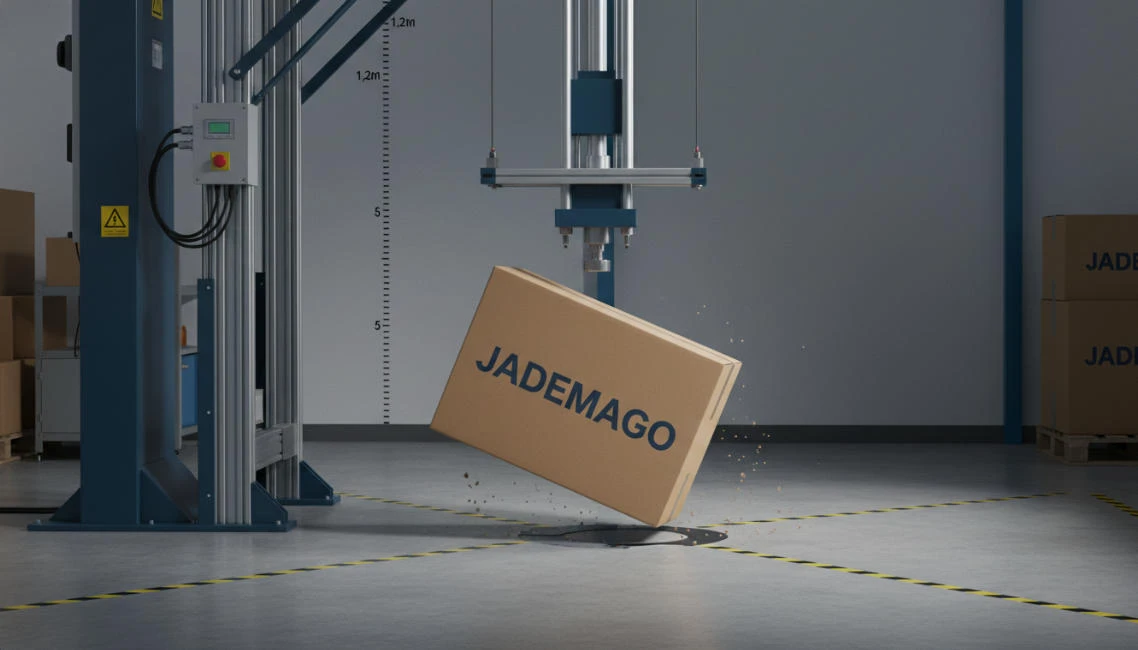
Consider the following scenario: a production batch of gemstone pieces clears every stage of manufacturing quality control with zero nonconformances. In-process inspection confirms dimensional accuracy at each production checkpoint. Final product inspection verifies appearance and tolerance compliance on every finished unit. Pre-shipment inspection documents a clean pass across all product, quantity, and packaging criteria. The order ships. Three weeks later, your receiving team opens the cartons to find a percentage of pieces with surface chips, edge fractures, and impact damage that did not exist when the order left the factory.
This is not a hypothetical. It is a recurring procurement outcome that costs B2B gemstone buyers an estimated 3–7% of shipment value per affected order in product replacement, reorder lead time, and downstream customer satisfaction impact — and it is almost entirely attributable to packaging quality control failure rather than manufacturing defect. The finished product was correct. The packaging system failed to protect it through the physical realities of international freight handling.
Packaging quality control is consistently the most underinvested stage in gemstone manufacturing quality control systems. It lacks the technical complexity of cutting or polishing, it occurs after the product is already completed, and its failures are attributed to “shipping damage” rather than supplier quality failure — a misattribution that allows packaging system deficiencies to persist across order after order without being corrected at the source. The reality is that a gemstone manufacturer‘s responsibility for product quality does not end when finished goods pass FPI. It extends through to the moment your receiving team confirms the shipment arrived intact. Packaging is the engineering system that bridges that gap, and it requires the same structured design and verification discipline applied to every other stage of the quality control framework.
Structural Packaging Design — Engineering Protection Across Two Distinct Layers
Effective gemstone packaging is not a single-layer problem. It requires coordinated protection architecture across two structurally distinct levels, each addressing a different physical threat to product integrity during transit.
The first layer is the relationship between the individual gemstone piece and its immediate inner packaging. At this level, the design objective is immobilization and cushioning: the product must be secured within its inner packaging with sufficient restraint to prevent any relative movement between the product and the packaging material during handling events. For gemstone products — which combine high surface finish value with brittle fracture susceptibility — even small-amplitude vibration-induced contact between a polished surface and an adjacent hard packaging material is sufficient to generate surface scratches or edge chips. The inner packaging material must therefore provide both adequate cushioning depth to absorb impact energy and sufficient structural conformity to the product geometry to prevent motion during sustained vibration. Foam inserts precision-cut to product geometry, individual compartmentalization for multi-piece packs, and surface-contact materials with confirmed non-abrasive properties are the standard design elements that address this first-layer requirement. When your supplier’s inner packaging is engineered to this standard, the probability of surface damage from routine freight handling drops to near zero — meaning the surface quality your quality team verified at FPI is the surface quality your receiving team will find.
The second layer addresses the structural relationship between inner packaged units and the outer shipping carton. At this level, the design objective shifts from individual product protection to system-level structural integrity: the arrangement and securing of inner packages within the outer carton must minimize internal movement of the total package assembly during the mechanical stresses of international freight transit. Inadequately secured inner packages within an outer carton create a dynamic loading condition during transit — particularly during the deceleration events of air freight handling or the sustained vibration profile of ocean container shipping — where inner packages shift, collide with carton walls, and transfer impact energy to the products they contain. The engineering solution is straightforward: inner packages must be arrayed within the outer carton with structural infill material — whether foam blocks, corrugated dividers, or molded pulp — that eliminates void space and prevents relative movement of the internal package array under all foreseeable transit loading conditions. According to packaging engineering standards referenced by the International Safe Transit Association (ISTA), the combination of adequate cushioning thickness, void fill, and restraint geometry is the primary determinant of package system performance under dynamic transit loading — not the strength of the outer carton alone.
Drop Testing, Vibration Testing, and Compression Testing — Why Packaging Validation Cannot Be Based on Assumption
Structural packaging design, however well-reasoned, is a hypothesis until it is validated by physical testing. The transit environment that a gemstone shipment encounters — from factory loading dock through freight consolidation, air or ocean transit, destination customs handling, last-mile delivery, and receiver unloading — subjects the package system to a sequence of mechanical stresses that cannot be fully characterized by engineering judgment alone. A packaging design that performs acceptably in the designer’s mental model may fail at a specific impact angle, at a particular vibration frequency, or under a compressive load combination that was not anticipated during the design phase. The only reliable method to confirm that a packaging system will protect its contents through actual transit conditions is to physically simulate those conditions through standardized testing protocols before committing the design to production use.
JADEMAGO‘s packaging validation protocol incorporates three standardized test types, each targeting a distinct transit stress category. The drop test — conducted from both 1.0 meter and 1.2 meter drop heights across multiple orientations — simulates the impact loading generated by package drops during manual handling at freight consolidation and delivery points. Drop height selection is calibrated to the weight class and fragility rating of the packaged product, with heavier or more fragile items requiring validation at the higher drop height. A packaging system that passes drop testing at both heights across all specified orientations has demonstrated structural adequacy for the impact events most commonly associated with transit handling damage claims.
The vibration test simulates the sustained, low-amplitude mechanical vibration profile generated by road freight vehicles during over-the-road transport segments of the logistics chain. Vibration-induced damage is mechanically distinct from impact damage: rather than a single high-energy event, it represents cumulative fatigue loading applied over extended duration — the kind of loading that gradually works inner packaging loose from its initial secured position, progressively reducing the immobilization effectiveness that protects individual product pieces. A vibration test run to the frequency profile and duration parameters specified for the relevant transport mode confirms that the packaging system maintains its structural integrity — and its product immobilization function — throughout a representative transit duration.
The compression test addresses the stacking loads that packaged goods experience during warehousing and container loading, where multiple carton layers are stacked to ceiling height and the bottom layers bear the cumulative weight of everything above them. For gemstone shipments, compression failure of the outer carton transfers load directly to the inner packaging and ultimately to the product, with fracture and surface damage as predictable outcomes. Compression testing to the calculated stacking load for the relevant storage scenario confirms that the outer carton’s structural strength is adequate to protect its contents under realistic warehousing conditions without permanent deformation that would compromise inner package geometry. The ISTA 2A and 3A test protocols — among the most widely referenced packaging performance standards in international freight — incorporate all three of these test categories as components of a complete package system validation sequence, providing a recognized international benchmark against which any gemstone manufacturer‘s packaging validation practice can be assessed.
When your packaging system has been validated against all three test categories, you move from hoping your shipment arrives intact to having engineering evidence that it will. For procurement teams managing high-value gemstone orders across international logistics routes, that distinction represents a material reduction in shipment risk — and a corresponding reduction in the insurance, replacement, and customer relationship costs that packaging failures generate.
The Commercial Cost of Skipping Packaging Quality Control
The decision not to invest in structured packaging quality control is not a neutral cost-saving measure — it is a risk transfer. The cost does not disappear from the supply chain; it relocates from the supplier’s packaging engineering budget to the buyer’s claims resolution process, replacement order pipeline, and downstream customer satisfaction metrics. A gemstone manufacturer that ships without packaging validation is effectively asking its buyers to absorb the financial consequences of packaging system failures that the manufacturer was in the best position — and had the greatest responsibility — to prevent.
Quantifying this exposure: for an international gemstone order with a declared value of $50,000, a packaging failure rate of 4% generates $2,000 in direct product replacement cost before accounting for reorder lead time, expedited freight charges, and any downstream customer impact from delivery shortfalls. Across an annual procurement volume of four to six orders with the same supplier, that unmanaged packaging risk compounds to a meaningful annual loss figure — one that structured packaging validation, implemented by the gemstone factory before the first shipment, could reduce to near zero. This means that when evaluating a gemstone factory as a long-term supply partner, packaging quality control capability is not a secondary consideration. It is a direct determinant of your total cost of procurement.
Why Full-Chain Gemstone Manufacturing Quality Control Is the Most Undervalued Variable in Your Procurement Strategy
Procurement decisions in the gemstone manufacturing sector are predominantly evaluated on three visible variables: unit price, minimum order quantity, and sample quality. These are legitimate evaluation criteria. They are also insufficient. A gemstone manufacturer that competes on price while operating an unstructured quality control system is not offering you a cost advantage — it is offering you a deferred cost transfer. The quality failures that its uncontrolled process generates will not appear on your initial purchase order. They will appear in your defect rate data, your rework and replacement costs, your downstream customer complaint volume, and ultimately in the margin erosion that accumulates across a procurement relationship where quality outcomes are unpredictable.
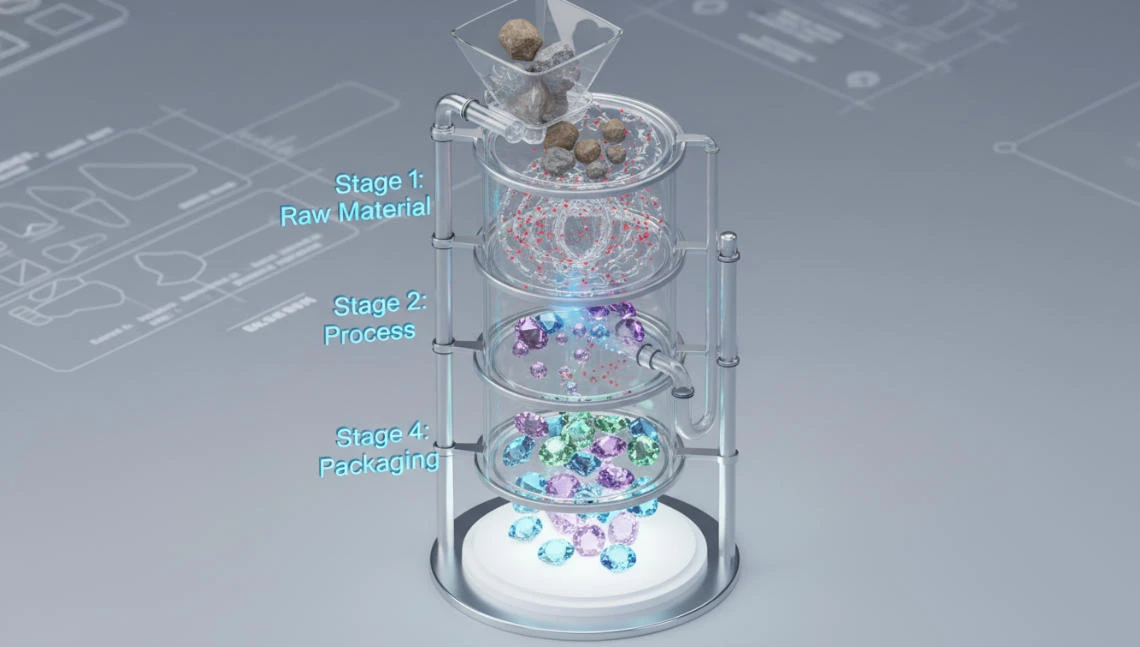
The four-stage quality control architecture described in this article — raw material control, manufacturing process control, multi-step inspection, and packaging validation — exists precisely to make quality outcomes predictable. Not occasionally good, not good on samples but inconsistent at volume, but systematically and documentably consistent across every production batch. For B2B gemstone buyers operating at meaningful procurement volumes, that predictability has a quantifiable commercial value that unit price comparison alone cannot capture.
How Consistent Gemstone Manufacturing Quality Control Directly Reduces Your Total Cost of Procurement
The relationship between supplier quality control maturity and buyer procurement cost is not abstract — it is calculable, and the calculation consistently favors sourcing from gemstone manufacturers with structured quality systems even when their unit pricing is not the lowest available in the market. Consider the cost components that a structured quality control system eliminates or reduces at your end of the supply chain.
Defect-related replacement costs are the most immediately visible. Industry benchmarks from the ASQ Cost of Quality framework establish that external failure costs — defects that escape the supplier’s quality system and reach the buyer — typically run 4–6 times higher than the internal failure costs that would have been incurred had the defect been caught and corrected within the supplier’s production process. When your gemstone manufacturer‘s quality control system intercepts defects internally — at in-process inspection, at final product inspection, before they ever reach your receiving dock — those external failure costs do not appear in your procurement ledger. The defect rate reduction translates directly to a reduction in replacement order frequency, replacement freight costs, and the administrative overhead of claims processing and supplier dispute resolution.
Incoming inspection costs at your facility represent a second, less obvious cost component. Buyers who source from suppliers with unverified or undocumented quality systems must invest in compensatory incoming inspection at their own receiving operation — dedicating staff time, inspection tooling, and process infrastructure to verify the quality that their supplier should have already guaranteed. A gemstone manufacturer with a documented, auditable three-step inspection protocol — providing inspection records, sampling methodology, and pass/fail data with each shipment — substantially reduces the incoming inspection burden your quality team must absorb. This is particularly relevant for buyers operating in markets with their own downstream quality compliance requirements, where the cost of incoming inspection is not optional.
Production schedule reliability represents the third cost component, and often the largest in absolute terms for buyers with committed downstream delivery obligations. When a gemstone order arrives with a defect-driven shortfall — because a percentage of the batch failed quality inspection after receipt — the downstream schedule impact cascades: customer delivery commitments are missed, expedited reorder costs are incurred, and the relationship cost of delivery failure is absorbed by your commercial team. A supplier whose quality system consistently delivers complete, compliant batches on schedule eliminates this cascade. The commercial value of that schedule reliability, priced against the cost of even one expedited reorder event per year, frequently exceeds the unit price premium — if any — associated with sourcing from a more quality-mature gemstone manufacturer.
What to Ask a Gemstone Manufacturer About Quality Control Before Placing Your First Order
Evaluating a gemstone factory‘s quality control capability before committing to a production order does not require an on-site audit — though an audit, where feasible, remains the gold standard. A structured set of questions, submitted in writing and evaluated against the specificity and documentation depth of the responses, can provide a reliable initial assessment of whether a manufacturer’s quality system is genuinely operational or primarily presentational.
On raw material control, ask your prospective gemstone manufacturer to describe their incoming raw material inspection procedure — specifically, what criteria are applied, who performs the inspection, and how nonconforming raw material is documented and dispositioned. Follow this with a direct question about whether a secondary pre-production inspection is performed on raw stones before they enter the cutting queue, and what that inspection evaluates. A gemstone factory with a genuine raw material quality system will answer both questions with operational specificity. A manufacturer whose quality control is primarily cosmetic will respond with general assurances about “sourcing from quality suppliers” without describing an actual inspection process.
On manufacturing process control, ask which specific quality checkpoints are applied during production — not after production — and at which stage transitions those checkpoints occur. Ask what happens operationally when a work-in-progress piece fails an in-process inspection checkpoint: is it reworked, scrapped, or continued into downstream operations? The answer to the second question is particularly revealing. A gemstone factory that continues nonconforming WIP into downstream operations to avoid production schedule disruption is not operating a genuine quality control system — it is operating a quality documentation system, which is a materially different thing.
On inspection protocols, request the gemstone manufacturer‘s finished goods inspection criteria in writing — specifically the appearance attributes evaluated, the dimensional tolerance standards applied, and the sampling methodology used. Ask whether pre-shipment inspection is conducted on packed goods, and whether PSI documentation is available for review with each shipment. According to GIA’s gemstone quality evaluation standards, color consistency, surface finish, and dimensional accuracy are the three attributes most directly correlated with end-market value retention in colored gemstone products — your supplier’s inspection criteria should explicitly address all three.
On packaging validation, ask directly whether the gemstone manufacturer has conducted physical drop testing, vibration testing, or compression testing on their standard gemstone packaging configurations, and request the test results or test certificates if available. This question has a reliable discriminating function: gemstone manufacturers who have invested in packaging validation will answer it immediately and specifically. Manufacturers who have not will either provide vague affirmations about “careful packaging” or redirect the conversation toward their production quality rather than their packaging system. Either response pattern tells you that packaging quality control is not a structured practice at that facility — and that your shipment risk is correspondingly elevated.
The ROI of Sourcing From a Quality-Controlled Gemstone Manufacturer: A Simplified Model
For procurement teams that need to justify a sourcing decision to internal stakeholders — particularly when the quality-controlled supplier’s pricing is not the lowest available — the following simplified ROI framework provides a structure for quantifying the value of quality system maturity in supplier selection.
Establish your baseline defect rate with your current supplier. If you do not have precise defect rate data, a conservative industry estimate for unstructured gemstone manufacturing supply chains is 6–10% of shipped units requiring replacement, rework, or credit. Apply your average unit value to calculate the annual direct replacement cost at your current defect rate. Add an estimate of incoming inspection labor cost, expedited reorder freight cost from defect-driven shortfalls, and a conservative estimate of downstream customer impact cost from delivery failures. This sum represents your current annual quality failure cost — the cost your procurement operation is already absorbing, even if it is not currently being tracked as a quality line item.
Now model the same calculation at a defect rate of 1–2%, which represents a realistic performance target for a gemstone manufacturer operating the full four-stage quality control system described in this article. The difference between your current quality failure cost and the projected quality failure cost at 1–2% defect rate is the annual value of quality system improvement — value that is available to offset any unit price premium associated with sourcing from a more quality-mature supplier, and that typically exceeds that premium by a significant margin. When your procurement team can demonstrate that sourcing from a quality-controlled gemstone manufacturer reduces total procurement cost even if unit price is marginally higher, the supplier selection rationale becomes financially defensible rather than qualitatively argued.
This means that the question your procurement strategy should be asking is not “which gemstone manufacturer offers the lowest unit price?” It is “which gemstone manufacturer‘s quality system produces the lowest total cost of procurement across a full order cycle?” Those two questions have different answers — and consistently sourcing based on the second question is what separates procurement operations that scale profitably from those that manage a perpetual cycle of quality failures and supplier transitions.
About JADEMAGO — 65 Years of Source-Origin Gemstone Manufacturing

JADEMAGO was established as a source-origin gemstone manufacturer and has operated continuously in crystal and jade processing, design, manufacturing, and wholesale distribution for over 65 years. The company’s production infrastructure is built around the full vertical integration of the gemstone manufacturing value chain — from direct raw material procurement through finished product delivery — a structural characteristic that distinguishes it from the majority of gemstone suppliers operating as trading intermediaries rather than manufacturing principals.
The company operates one of the few proprietary raw material trading platforms among Chinese gemstone manufacturers, maintaining direct import relationships with verified production regions across multiple continents. This sourcing infrastructure gives JADEMAGO‘s quality control system a capability that trading-based suppliers structurally cannot replicate: the ability to apply quality control at the raw material procurement stage itself, before material enters the manufacturing chain, rather than inheriting whatever quality variance the open market delivers. For buyers evaluating gemstone manufacturers on the basis of batch consistency and quality predictability, this upstream sourcing control is a foundational differentiator — not a marketing point, but a structural quality advantage embedded in the supply chain architecture.
A Gemstone Manufacturing Operation Built Around Documented Process, Not Individual Performance
One of the persistent risks in artisan-dependent manufacturing — and gemstone manufacturing is, at its core, artisan-dependent — is that quality outcomes vary with individual technician performance rather than being anchored to documented process standards. A gemstone factory whose quality depends on the presence of its most skilled artisans is a factory whose quality is fragile: it degrades with personnel turnover, fluctuates with workforce capacity, and cannot be reliably replicated across facilities or production shifts.
JADEMAGO‘s approach to this structural risk is the combination of deep artisan skill development — with production technicians trained across the full five-step manufacturing sequence and experienced with the specific behavioral characteristics of crystal and jade materials — and documented process standards that define the quality parameters, inspection criteria, and operational protocols governing each production stage. The artisan skill drives performance quality. The documented process standards ensure that performance quality is consistent, auditable, and transferable — not dependent on any single individual’s presence on the production floor. What this means for your procurement operation: the quality outcomes you verify during supplier qualification are the quality outcomes you will receive on your tenth production order, not just your first.
Gemstone Product Categories and Custom Manufacturing Capability
JADEMAGO‘s gemstone manufacturing capability spans the primary categories of crystal and jade gemstone products, including carved figures and decorative objects, spheres and freeform polished pieces, cabochons, beads, and custom-geometry components for jewelry and product integration applications. The company’s production infrastructure supports both standard catalog specifications and fully custom product development — including custom geometry, custom finish specification, custom sizing tolerances, and custom packaging design.
For B2B buyers with product specifications that fall outside standard catalog parameters — whether due to application-specific dimensional requirements, proprietary design geometry, or end-market quality grade specifications — JADEMAGO‘s custom gemstone manufacturing capability means your specification can be accommodated within a structured production framework rather than treated as an exception that strains the factory’s standard process. Custom orders receive the same four-stage gemstone manufacturing quality control architecture applied to standard production: raw material selection calibrated to the specific quality requirements of the custom specification, manufacturing process parameters adjusted for the geometry and material characteristics of the custom product, inspection criteria defined against the custom specification’s dimensional and appearance requirements, and packaging design validated for the specific product geometry and shipment configuration.
Transparency as a Supply Chain Commitment
The gemstone manufacturing quality control framework described throughout this article — four stages, three inspection steps, documented criteria, physical packaging validation — is not a theoretical standard that JADEMAGO presents for marketing purposes and approximates in practice. It is an operational system that generates documentation at each stage: incoming inspection records, pre-production secondary inspection logs, in-process inspection checkpoints, final product inspection reports, pre-shipment inspection documentation, and packaging test certificates. This documentation is available to buyers as part of the standard order delivery package, providing your quality team with a complete, verifiable quality record for every production batch received.
For procurement operations that are themselves subject to downstream quality compliance requirements — whether from retail partners, brand standards, or regulatory frameworks in their end markets — this documentation chain provides the evidentiary basis for demonstrating supply chain quality control compliance. The GIA’s quality assurance guidelines for gemstone supply chains consistently identify supplier-provided quality documentation as a foundational requirement for buyers seeking to maintain defensible quality records across their gemstone manufacturing procurement activities. Your ability to provide your own customers and compliance stakeholders with evidence of quality-controlled sourcing depends on your supplier’s ability to provide that evidence to you — and that ability, in turn, depends on whether your supplier’s quality system is genuinely operational or merely claimed.
Gemstone Manufacturing Quality Control Is Not a Supplier Feature — It Is a Procurement Risk Management Tool
The four stages of gemstone manufacturing quality control examined in this article — raw material control, manufacturing process control, multi-step inspection, and packaging validation — are not independent best practices that a sophisticated gemstone factory happens to have assembled. They are an integrated risk management architecture, where each stage closes the quality risk gaps that the preceding stage cannot fully address, and where the absence of any single stage creates a vulnerability that will eventually generate a procurement loss event.
Raw material control without manufacturing process control means you start with quality inputs and lose them in production. Manufacturing process control without structured inspection means process discipline is applied but never independently verified. Inspection without packaging validation means quality is confirmed on the production floor and then exposed to unmanaged transit risk. And any of these stages without documented records means the quality system exists in practice but not on paper — leaving your procurement team without the evidence base needed to evaluate supplier performance, resolve disputes, or demonstrate supply chain quality control to your own stakeholders.
The question worth asking your current gemstone manufacturer — or any gemstone factory you are evaluating — is not whether they have quality control. Every supplier will affirm that they do. The question is whether their gemstone manufacturing quality control system covers all four stages, whether it generates documentation at each stage, and whether that documentation is available to you as part of your standard order delivery. A supplier who can answer all three questions specifically and immediately, with supporting evidence, is a supplier whose quality system is operational. A supplier who answers with general quality assurances and redirects to sample offers is a supplier whose quality system is primarily presentational — and whose shipments carry quality risk that your procurement operation will eventually absorb.
Your gemstone procurement strategy deserves a supply partner whose quality control architecture matches the commercial standards you hold yourself to. The framework exists. The documentation standards are established. The only variable is whether the gemstone manufacturer you choose has built their operation around them — or built their marketing around the appearance of them.
Faqs About 4 Stages Gemstone Manufacturing Quality Control
1. What are the main stages of quality control in gemstone manufacturing?
Gemstone manufacturing quality control covers four stages: raw material inspection, manufacturing process control (cutting, shaping, grinding, polishing, and cleaning), multi-step product inspection, and packaging validation. Each stage addresses specific risk points that the previous stage cannot fully eliminate on its own.
2. Why does raw material selection affect finished gemstone quality?
Natural gemstones vary in color, clarity, and internal structure between individual stones. A raw stone with hidden internal fractures or inconsistent color will produce a substandard finished product regardless of how precise the manufacturing process is. Controlling raw material quality at the sourcing stage sets the quality ceiling for everything that follows.
3. What does a gemstone factory inspect during final product quality control?
Final product inspection evaluates two dimensions: appearance and dimensional compliance. Appearance inspection covers scratches, cracks, bubbles, color consistency, and polish uniformity. Dimensional inspection verifies that each piece falls within the agreed tolerance range for all critical measurements specified in the order.
4. How does packaging affect gemstone quality during shipping?
Even a perfectly manufactured gemstone can arrive damaged if the packaging system is inadequate. Without proper immobilization, cushioning, and structural integrity between inner and outer packaging, vibration and impact during international freight transit can cause surface scratches, edge chips, and fractures. Validated packaging — tested through drop, vibration, and compression protocols — is the only reliable way to protect finished product quality through the logistics chain.
5. How do I evaluate a gemstone manufacturer’s quality control before placing an order?
Request written documentation of their raw material inspection criteria, in-process inspection checkpoints, finished goods inspection standards, and packaging test records. A gemstone manufacturer with a genuine quality control system will answer these questions with operational specificity and supporting documentation. Vague assurances about “strict quality standards” without verifiable process detail are a reliable indicator of an underdeveloped quality system.