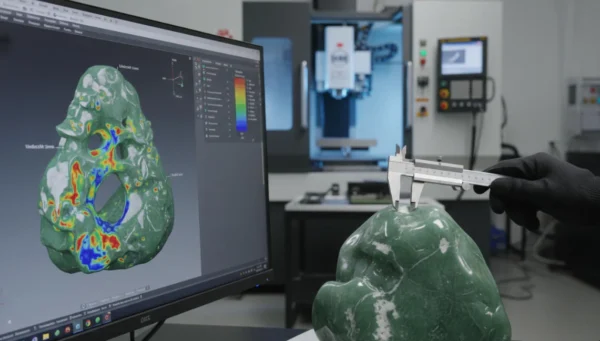
In almost all facets of the jade trade, the jade material yield rate is a metric that is frequently concealed. While jade manufacturers are fully cognizant of this figure, buyers typically remain completely unaware of it. Although this metric may appear to be merely an internal assessment tool for manufacturers, in reality, it bears a direct and significant impact on the interests of the buyers.
In precision jade manufacturing, the difference between a 70% yield rate and a 92% yield rate on the same block of raw nephrite or jadeite does not just affect the factory floor — it directly compresses or expands your procurement cost per unit. Based on JADEMAGO’s internal production data across multiple product categories, optimizing jade material yield rate through advanced jade CNC machining and systematic process controls can reduce per-unit raw material cost by 18% to 27%, without changing the raw stone you purchase. That figure is the starting point of every conversation about supplier selection that actually matters.
Yield rate, at its technical core, is the ratio of finished sellable product volume to total input raw material volume. It sounds straightforward. In practice, it is shaped by at least six compounding variables — each of which most buyers never audit when evaluating a jade manufacturer. This article breaks down what those variables are, how they interact, what the data says about industry performance gaps, and — critically — what you can do with that information the next time you place a sourcing order.
Table of Contents
What Is Jade Material Yield Rate, And How It Affects Your Bottom Line.
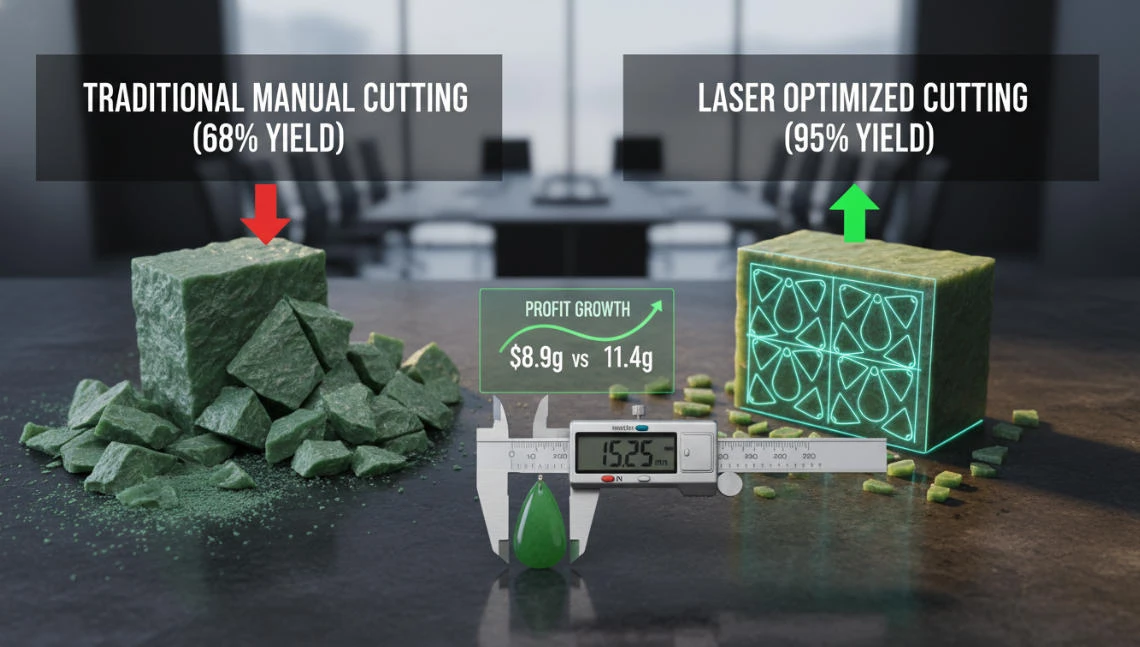
Every jade sourcing decision is, at its foundation, a yield rate decision. When a jade manufacturer quotes you a price per piece, that number embeds their yield assumption. A factory operating at 72% yield on a given material must price significantly higher per finished unit than one achieving 91% on the same raw stone — or they absorb the loss. More commonly, they pass it to you in ways that are difficult to detect line by line in a standard quote sheet.
Understanding jade material yield rate reframes how you evaluate supplier pricing. It shifts the question from “is this quote competitive?” to “what yield rate is this quote built on?” Those are fundamentally different questions, and only the second one protects your margin.
The Jade Material Yield Rate is A Powerful Pricing Factor.
Consider a practical scenario. Two jade manufacturers both quote on a batch of 500 carved pendants using the same grade of Hetian nephrite. Supplier A quotes $12.80 per piece. Supplier B quotes $10.40 per piece. The instinct is to select Supplier B. But if Supplier A is operating at 89% jade material yield rate and Supplier B at 68%, A lower quoted price may reflect that the product’s authenticity is not as portrayed—potentially involving falsification of either quality or materials. According to sourcing risk frameworks documented by the Gemological Institute of America (GIA), material traceability and processing consistency are foundational to stable jade supply chain quality — and both are direct outputs of how seriously a manufacturer manages yield.
The math is not abstract. If raw nephrite costs $180 per kilogram and a pendant requires 8 grams of finished product, a factory at 70% yield consumes approximately 11.4 grams of raw material per piece. At 90% yield, that same pendant requires only 8.9 grams. Across 10,000 units annually, that 20-percentage-point yield gap represents over 25 kilograms of wasted material — at $180/kg, that is $4,500 in raw stone that either disappears as dust or gets absorbed into your unit price.
What Is a Competitive Jade Material Yield Rate?
The jade processing industry does not publish standardized yield benchmarks the way semiconductor or precision metal machining sectors do. However, based on observable production data across jade process facilities in Yunnan, Xinjiang, and Guangdong production regions, the following ranges reflect realistic performance tiers.
Facilities relying primarily on hand carving and manual grinding typically achieve jade material yield rates in the 68% to 82% range, with significant batch-to-batch variance. Facilities that have integrated jade CNC machining with standardized process protocols — including pre-cut material analysis, optimized layout planning, and calibrated tool parameters — consistently operate in the 85% to 95%+ range. The gap between these tiers is not a matter of effort. It is a matter of system design.
The International Gem Society (IGS) notes that natural jade’s structural complexity — including internal fracture networks, color banding, and grain orientation — makes it one of the most technically demanding materials for consistent precision processing. That structural complexity is precisely why yield rate management requires a systematic approach rather than individual craftsmanship alone.
6 Core Factors That Control Jade Material Yield Rate
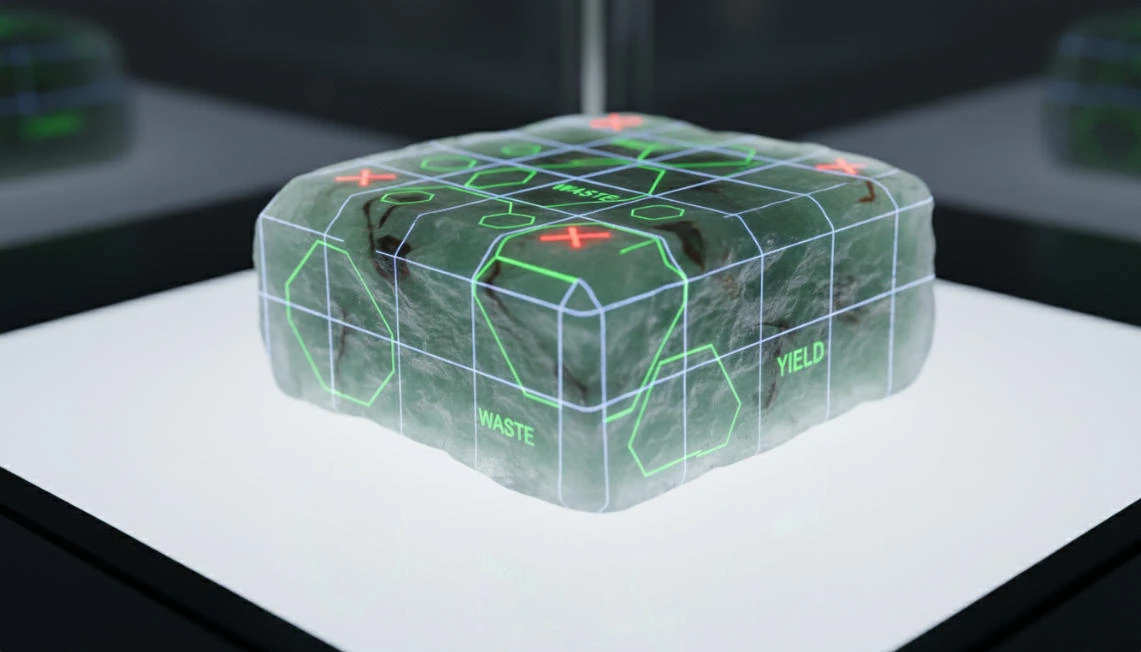
Jade material yield rate is not a single-lever problem. It is the compounded output of six interacting variables, each of which introduces its own category of loss. Understanding them individually allows you to ask better questions of any jade manufacturer you evaluate. Understanding how they interact tells you whether a supplier has genuinely engineered their jade process — or is simply quoting from experience and hoping for the best.
1 — The Jade Material Quality Determines the Loss Incurred Prior to the Initial Cutting.
The most important thing to understand about raw jade material is this: the volume you purchase is not the volume you can use. Every natural jade stone — whether nephrite from Xinjiang or jadeite from Myanmar — contains structural variables that reduce usable yield before a single blade makes contact. Internal fracture networks, uneven color banding, irregular block geometry, and surface weathering zones all represent material that must be removed, routed around, or accepted as loss before any jade process begins.
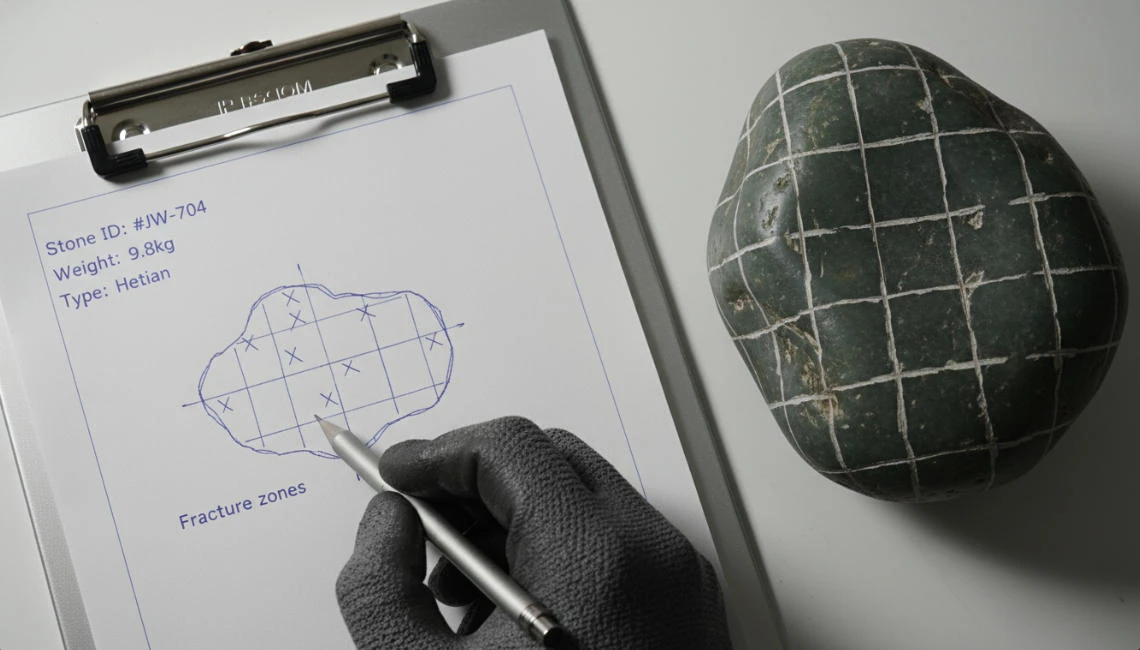
This is not a quality control failure. It is the geological reality of natural stone. What separates high-yield jade manufacturers from low-yield ones at this stage is not the stone they receive — it is how thoroughly they analyze that stone before committing to a design layout. A manufacturer that skips pre-cut material analysis and proceeds directly to standard-dimension sawing will lose 8% to 15% more usable volume than one that maps fracture lines and color zones first. That difference comes entirely from what happens before machining starts. This means your supplier’s raw material assessment protocol is the first yield rate lever — and it is one you can audit before placing an order.
2 — Design and Layout Optimization: Hidden Jade Material Yield Rate (Most to 20%)
Design layout is the second-largest yield determinant in jade manufacturing, and it is the variable most frequently underestimated by procurement teams evaluating supplier capability. An experienced jade process engineer does not approach a raw stone by first asking “what product do I want to make?” They ask “what does this material allow, and how do I extract maximum usable volume from its actual geometry?”
The practical difference is measurable. A poorly optimized layout on a single piece of raw nephrite can reduce jade material yield rate by 15 to 25 percentage points compared to a layout that accounts for grain orientation, fracture avoidance routing, and multi-piece nesting. Nesting — the practice of planning multiple product profiles from a single block simultaneously, rather than cutting pieces sequentially — is one of the highest-impact layout techniques available in jade CNC machining environments. When applied correctly, it converts material that would otherwise become kerf waste between sequential cuts into productive product volume. For buyers sourcing high volumes of standardized forms — beads, cabochons, rectangular panels, carved pendants — the presence or absence of nesting capability in a jade manufacturer’s workflow is worth approximately 10% to 18% of your raw material cost per order.
3 — Cutting Method and Kerf Loss: Every Blade Pass Removes Material Permanently
Each time a saw blade, wire cutter, or grinding wheel passes through jade material, it removes a volume of stone equal to the tool’s kerf width. That material is gone — it becomes slurry, abrasive dust, and cooling fluid waste. The question is not whether kerf loss exists, but how many cuts are required, how wide each kerf is, and whether the cutting path was planned to minimize total passes.
Standard inner-diameter blade saws used in conventional jade process facilities typically produce kerf losses of 0.3mm to 0.6mm per pass. Wire saw systems — increasingly adopted in precision jade carving operations — reduce kerf loss to approximately 0.15mm to 0.25mm. That difference may appear negligible per cut. Across a production run requiring 40 cuts per block, at a raw material value of $200 per kilogram, the kerf reduction from wire saw adoption can represent $60 to $120 in recovered material value per block. Multiplied across annual volume, this is a recoverable cost that your current supplier may or may not be capturing on your behalf.
4 — Precision CNC Machining of Jade and Tolerance Control Result in Varying Levels of Material Loss.
Dimensional inconsistency in jade manufacturing creates a category of loss that is particularly costly: the rework cycle. When a carved or machined piece falls outside dimensional tolerance — even by 0.3mm in a precision fit application — it must either be re-ground to new specifications or rejected entirely. Re-grinding reduces the piece’s finished dimensions, which may render it non-conformant to the original specification at a smaller size. Rejection converts finished product back into waste.
In facilities relying on manual carving and hand-grinding, tolerance variation of ±0.5mm to ±1.2mm is common across a production batch. In jade CNC machining environments — particularly those employing 5-axis CNC gemstone machining platforms — achievable tolerances fall in the ±0.05mm to ±0.15mm range. That tightening of tolerance does not merely improve dimensional consistency. It eliminates the rework cycle as a yield loss mechanism. When dimensional accuracy is maintained from the first pass, material that would otherwise become rework scrap is instead delivered as conformant finished product. This means that your defect rate and your yield rate are the same metric — they are both measuring how much of the raw material you purchased ultimately reaches you as usable inventory.
5 — In Jade Process Breakage Risk: Destroys Entire Pieces
Fracture during processing is the highest-severity yield loss event in jade manufacturing. Unlike kerf loss or rework waste — both of which reduce yield incrementally — in-process fracture typically destroys the entire piece. A carving that cracks under excessive spindle pressure, a thin panel that shatters during edge grinding, or a drilled bead that explodes at the drill exit point: each of these events converts a near-finished product into zero-value material in a single moment.
The Swiss Gemmological Institute SSEF identifies jade’s unique crystalline microstructure as both the source of its durability in finished form and its sensitivity to shock and vibration during processing. Managing in-process breakage in precision jade carving requires real-time control of three mechanical parameters: spindle rotational speed, tool feed rate, and coolant delivery volume. Deviations in any one of these parameters — even momentary ones — can induce micro-fractures that propagate through a piece during subsequent operations. Facilities that monitor these parameters digitally, rather than relying on operator judgment, demonstrate measurably lower in-process breakage rates. The difference between a 2.1% fracture rate and a 5.8% fracture rate on thin-wall jade components, across a 1,000-piece production run, is approximately 37 pieces — each representing full raw material and machining labor cost with zero recovered value.
6 — Operator Skill Gap and Standardized Process: The Invisible 15% Different of Jade Material Yield Rate
The final yield variable is the one most difficult to quantify in a supplier audit — and the one most likely to produce batch-to-batch inconsistency in your orders. The performance gap between an experienced jade carver and a technician with fewer than two years of jade process experience is typically 12% to 18% in yield rate terms, measured on identical material and product specifications.
This gap exists not because less experienced operators lack effort, but because yield-protective decision-making in jade processing is deeply experiential. Recognizing an emerging fracture from tool vibration frequency. Adjusting feed rate in real time when material grain resistance changes mid-pass. Repositioning a workpiece to route around a color band discovered after the first cut. These are judgment calls that experienced technicians make automatically and that standardized process documentation can only partially substitute for. The most effective mitigation is a documented process protocol — including parameter tables for different material types, layout decision trees, and quality gate checklists — that captures experienced technician knowledge and makes it executable by the broader production team.
How a Structured Jade Process Raises Yield Rate from 70% to 95%+
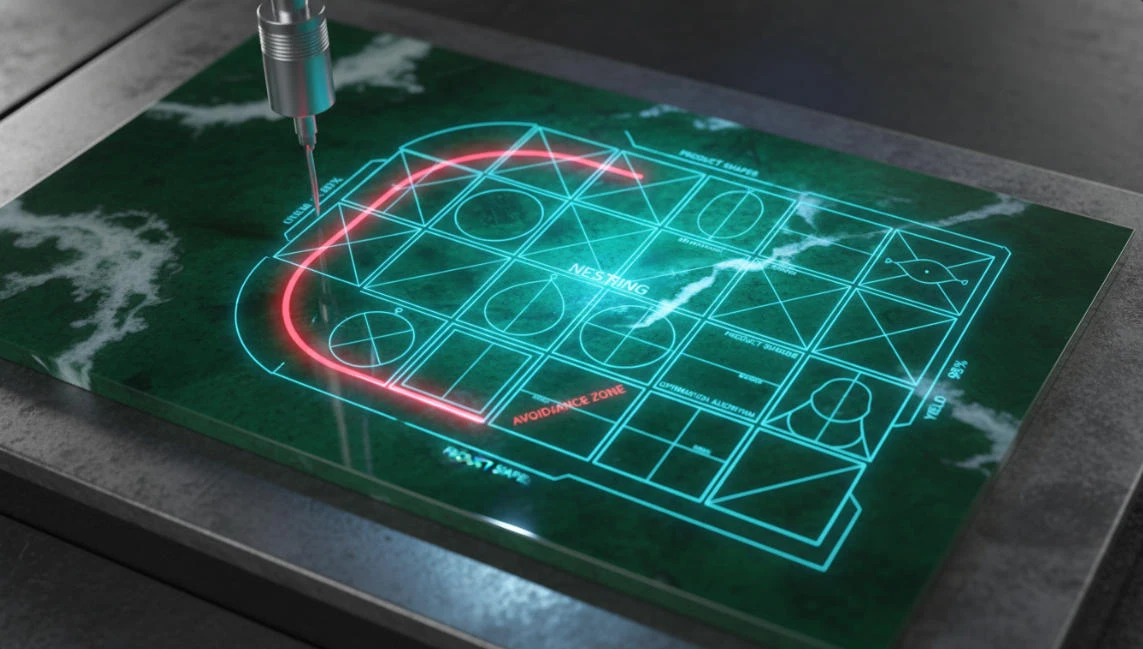
Improving jade material yield rate is not achieved by any single intervention. Each of the six factors described above contributes its own category of loss — and each requires its own targeted countermeasure. The following section outlines the specific process architecture used to move yield performance from the industry average into the 85% to 95%+ operational range, covering the full production chain from raw material sourcing through final quality gate.
Dual-Stage Raw Material Inspection Before Jade Process Begins
The foundation of yield rate management is accurate knowledge of what you are working with. Before any jade process step is authorized, incoming raw material goes through two structured inspection stages. The first occurs at the point of material receipt: surface condition, block geometry, and visible fracture mapping are documented, and the material’s estimated usable volume is recorded against gross weight. The second inspection occurs immediately before machining is scheduled and includes internal assessment techniques — transmitted light inspection for fracture depth, density estimation for color band mapping, and dimensional verification against layout requirements.
This dual-inspection protocol does more than catch defective material early. It builds an accurate usable-volume baseline that drives every downstream layout and cutting decision. When you know, before the first cut, that a block contains a subsurface fracture running 18mm deep on the north face, you do not lay out your highest-value product profiles in that zone. You route around it, assign lower-specification profiles to the affected volume, and preserve your primary yield. This means that by the time a blade contacts the stone, yield-protective decisions have already been made — and the risk of discovering problems mid-process is substantially reduced.
Material-First Layout Planning to Maximize Jade Material Yield Rate
Standard manufacturing practice starts with a product specification and asks: how do I cut this from the available material? A yield-optimized jade process inverts that sequence. It starts with a material analysis and asks: given what this stone actually contains, what is the most efficient product configuration I can extract?
In practice, this means layout engineers review the material inspection report before opening any CAD template. Grain orientation is mapped and product profiles are aligned to run parallel to natural cleavage planes where possible, reducing the force required per cut and lowering fracture risk. Multi-piece nesting is applied wherever dimensional specifications allow, converting the inter-piece gaps that sequential cutting produces into additional product slots. Edge and corner volumes that would be discarded in a single-piece layout are evaluated for secondary product potential — smaller beads, thin inlay panels, or decorative chips — before being classified as waste. On complex raw material blocks, this layout optimization process recovers between 8% and 22% of usable volume compared to standard single-piece layout approaches.
Precision Jade CNC Machining: Cutting Paths That Eliminate Redundant Passes
Once layout is finalized, the cutting sequence is programmed to minimize total blade passes, eliminate redundant cuts, and sequence operations in a specific order that reduces workpiece repositioning. In jade CNC machining environments, cutting path programming is as significant a yield lever as the physical equipment itself. A cutting path that requires six repositioning operations introduces six opportunities for dimensional error accumulation. A path engineered to complete the same geometry in three repositioning operations halves that error accumulation risk.
Where 5-axis CNC gemstone machining platforms are available, complex curved profiles — previously achievable only through multiple sequential 3-axis setups — are completed in a single continuous toolpath. This reduces both the number of workpiece clamp-and-release cycles and the total machining time per piece, both of which are direct contributors to breakage risk and dimensional inconsistency. For buyers sourcing complex carved forms at volume, the availability of 5-axis CNC gemstone machining in a supplier’s facility is not a premium feature. It is a yield rate enabler that directly affects the number of conformant pieces you receive per kilogram of raw material consumed.
Calibrated Process Parameters for Every Material and Product Type
The same spindle speed that produces clean surface finish on dense nephrite will generate micro-fracturing on a lower-density jadeite variety. The coolant flow rate appropriate for a 15mm-thick panel will be insufficient for a 4mm-thick carved screen. In a standardized jade process environment, process parameters — spindle RPM, feed rate, coolant delivery volume, tool engagement depth — are not set once and held constant across all production. They are calibrated per material type and per product geometry, using documented parameter tables derived from empirical testing.
This calibration discipline has a measurable effect on jade material yield rate. Facilities that apply static parameters across all production — the operational norm in many small-scale jade carving workshops — typically see in-process breakage rates of 4% to 7% on thin-wall or complex-profile products. Facilities with documented per-material parameter tables report breakage rates of 0.8% to 2.1% on comparable products. That 3 to 5 percentage point improvement in breakage rate translates directly to finished product that reaches you rather than scrap that disappears from the yield calculation. This means that calibrated process parameters are not a manufacturing refinement — they are a procurement protection mechanism.
Precision Jade Carving Standards and Final Quality Gate
Every finished piece in a precision jade carving workflow passes through a defined quality gate before it is counted as yield. Dimensional verification, surface finish inspection, and fracture assessment under magnification are performed against documented acceptance criteria — not operator judgment. Pieces that fail the gate are categorized by failure mode: dimensional, surface, or structural. Dimensional failures are evaluated for regrade potential. Surface failures go to rework. Structural failures — meaning any piece with a propagated fracture — are immediately separated and documented.
This gate serves two functions. First, it prevents non-conformant product from reaching the buyer — protecting your inventory quality. Second, it generates yield rate data that feeds back into layout and parameter decisions for subsequent production runs. When failure mode data shows that 60% of rejections are dimensional failures on a specific product profile, that signals a layout or fixturing problem that, once corrected, improves jade material yield rate on all future orders of that profile. The quality gate is not the end of the production cycle — it is the beginning of the optimization cycle for the next one.
How Optimized Jade Material Yield Rate Created a Second Product Line from One Order
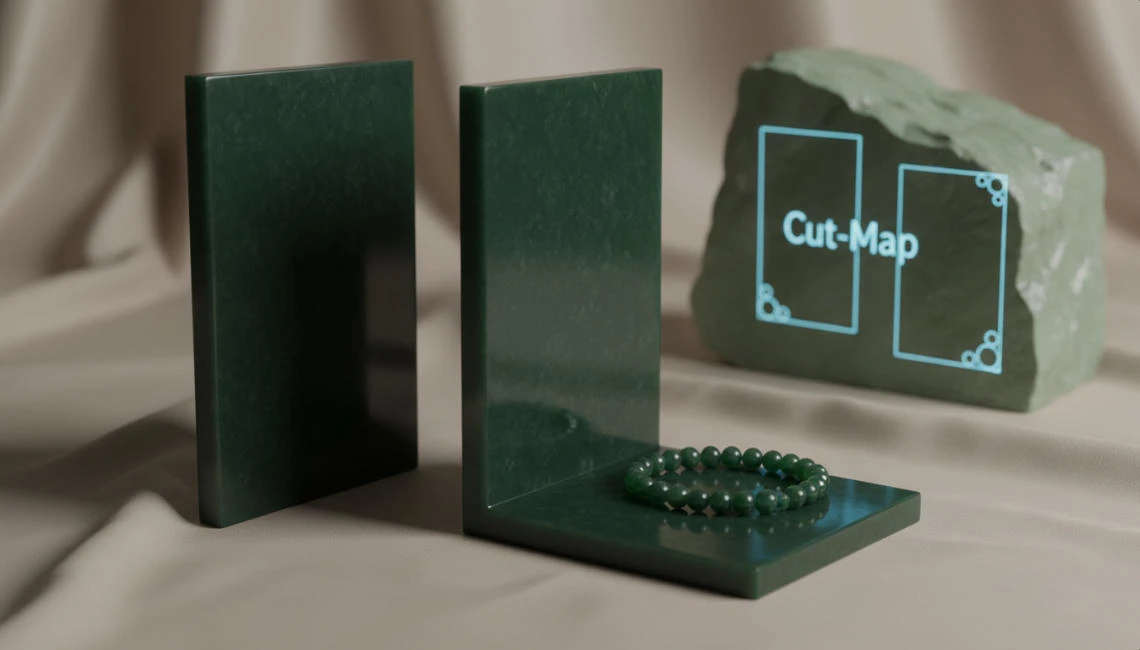
The most persuasive evidence for the buyer-side value of jade material yield rate optimization is not theoretical. It is observable in completed orders where process discipline produced outcomes that went beyond the original product specification. The following case from 2025 demonstrates what happens when precision jade process engineering is applied to client-supplied raw material — and why the results matter to any buyer who has ever watched expensive raw stone become dust.
300-Set Custom Jade Book Ends, Client-Supplied Raw Material
In 2025, a client commissioned a production run of approximately 300 sets of custom jade book ends — solid rectangular-form pieces designed to be placed at the ends of a book row to prevent the books from falling. The product specification was geometrically straightforward: consistent rectangular dimensions, flat parallel faces, clean right-angle corners, and uniform surface finish. What made this order structurally different from a standard jade manufacturer engagement was the material arrangement: the client supplied their own raw jade stone rather than purchasing material through the manufacturer.
This arrangement is not unusual in high-value custom jade procurement. Clients who have sourced particularly significant raw material — whether for geological quality, provenance, or investment value — reasonably prefer to control the material themselves and commission only the fabrication service. The arrangement also means that every gram of material lost during processing represents a cost absorbed entirely by the client, not redistributed across a manufacturer’s broader material purchasing. Yield rate management in client-supplied material scenarios is therefore not an internal manufacturing metric. It is a direct fiduciary responsibility to the buyer.
Material Analysis Before Any Design Was Finalized
Rather than applying a standard rectangular template to the client’s raw material immediately, the production team’s first step was a complete material analysis. The raw stone blocks were assessed for internal fracture density, color banding distribution, and dimensional geometry. This analysis revealed that the blocks contained natural color variation zones — areas where the stone’s visual character shifted — that would, under a standard uniform-layout approach, either be distributed randomly across finished pieces or lost entirely to kerf.
By mapping these color zones before layout was finalized, the layout engineer was able to orient the rectangular product profiles so that color variation either fell within acceptable aesthetic range for the book end specification, or — where the variation was too significant — was routed to the block edges where it would be removed as trim waste rather than appearing as a visual defect in a finished piece. Simultaneously, the cutting path was planned to complete all primary rectangular profiles using the minimum number of blade passes, with pass sequencing optimized to avoid any cut that would traverse a mapped fracture zone under lateral load. The result was a cutting plan that protected both dimensional accuracy and internal material integrity throughout the entire production sequence.
Precision Jade CNC Machining Execution — Tolerances That Protected Every Millimeter
The production was executed using jade CNC machining with digitally controlled feed rates and real-time coolant delivery monitoring. For a rectangular solid product with flat-face requirements, the critical tolerance parameters were face planarity — the maximum allowable deviation from a true flat surface across the face of each piece — and corner perpendicularity, ensuring each right angle held within specification across all 300 sets.
Achieving consistent face planarity across a batch of this size requires not only accurate machine setup but stable workholding throughout each machining cycle. Any workpiece movement during face grinding introduces a planarity error that compounds through subsequent operations. The fixturing system was configured to maintain consistent clamping pressure across pieces of varying raw dimension — a variable that matters precisely because the client’s raw material was natural stone with dimensional irregularity, not pre-cut industrial stock. By maintaining dimensional consistency within ±0.12mm across all 300 sets, the production avoided the rework cycles that would have consumed additional material and machining time without producing additional sellable units.
Finished Products Delivered and Surplus Material Returned to the Client
When the 300 sets of jade book ends were completed and passed final quality inspection, the production team compiled the cut-off material that had been separated during the optimized cutting sequence. Because the cutting paths had been planned specifically to minimize waste volume and maximize recoverable piece size in the off-cuts, the separated material was not fine dust and slurry — it was a collection of structurally intact jade pieces of varying dimensions, each retaining the material quality of the original raw stone.
This surplus material was returned to the client in full. In a standard production scenario — where cutting paths are designed for production efficiency rather than material recovery — the majority of this off-cut volume would have been classified as process waste and discarded or absorbed into the manufacturer’s material account. The deliberate choice to plan cutting paths with client material recovery as an explicit design objective preserved material that, under conventional jade process management, would simply have ceased to exist as usable stone.
Client Repurposed Returned Jade into Gemstone Bead Bracelets
The returned surplus material did not sit unused. The client’s team assessed the recovered jade pieces and identified that their dimensions and structural integrity were suitable for bead production. A subsequent order was placed — with the returned material as the raw stock — to produce round bead jade bracelets. The bracelets were completed and added to the client’s product catalog as a distinct line from the original book end collection.
This outcome is worth examining carefully, because it illustrates the buyer-side value of jade material yield rate optimization in its most concrete form. The client entered the original engagement expecting to purchase 300 sets of jade book ends and to accept some level of raw material loss as a processing cost. They exited the engagement with 300 sets of book ends, a quantity of recovered raw material, and a second product line that those recovered materials enabled. No additional raw stone was purchased. No additional material budget was allocated. The second product line existed because the jade process was engineered to recover material that a lower-yield approach would have destroyed.
For any buyer working with expensive raw jade — whether client-supplied or manufacturer-sourced — this case defines what it means to choose a jade manufacturer based on yield rate capability rather than unit price alone.
What Higher Jade Material Yield Rate Means for Supplier
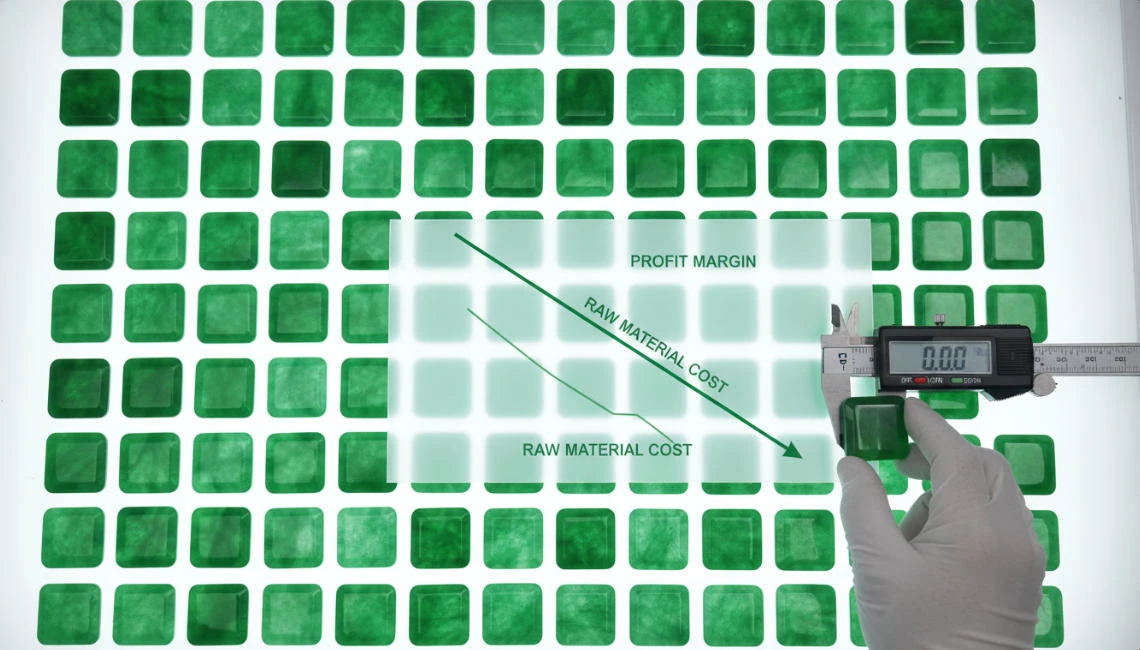
The manufacturing discussion of jade material yield rate — the six factors, the process controls, the CNC machining precision — is only half of the relevant picture. The other half belongs entirely to you as the buyer. Every percentage point of yield improvement that a jade manufacturer achieves has a downstream financial consequence in your procurement cost structure. Understanding that consequence in quantitative terms is what allows you to make supplier selection decisions based on total cost of ownership rather than quoted unit price.
How Jade Material Yield Rate Translates to Your Per-Unit Price
Raw jade material cost is typically the largest single component of a finished jade product’s manufacturing cost — in many product categories, it represents 45% to 65% of total production cost. When a jade manufacturer’s yield rate improves, the raw material consumed per finished unit decreases. That decrease flows through to the cost basis of each piece, which in turn affects what price a competitive supplier can offer without sacrificing margin.
To make this concrete: assume a jade product requires 12 grams of finished stone, raw material costs $160 per kilogram, and the order volume is 2,000 units. At 72% yield, raw material consumption per unit is approximately 16.7 grams, and total raw material cost across the order is $5,344. At 90% yield, raw material consumption per unit falls to 13.3 grams, and total raw material cost across the same order is $4,256. The yield improvement from 72% to 90% recovers $1,088 in raw material cost on a single 2,000-unit order — without any change in product specification, material grade, or order volume. That $1,088 either becomes available as cost reduction in the supplier’s quote, or it disappears as a margin difference between two suppliers quoting on identical specifications.
Yield Rate and Product Quality Are Not Independent Variables
There is a common misconception in jade procurement that yield rate and quality are a trade-off — that pushing a supplier to improve yield will result in pieces that are cut more aggressively, with tighter material margins that increase defect risk. This reflects a fundamental misunderstanding of how yield rate improvement actually works in a precision jade carving environment.
When yield improvement comes from better layout planning, more accurate cutting paths, tighter machining tolerances, and reduced in-process breakage — which is the only sustainable form of yield improvement — quality does not decrease. It improves simultaneously with yield. Tighter tolerances mean fewer dimensional rejections. Better layout means fewer pieces with color or structural defects. Lower breakage rates mean more pieces arrive at the quality gate intact. The Gemological Institute of America’s jade identification and grading documentation consistently identifies processing consistency as a key determinant of finished jade quality — and processing consistency is precisely what drives both higher yield and better quality outcomes in the same operation.
What this means for your sourcing is that a supplier demonstrating higher jade material yield rate — when that yield improvement is process-driven rather than specification-compromise-driven — is also a supplier delivering more consistent product quality per batch. You are not choosing between yield and quality. You are identifying suppliers who have developed the process discipline to achieve both.
Defect Rate as a Yield Rate Proxy Metric for Supplier Evaluation
Because jade material yield rate is not a figure that most suppliers publish or share proactively, buyers need proxy metrics that reveal yield performance indirectly. Defect rate on delivered product is the most accessible and reliable of these proxies. A supplier with high jade material yield rate — meaning they lose very little material to rework, breakage, or dimensional rejection during production — will also show a low delivered defect rate, because the same process disciplines that protect yield also protect finished product quality.
When evaluating a jade manufacturer, requesting historical defect rate data by product category is a more revealing question than asking “what is your yield rate?” Most factories track delivered defect rates as a customer service metric even when they do not track internal yield formally. A delivered defect rate below 1.5% on standard carved or machined jade products is consistent with a production yield rate above 87%. A delivered defect rate above 4% suggests yield rate challenges that will surface in your pricing, your reorder timelines, and your inventory planning.
A Framework for Evaluating Jade Manufacturer Centered on Jade Material Yield Rate
Supplier selection in jade procurement typically focuses on price, lead time, sample quality, and factory certifications. These are legitimate evaluation criteria. They are also insufficient on their own, because none of them directly measure the yield rate performance that determines your long-term procurement cost structure. The following framework adds yield-rate-specific evaluation criteria that you can apply during supplier qualification without requiring access to a factory’s internal production data.
How to Assess a Jade Manufacturer’s Yield Rate Capability Before Placing an Order
The most direct approach is to ask specific process questions during supplier evaluation. Does the supplier perform pre-cut material analysis on incoming raw stone, or does production begin immediately upon receipt? Can they provide a sample layout plan for a defined raw material block, showing how they would configure product profiles to maximize usable volume? What cutting equipment do they operate, and what is the kerf width of their primary cutting system? Do they use jade CNC machining with programmed cutting paths, or primarily manual cutting with operator-guided equipment?
These questions do not require factory access to ask, and they generate responses that reveal process maturity directly. A jade manufacturer who can immediately describe their material analysis protocol, explain their nesting strategy for multi-piece layouts, and specify the kerf width of their cutting equipment is demonstrating the kind of systematic yield rate awareness that produces the 85% to 95%+ performance range. A supplier who responds to these questions with general assurances about experience and quality — without specific process detail — is likely operating in the 68% to 78% range, regardless of what their samples look like.
5 Specific Questions That Reveal a Supplier’s Jade Material Yield Rate Performance
When you reach the qualification conversation with a jade manufacturer, the following five questions are designed to surface yield rate capability without requiring a factory audit. First: what is your pre-cut inspection protocol for raw material, and what documentation do you produce from it? Second: can you walk me through how your layout plan would change for a batch with significant internal fracturing versus a clean block? Third: what is your average delivered defect rate on rectangular or panel-form jade products, and what is the primary defect category you see? Fourth: do you operate 5-axis CNC gemstone machining equipment, and for which product categories do you apply it? Fifth: if you were working with client-supplied raw material on a 500-unit order, how would you document and report material recovery to the client?
Each question targets a specific yield rate lever. The first tests pre-cut material analysis discipline. The second tests layout optimization capability. The third uses defect rate as a yield proxy. The fourth identifies precision jade CNC machining capability for complex profiles. The fifth reveals whether the supplier treats client material with the same rigor they would apply to their own — which is the most direct test of whether yield rate management is a system or merely a preference.
Do not accept vague answers. A supplier who has genuinely engineered their jade process for yield will have specific, detailed responses to all five questions. A supplier who has not will either deflect to quality assurances or provide generalities that cannot be verified. The specificity of the answer is itself the data point you are collecting.
FAQs About Jade Material Yield Rate
1. What is a good jade material yield rate for a production order?
For standard carved or machined jade products in a jade CNC machining environment with documented process controls, a yield rate of 85% to 92% is a realistic and competitive target. For complex profiles requiring 5-axis CNC gemstone machining or precision jade carving techniques, the range narrows slightly to 83% to 90%, reflecting the added geometric complexity. Rates below 78% on standard product forms suggest process gaps worth investigating before committing to a long-term supply relationship.
2. How does jade material yield rate affect pricing?
Raw material typically represents 45% to 65% of a finished jade product’s manufacturing cost. A 15-percentage-point improvement in yield rate — from 72% to 87%, for example — reduces raw material consumption per unit by approximately 17%, which translates to a 7% to 10% reduction in total manufacturing cost per piece. For high-value jade materials, that percentage reduction represents substantial absolute dollar savings per unit at volume.
3. Can jade CNC machining improve yield rate over hand carving?
Yes, measurably. The tolerance control achievable through jade CNC machining — typically ±0.05mm to ±0.15mm versus ±0.5mm to ±1.2mm in manual carving — reduces the rework and rejection rates that are primary yield loss mechanisms in hand-production environments. For standardized product forms produced at volume, jade CNC machining consistently delivers higher yield rates than manual carving, with the additional benefit of batch-to-batch dimensional consistency that manual production cannot reliably replicate.
4. What role does 5-axis CNC gemstone machining play in yield rate?
5-axis CNC gemstone machining enables complex curved and multi-face profiles to be completed in a single continuous toolpath, eliminating the workpiece repositioning cycles that introduce error accumulation and breakage risk in multi-setup 3-axis operations. For buyers sourcing complex carved jade forms — sculptural pieces, curved panels, or multi-plane decorative elements — 5-axis capability in the supplier’s facility directly increases the proportion of complex pieces that exit production as conformant finished product rather than rework or scrap.