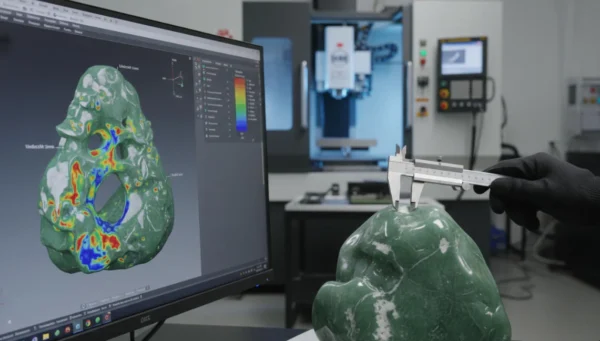
If you are sourcing crystals the same way your competitors are, you are not competing on product — you are competing on price. According to a 2023 global B2B procurement survey by Statista, over 67% of wholesale crystal and gemstone buyers identified product differentiation — not unit cost — as their primary bottleneck to scaling revenue. A private label crystal manufacturer solves that problem at the root. Unlike standard suppliers who sell identical inventory to every buyer in your market, a private label crystal manufacturer produces finished goods exclusively under your brand identity: your logo, your packaging, your engineered specifications. This article breaks down exactly what a private label crystal manufacturer does, how the model drives measurable ROI in B2B crystal sourcing, and what capabilities separate a true manufacturing partner from a factory floor dressed up with a professional website. If you have ever lost a customer because a competitor was selling the exact same product for $2 less, this is the structural answer.
Table of Contents
What Exactly Is a Private Label Crystal Manufacturer?
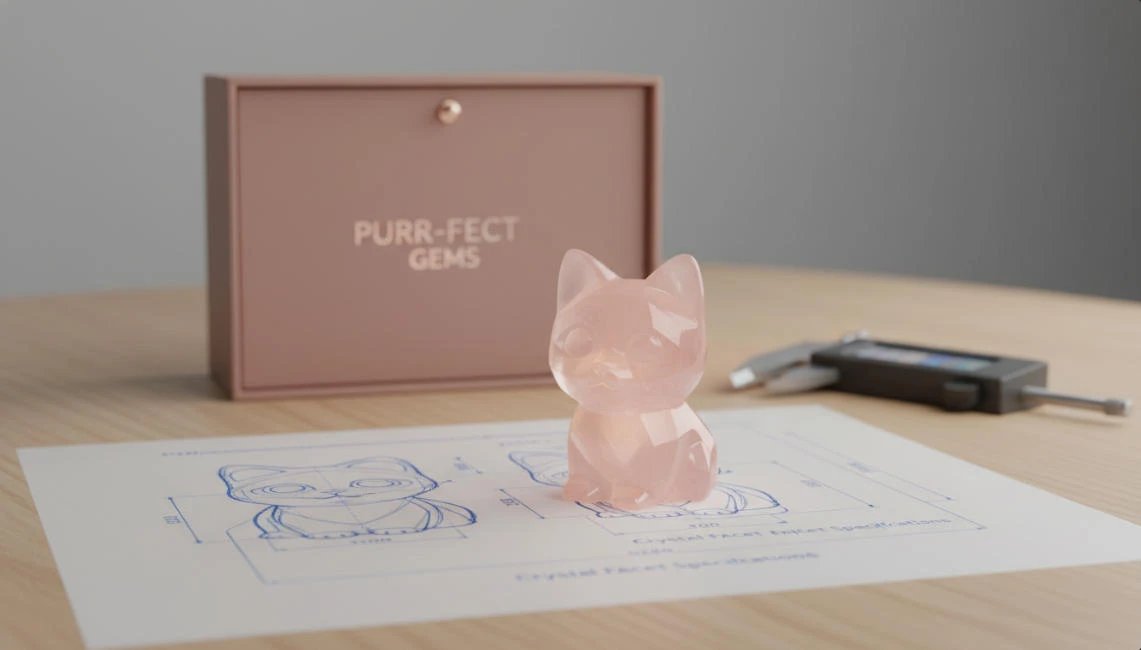
Your Brand, Their Engineering, Your Ownership
A private label crystal manufacturer is a production partner that fabricates crystal products according to your brand’s specifications and delivers them under your name — not theirs. The distinction sounds technical, but its commercial impact is immediate and compounding. When you buy from a standard wholesale crystal supplier, you are purchasing inventory that dozens — sometimes hundreds — of other retailers and distributors are selling simultaneously, often at indistinguishable price points. There is no structural barrier between your business and a competitor who decides to undercut your pricing by five percent tomorrow morning.
A private label crystal manufacturer, by contrast, architects that barrier for you. The design files, the molds, the surface treatment protocols, and the tolerance specifications are developed specifically around your SKU. For a competitor to replicate what you sell, they must develop their own version from the ground up — a process that, in the crystal and gemstone category, typically requires six to eighteen months of development time, access to equivalent crystal process engineering capability, and the budget to absorb prototype iteration costs. That window of market exclusivity is not a marketing claim. It is an engineered product moat.
Private Label Crystal Manufacturer vs. Standard Crystal Supplier
The financial difference between these two sourcing models compounds with every sales cycle. Research published by McKinsey & Company on consumer goods brand premiums shows that products sold under a proprietary brand command, on average, 25% to 45% higher retail price points than functionally identical generic alternatives. In the crystal and gemstone category — where emotional resonance, perceived authenticity, and visual distinctiveness are primary purchase drivers — that premium ceiling extends even higher.
Consider a straightforward scenario grounded in current market data. A polished rose quartz sphere sold as a generic wholesale product might clear at $8 to $12 per unit at retail. That same sphere, when developed through crystal custom production with a proprietary surface finish, brand-specific packaging, and consistent dimensional standards, routinely retails between $28 and $55. That price delta is not created by marketing spend. It is the direct output of a private label crystal manufacturer relationship executed with engineering precision.
Beyond pricing power, supply chain control represents an equally critical financial argument. Standard crystal commodities — particularly quartz, amethyst, obsidian, and selenite — experience price fluctuations of 20% to 40% seasonally, driven by mining output variability, export policy shifts in source countries such as Brazil and Madagascar, and container freight availability. When your product is a commodity, every one of those fluctuations flows directly into your gross margin. When your product is a spec-controlled item produced by a private label crystal manufacturer, you negotiate against defined material grades, fixed tolerance bands, and planned production schedules — which means you can forecast, price, and commit to customers with accuracy.
The Gemological Institute of America (GIA) has extensively documented how material traceability standards and specification controls directly affect long-term supply chain reliability across gemstone categories. Their research reinforces a point that too many B2B crystal sourcing buyers learn too late: specification control is not a premium-tier feature. It is a baseline risk management requirement. You can either define your material standards upfront, or absorb unpredictable variance in every shipment.
What a Private Label Crystal Manufacturer Is Not
It is also worth stating this plainly, because the sourcing market is crowded with actors who blur these definitions deliberately. A private label crystal manufacturer is not a dropshipper who applies your logo sticker to pre-stocked inventory. It is not a trading company acting as an intermediary between you and an unnamed factory — collecting margin while adding no engineering value. And it is not a workshop that can produce one visually impressive sample but cannot hold that standard across five thousand units. Each of those models has a place in the sourcing ecosystem. But none of them gives you what a legitimate private label crystal manufacturer delivers: owned product architecture, repeatable quality at scale, and a defensible brand position built on something no competitor can simply purchase from the same catalog.
The International Gem Society (IGS) recommends that B2B buyers specifically verify manufacturer-level credentials — including in-house tooling capability, documented quality control systems, and prototype validation processes — before committing to any private label production program. That verification framework is exactly the lens through which the next section evaluates what genuine manufacturing capability looks like.
Why Relying Solely on Generic Crystal Sourcing Creates Long-Term Business Risk — And What Private Label Solves
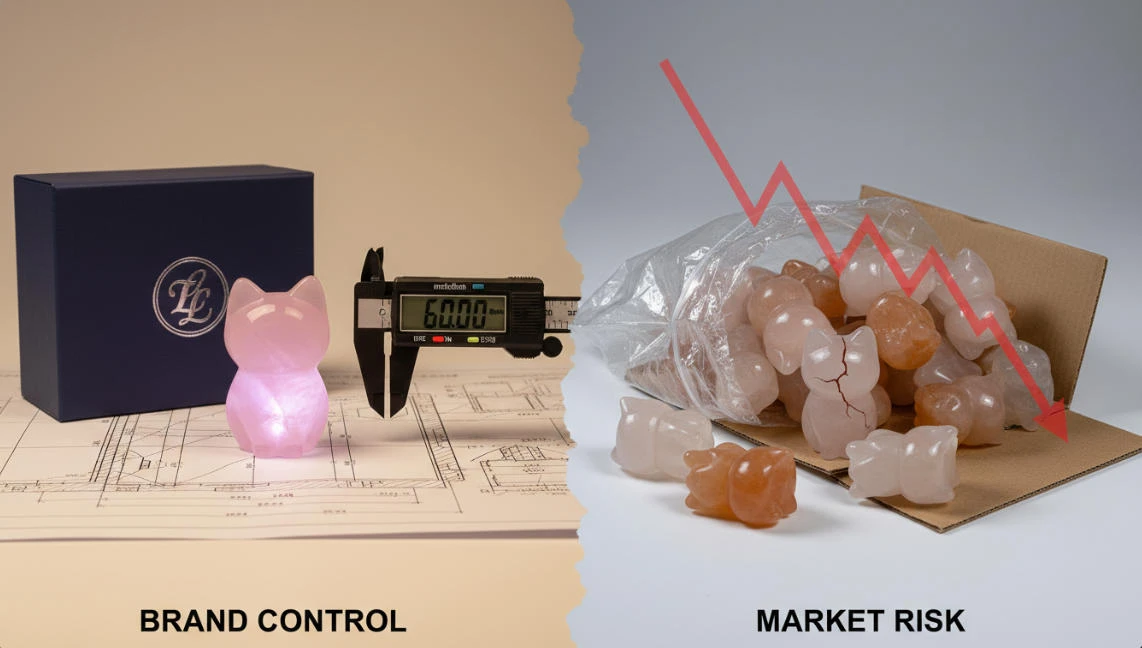
Most crystal buyers enter the wholesale market chasing the lowest unit cost. That logic is rational in the short term and structurally damaging over a three-to-five year horizon. When every buyer in your category has access to the same supplier network, the same product catalog, and the same FOB pricing tiers, competing on margin becomes a mathematical inevitability — and a losing one. The data is consistent across consumer goods categories: according to Harvard Business Review, acquiring a new customer costs five to seven times more than retaining an existing one, yet commodity-sourced product lines generate measurably lower repeat purchase rates because customers experience no brand-specific loyalty — only price sensitivity. A private label crystal manufacturer relationship reorients this dynamic across three compounding business outcomes: more profitability, more control, and more long-term sustainability. Each of these outcomes deserves precise commercial unpacking, because the sourcing decisions you make this quarter will determine your margin structure for the next several years.
More Profitable — How Crystal Custom Production Breaks the Price War Cycle
Price wars in the wholesale crystal market are not caused by bad competitors. They are caused by identical products. When ten distributors are all listing the same amethyst cluster or selenite wand — sourced from the same trading networks, photographed against the same white backgrounds — the only remaining competitive variable is the number in the price field. Buyers know this. Platforms know this. And the algorithmic logic of every major wholesale and retail marketplace is specifically designed to surface the lowest-cost option first.
Crystal custom production through a private label crystal manufacturer removes your product from that competitive framework entirely. When your rose quartz sphere carries a proprietary surface texture, a branded gift box engineered to your specifications, and dimensional standards that no catalog supplier can replicate on demand, the price comparison becomes structurally impossible. Your product is no longer competing against twenty similar listings — it is the only listing of its kind. That shift from price competition to brand recognition is not a marketing strategy. It is a manufacturing strategy executed upstream, at the product development stage.
The financial impact is quantifiable. A 2022 brand equity study referenced by Statista across consumer specialty goods found that branded proprietary products achieved an average revenue premium of 32% over comparable generic alternatives in the same retail category. In the crystal and gemstone segment — where buyer motivation is rooted in aesthetic experience, perceived energy properties, and gifting value — that premium expands further because emotional differentiation commands a price floor that commodity logic cannot erode. This means that every investment you make in crystal custom development through a qualified private label crystal manufacturer generates returns not in a single transaction cycle, but across the entire lifespan of that SKU.
Equally important is the pricing autonomy that crystal custom production restores to your business. When you source generic inventory, your price ceiling is constrained by market reference points that your competitors set — because your buyers can check those reference points in seconds. When your product is spec-controlled and brand-owned, you set the reference point. That self-determined pricing power, sustained across a product line of even ten to fifteen proprietary SKUs, produces a structural margin advantage that compounds with every reorder cycle.
More Controllable — Supply Chain Stability Through Engineered Crystal Process Standards
Control is the variable that most B2B crystal sourcing buyers underestimate until they lose it. Natural crystal materials — quartz, obsidian, labradorite, malachite, tourmaline — do not behave like industrial raw materials. Their hardness varies within the same mineral family. Their fracture patterns are directional and unpredictable. Colorimetric variation between mining batches from the same geographic source can exceed 30% under standardized lighting conditions, as documented by the GIA’s gemological research division. These are not quality failures. They are material realities. And the question for any serious B2B crystal sourcing buyer is not whether this variability exists — it does — but whether your supply chain is engineered to absorb it or exposed to it.
A professional private label crystal manufacturer manages material variability through three interlocking crystal process controls. The first is upstream material grading: defining the acceptable colorimetric range, inclusion density thresholds, and structural integrity parameters for each raw material input before production begins. This eliminates the most common source of batch inconsistency — sourcing raw material from whichever supplier had inventory available that week. The second control is dimensional tolerance engineering: establishing specific acceptable variance bands for every critical product dimension, so that a sphere specified at 60mm diameter is guaranteed to arrive between 59.5mm and 60.5mm — not “approximately 60mm,” which in practice means anything from 57mm to 63mm depending on the workshop’s calibration standards. The third is batch traceability: maintaining production records that link each finished unit back to its raw material lot, enabling rapid isolation and response when a material-level issue is identified downstream.
According to the Swiss Gemmological Institute (SSEF), traceability and specification documentation are increasingly adopted as baseline procurement standards by institutional gemstone buyers — a standard now migrating into the B2B wholesale crystal market as buyers become more sophisticated. This means that your product experience — the tactile quality, the visual consistency, the dimensional fit of packaging — becomes something you engineer, not something you accept passively from whichever material lot arrived at the factory that week. For your customers, this translates directly into a higher unboxing experience and lower return rates. For your operations team, it translates into predictable inventory specifications and fewer sourcing crises. This means that working with a private label crystal manufacturer who applies rigorous crystal process standards does not just protect your product quality — it protects your customer relationships.
More Sustainable — Building a Crystal Brand That Compounds Over Time
Short-term sourcing optimizes for the next shipment. Brand building optimizes for the next decade. These two orientations are not always in conflict, but they do require different infrastructure — and the choice of whether to work with a private label crystal manufacturer or a commodity supplier is one of the most consequential infrastructure decisions a crystal business makes in its early stages.
The sustainability argument for crystal custom development operates at three levels. At the customer level, proprietary products create brand-specific loyalty that generic products cannot generate. A buyer who discovers your branded amethyst collection, resonates with its aesthetic identity, and receives a consistent product experience across three consecutive orders is building a relationship with your brand — not with “amethyst clusters” as a category. That relationship is a business asset with measurable lifetime value. Research from Harvard Business Review consistently shows that increasing customer retention by just 5% can increase overall profitability by 25% to 95%, depending on the category. In the crystal market — where gift purchases, seasonal buying, and collection behavior drive repeat transactions — that retention premium is structurally accessible to any business with a differentiated product identity.
At the competitive level, a private label crystal manufacturer relationship creates what strategists call a time-based moat. If a competitor decides to copy your best-selling product, they cannot simply place an order with the same factory you used — because your specifications, your molds, and your surface treatment protocols are yours. They must start a development cycle from scratch: identifying a capable private label crystal manufacturer, articulating product requirements, completing prototype iterations, validating against their quality standards, and committing to minimum order quantities for production. In the crystal category, that cycle typically consumes six to twelve months of calendar time and meaningful capital. During that window, your brand is accumulating further market recognition, customer data, and category authority. The competitor’s copy, when it eventually arrives, enters a market where your product is already the established reference point.
At the operational level, an owned product line creates portfolio leverage that commodity sourcing cannot provide. Once your crystal custom specifications are documented and validated, adding a new colorway, size variant, or complementary product becomes an incremental development exercise rather than a full restart. Your private label crystal manufacturer already understands your material standards, your tolerance requirements, and your packaging architecture. Scaling a product line built on that foundation is systematically faster and less expensive than building each new product from a cold start with a different supplier each time. This is the compounding logic that transforms a B2B crystal sourcing relationship from a transaction into a strategic asset — one that appreciates in value every time you add another validated SKU to the portfolio.
The 6 Capabilities That Separate a True Private Label Crystal Manufacturer from a Workshop
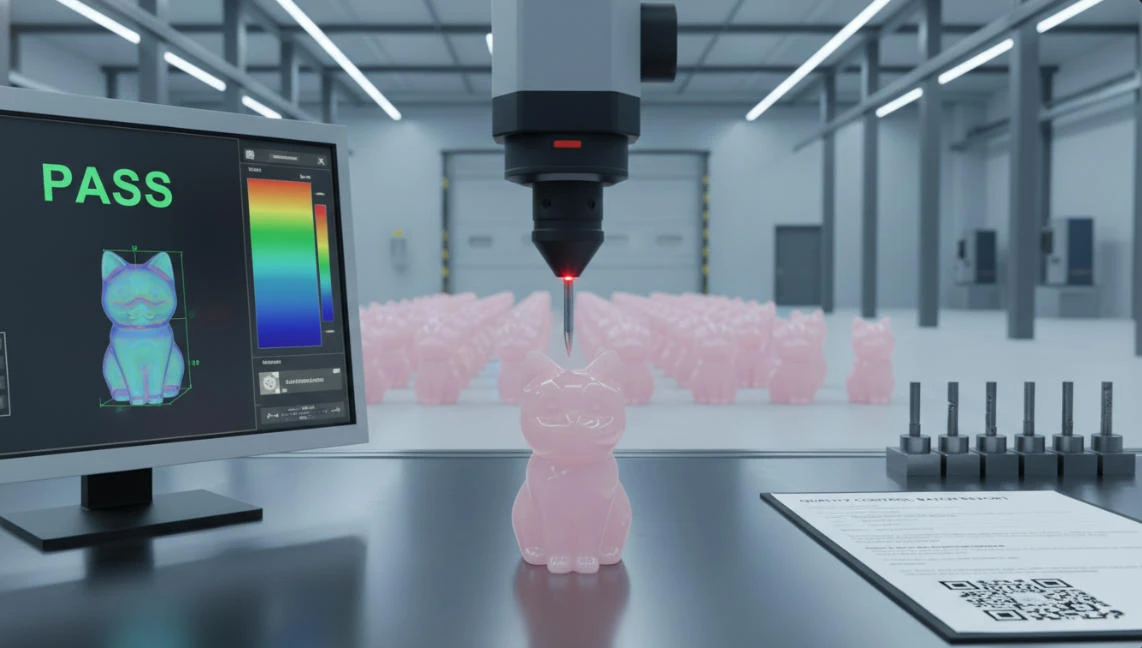
Knowing that you need a private label crystal manufacturer is step one. Knowing how to identify one with genuine production capability — rather than a workshop that markets itself as one — is where most B2B crystal sourcing decisions either succeed or fail. The difference is not visible in a product catalog or a factory tour photograph. It lives inside six specific operational capabilities that determine whether a manufacturer can deliver consistent, brand-grade output at commercial scale. Each capability addressed below represents a documented failure point in the crystal sourcing market, and each one carries direct consequences for your product quality, your customer experience, and your operational risk exposure.
1: Design-to-Production Conversion — Turning Your Concept Into a Manufacturable Crystal Custom Product
Most buyers arrive at a private label crystal manufacturer with a reference image, a competitor product, or a rough concept sketch. What happens next is the first major differentiator between a workshop and a professional manufacturing partner. A workshop will attempt to replicate what it sees. A capable private label crystal manufacturer will evaluate what it sees against three engineering criteria before a single gram of raw material is touched.
The first criterion is structural achievability: does the proposed geometry translate into a form that can be machined from natural crystal without compromising the material’s integrity? Natural crystal is not homogeneous. Its fracture planes, cleavage directions, and inclusion distribution mean that a design featuring acute angles, thin walls below 3mm, or asymmetric mass distribution carries measurable breakage risk during crystal process fabrication — risk that compounds at volume. The second criterion is process compatibility: can the proposed surface finish, dimensional specification, and feature detail be achieved with available tooling at the required production tolerance? And the third is optimization opportunity: where can the prototype be refined — not just reproduced — to perform better across material efficiency, structural durability, and aesthetic output?
This last criterion is where experience becomes quantifiable. A manufacturer with deep crystal process knowledge will identify, for example, that a 2mm reduction in wall thickness on a hollow sphere design increases breakage rate by approximately 18% at batch scale — and will propose an alternative geometry that preserves the visual intent while eliminating that production risk. That kind of upstream design intelligence is what converts a concept into a commercially viable crystal custom product, rather than an expensive prototype that fails in production. This means that your development budget is protected from the most common and most costly failure mode in crystal product development: a sample that looks right but cannot be manufactured consistently.
2: Material Intelligence — Why Crystal Process Expertise Goes Beyond Selecting Stones
Natural crystal materials behave in ways that industrial raw materials do not, and a private label crystal manufacturer without deep material knowledge will consistently underestimate the impact of that difference on your finished product. The GIA Gem Encyclopedia documents the hardness variation across common crystal categories on the Mohs scale: quartz minerals register between 7.0 and 7.5, while softer materials such as selenite and calcite range from 2.0 to 3.0. That four-to-five point range translates directly into tool wear rates, cutting speed parameters, and surface finish outcomes — all of which must be engineered differently for each material category.
Beyond hardness, colorimetric consistency represents a sourcing challenge that inexperienced manufacturers routinely underestimate. Within a single mineral family — amethyst, for example — color saturation can range from pale lavender to deep violet within the same mining lot, and the distribution of color zones within individual rough stones means that two pieces cut from the same boulder can produce visually distinct finished products. A professional private label crystal manufacturer addresses this through upstream material grading protocols that define acceptable colorimetric parameters before raw material procurement is approved. According to research standards established by the Swiss Gemmological Institute SSEF, systematic color grading using calibrated reference standards is the established method for achieving batch-level consistency in gemstone and crystal production — a standard that applies equally to commercial crystal custom manufacturing.
Material loss rate is the third variable that separates informed manufacturers from uninformed ones. Harder materials such as quartz generate lower fabrication waste per unit than softer, more friable materials such as selenite or fluorite — but they also require slower machining speeds and more frequent tool changes, which affects production cost and lead time. A capable private label crystal manufacturer will model material loss rates by product geometry and raw material category, providing you with accurate cost-per-unit projections before production begins, rather than adjusting pricing after the first batch reveals unexpected material consumption. This means that your landed cost forecasting is grounded in engineering data rather than optimistic estimates that collapse under production reality.
3: Engineering Tolerances — The Measurable Line Between Workshop and Private Label Crystal Manufacturer
Tolerance specification is the single most reliable diagnostic for distinguishing a professional private label crystal manufacturer from a workshop operating at artisan scale. Ask any prospective manufacturing partner to provide their written tolerance standards for a standard product category — a sphere, a tower, a palm stone — and the response will tell you everything you need to know about their actual production capability.
A workshop will typically respond with qualitative language: “approximately,” “similar to the sample,” or “natural variation is expected.” A professional private label crystal manufacturer will respond with documented dimensional bands: sphere diameter held to ±0.5mm, surface finish Ra value specified in micrometers, weight variance capped at ±3% of nominal. These are not bureaucratic formalities. They are the engineering foundation that makes your product consistent across batches, predictable for packaging specifications, and defensible to your retail buyers when they place reorders expecting the same product they received last quarter.
The practical stakes of tolerance control in B2B crystal sourcing are significant. A sphere specified at 80mm diameter that arrives with actual measurements ranging from 76mm to 84mm creates immediate downstream problems: packaging that doesn’t close correctly, display configurations that look inconsistent, and customer-facing quality complaints that damage brand perception. The GIA’s applied gemology research consistently identifies dimensional consistency as a primary driver of perceived product quality in the gemstone and crystal retail segment — a finding with direct implications for how tolerance engineering affects your brand’s market reputation, not just your production specifications. This means that when your private label crystal manufacturer documents and holds tight tolerances, you are not paying for precision for its own sake — you are paying for the customer experience consistency that drives repeat purchases.
4: Sampling and A/B Validation — How Professional Crystal Custom Prototyping Works
A single sample proves that a product can exist. It does not prove that the product should exist in its current form, that it can be reproduced consistently, or that it performs to specification under real-world conditions. Professional crystal custom prototyping through a qualified private label crystal manufacturer is a multi-stage validation process, not a one-shot exercise.
The standard approach involves parallel prototype development across multiple versions — typically two to three variants that test different process approaches, material grades, or surface treatment combinations simultaneously. These variants are then evaluated against objective criteria: dimensional measurements against specification, surface finish assessment, structural integrity testing under simulated handling conditions, and colorimetric consistency comparison across units within the same batch. The goal is not to identify the “prettiest” sample. It is to identify the variant that delivers the optimal combination of visual output, production consistency, and material efficiency at scale.
Real-world validation extends beyond the workbench. A private label crystal manufacturer with genuine product development capability will test finished prototypes against their intended use conditions — packaging fit, display configuration, weight distribution for shipping — before approving a design for production. This upstream validation investment typically adds two to four weeks to the development timeline. What it eliminates is the far more expensive scenario: discovering a fundamental design or process flaw after a full production run has been completed and shipped. According to quality management principles documented by the American Society for Quality (ASQ), defect costs identified at the design stage are approximately ten times less expensive to resolve than those identified in finished goods. In crystal custom manufacturing, where material costs, labor intensity, and long lead times amplify the financial impact of production errors, that cost ratio makes pre-production validation one of the highest-return investments in your entire sourcing process.
5: Process Integration — Orchestrating Multiple Crystal Process Steps Into One Repeatable Workflow
A finished crystal product is rarely the output of a single manufacturing step. A typical carved crystal tower, for example, passes through raw material selection and grading, rough shaping on diamond tooling, progressive surface grinding through multiple abrasive grades, final polish to target Ra specification, optional secondary processes such as laser engraving or surface coating, quality inspection, and packaging assembly. Each of these steps involves different equipment, different operator skill sets, and different quality control checkpoints — and the handoffs between them are where quality variance accumulates.
A workshop manages these steps reactively, coordinating between separate vendors or operators on an ad hoc basis with no standardized handoff protocol. A professional private label crystal manufacturer manages them through a documented production workflow that specifies input requirements, process parameters, and output acceptance criteria at every stage. That workflow documentation transforms a complex, multi-step crystal process from an artisan exercise into a reproducible industrial procedure — one that a production team can execute consistently across operators, shifts, and production runs without relying on individual expertise to compensate for the absence of process standards.
The commercial value of this integration capability is most visible at the reorder stage. When your first production run is complete and you place a reorder six months later, a manufacturer with documented process workflows will reproduce your product to the same specification because the process is written down and followed — not because the same craftsperson happens to be available. That reproducibility is the operational definition of a scalable B2B crystal sourcing partnership, and it is precisely what the absence of process integration makes impossible to guarantee.
6: Mass Production Replicability — From One Validated Sample to Consistent Volume Output
This is the capability where the most manufacturing relationships break down, and where the financial consequences of choosing the wrong private label crystal manufacturer are most severe. Any workshop with sufficient skill can produce one impressive sample. The engineering challenge — and the genuine differentiator — is producing ten thousand units at the same standard as that sample, with variance controlled within specification across every unit in the batch.
Replicability at scale requires three operational foundations that workshops typically lack. The first is process standardization: every production step documented with sufficient precision that any trained operator produces the same output. The second is statistical process control: systematic measurement of output parameters across the production run, with corrective action protocols triggered when measurements drift toward tolerance boundaries before they breach them. The third is batch management: the organizational infrastructure to track material lots, process parameters, and quality inspection results across a production run of thousands of units, and to isolate and address variance before it contaminates the full batch.
Research from the American Society for Quality on manufacturing consistency shows that organizations implementing documented statistical process control reduce defect rates by an average of 40% to 60% compared to those relying on operator judgment alone. In the context of crystal custom production — where natural material variability already introduces baseline inconsistency that must be managed — that defect reduction translates directly into a lower cost per acceptable unit, a more predictable yield rate, and a more reliable delivery timeline for your purchase orders. This means that the manufacturer’s investment in production systems is not overhead you are paying for indirectly — it is the mechanism that protects your per-unit economics and your delivery commitments to downstream customers.
How to Evaluate a Private Label Crystal Manufacturer — A Practical Framework for B2B Crystal Sourcing Buyers
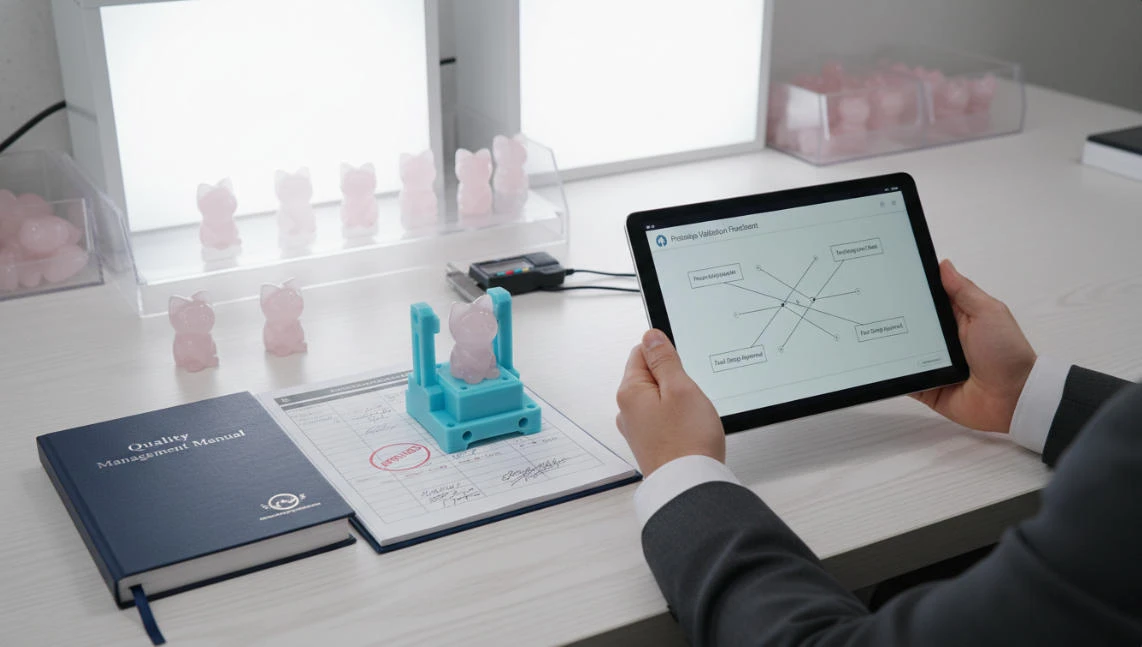
Identifying a capable private label crystal manufacturer requires more than reviewing a product catalog or requesting a factory audit certificate. The crystal and gemstone manufacturing sector contains a wide spectrum of production capability — from genuine engineering-grade manufacturers to trading companies and workshops that present themselves with identical professional branding. The evaluation framework below is designed to give B2B crystal sourcing buyers a structured, evidence-based method for assessing manufacturing partners before committing capital to a production program. Each criterion maps directly to a documented failure mode in the sourcing market, and each question is designed to generate responses that reveal actual capability rather than rehearsed sales messaging.
Why Most Supplier Evaluation Processes Fail B2B Crystal Sourcing Buyers
The standard supplier evaluation approach — factory visit, product sample request, reference check — is insufficient for assessing crystal custom manufacturing capability for one fundamental reason: it measures output at a single point in time rather than the system that produces that output. A factory can prepare an impressive showroom sample specifically for evaluation purposes. It can present a facility that looks organized during a scheduled visit. What it cannot easily fabricate is documented evidence of the engineering systems, process controls, and validation protocols that determine whether that sample quality is reproducible at commercial volume.
According to procurement best practice guidelines published by the Chartered Institute of Procurement & Supply (CIPS), supplier evaluation in complex manufacturing categories should weight process capability evidence — documented quality systems, tolerance records, production workflow specifications — at least equally with product sample assessment. In categories involving natural material variability, such as crystal and gemstone production, process capability evidence carries even greater predictive weight because the material itself introduces baseline inconsistency that only engineered systems can reliably manage. The following five questions are structured around that principle: each one targets a specific system, not a specific product.
5 Questions Every B2B Crystal Sourcing Buyer Should Ask Before Signing a Crystal Custom Production Agreement
Question 1: Can you provide written tolerance specifications for this product category?
This question has a binary outcome. A professional private label crystal manufacturer will produce a document — not a verbal assurance — specifying acceptable dimensional variance, surface finish parameters, and weight tolerance for the product category in question. That document should reference specific measurement units: millimeters for dimensional tolerances, Ra values or equivalent surface roughness metrics for finish specifications, and percentage bands for weight variance. If the response involves qualitative language — “we follow industry standards,” “natural variation is expected,” “our craftspeople have many years of experience” — you are speaking with a workshop. The absence of written tolerance documentation is not a negotiation point. It is a structural signal that the manufacturer lacks the engineering infrastructure to guarantee batch consistency, which means your reorder quality is a function of luck rather than process control.
Question 2: What does your prototype validation process look like, and how many versions do you typically develop before approving a design for production?
The answer to this question reveals the manufacturer’s product development philosophy. A capable private label crystal manufacturer will describe a multi-version prototyping process involving parallel variants, objective evaluation criteria, and functional testing against real-world use conditions — not a single sample produced and presented for approval. If the answer is “we make one sample and you approve it,” the manufacturer is optimizing for speed and simplicity rather than for your product’s commercial performance. The cost of inadequate prototype validation is not paid during the sampling stage — it is paid during the first full production run, when a design or process flaw that should have been identified upstream generates a batch of non-conforming finished goods. For reference, the American Society for Quality documents that defects identified at the prototype stage cost approximately one-tenth as much to resolve as those identified in finished production — a ratio that makes rigorous prototype validation one of the highest-return risk management investments available in crystal custom development.
Question 3: How do you manage material grading and lot consistency across a full production run?
Natural crystal materials introduce colorimetric and structural variability that cannot be eliminated — only managed. A professional private label crystal manufacturer will describe an upstream material grading protocol that defines acceptable parameters for raw material inputs before production begins, combined with lot tracking systems that link finished units back to specific raw material batches. This traceability infrastructure serves two functions: it prevents out-of-specification material from entering the production stream, and it enables rapid batch isolation when a material-level issue is identified after production is complete. If the manufacturer’s answer focuses exclusively on finished product inspection — “we check everything before shipment” — rather than upstream material control, your quality assurance is operating reactively rather than preventively. In a material category as variable as natural crystal, reactive quality control is systematically insufficient because inspection can identify non-conforming units but cannot recover the material, time, and production cost already consumed in making them.
Question 4: Can you provide production records or quality data from a comparable previous order?
This question distinguishes manufacturers with genuine quality management systems from those with quality management marketing. A private label crystal manufacturer operating at professional standard maintains production records that include raw material lot identifications, process parameter logs, in-process inspection data, and finished goods measurement records for every production run. These records exist not for customer presentation purposes but because the manufacturer’s own process control system generates and uses them operationally. Requesting a sample of this documentation from a previous comparable order — with commercially sensitive information redacted as appropriate — is a legitimate and reasonable due diligence step. A manufacturer unwilling to provide any production record evidence is effectively asking you to trust verbal assertions over documented performance. In B2B crystal sourcing at commercial scale, that is an asymmetric risk you should not accept.
Question 5: What is your documented process for managing batch consistency across orders of 5,000 units or more?
Scale is where workshop capability separates from genuine manufacturing capability, and this question targets that boundary directly. The answer should describe specific operational mechanisms: statistical sampling protocols applied during production, corrective action triggers based on measurement data rather than visual inspection, and production planning approaches that account for natural material variability at the raw material procurement stage. Vague answers referencing experienced craftspeople, quality teams, or stringent inspection processes without describing the underlying measurement and decision systems indicate that batch consistency is managed by human judgment rather than engineered process — which means it degrades as order volume increases, operator familiarity decreases, or production pressure intensifies. Your confidence in a private label crystal manufacturer‘s scale capability should be proportional to the specificity and documentation depth of their answer to this question.
Red Flags That Signal You Are Evaluating a Workshop, Not a Private Label Crystal Manufacturer
Beyond the five core evaluation questions, several observable signals consistently indicate that a prospective manufacturing partner lacks the capability to deliver a professional crystal custom program at commercial scale. Recognizing these signals early — before a deposit has been transferred or a production timeline has been committed — is one of the most financially consequential skills a B2B crystal sourcing buyer can develop.
The first signal is pricing that appears significantly below market rate for the product category and specification you have described. Natural crystal materials carry real commodity costs, and professional crystal process operations — with calibrated equipment, trained operators, documented quality systems, and multi-stage prototype validation — carry real operating costs. A price quote that sits 30% or more below what comparable professional manufacturers are offering is not evidence of efficiency. It is evidence that something in the quality system, the material standard, or the production process has been removed to reach that price point. Understanding what has been removed requires investigation, not optimism.
The second signal is an inability or unwillingness to provide written specifications before production begins. Professional manufacturers document specifications because their production systems require documentation to function. Manufacturers who resist written specifications are typically protecting the flexibility to deliver whatever they produce rather than committing to what you specified.
The third signal is prototype delivery that consistently exceeds agreed timelines without process-level explanation. A single prototype delay can reflect genuine production complexity. Repeated prototype delays, or delays accompanied by explanations that focus on external factors rather than internal process adjustments, indicate that the manufacturer’s production planning and capacity management systems are insufficient to support a predictable commercial relationship.
The fourth signal is a product range that appears exceptionally broad relative to the manufacturer’s stated team size and facility scale. A genuine private label crystal manufacturer with deep crystal process capability will typically have identifiable areas of manufacturing strength — specific material categories, specific product geometries, specific surface treatment processes — where their engineering depth is demonstrable. A supplier presenting themselves as capable of manufacturing virtually anything in any material at any scale is more likely a trading company coordinating between multiple sub-suppliers than a manufacturer with owned production capability.
The International Gem Society (IGS) specifically advises gemstone and crystal buyers to verify direct manufacturing capability — including owned tooling, in-house quality control, and documented process standards — as a prerequisite to any significant production commitment. That verification standard applies with equal force to crystal custom private label programs, where your brand identity and customer commitments are directly dependent on your manufacturer’s ability to perform consistently over multiple production cycles, not just the first one.
Quantifying the ROI of Choosing the Right Private Label Crystal Manufacturer
The evaluation process described above requires time, diligence, and in some cases, investment in additional prototype rounds or factory verification visits. Understanding the financial return on that investment helps contextualize why it is justified. Consider a B2B crystal sourcing buyer placing orders of 3,000 units per quarter across a branded product line with an average retail value of $35 per unit. At a conservative sell-through rate of 85%, that represents approximately $89,250 in quarterly retail revenue from a single product line.
A production quality failure — caused by choosing a manufacturing partner without the tolerance engineering or batch consistency capability described in this framework — that results in a 15% non-conforming unit rate across a production run generates approximately $13,387 in unrecoverable product cost per quarter, plus the downstream costs of customer returns, replacement shipments, and brand reputation impact with retail buyers. That single quality failure, replicated across two production runs, exceeds the cost of the additional due diligence investment required to identify and qualify a professional private label crystal manufacturer in the first place.
The inverse calculation is equally instructive. A crystal custom program executed through a capable private label crystal manufacturer — with brand-owned specifications, consistent quality output, and proprietary product architecture — generates a pricing premium that, at 30% above generic sourcing alternatives, adds approximately $26,775 in additional quarterly revenue from the same sales volume. The ROI on choosing the right manufacturing partner is not theoretical. It is the delta between those two scenarios — a spread that compounds with every production cycle and every customer relationship that your brand-owned product line either earns or forfeits.
Why JADEMAGO Is the Private Label Crystal Manufacturer Built for Serious B2B Crystal Sourcing Partners

Every capability framework in this article ultimately converges on one practical question: where do you find a private label crystal manufacturer that actually delivers against these standards at commercial scale? The answer requires a manufacturer whose engineering depth, material knowledge, and production systems have been validated not through marketing claims but through decades of measurable output — across product categories, client types, and order volumes that reflect the full complexity of professional B2B crystal sourcing. JADEMAGO was built precisely for that requirement.
From Concept to Crystal Custom Product: How JADEMAGO Executes the Full Private Label Journey
The private label crystal manufacturer relationship that generates compounding brand value is not a transactional one. It is a structured development partnership that begins with your concept and ends with a validated, production-ready product specification that your brand owns. Here is how that journey works through JADEMAGO‘s development process — and what each stage delivers for your business specifically.
1 — Concept Evaluation and Design Optimization. When you bring a reference image, a competitor product, or a design concept to JADEMAGO, the first step is not sample production. It is engineering evaluation. Your concept is assessed against structural achievability in natural crystal, crystal process compatibility with available tooling and fabrication methods, and optimization opportunities that preserve your design intent while eliminating structural fragility or material inefficiency. You receive a documented evaluation with specific recommendations before any production investment is made — which means your development budget is protected from the most common and costly failure in crystal product development: a prototype that looks right and cannot be manufactured reliably.
2 — Material Solution Recommendation. Based on your design requirements, target price point, and brand positioning, JADEMAGO‘s material team recommends specific raw material grades with defined colorimetric parameters, structural quality thresholds, and lot consistency standards. This recommendation is not generic — it is calibrated to your specific product geometry, surface finish requirements, and minimum order volume. The SSEF’s gemological standards for color grading inform the material specification methodology applied at this stage, ensuring that your material parameters are anchored to internationally recognized assessment frameworks rather than subjective in-house definitions. This means you can communicate material specifications to your retail buyers with technical confidence rather than approximate descriptions.
3 — Multi-Version Prototype Development and A/B Validation. JADEMAGO does not produce a single prototype for approval. The standard development process involves parallel prototypes across two to three variants — testing different crystal process approaches, surface treatment combinations, or material grade options simultaneously — evaluated against objective dimensional, colorimetric, and structural criteria. Functional validation against packaging fit, display configuration, and shipping stress conditions is completed before any variant is recommended for production approval. You receive comparative evaluation data, not just a product to approve visually. This means your production investment is committed to a design and process combination that has been validated to perform — not merely to look impressive in a single sample.
4 — Tolerance Documentation and Production Standard Setting. Before mass production begins, JADEMAGO produces written tolerance specifications for every critical product parameter: dimensional bands, surface finish targets, weight variance limits, and colorimetric acceptance criteria. These documents become the production standard against which every batch is measured — and the quality assurance baseline against which you can hold JADEMAGO accountable across every subsequent order. According to quality management principles established by the American Society for Quality, written production standards are the foundational requirement for achieving measurable batch-to-batch consistency in complex manufacturing — and they are the document set your B2B crystal sourcing operation should be filing alongside every production agreement you sign.
5 — Scalable Mass Production with Statistical Batch Control. When your design is approved and specifications are documented, JADEMAGO‘s production system applies statistical process control across the full production run — measuring output parameters at defined intervals, triggering corrective action when measurements approach tolerance boundaries, and maintaining batch traceability records that link every finished unit to its raw material lot. The result is a defect rate and dimensional consistency profile that holds across an order of 500 units and an order of 50,000 units. This means that when your brand scales — when a product line that started at 1,000 units per quarter grows to 10,000 — your quality standard scales with it rather than degrading under volume pressure.
Start Your Private Label Crystal Manufacturer Partnership With JADEMAGO
If your current B2B crystal sourcing operation is generating the symptoms described in this article — margin compression from price competition, batch inconsistency across supplier orders, limited ability to differentiate your product line from competitors sourcing the same catalog — the structural solution is a crystal custom development program with a private label crystal manufacturer whose engineering capability matches the commercial ambition of your brand.
JADEMAGO has spent over 65 years developing exactly the manufacturing infrastructure — material sourcing relationships, crystal process engineering systems, prototype validation protocols, and mass production quality controls — that transforms a crystal sourcing relationship from a cost center into a brand-building asset. The question is not whether your business would benefit from that infrastructure. The question is how many more commodity sourcing cycles you can afford before a competitor with a proprietary product line captures the brand loyalty and pricing power that your current product mix cannot hold.
Your next step is straightforward. Bring JADEMAGO your concept — a reference image, a competitor product, a design sketch, or simply a market opportunity you want to own — and receive a structured engineering evaluation of what a crystal custom development program would deliver for your specific product category, target market, and volume requirements. No generic catalog. No off-the-shelf solution dressed up as customization. A documented development partnership built around your brand’s specifications and commercial objectives.
Contact JADEMAGO to begin your private label consultation and receive a material solution recommendation, prototype timeline, and production cost projection calibrated to your program requirements.
FAQs: Private Label Crystal Manufacturer
1. What is a private label crystal manufacturer, and how is it different from a regular crystal supplier?
A private label crystal manufacturer produces crystal products to your exact specifications — your logo, your packaging, your tolerances — rather than selling identical catalog inventory to every buyer in your market. The core difference is ownership: your product architecture belongs to your brand, not a shared supplier catalog. That ownership is what converts price competition into brand premium.
2. What minimum order quantities should I expect for a crystal custom program?
Most professional private label crystal manufacturers set production MOQs between 300 and 1,000 units per SKU, depending on product complexity and material category. This volume threshold reflects the engineering investment in prototype validation, tolerance documentation, and material grading — and is the mechanism that keeps your specifications exclusive to your account.
3. How long does development take from concept to first production run?
A complete B2B crystal sourcing development cycle — concept evaluation, material recommendation, multi-version prototyping, and production approval — typically runs eight to sixteen weeks. Crystal process complexity and surface treatment requirements determine where your project sits within that range. Compressing the timeline by skipping validation stages reliably creates larger costs downstream.
4. Can natural crystal materials be manufactured to consistent tolerances?
Yes, with the right upstream controls. As GIA research confirms, natural crystal variability is real but manageable. A professional private label crystal manufacturer controls it through upstream material grading and statistical process monitoring — achieving dimensional tolerances of ±0.5mm or tighter across commercial production volumes.
5. How do I protect my designs after development?
Protection operates on 3 levels. Contractually, your crystal custom specifications, molds, and process protocols should be documented as proprietary to your account. Structurally, the development investment itself creates the real barrier — replicating your product requires a competitor to run a full independent development cycle, which in the B2B crystal sourcing market typically consumes six to eighteen months and significant capital before anything reaches market. From a legal standpoint, you can apply for a patent to protect your design from plagiarism.