If you’ve been searching for how much is a jade bracelet and expecting a clean single number, here is the most useful answer available: jade bracelet price ranges from under $10 at the wholesale factory level to well over $10,000 at the luxury retail end — and a bracelet with just $120 in raw material cost can legitimately retail for $1,000. That gap is not a markup mystery. It is a five-layer cost structure combined with brand positioning, and every dollar in between is fully explainable once you understand what you are actually paying for.
The retail markup on jade bracelets sits between 130% and 1,000% above factory exit price. That range comes from direct comparisons between factory invoices and the final retail listings of brands sourcing from jade manufacturers across Guangdong and Yunnan provinces. Understanding how that gap is constructed is the most commercially valuable thing this article can offer — whether you are a brand builder, a product manager running sourcing decisions, or an independent studio owner placing your first wholesale order.
Table of Contents
Why Jade Bracelet Price Ranges So Dramatically?
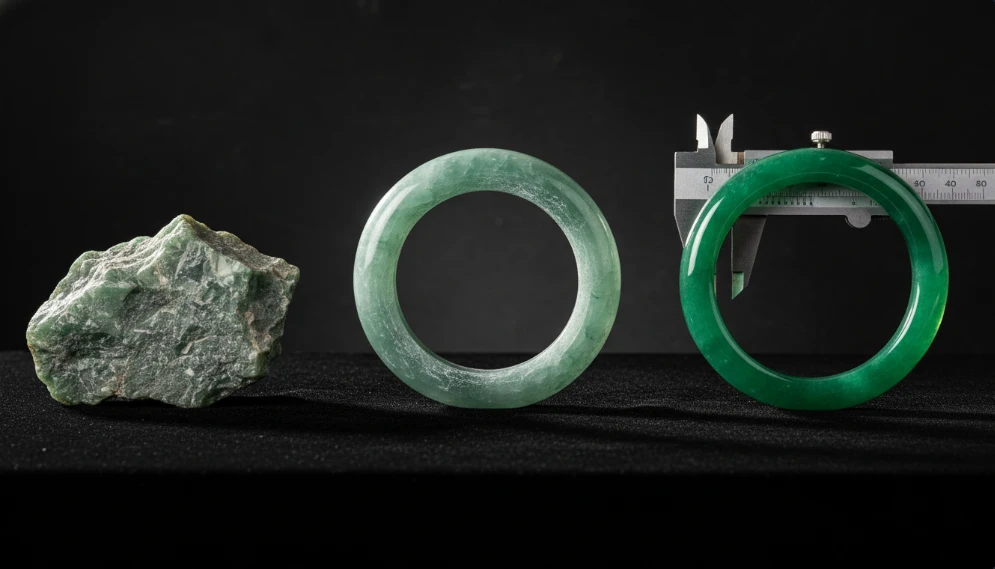
The jade bracelet price range you encounter in the market — from $8 on a bulk wholesale platform to $8,000 in a boutique — reflects three compounding variables: the intrinsic quality of the raw jade material, the craftsmanship method applied during manufacturing, and the brand equity layered on top at the point of sale. Remove brand positioning entirely and you still face a 10x price difference driven purely by material and craft. Add brand positioning back, and that multiplier can reach 50x for the same physical dimensions of stone.
The practical implication is this: a price tag tells you almost nothing about value unless you can read the cost structure behind it. The sections that follow are designed to give you exactly that reading capability — with enough data precision to use it in a real supplier negotiation.
The $120-to-$1,000 Pathway
To anchor everything that follows: a mid-quality jadeite bracelet, cut from rough purchased at $200 per kilogram, finished through semi-handmade processing, factory QC-checked, and packaged in a mid-range gift box, carries approximately $120 in raw material cost. By the time it reaches a consumer through a branded retail channel, the price is $1,000. Every dollar added between those two numbers will be accounted for in the sections ahead.
The 5-Layer Cost Stack: How Jade Bracelet Prices Are Built at the Factory Level
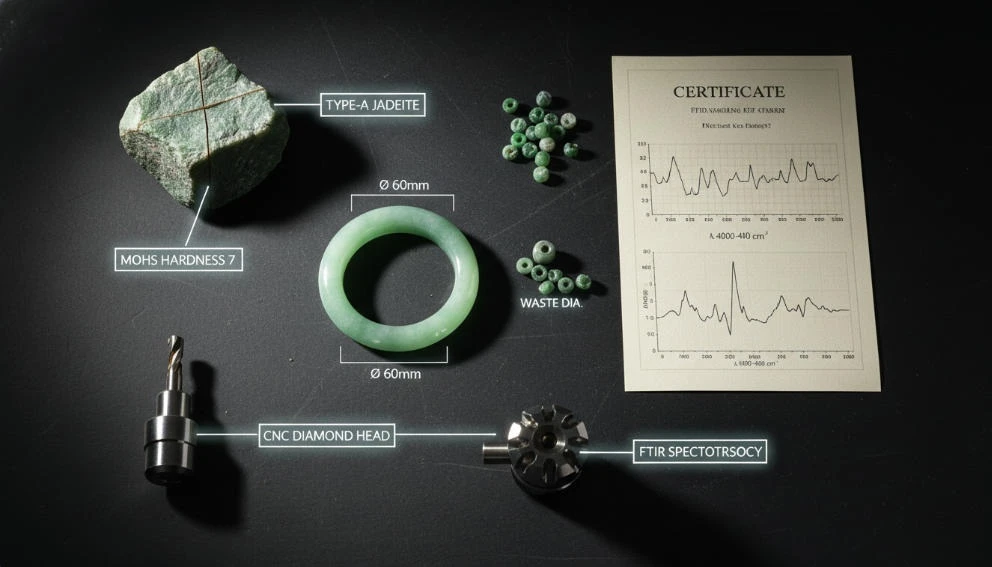
Material Cost — The Variable That Drives Everything – 40%–80% of Total Cost
Raw material is the single largest and most volatile cost component in jade bracelet manufacturing. Depending on the quality tier being sourced, material cost accounts for 40% to 80% of total production cost. That range exists because jade pricing is non-linear — a marginal improvement in color saturation or transparency can multiply raw stone cost by a factor of five or ten, while the physical weight of the stone changes very little.
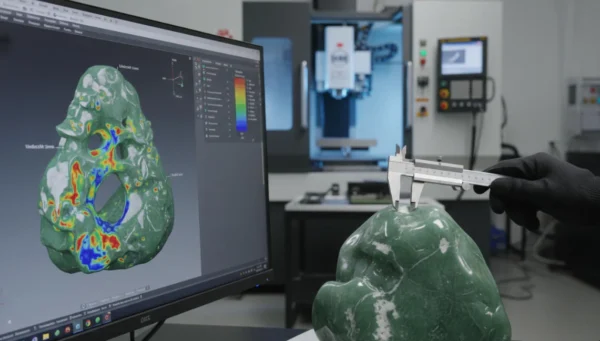
The yield problem compounds this further. From a 2-kilogram rough jade stone, a skilled cutter will typically recover only 1 to 2 complete, sellable bracelets — a material yield rate of 15% to 35%. The remaining 65% to 85% by weight becomes lower-value cabochons, beads, or cutting waste. Source: GIA: Jade Quality Factors — cutting and yield methodology.
At a raw stone cost of $200 per kilogram, a single bracelet blank carries approximately $100 to $120 in attributable raw material cost before any shaping work begins. That figure is your material cost floor. This means you can use the yield calculation as a direct verification tool every time you evaluate a new supplier’s pricing.
Processing Cost — From Machine Output to Master Carving – $5 – $500+ Per Piece
Processing cost is where the most significant differences in product positioning are created. It falls across three distinct tiers, each corresponding to a different production method, quality standard, and retail narrative.
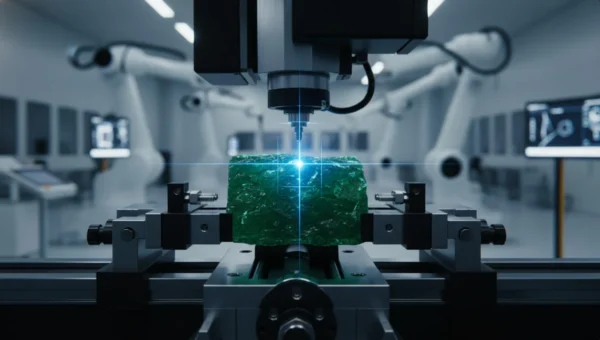
Machine processing produces jade bracelets at $5 to $20 per piece. CNC-guided cutting achieves dimensional consistency across large production runs, making this the standard method for e-commerce volume products and unbranded wholesale inventory. The output is geometrically precise, but it carries no craft narrative — which structurally limits the retail price ceiling for any brand built around machine-processed product.
Semi-handmade processing, where machines handle rough shaping and craftspeople perform finishing and surface work, runs $20 to $80 per bracelet. This is the dominant production method for mid-tier branded jade jewelry. It balances cost efficiency with enough artisan involvement to support a credible brand story.
Full hand-carving by a master craftsperson starts at $100 per bracelet and regularly exceeds $500 for complex relief work. For brands targeting the premium segment, this is not a cost problem — it is the product’s core value proposition. This means you can command a retail price that machine-processed competitors structurally cannot match on the same aesthetic terms.
Quality Inspection Cost — Protects Your Retail Price – $1 – $150 Per Piece
Factory-level basic inspection costs $1 to $5 per bracelet and is standard at any reputable jade production facility. This is sufficient for wholesale catalog products where the buyer is an experienced trader conducting their own assessment on receipt.
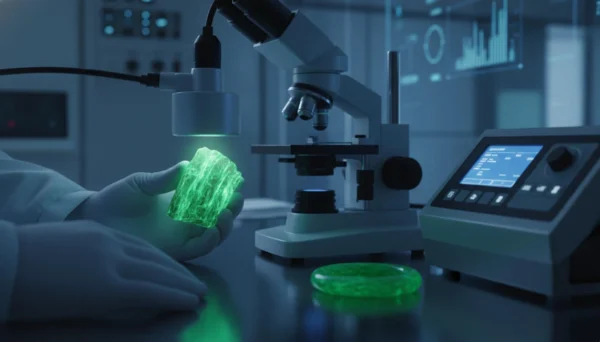
Third-party laboratory certification runs $30 to $150 per bracelet. For jadeite specifically, the critical lab testing strategy involves FTIR spectroscopy and Raman spectroscopy, which together definitively identify whether a stone is Type A (untreated natural), Type B (polymer-impregnated), or Type C (dyed). References: SSEF: Jade Testing & Certification Reports | IGS: Jadeite Treatment Identification.
For any brand selling to end consumers at $300 or above per bracelet, third-party certification is not optional — it is the foundation of the price claim. This means you protect your margins, your reputation, and your customer relationships with a single line item in your cost structure.
Packaging Cost — The Physical Signal of Your Price Point $1 – $30 Per Piece
Packaging in the jade bracelet category serves a function beyond protection during shipping. At the point of unboxing, it is the first physical confirmation a consumer receives that the price they paid was appropriate. A $600 bracelet delivered in a polyethylene bag creates cognitive dissonance that product quality alone cannot overcome.
Standard e-commerce packaging runs $1 to $3 per unit. Gift box packaging runs $5 to $15. Premium brand packaging runs $10 to $30 and is the minimum credible presentation for any bracelet positioned above $600 at retail. Packaging cost should represent approximately 1% to 3% of retail price to maintain proportionality.
Factory Profit Margin — The Honest Number 10% – 15%
A professional jade manufacturing facility operates on a net profit margin of 10% to 15% on production cost. This covers equipment depreciation, QC infrastructure, skilled labor overhead, raw material storage and insurance, and the operational cost of maintaining production consistency. The factory’s margin is not the gap between factory price and retail price — that gap belongs to the brand and the distribution channel.
When a factory offers a price 30% below their initial quote without any change in specification, that reduction is coming from somewhere — typically material quality, processing time, or QC thoroughness. This means you can negotiate from a position of knowledge rather than suspicion, and catch substitution risk before it reaches your customers.
The Jade Bracelet Price Formula: From Raw Stone to Retail Tag
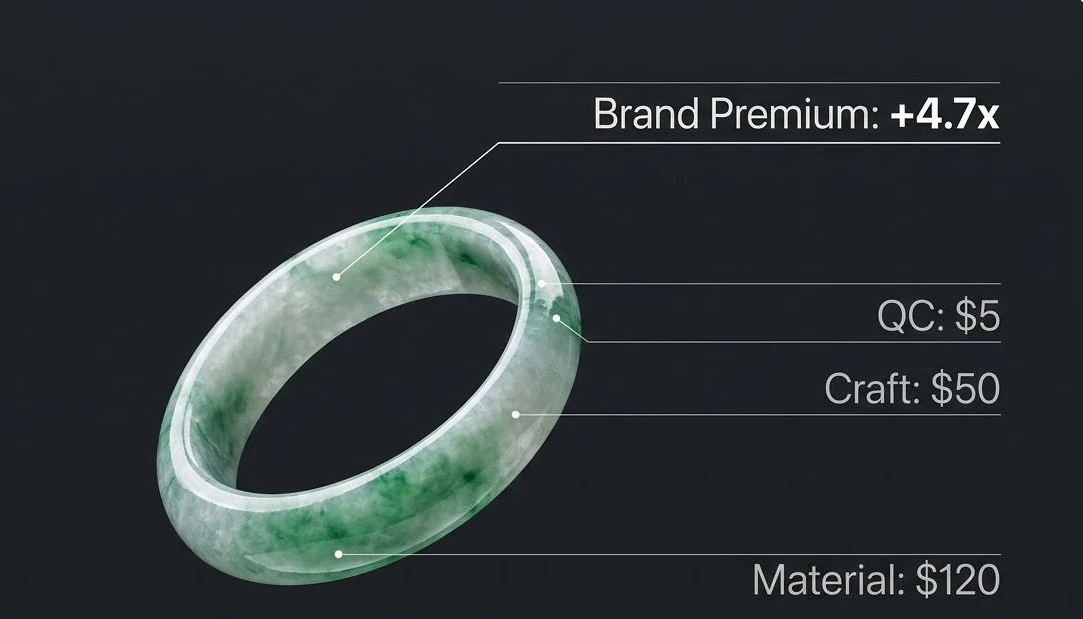
Every cost layer described in the previous section is measurable and verifiable — but only becomes useful when assembled into a working model. The formula below is the calculation framework any serious buyer or brand manager should run against every supplier quote they receive. If a quote cannot survive this formula, it cannot survive market reality either.
The Formula: Building Price From the Ground Up
| Factory Exit Price = (Material Cost + Processing Cost + QC Cost + Packaging Cost) × (1 + Factory Margin Rate)Retail Price = Factory Exit Price × (1 + Retail Markup Rate) |
The variables and their standard ranges, drawn from production data across jade manufacturing facilities in Guangdong and Yunnan provinces, break down as follows: material cost $20–$500+ per bracelet depending on jade grade; processing cost $5–$500+ depending on craftsmanship tier; QC cost $1–$150 depending on certification level; packaging cost $1–$30 depending on brand positioning; factory margin 10–15%; retail markup 130%–1,000% above factory exit price.
What makes this formula practically powerful is its diagnostic function. When you receive a wholesale quote, you can reverse-engineer the implied material cost by subtracting standard processing, QC, and packaging figures, then deflating by the factory margin. This means you enter every sourcing conversation with a number, not a feeling.
Case Study: The $120 Material Bracelet That Retails for $1,000
The subject is a mid-quality jadeite bracelet — commercially classified as Grade B+, with even light green coloring and a translucency level consistent with the glutinous transparency grade (糯种, nuò zhǒng) — no visible fractures or inclusions. This is solidly mid-market: the kind of product a credible lifestyle jewelry brand would build a core SKU around.
| Cost Layer | Detail | Amount |
| Raw Material Cost | $200/kg rough; 1.5 kg section; 2 bracelets recovered (~28% yield) | $120 |
| Processing Cost | Semi-handmade; CNC rough shape + hand polish; ~2.5 hrs per piece | $50 |
| QC Cost | Factory-level basic inspection; visual grading + dimensional check | $5 |
| Packaging Cost | Mid-range gift box; velvet lining; magnetic closure; brand card | $10 |
| Total Production Cost | Sum of all layers above | $185 |
| Factory Exit Price | $185 × 1.15 (15% factory margin) | $213 |
| Retail Price | $213 × 4.7x markup (mid-market branded channel) | ~$1,000 |
The math closes cleanly at $1,000. No step in this calculation involves margin manipulation or unusual market conditions. This is standard commercial structure for a properly positioned mid-market jade bracelet brand.
What This Model Tells You About Your Pricing Strategy
The case study reveals something that pure market research cannot: the retail price of a jade bracelet is, to a significant degree, a brand decision rather than a cost inevitability. The same $213 factory exit price could support a retail positioning anywhere from $480 at a price-competitive e-commerce strategy to $1,500 or beyond under a premium brand. The factory cost establishes a floor; the ceiling is determined by how well your brand positioning justifies the price to your target customer.
According to research on consumer price perception in the natural gemstone jewelry category, buyers’ willingness to pay at the mid-market tier correlates more strongly with certification, provenance narrative, and presentation quality than with objective gemological grade alone. GIA: Jade Buyer’s Guide — quality, certification & value perception. Reallocating $25–$40 per unit toward third-party QC certification and premium packaging can enable a retail price increase of $150–$300 — a measurable positive ROI.
The 3 Factors That Actually Determine Jade Bracelet Market Price
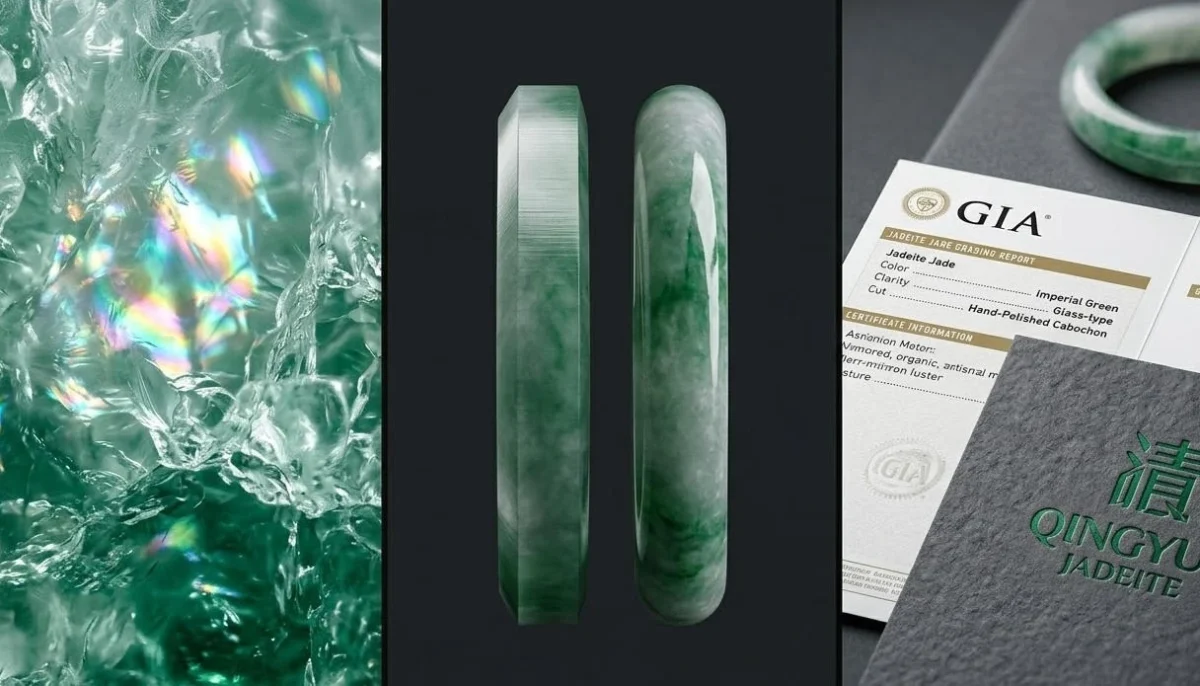
The cost formula tells you what a jade bracelet should cost to produce. But the market price — the number a consumer actually pays — is governed by a different set of variables. These three factors operate above the cost layer, and they are the primary reason why two bracelets with identical production costs can command prices that differ by 500% on the same retail platform.
Jade Quality — The Foundation That No Branding Can Replace
Jade quality is the bedrock variable in any real jade bracelet price discussion. For jadeite — sourced primarily from Myanmar — quality assessment rests on four interconnected dimensions: color, transparency, texture, and structural integrity.
Color: In the jadeite market, imperial green — vivid, evenly saturated emerald green with high transparency — commands price premiums that are exponential rather than linear. A bracelet cut from imperial green rough can carry a raw material cost 50 to 100 times higher than a bracelet of equivalent dimensions cut from pale lavender or white jadeite.
Transparency grade — what the Chinese jade trade calls “种水” (zhǒng shuǐ) — runs from “玻璃种” (glass type) through “冰种” (ice type) and “糯种” (glutinous type), down to fully opaque varieties. Glass-type jadeite bracelets sit among the most valuable objects in the jade market per unit weight. IGS: Jade Buying Guide — full jadeite grading framework.
Understanding these quality dimensions means you can have a precise, evidence-based conversation with your supplier about what you are paying for — rather than accepting a grade description at face value.
Craftsmanship — The Multiplier That Creates or Destroys Margin
The relationship between craftsmanship and price in the jade bracelet market is not proportional — it is exponential at the upper end. Craftsmanship does two things simultaneously: it contributes to the physical quality of the finished piece, and it generates the narrative of scarcity and skill that justifies premium pricing to the end consumer.
At the machine-processing tier, the product story is dimensional accuracy and consistency — real virtues for price-sensitive e-commerce channels, but a story with a structural ceiling on retail pricing. Semi-handmade processing introduces a differentiating element: the finishing decisions made by a craftsperson are not replicable by machine and are perceptible in the finished product. This is why mid-tier branded jade jewelry almost universally uses semi-handmade processing.
Full hand-carving by a senior artisan introduces provenance — a specific maker, a documentable process, a piece that cannot be reproduced identically. Pricing data from jade auction results shows that hand-carved jadeite bracelets by named craftspeople regularly achieve 3 to 8 times the retail price of machine-processed bracelets in equivalent material grades. This means that investing in documented craftsmanship provenance is one of the highest-ROI positioning decisions available in the jade bracelet category.
Brand Positioning — The Multiplier That Exists Above the Product
Brand positioning is the variable that most directly determines where within the 130%–1,000% retail markup range your product will land. Consider two bracelets cut from the same batch of mid-grade jadeite rough, finished the same way. One sells unbranded at $180. The other sells through a curated lifestyle brand — coherent visual identity, documented sourcing narrative, third-party GIA-recognized certification, boutique retail presence — at $950. GIA: Jade Quality Factors — the role of certification in consumer value perception.
The $770 difference is entirely attributable to brand positioning. Research on natural gemstone jewelry purchasing consistently shows that consumers are buying a combination of the physical object and the confidence, story, and identity that the brand provides around it.
For anyone building a jade bracelet product line, this translates into a clear strategic priority: the highest-leverage investment is not in marginally better raw material — it is in the brand infrastructure that converts a $213 factory exit price into a $1,000 consumer purchase.
How to Source Jade Bracelets at the Right Factory Price
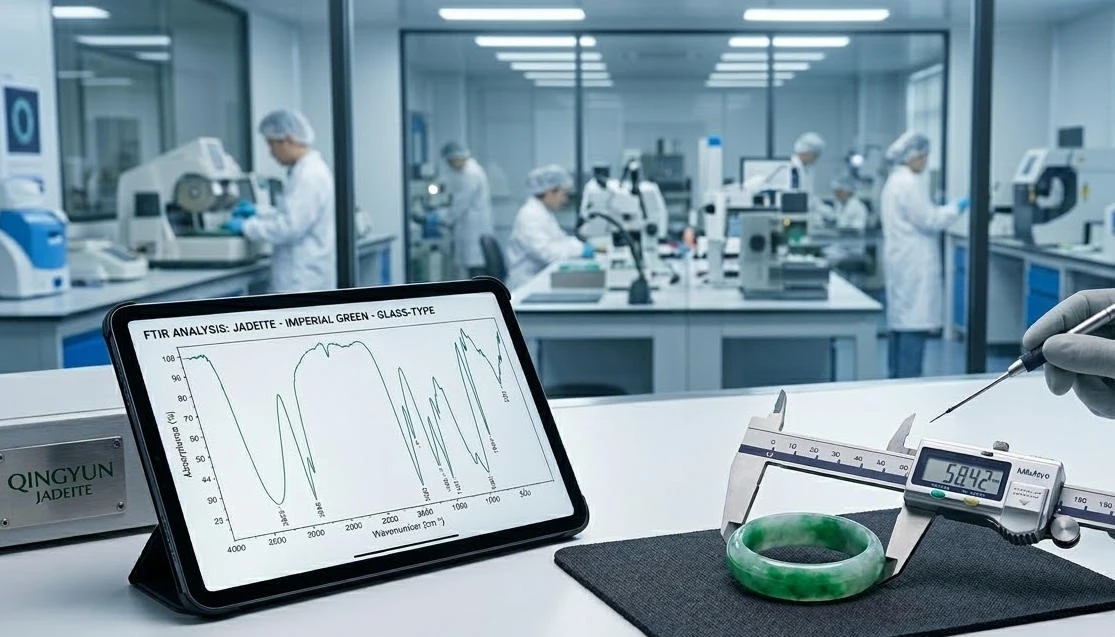
The cost model and pricing formula in the previous sections are only useful if you can apply them in a real sourcing conversation. Most buyers who overpay for jade bracelets — or receive product that does not match what was quoted — do not fail because they lacked gemological knowledge. They fail because they had no structured framework for evaluating supplier claims against verifiable cost benchmarks.
Identifying Pricing Red Flags Before You Commit
A quote more than 25% below the implied cost floor for the stated material grade is not a competitive price — it is a data point requiring explanation. Given that raw material accounts for 40–80% of production cost, a jade factory offering mid-grade jadeite bracelets at $60 when material cost alone should be $80–$120 is either working with misrepresented material, applying machine processing where semi-handmade was specified, or bypassing QC steps.
Conversely, a quote significantly above market without a clear differentiating factor — documented master-carver involvement, third-party certification from SSEF or a GIA-affiliated laboratory — is not necessarily a sign of superior quality. Your ability to reverse-engineer the cost stack is the specific tool that protects you in both directions. This means you enter every sourcing negotiation with a quantified position rather than a subjective impression.
Five Questions to Ask Every Jade Factory Before Ordering
1. Raw Material Sourcing & Traceability
Where is the jadeite rough purchased, and can the supplier provide documentation? Myanmar-origin jadeite is subject to import regulations in multiple markets. U.S. Department of State: Burma Sanctions — current import regulations on Myanmar-origin jadeite.
2. Processing Method Verification
What is the specific processing workflow for your SKU, and can the factory provide process documentation or workshop footage? The distinction between machine, semi-handmade, and full hand-carving is not always self-evident in finished product photography.
3. QC Protocol & Certification Capability
Does the factory conduct FTIR and Raman spectroscopy testing in-house, or does it coordinate with a third-party laboratory? Certificates from unrecognized testing facilities provide no meaningful protection against a Type B or Type C jade misrepresentation claim. SSEF: Jadeite Impregnated and Dyed — case study with FTIR spectroscopy analysis.
4. Minimum Order Quantity & Sampling Terms
A factory requiring large minimum orders before allowing sample evaluation is transferring all sourcing risk to the buyer. Professional jade manufacturers with confidence in their production consistency provide samples — typically at cost or a modest premium — before any production commitment is made.
5. Packaging Customization Capability
If your brand positioning requires custom packaging — and at any retail price above $200, it should — confirm whether the factory handles this in-house or sources externally. Factories sourcing packaging from third parties have less control over lead times and quality consistency, which creates fulfillment risk at scale.
Why Manufacturing Experience Is a Quantifiable Asset
In the jade manufacturing category, production experience translates into measurable outcomes. A workshop that has been cutting jadeite rough for decades has developed raw material assessment skills that reduce yield risk — the ability to read a rough stone’s internal structure before cutting and position the bracelet blank to maximize recovery rate. The difference between a 20% yield and a 30% yield on the same quality rough represents a 50% difference in effective material cost per finished bracelet.
When evaluating manufacturing partners, years of category-specific experience in jade manufacturing is not a marketing claim — it is a proxy for the yield efficiency, QC consistency, and material knowledge that directly affect what you pay per finished unit and how reliably that unit matches your specification.
About JADE MAGO: 65 Years of Jade Manufacturing
JADE MAGO was built around a production capability refined across 65 years of jade processing — long enough to have witnessed every major shift in the Myanmar rough jade market, every evolution in cutting and polishing technology, and every change in what international buyers require from a manufacturing partner. The yield efficiency, material assessment skill, and QC consistency described throughout this article are not qualities that can be acquired quickly. They accumulate through decades of category-specific production experience.
What you can access through a JADE MAGO manufacturing partnership is a cost structure built on genuine raw material expertise — the ability to select rough jade that maximizes bracelet yield at a given quality tier, reducing your effective material cost per finished unit in ways that a less experienced facility cannot replicate. You also gain access to a full-workflow production facility covering everything from raw stone to finished packaged product, including third-party QC coordination, custom packaging production, and white-label fulfillment. That means your sourcing process involves one accountable partner rather than a chain of vendors whose quality standards you have to align independently.
The cost model in this article reflects how JADE MAGO approaches every client relationship:transparent numbers, verifiable processes, and a product that can substantiate every dollar of the retail price your brand charges. Your product line deserves a manufacturing foundation that makes that substantiation possible.
Faqs About How Much is A Jade Bracelet
1. How much does a jade bracelet cost on average?
Jade bracelet price varies widely — from under $10 at the wholesale factory level to over $10,000 at the luxury retail end. A mid-quality jadeite bracelet with $120 in raw material cost typically retails between $500 and $1,000, depending on craftsmanship tier and brand positioning. There is no single “average” price because the cost structure behind each bracelet differs significantly across material grade, processing method, and distribution channel.
2. Why is there such a big price gap between jade bracelets that look the same?
Two visually similar bracelets can carry prices that differ by 500% or more due to three variables: jade quality (color saturation, transparency grade, and texture), craftsmanship method (machine-cut vs. master hand-carved), and brand positioning. A machine-processed bracelet in pale jadeite sold unbranded and the same dimensions in imperial green jadeite finished by a master carver under a premium brand are fundamentally different products — even if they look nearly identical in a photograph.
3. How do I know if a jade bracelet is real and worth the price?
The most reliable verification method is third-party laboratory certification using FTIR and Raman spectroscopy, which definitively identifies whether a stone is Type A (untreated natural jadeite), Type B (polymer-impregnated), or Type C (dyed). Recognized testing laboratories include SSEF, Gübelin, and GIA laboratory services. Without a certificate from an accredited institution, any stated jade bracelet price above $300 rests on an unverifiable claim.
4. What is a fair wholesale or factory price for jade bracelets?
A fair jade bangle factory price reflects five cost layers: raw material (40–80% of total cost), processing ($5–$500+ depending on craftsmanship tier), quality inspection ($1–$150), packaging ($1–$30), and a factory profit margin of 10–15%. For a mid-grade semi-handmade jadeite bracelet, a legitimate factory exit price typically falls between $80 and $250. Any quote significantly below this range without a change in specification warrants direct scrutiny of the material source and QC process.
5. What is the biggest factor that determines jade bracelet resale or retail value?
At the mid-market tier, brand positioning has a greater impact on retail price than any single product specification. Research on gemstone consumer behavior consistently shows that certification, provenance narrative, and packaging quality drive willingness to pay more strongly than objective gemological grade alone. The same $213 factory exit price can support a retail positioning anywhere from $480 to $1,500 — the difference is entirely determined by how effectively the brand justifies the price to its target customer.