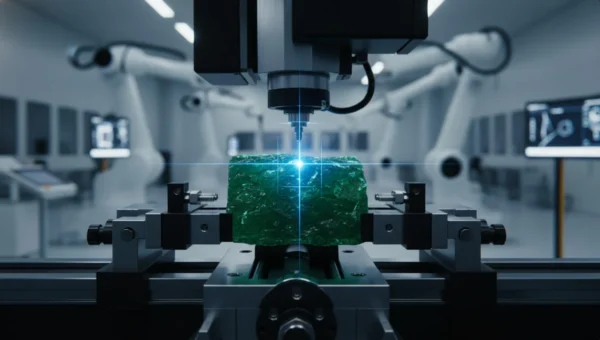
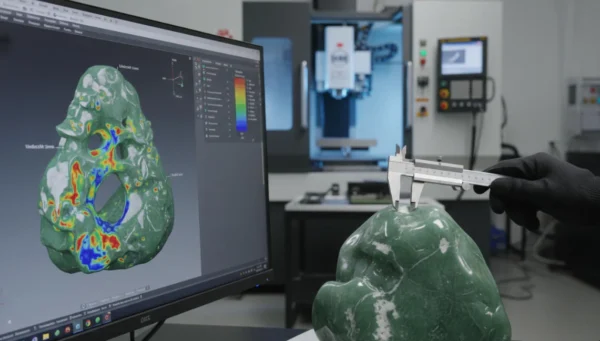
If you source jade products at commercial scale, the most important variable in your supply chain is not material cost — it is the efficiency of the jade process used to transform raw stone into finished goods. Internal production data from JADEMAGO, measured in 2019 under controlled conditions, shows that integrating a shaping machine with precision molds increased semi-finished output by 81.6% compared to hand carving within a single shift — while simultaneously delivering tighter dimensional consistency. This is not a theoretical projection. It is a figure recorded on a live production line, with raw material type and target output shape held constant as controlled variables. Note: this data is sourced from JADEMAGO’s internal testing and does not represent a generalized industry standard.
That performance gap has direct consequences for your supply chain economics. When a jade manufacturer can produce standardized semi-finished pieces at nearly double the rate of hand carving, your per-unit cost drops, your lead time compresses, and your batch-to-batch consistency improves — simultaneously, not as separate outcomes. The question is not whether shaping machine technology produces real efficiency gains. The data confirms it does. The more important question is: does your current supplier’s jade process actually take full advantage of it, and can they prove it with production-level data?
Table of Contents
The 81.6% Efficiency Gain: What JADEMAGO‘s Production Data Tells You About the Jade Process
Test Conditions That Make This Number Credible
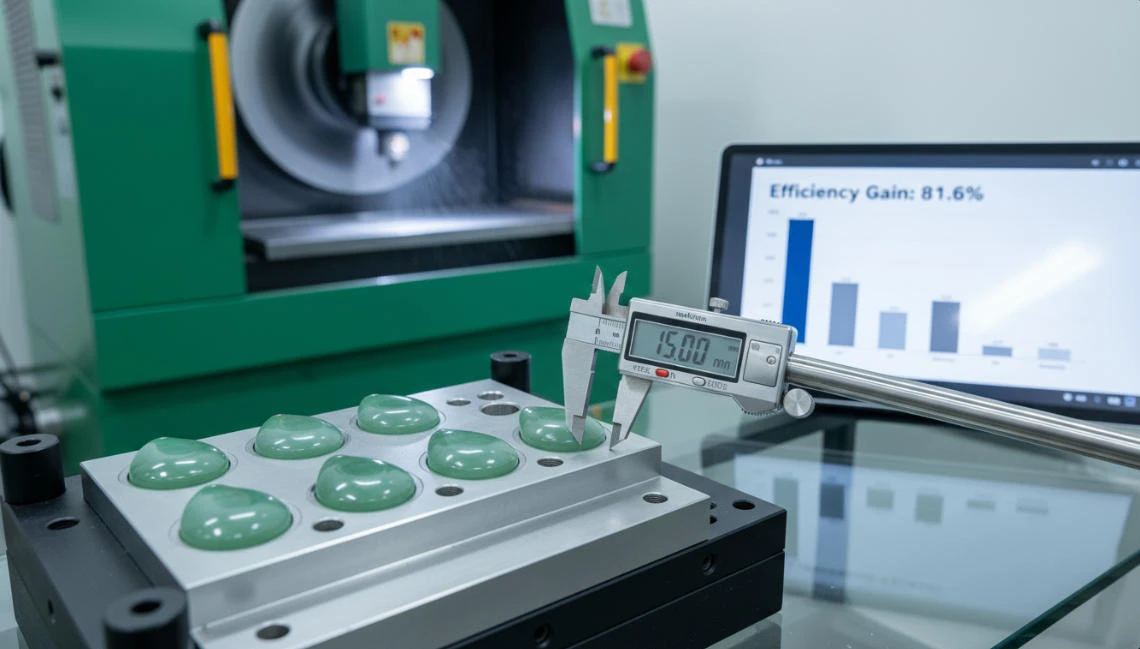
Numbers without context are noise. Before you apply the 81.6% efficiency figure to your own sourcing decisions, you need to understand exactly what was measured and under what conditions. JADEMAGO conducted this internal production comparison in 2019, holding three key variables constant: raw material type, target output shape, and total working hours per shift. The only variable changed between the two tested production methods was the processing approach — hand carving versus shaping machine operation with a standardized mold set. The result: the shaping machine method produced 81.6% more semi-finished units within the same time window and delivered tighter dimensional consistency than the hand-carved control group.
This methodology matters because it isolates the process variable from confounding factors. A production gain measured across different material types, different operators, or different target shapes would be unreliable as a benchmark. By locking all other variables, the test produces a figure that reflects the shaping machine’s actual output advantage under conditions representative of real commercial production. You should expect any production claim from a jade manufacturer to meet this same methodological standard — if a supplier cannot describe the controlled conditions behind their efficiency claims, the claims themselves are not auditable and should not drive sourcing decisions.
JADEMAGO‘s 2019 data provides a verified internal reference point, not an industry-wide generalization. Individual production environments, material characteristics, and operator skill levels will produce different absolute numbers. This means you should use 81.6% as a directional benchmark — a calibration of what disciplined jade process improvement looks like — rather than a guarantee of what any specific production run will achieve.
Hand Carving vs. Shaping Machine — A Direct Production Comparison in the Jade Process
Hand carving a single jade bangle from raw block to rough-shaped form takes a skilled artisan two to four hours under typical workshop conditions. A shaping machine operating with a matched mold set completes the same rough-forming stage in tens of minutes per piece. That time gap is not a marginal efficiency improvement — it is a structural redesign of which step in the jade process limits your total line output. In a standard eight-hour shift, one shaping machine operator can process a volume of rough-formed semi-finished pieces that would require three to four hand carvers working full time to match.
The dimensional consistency story compounds the throughput argument. Hand carving introduces inter-operator variability: two artisans working from the same reference design will produce pieces with measurable differences in curvature, thickness, and cross-sectional profile, because hand-guided tools are inherently sensitive to individual differences in pressure application, tool angle, and feed path. The Gemological Institute of America (GIA) has extensively documented how stone processing consistency directly influences finished jewelry quality outcomes — and dimensional variance introduced at the rough-shaping stage propagates into every subsequent processing step. The shaping machine, guided by a fixed mold, removes this variability at its source. This means your finished products reach final quality inspection with higher dimensional conformance rates, fewer pieces rejected for geometric non-compliance, and a higher effective yield from each block of raw jade material.
The direct production comparison, in practical terms: at 40 pieces per shift using hand carving versus 73 pieces per shift using a shaping machine (illustrative of the 81.6% delta), the economic calculus is unambiguous. Your effective cost per rough-formed piece decreases, your weekly production capacity increases without adding headcount, and your quality inspection pass rate improves because the source of dimensional variance has been mechanically constrained. This means the shaping machine investment in a jade process operation is not a technology upgrade — it is an economic restructuring of your production unit economics.
How the Jade Process Works: Shaping Machine and Mold Coordination Explained
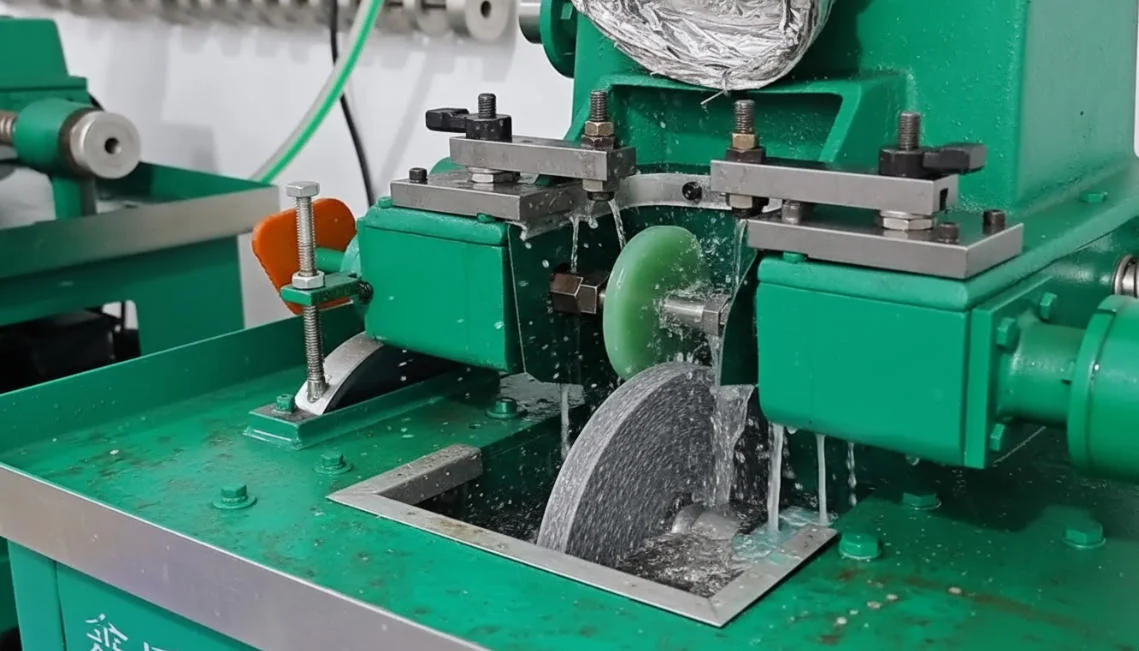
The Mechanical Logic of the Grinding Wheel in the Jade Process
The shaping machine’s operating principle is counterintuitive at first encounter: the grinding wheel is fixed to the base of the workstation and does not move laterally, while the fixture — which holds the jade raw material — is the moving element, rotating and translating to bring different areas of the stone’s surface into contact with the wheel. This inversion of the expected tool-moves-against-workpiece relationship gives the system a key mechanical advantage: the grinding wheel’s contact geometry is stable and predictable, while the fixture’s path is precisely constrained by the mold. There is no operator hand-guiding a moving tool across a fixed stone — the machine’s mechanical architecture removes that degree of freedom from the equation.
The grinding wheel itself is the material removal agent: a high-speed rotating disc surfaced with abrasive particles selected to match the hardness and toughness characteristics of the jade being processed. Jade presents a demanding abrasion challenge — the International Gem Society (IGS) classifies jadeite at 6.5–7 on the Mohs hardness scale and nephrite at 6–6.5, but both materials are exceptionally tough (fracture-resistant) relative to their hardness, meaning that the correct wheel specification must balance cutting efficiency against the risk of propagating internal micro-fractures during material removal. Selecting the wrong abrasive for the jade type in your jade process does not just reduce efficiency — it introduces sub-surface damage that will only become visible in the polishing stage, when affected pieces must be rejected. This means wheel specification is a primary engineering decision in every jade process production run, not a secondary operational detail.
How the Mold Guides the Jade Process From Raw Stone to Consistent Semi-Finished Output
The mold — or template — is the intelligence layer of the entire jade process system. It is a pre-formed shape, typically precision-machined from hardened metal, dense engineering plastic, or high-grade hardwood, that mounts onto the fixture or guiding apparatus of the shaping machine. As the fixture rotates and advances against the grinding wheel, the mold constrains the fixture’s travel path: the fixture can only follow the trajectory defined by the mold’s outer profile. This means the stone mounted in the fixture is ground to the exact contour encoded in the mold, regardless of which operator is running the machine and regardless of how many pieces have already been processed in the same session.
For a jade manufacturer running standardized product lines — bangles, oval cabochons, round pendants, matched-pair stones for earring sets — this mechanical constraint converts a skill-dependent craft operation into a repeatable mechanical process. The target shape is not in the operator’s hands; it is in the mold. An operator who has run a shaping machine for one month can produce the same output profile as an operator who has run one for ten years, because the mold is doing the geometric work. This means your production capacity no longer scales exclusively with the availability of highly experienced jade artisans — a significant operational advantage in sourcing markets where skilled carving labor is increasingly constrained.
Three Stages of the Jade Process: From Rough Block to Polished Output
The complete jade process using a shaping machine operates across three defined stages, each serving a distinct function with its own quality checkpoint. In the first stage, the raw jade block — still in its natural, irregular form — is loaded into the fixture and locked against the mold template. The fixture is engaged against the grinding wheel, and rough forming begins: the wheel removes material continuously until the stone’s outer profile conforms to the mold’s contours. This stage is the primary efficiency multiplier — the 81.6% gain is generated almost entirely here, by replacing hours of hand-guided carving with minutes of mechanically-constrained grinding.
In the second stage, the rough-formed semi-finished pieces are released from the shaping machine and inspected for profile accuracy and surface condition. Pieces within dimensional tolerance proceed to precision grinding, where finer abrasive wheels refine the surface geometry, remove the coarse tool marks left by the rough-forming wheel, and bring the stone closer to its final dimensional specification. The third stage is polishing — a multi-step process using progressively finer abrasive compounds and buffing media to develop the jade surface to its target luster and finish. It is worth noting that SSEF — Swiss Gemmological Institute testing standards for jade quality and origin assessment evaluate surface finish and internal clarity as primary quality indicators — which means your polishing process discipline directly influences how finished pieces perform in third-party certification contexts. This means process investment at each of the three stages is not optional if your products are entering markets where certification is a purchasing requirement.
4 Reasons the Shaping Machine Eliminates the Largest Bottlenecks in Jade Manufacturing
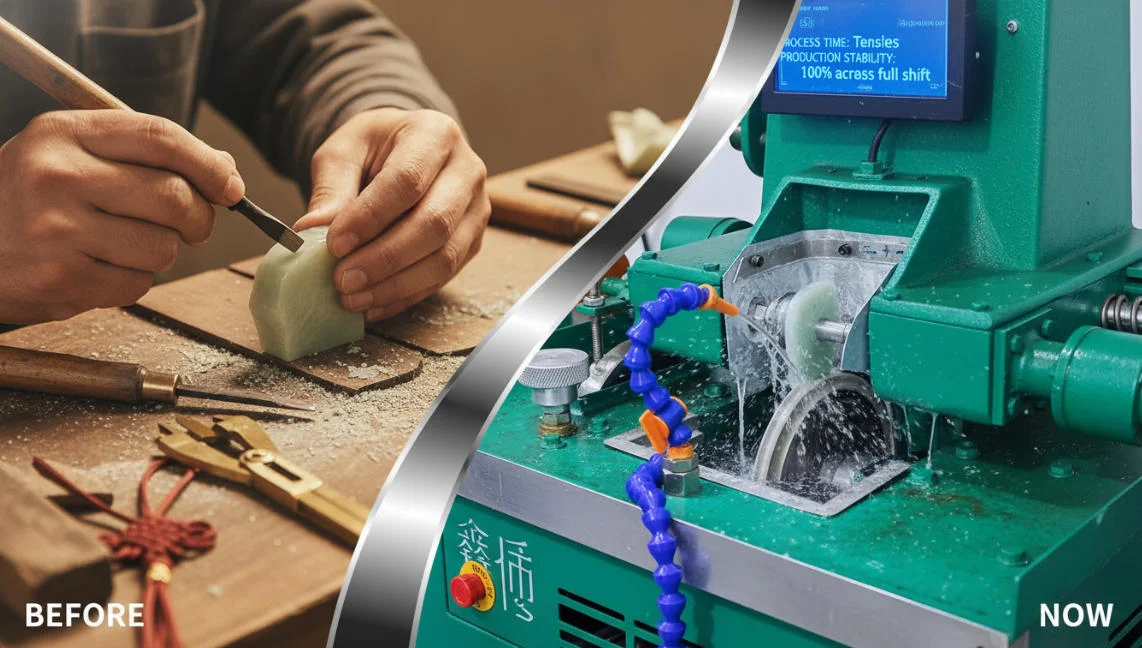
Rapid Rough Shaping Compresses the Most Time-Intensive Stage of the Jade Process
In a traditional hand-carving operation, rough shaping is the rate-limiting step that determines the entire line’s throughput ceiling — because it is simultaneously the most physically demanding, the most skill-dependent, and the most time-consuming operation in the production sequence. A skilled artisan carving a jade bangle blank from raw stock to rough shape invests two to four hours per piece under normal workshop conditions. The shaping machine reduces that same operation to tens of minutes. If your production target is 200 jade bangles per month, that time compression does not just increase daily output — it fundamentally changes the labor structure of your entire jade process. You are no longer paying skilled artisan hours for rough-forming work that a mechanical system can perform faster, more consistently, and at lower fatigue cost. This means your highest-skilled labor can be redirected to the stages of the jade process where human judgment genuinely adds value: precision finishing, quality inspection, and artisan-level surface detail work.
Eliminating Repeated Measurement Reduces Per-Piece Processing Time in the Jade Process
In a hand-carving workflow, the artisan measures the workpiece against a dimensional reference at multiple points during rough shaping — checking width, curvature, thickness, and symmetry repeatedly before declaring the piece complete at the rough stage. This measurement overhead is not trivial. Depending on shape complexity, repeated measurement and adjustment can add 15 to 30 minutes to a single piece’s processing time. Across a production run of 50 pieces, that overhead accumulates to 12–25 person-hours of measurement activity that contributes nothing to material removal.
The shaping machine with a precision mold eliminates this overhead by design. The mold is the dimensional reference — a physical encoding of the target geometry — and the fixture’s mechanically constrained path ensures output conformance without manual verification at each piece. The operator’s attention shifts from checking dimensions to monitoring feed rate and observing the stone’s surface for anomalies, which is a fundamentally different — and faster — cognitive task. This means your per-piece processing time drops not just because grinding is faster than hand carving, but because the mold system removes an entire category of non-value-adding activity from the jade process sequence.
Continuous Batch Processing Makes the Jade Process Scalable for Commercial Orders
A matched mold set can run continuously across a full production shift without reconfiguration. Once the fixture is set up, the mold is mounted, and the wheel contact depth is calibrated, the system repeats the same profile on every successive piece loaded — with no setup overhead between individual pieces, only the time to unload a finished blank and load the next raw stone. For commercial-scale jade orders — where the requirement is hundreds or thousands of geometrically identical semi-finished pieces — this continuous batch capability is the mechanism that makes the jade process economically scalable at volume.
The per-piece setup cost approaches zero as batch size increases, because the fixed setup investment is amortized across every piece in the run. At a batch of 10 pieces, the setup cost per piece is meaningful. At 500 pieces, it is negligible. This is the scaling economics that hand carving cannot replicate without proportional increases in skilled artisan headcount — because hand carving’s per-piece time is relatively fixed regardless of batch size, with no setup amortization benefit. This means the shaping machine jade process becomes progressively more cost-advantaged relative to hand carving as your order volume increases, which is why it is the standard rough-forming method at every production-scale jade manufacturer operating at commercial volume.
Mechanical Grinding Reduces Worker Fatigue, Stabilizing Jade Process Output Quality Across Full Shifts
Manual jade carving is physically intensive in ways that are easy to underestimate: maintaining consistent tool pressure, holding precise angles, and controlling fine movements over continuous hours produces measurable physical fatigue that directly degrades output quality. Research in manufacturing ergonomics consistently documents quality degradation rates of 10–20% in manual precision tasks during the final two hours of a long production shift, as fatigue increases dimensional variance and reduces operator sensitivity to surface anomalies.
The shaping machine transfers the primary cutting force to the grinding wheel and delegates path control to the mold. The operator’s role becomes feed rate management and surface monitoring — a far less physically demanding task profile than active hand carving. This operational redesign means quality consistency holds across the full production shift: the pieces produced in the final hour carry the same dimensional accuracy as the pieces produced in the first hour, because the source of geometric control has been moved from the operator’s hands to the machine’s mechanical constraints. For a jade manufacturer supplying finished jewelry markets where piece-to-piece consistency is a specification requirement, that shift-long stability is not a convenience — it is a quality assurance foundation.
How Mold Standardization Controls Batch Consistency — The Core Challenge in the Jade Process
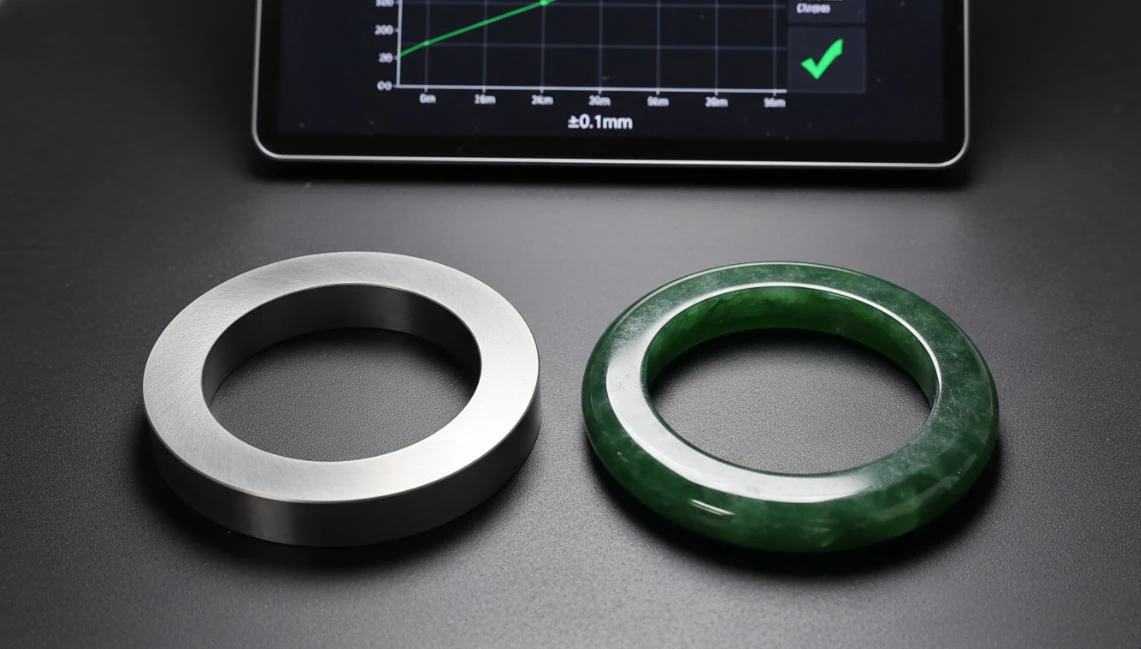
Batch consistency is the variable that most reliably separates reliable jade manufacturers from unreliable ones in commercial supply chain evaluation. When your sample of ten pieces meets specification but your production batch of five hundred shows dimensional drift, the failure point is almost always in the rough-shaping stage of the jade process — where operator-driven variability introduces geometric deviations that propagate through every subsequent processing step, compounding into finished-piece non-conformances that cannot be corrected at the polishing stage. The shaping machine and mold system addresses this failure point mechanically, by removing operator judgment from the geometric control function of rough forming.
How Standardized Mold Templates Lock Shape Into the Jade Process From the Start
The mold template defines the geometric boundary of every piece produced in its production run. Every contour, every radius, every dimensional limit of the target shape is encoded in the mold’s physical form. When the fixture traces the mold’s outer profile during grinding, it is not approximating the target shape — it is tracing a physical replica of it. Dimensional variability in the output is therefore bounded by the precision of the mold itself, not by the operator’s skill level, physical condition, or accumulated fatigue on that shift.
For this system to maintain dimensional accuracy across extended production runs, mold material selection is critical. Molds machined from hardened tool steel maintain their profile geometry through thousands of production cycles; molds fabricated from softer aluminum alloys or polymer materials show measurable wear-induced profile drift after significantly shorter runs. The International Gem Society (IGS) has documented that dimensional stability in gemstone processing begins at the tooling level — which means mold material specification is a direct upstream input into your finished product quality outcomes. This means when you qualify a jade manufacturer, asking for their mold material specification and replacement interval protocol is not excessive diligence — it is a fundamental quality assurance question.
Mechanical Depth Control Keeps Thickness and Curvature Stable Across Every Piece
The shaping machine allows the operator to set grinding depth and wheel contact angle before the production run begins, and these parameters remain mechanically fixed throughout the batch. This controlled depth setting means that piece-to-piece variation in thickness — one of the most common batch consistency failures in jade rough shaping — is eliminated as a free variable. The wheel removes the same volume of material from each piece at the same angle and depth, because the machine’s mechanical constraints do not drift between pieces the way an operator’s hand does over the course of a shift.
In practical production terms, a properly maintained shaping machine and mold combination delivers a dimensional error range of 0.1–0.3 mm across a full batch run. For standard jade product categories — bangles, oval pendants, matched cabochon pairs — this precision level is sufficient for consistent mounting, setting, and assembly in finished jewelry production. According to GIA’s gemstone quality documentation, dimensional uniformity in jade pieces directly affects how efficiently they can be set into standard-specification mountings without hand-fitting adjustment. This means tighter rough-shaping consistency translates into lower finishing labor cost and lower stone rejection rates at the setting stage — a downstream financial benefit of upstream jade process precision that is frequently undervalued in supplier selection decisions.
Reducing Human Error in the Jade Process — Why Mechanical Consistency Outperforms Even Skilled Artisans
Is it realistic to expect that your best artisans produce perfectly consistent output across a full production run? The honest answer is no — and the production data consistently confirms this. Even experienced jade carvers working from the same reference design will produce pieces with measurable differences in curvature and cross-sectional profile, because hand-guided tools are inherently subject to micro-variations in pressure, angle, and path that accumulate differently for each piece and each operator. At small batch sizes, this variability is manageable through quality sorting. At commercial volumes of hundreds or thousands of pieces, variability-driven rejects create a compounding cost problem: more raw material consumed per finished piece, more labor hours invested in pieces that cannot be used, and more time lost to rework at the precision finishing stage.
The shaping machine removes human judgment from the geometric control function of the jade process rough-forming stage — not from the entire process, but from the stage where variability has the largest downstream impact. This means your incoming quality control rejection rate drops, your effective material yield per raw stone block increases, and your per-finished-piece production cost decreases — not as theoretical improvements but as measurable operational outcomes that show up in your production economics within the first month of implementing a disciplined shaping machine and mold workflow.
Shapping Machine Jade Process vs. Jade CNC Machining
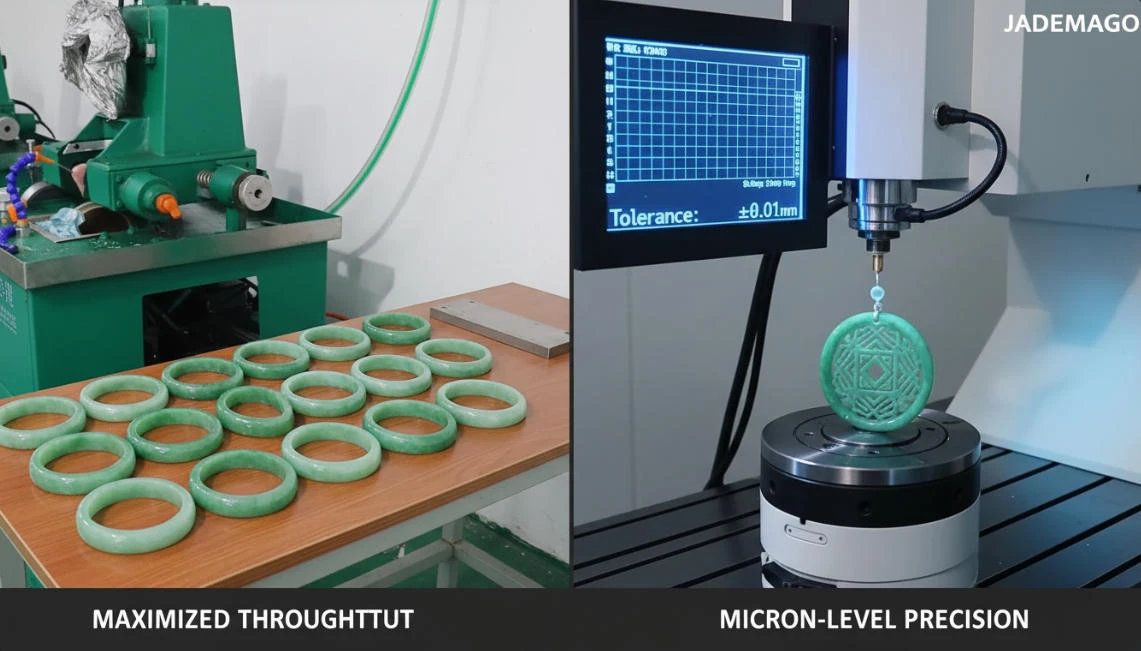
The most consequential technology decision in jade manufacturing is not choosing between shaping machines and hand carving — that decision has effectively been made by production economics. The real decision is understanding the boundary between the shaping machine jade process and jade CNC machining, and applying each method where it generates the best outcome for your specific product requirements. These two technologies are not competitors — they are complementary tools that excel at different stages and different product profiles. Applying the wrong one for the wrong reason costs you either precision you needed or money you didn’t need to spend.
Where the Shaping Machine Jade Process Outperforms Jade CNC Machining for Standard Production
For standard-shape, high-volume production — bangles, round or oval cabochons, basic pendant blanks, matched-pair stones — the shaping machine jade process has four structural advantages over jade CNC machining that hold consistently across production contexts. First, equipment and mold cost: a shaping machine setup costs a fraction of a CNC jade processing center, and mold fabrication is dramatically cheaper than CNC programming, fixturing, and toolpath verification. For a jade manufacturer operating at mid-volume on standard product lines, this cost differential directly determines your sourced piece price — and the shaping machine method frequently delivers lower per-piece economics on standard shapes than jade CNC machining, even before factoring in speed.
Second, material adaptability: jade raw material is natural, and natural stone contains inclusions, fracture planes, and color concentration patterns that are not visible from the block’s exterior. A shaping machine operator can observe the stone continuously during grinding, adjust feed rate when the wheel approaches a visible inclusion or surface crack, and change the processing path to preserve material integrity. Jade CNC machining executes pre-programmed tool paths without real-time material feedback, which means fracture-sensitive stones carry a measurably higher breakage risk under CNC’s committed cutting paths. This means the shaping machine approach delivers higher material yield on challenging or high-value raw stock — a cost factor that becomes significant when working with premium jadeite or high-clarity nephrite.
Third, rough-forming throughput: for standard template profiles on stone blanks that fit within the mold system’s working range, the shaping machine completes rough forming in tens of minutes per piece. CNC setup, programming verification, and toolpath execution for equivalent simple shapes carry per-run overhead that the shaping machine avoids entirely once the mold is calibrated. The shaping machine’s throughput advantage is most pronounced at mid-range batch sizes — below the volume threshold where CNC’s automation benefits fully amortize its per-run setup cost.
Where Jade CNC Machining Exceeds the Shaping Machine Jade Process
Jade CNC machining operates at a precision level that shaping machines are mechanically incapable of matching. CNC jade processing centers achieve dimensional tolerances of 0.01 mm — approximately one order of magnitude tighter than the 0.1–0.3 mm range of a well-maintained shaping machine. For products requiring precise stone-to-setting fit in luxury jewelry, matched pairs specified to sub-0.05 mm tolerances, or complex three-dimensional carved surface geometry, this precision gap is not a theoretical difference — it determines whether finished pieces fit their settings without adjustment or require costly hand-fitting rework.
Jade CNC machining also handles geometric complexity that falls outside the shaping machine’s design envelope. Three-dimensional carved surfaces, undercut geometries, detailed relief patterns, channel carving, and precise lattice structures require CNC’s programmable multi-axis tool paths. No fixed mold template can replicate this capability, and attempting to approximate it with shaping machine workarounds produces results that fall short of the precision and repeatability that luxury product markets require. For jade manufacturers serving high-specification design categories, jade CNC machining is not a premium option — it is the only viable process. This means your product design specifications should drive your process selection, not historical familiarity with one technology or the other.
A Decision Framework for Selecting the Right Jade Process Method
Three variables should drive your process selection: shape complexity, required dimensional tolerance, and batch volume profile. For standard shapes at the 0.1–0.3 mm tolerance level in batches of 50 pieces or more, the shaping machine jade process delivers lower unit cost and faster throughput. For complex three-dimensional designs, tolerance requirements below 0.05 mm, or product categories where CNC’s cycle-to-cycle consistency across extended automated runs is essential to meeting specifications, jade CNC machining is the appropriate choice. Many production-scale jade manufacturers apply both technologies in sequence: shaping machines for rough forming across the full batch, followed by jade CNC machining for precision finishing on the subset of pieces destined for high-specification product lines. This means the most capable supplier is not one who has chosen one technology — it is one whose jade process portfolio includes both and applies them at the correct stage for each product category.
Critical Operating Parameters That Determine Shaping Machine Performance in the Jade Process
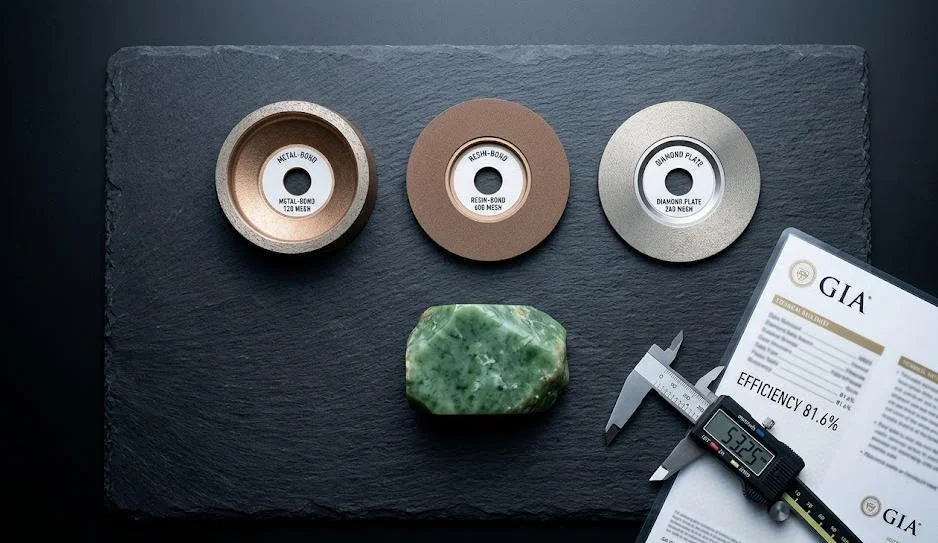
The 81.6% efficiency gain is not automatic — it is the result of correctly managing four interdependent operating parameters that, when mishandled, can negate the machine’s advantages entirely and introduce quality problems that cost more to resolve than the efficiency gain was worth. Can your current supplier articulate, with specific numbers, how they control each of these parameters? If not, their jade process discipline may not be operating at production grade.
Mold Material Specification — The Hidden Variable in Jade Process Dimensional Stability
Mold wear is the most underestimated source of dimensional drift in shaping machine production, and it is the failure mode most likely to go undetected until a customer quality complaint surfaces. A mold that has processed 5,000 pieces from a softer material — aluminum alloy or engineering polymer — will have a measurably different profile geometry than a new mold of the same design. As the mold profile erodes, the output pieces’ geometry drifts with it: radii open, curvatures flatten, and dimensional tolerances that were within specification at the start of the mold’s life move progressively outside specification before the mold is replaced.
A production-grade jade process sets mold material specification by hardness rating, tracks usage cycles, and triggers replacement based on measured profile deviation against the original mold master — not on arbitrary time intervals or a rough estimate of cycles completed. Hardened tool steel molds maintain dimensional accuracy through significantly more cycles than softer alternatives, and their higher initial fabrication cost is recovered rapidly through reduced replacement frequency and the scrap elimination that comes from not discovering drift-induced non-conformances at final inspection. This means when you audit a jade manufacturer‘s process documentation, asking for their mold replacement protocol and their mold material specification is a supplier qualification requirement, not an optional technical question.
Grinding Wheel Selection — Matching Abrasive Specification to Your Jade Process Material
Jade encompasses two mineralogically distinct materials — jadeite and nephrite — with different hardness, toughness, and crystal grain structure characteristics that require different abrasive approaches. The Gemological Institute of America (GIA) clearly distinguishes these two materials in its grading and identification protocols, and their mechanical property differences translate directly into wheel specification requirements in the jade process. A grinding wheel optimized for nephrite’s relatively coarser grain structure may be too aggressive for jadeite’s tighter, interlocked crystal network, producing surface micro-fractures that reduce finished piece value without being detectable at the rough-forming stage.
Key wheel specification variables include abrasive type (diamond, silicon carbide, or aluminum oxide), grain size expressed in mesh count, bond type (resin, metal, or vitrified), and abrasive concentration. For a jade manufacturer running multiple jade material types across the same production line, maintaining separate, clearly labeled wheel inventories for each material category is a process discipline requirement with direct quality consequences. Running the wrong wheel on a premium jadeite batch does not produce a slightly suboptimal result — it risks the entire batch. This means wheel specification management belongs in your supplier process audit checklist, with documentation reviewed against actual production material types.
Speed Control and Cooling — Protecting the Integrity of the Jade Process Output
Grinding generates heat at the tool-stone interface, and for jade — a material valued precisely for its internal structural integrity and optical clarity — heat accumulation above threshold levels triggers two distinct failure modes. The first is thermal micro-cracking of the stone itself: internal fractures that develop below the surface during grinding and only become visible during polishing or under magnification, at which point the piece must be rejected or downgraded. The second is accelerated wheel wear: elevated temperatures alter the bond structure of resin-bonded wheels, causing premature glazing that reduces cutting efficiency and changes the effective surface finish specification.
Both failure modes are preventable through proper speed control and continuous water cooling, but neither is preventable through passive assumption that the machine’s default settings are appropriate for every material and cut depth combination. The correct operating speed for jade rough-shaping varies by material density, wheel grain size, and depth of cut per pass — no single universal setting applies across all combinations. Continuous water cooling at the wheel-stone contact zone serves three simultaneous functions: temperature management, abrasive particle removal (which would otherwise re-bond as glazed material reducing cutting rate), and processing dust suppression. Occupational health standards for gem and mineral processing industries treat dry grinding of siliceous materials as a respiratory hazard requiring engineering controls — making water cooling both a quality measure and a workplace safety baseline. This means proper cooling is not an optional enhancement in a production-grade jade process — it is a specification requirement at both the quality and compliance levels.
Workpiece Fixation — Why Clamping Precision Controls Your Jade Process Output Shape
The mold controls the fixture’s path; the fixture controls the stone’s orientation relative to the grinding wheel; the stone’s orientation at the point of wheel contact determines the output piece’s geometry. Any movement of the stone within the fixture during grinding — including micro-displacement from vibration or insufficient clamping force — produces a proportional deviation in the output piece’s profile. At a nominal tolerance of 0.1–0.3 mm, a stone that shifts even 0.2 mm mid-cut will produce a piece at the outer boundary of its dimensional tolerance or beyond it — and that piece will carry the deviation into every subsequent processing stage.
Effective fixation requires clamping fixtures that apply distributed, even pressure across the stone’s contact surface area without creating localized stress concentrations. Jade’s toughness is its resistance to fracture under distributed load — but it is not immune to localized point stress from poorly designed or worn clamping components. A fixture that concentrates clamping force at a small contact area will damage or fracture stones that a properly distributed fixture would process without incident. This means clamping fixture design and maintenance condition are precision engineering concerns, not minor operational variables. When evaluating a jade manufacturer‘s process capability, the design and condition of their fixturing is as diagnostic of production quality as the specification of their molds or the grade of their grinding wheels.
FAQs — Jade Process: Shaping Machine & Mold System
1. How much faster is a shaping machine compared to hand carving in the jade process?
Based on JADEMAGO‘s 2019 internal production testing, using a shaping machine with a standardized mold set increased semi-finished output by 81.6% within a single shift compared to hand carving, under controlled material and shape conditions. A piece that takes a skilled artisan two to four hours to rough-form by hand can be completed in tens of minutes on a shaping machine. This figure reflects JADEMAGO’s internal test data and does not represent a universal industry standard.
2. What dimensional accuracy can I expect from the shaping machine jade process?
A properly maintained shaping machine and mold combination delivers a dimensional error range of 0.1–0.3 mm across a full production batch. For standard jade product categories — bangles, cabochons, and pendant blanks — this tolerance is sufficient for consistent mounting and assembly in finished jewelry production without hand-fitting adjustment.
3. When should I choose jade CNC machining over a shaping machine?
Choose jade CNC machining when your product requires tolerances tighter than 0.05 mm, complex three-dimensional carved surfaces, or detailed relief geometry. For standard shapes at commercial batch volumes, the shaping machine jade process delivers faster throughput and lower per-piece cost. Many production-scale jade manufacturers apply both technologies in sequence — shaping machines for rough forming, CNC for precision finishing.